
How the County’s 170,000+ EVs Are Quietly Testing Song-Beverly’s Limits in Real Time
Read time: roughly 18 minutes. Every statistic in this article is hyperlinked to a primary-source PDF — government, academic, or industry — and the full URL is printed inline so the citation survives any export, copy-paste, or PDF conversion. Numbers are paired with what they mean, what to do about them, and the specific document you can hand a lawyer or an arbitrator.
Why San Diego, specifically
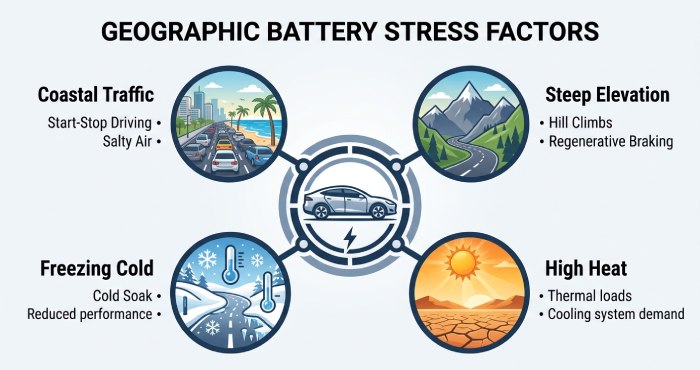
Most U.S. cities stress an electric vehicle in one or two ways. Minneapolis stresses batteries with cold. Houston stresses them with freeway distance. San Francisco stresses them with grade and density. San Diego County stresses an EV in every direction at once — and it does so for a buyer base that has now grown past 170,000 vehicles, with a regulatory framework written in the 1970s for transmission complaints. That collision is the subject of this article.
A typical Carlsbad resident can drive 80 miles of freeway from Oceanside to downtown in the morning, climb a 12% grade through La Jolla in the afternoon, run the air conditioning through 95°F inland heat on the return, and take the same car to snow at Big Bear Lake or 110°F desert at Anza-Borrego on the weekend. Each of those conditions degrades range, capacity, or both — and each is now being tested against the Song-Beverly Consumer Warranty Act, the most consumer-friendly lemon law in the country, freshly rewired by AB 1755 in January 2025 and SB 26 in April 2025.
This piece is the synthesis. It pulls together 20+ primary-source statistics — from CARB, NHTSA, the U.S. Department of Energy, the California Assembly Judiciary Committee, SANDAG, peer-reviewed battery research, and Tesla’s own warranty documents — and translates each one into what it actually means for a San Diego EV owner. There is also a five-step checklist at the end that requires no attorney and costs less than $25 to execute. If you read nothing else, read that section.
“AB 1755 effectively nullifies 10-year emission warranties and 8 to 10-year electric vehicle battery warranties after just 6 years.”
— California Assembly Committee on Judiciary, Analysis of AB 1755 (Aug. 2024)
How to read this article
Each section has three pieces:
- The data — the primary-source statistic, with an inline clickable hyperlink and the full plain-text URL.
- What this means — context, perspective, and translation into something practical.
- What to do next — a concrete, specific action a San Diego owner can take today.
The article ends with a 5-step checklist and a complete reference list of every PDF cited.
1. The installed base is much bigger than headlines suggest
The data
CalMAC’s 2024 Load Impact Evaluation of San Diego Gas & Electric — a report filed with the California Public Utilities Commission — confirms that as of December 2023, more than 130,000 battery-electric vehicles and 40,000 plug-in hybrids were registered with the California DMV inside SDG&E’s service territory. That territory covers all of San Diego County plus a slice of southern Orange County. The same report shows SDG&E has enrolled roughly 60,000 homes on dedicated EV time-of-use rates, and on the top five CAISO peak-load days these EV customers curtailed peak-hour demand by an average of 12% (MW) (CalMAC 2024 EV TOU Load Impact Evaluation — https://www.calmac.org/publications/DSA_PY2024_Electric_Vehicle_Time_Varying_Rates_Evaluation_Report_FINAL.pdf).
Separately, the County of San Diego’s 2023 EV Roadmap Annual Report cites California Energy Commission data showing light-duty zero-emission vehicles “on the road” in San Diego County more than doubled — from 44,168 in 2019 to 95,024 in 2022, the most recent year with complete data (County of San Diego 2023 EV Roadmap Annual Report — https://www.sandiegocounty.gov/content/dam/sdc/sustainability/docs/CAP-EVRM-AR-2023.pdf). The 2024 update confirms the trajectory has continued (County of San Diego 2024 EV Roadmap Annual Report — https://www.sandiegocounty.gov/content/dam/sdc/sustainability/docs/CAP-EVRM-AR-2024.pdf), and SDG&E’s regional Gap Analysis projects continued exponential growth in adoption through 2030 (SDG&E Regional EV Gap Analysis — https://www.sdge.com/sites/default/files/2021-07/FINAL%20San%20Diego%20Regional%20EV%20Gap%20Analysis%20(1).pdf).

What this actually means
The widely cited “60,000 San Diego EVs” figure circulating in local press is not the EV count — it is the number of homes on SDG&E’s EV-specific rate plan. The true vehicle exposure is closer to 170,000 EVs and PHEVs combined, and the underlying ZEV base is doubling every three years. Three structural consequences follow:
- Warranty-active fleet is still growing. Almost every San Diego EV on the road today remains inside its original 8-year/100,000-mile battery warranty. The Song-Beverly-eligible population is expanding, not contracting.
- Buyer demographics are shifting. Early adopters tend to be technically literate, financially comfortable, and patient with minor defects. The 2019–2024 wave of buyers is broader, more demographically representative of San Diego at large, and more likely to file formal complaints when something fails.
- The used-EV market is now mature enough to create second-owner disputes. Defects originally papered over by trade-in are surfacing under second owners — and the California Supreme Court’s decision in Rodriguez v. FCA US LLC (2024) significantly narrowed used-vehicle Song-Beverly coverage, creating a procedural minefield exactly when used-EV volume is rising.
The math nobody is doing
If 170,000 EVs are on San Diego roads and even 1% experience an early battery or drive-unit defect serious enough to trigger a Song-Beverly claim, that is 1,700 potential cases — in one county. At an industry-typical average settlement of $40,000 to $80,000 per case (replace-or-refund plus civil penalty), that is $68 million to $136 million in localized warranty exposure. The number rises with every quarter of new EV registrations, and it falls outside the AB 1755 six-year cap one delivery date at a time.
| What to do next
If you bought a new EV in San Diego County between 2018 and 2022, you are still inside the original-owner warranty window — but probably not for much longer. Open the warranty booklet and write down two dates:(1) your original delivery date, and (2) the date your battery/drive-unit warranty expires. Under AB 1755, the earlier of “one year after warranty expiration” or “six years from delivery” controls. If your delivery was in 2019 or 2020, the Song-Beverly clock is already past the midpoint. |
2. The Oceanside-to-downtown corridor: a real-world range stress test
The data
SANDAG’s State of the Commute Report — the official regional transportation-performance dashboard — measured the average peak-hour southbound car commute from Oceanside to downtown San Diego at 49 minutes, with the parallel COASTER commuter rail averaging 66 minutes. The same report puts average daily COASTER ridership at 5,092 passengers on the Oceanside–downtown corridor (SANDAG 2019 State of the Commute Report — https://www.sandag.org/-/media/SANDAG/Documents/PDF/data-and-research/applied-research-and-performance-monitoring/performance-monitoring/infobits-2019-state-of-the-commute-report-2020-04-01.pdf).
A round trip on I-5 between Oceanside and downtown San Diego is approximately 80 to 100 freeway miles, and the route includes sustained climbs through Sorrento Valley and secondary grade climbs into La Jolla, UTC, and Kearny Mesa.
What this means for EV range claims
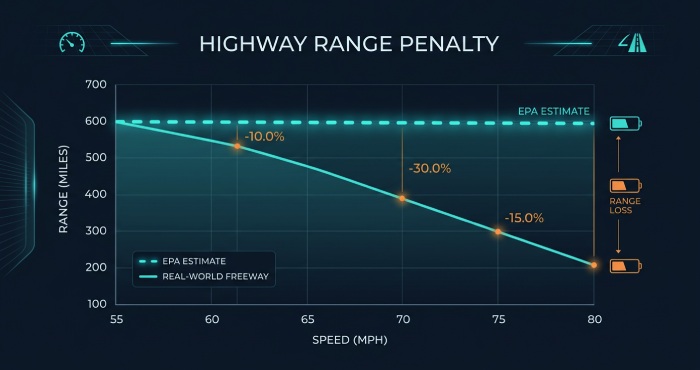
EPA window-sticker range is measured on a combined city/highway test cycle at 75°F on level ground. None of those conditions describes I-5 between Oceanside and downtown San Diego during a weekday afternoon. The result is a systematic gap between what a buyer was told the car would do and what the car actually does on the trip they bought it to make. That gap is precisely the territory Song-Beverly’s “substantial impairment of use, value, or safety” standard was designed to police.
Walking through the numbers for a Carlsbad commuter
Take a 250-mile-rated EV — typical of a 2021–2023 Tesla Model Y Long Range, Ford Mustang Mach-E, or Hyundai Ioniq 5 — owned by a commuter in Carlsbad with a downtown San Diego workplace:
- Round-trip distance: roughly 85 miles of freeway, much of it at 70+ mph (above the EPA combined-cycle test speed).
- Real-world freeway efficiency penalty: 15–20% below sticker range at sustained 70 mph (well-documented in EV testing literature).
- Net effective range: approximately 200 miles, not 250.
- Effective days between charges at 85 miles/day: approximately 2.3, not the 2.9 the sticker implied.
That 0.6-day difference compounds into about one extra charging session per week, which translates into roughly $400 to $600 per year in either home-charging electricity at peak SDG&E rates or DC fast-charging premium pricing — a number the EPA range figure never disclosed.
Why this matters for Song-Beverly
Range mismatch in isolation is not a defect. Song-Beverly does not promise EPA-perfect performance under all conditions. But three patterns do become actionable:
- Range falls below the manufacturer’s own range estimator output. If the dashboard projects 240 miles at 100% charge but the car only delivers 180 miles in normal driving, the deviation is from the manufacturer’s own number, not from a third-party test.
- Range falls below CARB’s MY2030 floor. California now requires 80% range retention for 10 years/150,000 miles. A vehicle below that threshold is, by regulation, in a warrantable condition (see Section 5).
- Range falls along with a battery state-of-health metric. This is the strongest combination — measured capacity loss paired with documented range loss removes any manufacturer argument about driving behavior or thermal management.
| What to do next
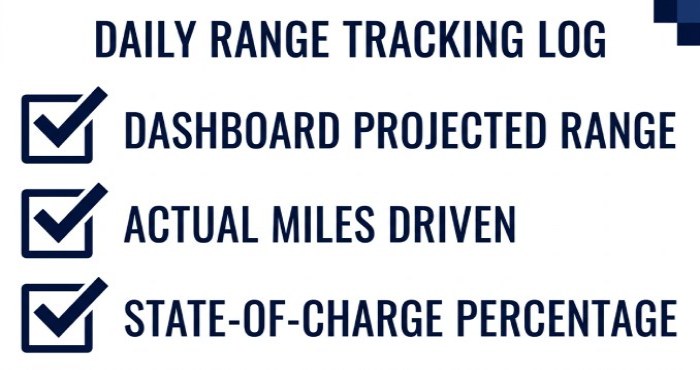
Keep a 30-day driving log. Record three numbers each morning: (a) the dashboard’s projected range at full charge, (b) the actual miles driven before the next charge, (c) the percentage state-of-charge when you plugged back in. Most modern EVs let you export trip-history data to a phone app — pulling it monthly costs nothing. If real-world range is consistently 15%+ below the EPA-advertised number and 10%+ below the dashboard estimator, that is the documentary backbone of a substantial-impairment argument. |
3. Cold weather and mountain trips: the Big Bear problem
The data
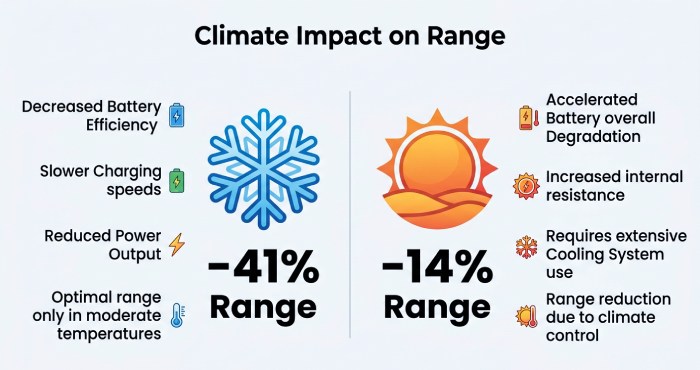
The U.S. Department of Energy’s Vehicle Technologies Office published a September 2024 Program Record summarizing chassis-dynamometer testing at Argonne National Laboratory across temperatures from 0°F to 95°F. The headline finding, in DOE’s own words: in typical cold conditions (20°F), BEV range decreased by 41%, compared with just 10% for a comparable internal-combustion vehicle. At 95°F, BEV range fell 14% — proportionally identical to ICE losses, but compounded by reduced DC fast-charging speeds at high battery temperatures (DOE VTO Program Record on Cold-Weather BEV Performance — https://www.energy.gov/sites/default/files/2024-10/Impact_of_Cold_Ambient_Temperature_on_BEV_Performance_v15_TechEditFinal_12Sep2024__0.pdf).
What this means for San Diego owners specifically
San Diego’s coastal climate masks the cold-weather problem most of the year. But every year, tens of thousands of San Diego EV owners deliberately drive into conditions where the DOE data applies directly:
- Big Bear Lake (elevation ~6,750 ft): winter overnight lows routinely 15–25°F. A 250-mile EV becomes a ~150-mile EV at the destination, before any cabin heating draw, before any drive home, and before any reduced charging speed from the cold Level-2 chargers at most mountain rentals.
- Mount Laguna and Julian: winter lows in the teens are common. The drive up Sunrise Highway adds significant elevation gain that consumes range disproportionately on the way up and recovers only a fraction on the way down through regenerative braking.
- Anza-Borrego in summer: 110°F+ is normal. Range falls 14%, and DC fast-charging throttles aggressively to protect the battery — meaning the charger that took 25 minutes in San Diego may take 50 minutes in Borrego Springs.
- Borrego Springs in winter: nighttime temperatures can drop near freezing despite warm daytime conditions, creating worst-case overnight cold-soaking on a pack that may have charged in 90°F afternoon heat.
The trip math: Oceanside to Big Bear in February
Concrete example. A 250-mile EV starts in 65°F coastal Oceanside, charges to 100% the night before, and drives to Big Bear Lake — roughly 130 highway miles. On paper, that is a one-way trip with comfortable margin. Walk it through with DOE’s data:
- Pre-departure usable range: 250 miles (advertised) — already factor in the 15% freeway penalty = ~213 miles.
- Elevation gain to Big Bear: roughly 6,750 ft, which DOE data and SAE testing put at an additional 10–15% range penalty net of recoverable regenerative braking.
- Cold-soak on arrival (overnight at 20°F): apply DOE’s 41% cold-weather range loss to the remaining pack capacity. A pack that arrived with 80 miles of nominal range projects only ~47 cold-equivalent miles the next morning.
- Return trip planning: the nearest reliable DC fast charger may be 30+ miles down the mountain. The margin for error is now narrow enough that an unplanned stop, a closed charger, or a queue at the charger turns into a stranded vehicle.
None of this is hypothetical. Big Bear EV-charger reliability issues have been a recurring complaint in PlugShare and ChargeHub data since at least 2021, and Mountain weekend traffic regularly stresses the small number of available chargers.
Why this matters for Song-Beverly
Cold-weather range loss is not a defect. EV manufacturers know about temperature sensitivity; CARB knows about it; the DOE has published the numbers. But when sales materials advertise a range figure measured at 75°F and silent about the 41% cold-weather penalty, the gap between marketing and lived experience starts to look like a disclosure problem, not a physics problem. That is the angle on which Song-Beverly claims have been most successful — not on the existence of degradation, but on the manufacturer’s failure to disclose or to make a reasonable repair attempt when the consumer reports the discrepancy.
| What to do next
Before any winter trip to Big Bear, Julian, or Mount Laguna, do four things and screenshot each: (1) charge to 100% the night before — don’t rely on cold-weather precharge alone; (2) record the dashboard’s projected range at full charge; (3) use the vehicle’s built-in trip planner with the destination temperature manually entered if the planner allows it; (4) record actual range achieved on arrival. If you ever need to argue that the vehicle did not perform as represented, those four data points are the foundation. The DOE Program Record is the federal-government data point that supports the claim — admissible, current, and citable to a U.S. government PDF. |
4. Battery aging: what is normal, what is not, and why the difference matters
The data
P3 Group and battery-diagnostics firm Aviloo analyzed more than 7,000 vehicles with mileages up to 300,000 km in a November 2024 whitepaper. The key finding: most EV batteries retain over 80% of their original capacity even at very high mileage, with significantly slower aging than press coverage has suggested. The same study notes the battery represents 20% to 30% of an EV’s total cost, making it the most expensive single warranty event in the automotive product category (P3 Group Battery Aging Whitepaper — https://www.p3-group.com/wp-content/uploads/2024/11/241125_Whitepaper_SOH_EN.pdf).
A peer-reviewed model published in PubMed Central — using lithium-manganese-oxide cell chemistry typical of early EVs — calculated first-year capacity loss between 4.9% in Alaska and 10.1% in Hawaii, with subsequent years declining as the dominant aging mechanism shifts from calendar to cycling (PMC Peer-Reviewed Battery Degradation Study — https://pmc.ncbi.nlm.nih.gov/articles/PMC6013442/). Industry consensus across 2024–2026 datasets puts normal annual capacity loss at roughly 1.5% to 2.5% — after the steeper first-year drop.
The two competing narratives, both technically true
Public discussion of EV battery aging splits into two camps that talk past each other:
- Narrative A: “EV batteries last a long time.” Supported by P3, supported by Recurrent’s published datasets, supported by manufacturer aggregate data. Most 100,000-mile EVs are at 85%+ state of health. True at the population level.
- Narrative B: “Some EV batteries fail early.” Also true. The 1.5–2.5% annual average hides a distribution. Some vehicles age at 4–5% per year, often due to manufacturing defects, thermal-management failures, BMS calibration errors, or specific cell chemistries that age poorly in California’s climate.
Song-Beverly was written specifically to protect the buyers in Narrative B. The state of California does not care that 95% of batteries age normally; it cares whether the specific vehicle in front of the specific consumer conforms to its express warranty. If a Carlsbad owner’s 2021 Model Y reads 72% state of health at 60,000 miles when the population average is 88%, that owner has a colorable Song-Beverly claim — and a real economic injury, because the battery they paid for is worth roughly $12,000 to $18,000 less than it should be.
How to use P3’s data as a benchmark
The P3 whitepaper publishes SoH curves by mileage band. A San Diego owner with a battery diagnostic report in hand can compare against P3’s published cohort and quickly identify whether they are inside, at the edge of, or outside the normal distribution:
- Inside the bell curve (within 5 SoH points of the cohort mean): no claim. Save the data anyway for next year’s comparison.
- Edge of the curve (5–10 points below cohort mean): document everything, request a manufacturer diagnostic test, schedule the next test 6 months out to identify trajectory.
- Outside the curve (10+ points below cohort mean): consultation with a California lemon law lawyer is warranted. The data point alone often justifies a warranty service request.
| What to do next
Run a state-of-health test once a year, ideally on the same date so the year-over-year comparison is clean. Tesla owners can pull the figure from in-car service menus or via third-party tools like TeslaFi and Scan My Tesla; other brands typically require a dealer scan or a service like Recurrent. Save each result in a dated email to yourself — self-mailed records are admissible and timestamped. If your SoH ever falls more than 10 percentage points below the P3 cohort average, that is the documented anomaly that opens both a warranty conversation and, if needed, a Song-Beverly conversation. |
5. CARB just codified a battery warranty floor
The data
Section 1962.8 of Title 13 of the California Code of Regulations — the operative part of CARB’s Advanced Clean Cars II Final Regulation Order — requires every ZEV manufacturer to warrant that the battery will not deteriorate below 70% state of health for 8 years or 100,000 miles, whichever comes first, for 2026 through 2030 model years, rising to 75% for 2031 and later (CARB ACC II Final Regulation Order §1962.8 — https://ww2.arb.ca.gov/sites/default/files/barcu/regact/2022/accii/acciifro1962.8.pdf).
CARB’s Final Statement of Reasons adds the range-retention requirement: by model year 2030, each ZEV must maintain at least 80% of certified electric range for 10 years or 150,000 miles, phased in from 70% for the 2026 through 2029 model years (CARB Final Statement of Reasons (ACC II) — https://ww2.arb.ca.gov/sites/default/files/barcu/regact/2022/accii/fsorappd.pdf). The same regulation requires manufacturers to provide a customer-readable state-of-health metric inside the vehicle, ending the era when owners could only learn about battery degradation by paying for a third-party diagnostic.
Why this is a turning point
Before ACC II, California had no codified threshold for what counted as unacceptable battery degradation. Every Song-Beverly dispute over a battery turned on a manufacturer-specific reading of a warranty booklet, and manufacturers could (and did) argue that any retained capacity above zero was “performing as expected.” That argument now collapses. The state has written into law that:
- A battery below 70% SoH within 8 years/100,000 miles is, by regulation, in a warrantable condition.
- A vehicle whose range falls below 70% of its certified figure within 10 years/150,000 miles is, by regulation, in a warrantable condition.
- The data needed to make the consumer’s case is, by regulation, available to the consumer inside the vehicle.
The first two items are now the regulatory definition of “substantial impairment” for a battery-electric vehicle. The third makes it impossible for a manufacturer to argue the consumer should have known sooner. Together, they hand a state-issued numerical benchmark to anyone — owner, attorney, arbitrator — disputing what counts as acceptable battery performance.
The pre-MY2026 problem
Here is the nuance most coverage misses: CARB’s 70% threshold formally applies to 2026 and later model years. A San Diego owner with a 2021 Tesla, a 2022 Ioniq 5, or a 2023 Mach-E is not directly covered by the new SoH floor. But the regulation can still be cited as the state’s expert determination of what constitutes acceptable performance — and arbitrators and juries are likely to treat 70% as a persuasive (if not binding) benchmark even for older vehicles, simply because no competing state-issued number exists.
| What to do next
If you are buying a new EV in 2026 or later, ask the dealer to demonstrate the in-car SoH display before you sign, and write the location of the display in your warranty booklet. If you already own an EV and your manufacturer publishes an SoH-equivalent metric (Tesla’s energy display, Hyundai-Kia’s service-mode menu, Ford’s dealer-tool readout), record the number today as a baseline. The CARB regulation makes 70% the floor going forward; you want to know how much margin you have, not learn it during a dealer dispute three years from now. |
6. EV recalls are rising faster than any other powertrain
The data
NHTSA’s 2024 Annual Recalls Report — published April 2025 — shows recalls of pure-electric or hybrid vehicles for EV-specific components rose from 12 in 2020 to 74 in 2024, a 517% increase over five years. The 2024 cohort alone covered 2,911,154 vehicles (NHTSA 2024 Annual Recalls Report — https://www.nhtsa.gov/sites/nhtsa.gov/files/2025-04/2024-annual-recalls-report.pdf).
NHTSA’s January 2025 Report on Vehicle Safety Recall Completion Rates separately documents that newer vehicles historically have completion rates around 87%, which decline as vehicles age — meaning a non-trivial portion of recalled EVs continue circulating with unremedied defects (NHTSA 2025 Recall Completion Rates Report — https://www.nhtsa.gov/sites/nhtsa.gov/files/2025-01/recall-completion-rates-report-update-01172025.pdf).
Three things are happening simultaneously
- EV designs are still maturing. Software-driven recalls, battery-management updates, and high-voltage component issues are appearing at rates that internal-combustion vehicles took decades to settle. The technology is rapidly improving, but improvement implies that earlier versions had more defects in the field.
- Many EV recalls are remedied via over-the-air updates. OTA repairs are faster than dealer visits, but they are also less visible to the owner. The repair shows up in a system log, not as a dealer appointment, so owners often do not realize a recall was performed at all. That matters for Song-Beverly because the consumer’s awareness of repair attempts is a factual element of the claim.
- Recall completion rates decline as vehicles age and change hands. By the time an EV is on its second owner, the original-purchaser contact data NHTSA relies on is stale, and second owners frequently never learn about an open recall on the vehicle they purchased.
Why recall history is critical for Song-Beverly
Recall data plays two roles in lemon-law disputes:
- Direct: an unremedied safety recall is itself a defect under the statute. If the recall remedy is not available, or the consumer was never notified, the manufacturer’s contract obligation to repair has not been satisfied.
- Indirect: recall pattern evidence. A vehicle’s recall history — especially repeated recalls for the same component family — is the strongest documentary evidence that a defect is structural, not isolated. “My car has the same problem your other 50,000 cars have” is a far more powerful claim than “my car has a problem.”
NHTSA’s VIN-lookup tool is free, accessible to anyone, and takes 60 seconds. Most owners never use it. That is a defensible-evidence vacuum sitting at the heart of nearly every EV lemon-law dispute.
| What to do next
Run a recall check on your VIN at https://www.nhtsa.gov/recalls today, and then every six months going forward. Save each search result as a PDF with the date in the filename. If you ever need to argue under Song-Beverly that a defect was longstanding, a contemporaneous record of recalls and their remedy dates is far stronger than reconstruction after the fact. Tesla owners should also check the in-car Service menu for any “campaigns” — Tesla treats some recalls as service campaigns and the labeling is inconsistent. |
7. The Tesla wrinkle: arbitration buried in the order page
The data
Tesla’s Model 3 New Vehicle Limited Warranty sets the contractual baseline for any defect claim, including the 8-year/120,000-mile battery and drive-unit warranty on most Model 3 configurations (Tesla Model 3 New Vehicle Limited Warranty — https://www.tesla.com/sites/default/files/downloads/Model_3_New_Vehicle_Limited_Warranty_NA_en.pdf). Tesla’s Order Agreement — the document every California buyer accepts at online checkout — contains an arbitration clause that funnels most disputes out of the California courts and into individual binding arbitration (Tesla Order Agreement — https://www.tesla.com/order/download-order-agreement).
Why this changes the calculus for San Diego owners
Tesla is the dominant EV brand in San Diego County. Its arbitration clause produces three practical effects on Song-Beverly claims:
- Most disputes never see a courtroom. Arbitration is private, faster, and tends to produce smaller awards on average than civil-jury trials. Public Tesla arbitration outcomes are sparse, by design.
- The owner has 30 days from delivery to opt out of arbitration in writing. The window is small and most buyers do not read the clause. Opting out preserves access to the full Song-Beverly civil-penalty remedy of up to 2× actual damages for willful violations.
- The interaction between mandatory arbitration and statutory Song-Beverly remedies is still developing law. California courts have repeatedly upheld pre-dispute arbitration clauses, but the question of whether arbitration can extinguish statutory remedies (as distinct from contract remedies) is unsettled.
The opt-out math
Consider two scenarios for the same hypothetical Tesla owner whose drive unit fails three times in 18 months:
- Owner did not opt out. Dispute proceeds to arbitration. Recovery is typically limited to refund or replacement, attorney’s fees are constrained by arbitration rules, and civil penalty exposure is reduced or eliminated. Typical recovery: $35,000–$55,000.
- Owner opted out within 30 days of delivery. Dispute proceeds in San Diego Superior Court. Replace-or-refund remedy is on the table, civil penalty exposure of up to 2× actual damages is preserved for willful violations, and prevailing-party attorney’s fees are recoverable under § 1794(d). Typical recovery range: $70,000–$130,000.
The opt-out itself takes five minutes and $10 in certified mail postage. The financial leverage it preserves can be tens of thousands of dollars.
| What to do next
If you are buying any new Tesla in San Diego: download the Order Agreement before signing (link above), search for the word “arbitration,” and read that section carefully. To preserve your full Song-Beverly civil remedy, send the opt-out notice in writing within 30 days of delivery, by certified mail with return receipt, and keep the receipt. This is a five-minute, ~$10 step that protects up to 2× damages plus attorney’s fees if a defect later turns into a willful Song-Beverly violation. If you have already passed your 30-day window, the arbitration clause is enforceable — but the underlying Song-Beverly remedies still apply within arbitration; you simply lose the courtroom and the jury. |
8. AB 1755 and SB 26: the structural collision with EV battery warranties
The data
The Assembly Judiciary Committee’s official analysis of AB 1755 documents that lemon-law cases filed under Song-Beverly surged from approximately 15,000 in 2022 to over 22,000 in 2023 and more than 25,000 in 2024 — a 67% increase in two years. The same analysis confirms AB 1755 requires every Song-Beverly action to be filed within one year of express-warranty expiration and in no event more than six years from original delivery, and acknowledges in its own text that this provision “effectively nullifies 10-year emission warranties and 8 to 10-year electric vehicle battery warranties” for lemon-law purposes (AB 1755 Assembly Judiciary Analysis — https://ajud.assembly.ca.gov/system/files/2024-08/ab-1755-analysis.pdf).
Senate Bill 26 — the 2025 follow-up — created an opt-in framework: only manufacturers who file written notice with the state are bound by the new AB 1755 timeline, leaving older procedural rules in force for non-electing manufacturers (SB 26 Senate Judiciary Analysis — https://trackbill.com/s3/bills/CA/2025/SB/26/analyses/senate-judiciary.pdf). Manufacturers who opt in commit to the AB 1755 framework for five years.
This is the single most important fact in this article
“For roughly two to four years at the tail of every modern EV’s battery warranty, the manufacturer’s contractual promise will exist with no Song-Beverly enforcement mechanism behind it.”
— Derived from AB 1755 (Assembly Judiciary Analysis, 2024) and CARB ACC II §1962.8
Set the numbers side by side:
- CARB requires battery warranties of 8 years / 100,000 miles (CCR §1962.8), rising to a 10-year range-retention requirement by MY 2030.
- AB 1755 caps Song-Beverly enforcement of those warranties at 6 years from delivery.
- Result: for 2 to 4 years at the tail of every modern EV’s battery warranty, the manufacturer’s contractual promise exists with no Song-Beverly enforcement mechanism behind it.
What that looks like in practice
A San Diego owner whose battery fails at year 7 — still inside the manufacturer’s express battery warranty — will discover that the only available remedy is a direct breach-of-warranty claim, not a Song-Beverly claim with its replace-or-refund mandate and 2× civil-penalty exposure. The leverage difference is enormous:
- Song-Beverly remedy (within 6 years): full refund or replacement, civil penalties up to 2× damages for willful violations, prevailing-party attorney’s fees recoverable. Manufacturer pays the lawyer.
- Breach-of-warranty remedy (after year 6, still in warranty): repair the defect. That is essentially the entire remedy. No civil penalty, attorney’s fees only if a separate contract clause provides them, and no replacement vehicle.
Civil-penalty exposure is historically what forced manufacturers to settle Song-Beverly cases quickly. Without it, the manufacturer has no economic reason to do anything more than the contractual minimum.
SB 26 makes the picture even more complex
SB 26’s opt-in framework means the procedural rules now depend on which manufacturer built the car. A Tesla owner in Carmel Valley and a Rivian owner in Encinitas may now face entirely different Song-Beverly timelines for the same kind of battery defect — depending solely on which manufacturer filed an opt-in notice with the state. As of this writing, the public list of opt-ins is still developing; any San Diego owner with an active dispute should ask their attorney to verify the manufacturer’s current status on the state’s opt-in roster before assuming which rules apply.
| What to do next
Calculate two dates and write them on the inside cover of your warranty booklet: (1) six years from your original delivery date — the absolute Song-Beverly filing cliff under AB 1755 for opted-in manufacturers; (2) one year after your battery warranty expires — the secondary cliff that may apply earlier. Whichever comes first is your actionable deadline. If you have an emerging battery, software, or drivetrain issue, you want to be talking to a Song-Beverly attorney 12 months before that date, not 12 months after. |
9. The forgotten layer: San Diego Superior Court procedure
The data
San Diego Superior Court has published Department 67 Rules and Procedures governing complex civil litigation in the county — the procedural framework into which most Song-Beverly cases involving battery, software, and infotainment defects now flow (San Diego Superior Court Department 67 Rules — https://www.sdcourt.ca.gov/sites/default/files/sdcourt/generalinformation/localrulesofcourt/rocdepartmentrules/department67/department_67_rules_and_procedures.pdf). The California Department of Consumer Affairs’ lemon-law Q&A confirms that under Song-Beverly the manufacturer must either replace the vehicle or refund the purchase price after a reasonable number of repair attempts (California DCA Lemon Law Q&A — https://www.dca.ca.gov/acp/pdf_files/lemonlaw_qa.pdf), and the BBB AUTO LINE California summary confirms that civil penalties of up to 2× actual damages remain available for willful violations (BBB California Lemon Law Summary — https://assets.bbbprograms.org/docs/default-source/auto-line/statelemonlaws/california-lemonlaw.pdf).
What this means locally
The substantive Song-Beverly entitlements have not changed. What has changed is the procedural choreography. Three local realities are worth knowing in advance:
- Mandatory pre-suit notice. A written demand for restitution or replacement, mailed to the manufacturer at least 30 days before any civil-penalty action, is now effectively required. Without it, the civil-penalty claim is at risk even if the underlying defect is real.
- Mandatory mediation. Mediation must be attempted before full discovery proceeds in most cases. The mediation window is typically 150 days from the manufacturer’s answer.
- Statutory document disclosures. AB 1755 created a list of documents each party must produce automatically within the first few months — eliminating some discovery motions but creating new sanction exposure for failing to produce the required documents on schedule.
The practical effect is that San Diego Song-Beverly cases now move faster than they used to, but the procedural penalties for getting the sequence wrong are much harsher. Self-represented plaintiffs are at a significant disadvantage; even experienced general civil attorneys not steeped in lemon-law practice can lose civil-penalty exposure by missing the new pre-suit notice timing.
How to position yourself before contacting an attorney
Before reaching out to a Lemon law attorney San Diego residents trust or a San Diego Song-Beverly firm, gather:
- The original purchase contract and warranty booklet (PDFs or photos are fine).
- Every repair order, even visits where the dealer reported “no issue found” — these still count toward the four-attempt presumption.
- A written log of dates the vehicle was out of service (any 30+ cumulative days within the first 18 months/18,000 miles triggers Song-Beverly’s statutory presumption).
- Any communications with the manufacturer or dealer (email, text, app messages, service-app screenshots).
- NHTSA VIN recall lookup printouts.
- Any battery state-of-health diagnostic reports.
Most San Diego lemon-law firms and RV lemon law attorney practices offer free case evaluations and work on contingency. An organized client with a complete documentary record on the first call can typically get a substantive evaluation in 30 minutes; a disorganized client can spend three months reconstructing the same record.
| What to do next
Open a single “EV Records” folder — physical or digital — and put every document into it as you receive it. Photograph every service receipt with your phone the day you receive it (the metadata timestamps are admissible). Email yourself a one-line summary of every dealer interaction within 24 hours. This is the documentation behavior that turns a possible Song-Beverly case into a provable one. The cost is approximately zero; the upside, if a real defect later emerges, is the difference between a $5,000 negotiated repair and a $90,000 statutory remedy. |
10. Second-life pack-reuse arguments don’t hold up
The data
The Washington Department of Ecology’s 2024 Final EV Battery Management Study — the most comprehensive state-level analysis published to date — projects that U.S. lithium-ion battery recycling capacity will approach end-of-life material volumes around 2044, meaning the recycling and repurposing infrastructure for EV packs is still roughly two decades from operating at meaningful scale (WA Department of Ecology EV Battery Management Study — https://apps.ecology.wa.gov/publications/documents/2407014.pdf). SANDAG’s regional EV charger management work documents a similar maturity gap on the regional infrastructure side (SANDAG EV Charger Management Next Steps Report — https://www.sandag.org/-/media/SANDAG/Documents/PDF/projects-and-programs/innovative-mobility/clean-transportation/regional-electric-vehicle-charger-management/next-steps-summary-report-2023-03-01.pdf).
Why this matters in a Song-Beverly dispute
Manufacturers in Song-Beverly battery disputes increasingly argue that a degraded pack “can be reused for stationary storage” or “repurposed for grid applications,” implying the consumer’s loss is somehow softened by aftermarket value. The Washington Ecology data demolishes that argument for the present-day market.
Three points worth making explicitly:
- There is no functioning consumer-facing second-life market for individual EV packs in 2026. Stationary-storage projects buy in bulk from manufacturers and large fleet operators, not from individual consumers.
- Recycling pays only commodity-level prices for the materials, often net-negative after shipping and processing. The salvage value of a degraded pack is, in most cases, zero or close to it from the consumer’s perspective.
- The 2044 saturation projection is a state-government data point. It establishes through a public, citable source that the infrastructure simply does not exist to give a consumer meaningful recovery on a degraded pack today.
| What to do next
If a manufacturer or arbitrator suggests that pack-reuse value should be deducted from a Song-Beverly remedy, cite the Washington Ecology study by name and URL (full citation above). The 2044 saturation projection is the cleanest available rebuttal to the second-life argument and undermines the foundation of the deduction. |
Putting it all together: the stacked-risk view
Each section above identified a single pressure on Song-Beverly. The deeper insight is that these pressures stack — and they stack in a way that uniquely concentrates in San Diego County.
Consider an actual San Diego owner profile:
- Lives in Carlsbad, works in downtown San Diego. Daily 85-mile freeway round-trip, year-round.
- Drives to Big Bear twice each winter. DOE 41% cold-weather penalty applies; charging-station availability is uncertain.
- Takes the family to Anza-Borrego in summer. 110°F heat applies the 14% range penalty and throttles fast charging.
- Bought a 2022 EV with an 8-year battery warranty. AB 1755 caps the Song-Beverly window at 2028 — two years before the warranty itself expires.
- Vehicle is a Tesla. Order Agreement contains an arbitration clause; opt-out window closed within 30 days of delivery.
Each individual stressor is manageable. The combination — high-mileage commuting, climate-diverse weekend trips, an aging battery in a fast-growing recall environment, a tight regulatory window, and a binding arbitration clause — is exactly the profile that makes San Diego the country’s most demanding EV warranty test bed. None of these conditions appear together in Texas, in Florida, or in most of California’s Bay Area. They appear together in San Diego, by climate and geography.
Bottom line: five steps every San Diego EV owner should do this year
If you read nothing else in this article, read this list. None of these steps requires an attorney. All of them preserve options that, if a serious defect later emerges, are worth thousands to tens of thousands of dollars in remedy leverage.
- Calculate your AB 1755 cliff date. Six years from your original delivery date. Write it down on the inside cover of your warranty booklet. Any Song-Beverly action against an opted-in manufacturer must be filed before that date. Also note the date one year after express-warranty expiration — whichever is earlier controls.
- Establish a state-of-health baseline now. Pull the SoH or capacity figure from your vehicle today and save it dated. Repeat every 12 months on the same date. The P3 Group dataset is your public benchmark for what “normal” looks like at your mileage. Anomalies of more than 10 points below cohort average warrant attention.
- Document every repair, including no-fix visits. Song-Beverly’s four-attempt and 30-day presumptions are documentary. Save every repair order — even when the dealer reports “no issue found,” those visits still count toward the attempt total. Photograph each receipt; the phone’s timestamp is admissible.
- Run a NHTSA VIN recall check every six months. Free, 60 seconds, at https://www.nhtsa.gov/recalls. Save each result as a dated PDF. EV recalls have grown 517% in five years; you want to know about them in real time, not after a dispute starts.
- If you bought a Tesla, check your arbitration opt-out status. Thirty days from delivery. The five-minute, ~$10 certified-mail opt-out preserves your full Song-Beverly civil-penalty remedy. If the window has closed, the arbitration clause is enforceable — but Song-Beverly’s substantive remedies still apply within arbitration; you simply lose the courtroom and the jury.
These five steps cost approximately $25 in total — the price of certified mail, a few PDF exports, and maybe a third-party battery diagnostic. The downside of skipping them is real: a defect that emerges in year 7 of an 8-year battery warranty, where AB 1755 has already closed the Song-Beverly door, is the difference between a meaningful statutory remedy and a basic contract claim.
Editorial note
This article is research and analysis. It is not legal advice. California’s lemon law contains substantive and procedural complexities that depend on the specific vehicle, manufacturer, defect, and timeline involved. A San Diego owner who believes they may have a Song-Beverly claim should consult a licensed California attorney. The statistics and citations in this article are accurate as of the publication dates of the underlying source documents, all of which are linked above for independent verification.
References — primary sources with clickable links and full URLs
Every source cited in this article, with its full title, year, file type, and complete URL. All URLs are reproduced as plain text so they remain accessible if hyperlink formatting is stripped by any export or conversion.
San Diego adoption, infrastructure, and commuting
- CalMAC — 2024 Load Impact Evaluation of San Diego Gas and Electric’s Electric Vehicle Time-Varying Rates (2024, PDF). https://www.calmac.org/publications/DSA_PY2024_Electric_Vehicle_Time_Varying_Rates_Evaluation_Report_FINAL.pdf
- County of San Diego — 2023 EV Roadmap Annual Report to the Board of Supervisors (2024, PDF). https://www.sandiegocounty.gov/content/dam/sdc/sustainability/docs/CAP-EVRM-AR-2023.pdf
- County of San Diego — 2024 EV Roadmap Annual Report (2025, PDF). https://www.sandiegocounty.gov/content/dam/sdc/sustainability/docs/CAP-EVRM-AR-2024.pdf
- SANDAG — 2019 State of the Commute Report (Regional Transportation Performance) (2020, PDF). https://www.sandag.org/-/media/SANDAG/Documents/PDF/data-and-research/applied-research-and-performance-monitoring/performance-monitoring/infobits-2019-state-of-the-commute-report-2020-04-01.pdf
- SANDAG — Regional EV Charger Management Next Steps Summary Report (2023, PDF). https://www.sandag.org/-/media/SANDAG/Documents/PDF/projects-and-programs/innovative-mobility/clean-transportation/regional-electric-vehicle-charger-management/next-steps-summary-report-2023-03-01.pdf
- San Diego Gas & Electric — San Diego Regional Electric Vehicle Gap Analysis (2021, PDF). https://www.sdge.com/sites/default/files/2021-07/FINAL%20San%20Diego%20Regional%20EV%20Gap%20Analysis%20(1).pdf
Cold weather, battery aging, and degradation modeling
- U.S. Department of Energy, Vehicle Technologies Office — Impact of Cold Ambient Temperature and Extreme Conditions on Electric Vehicles (2024, PDF). https://www.energy.gov/sites/default/files/2024-10/Impact_of_Cold_Ambient_Temperature_on_BEV_Performance_v15_TechEditFinal_12Sep2024__0.pdf
- P3 Group — Battery Aging in Practice: Analysis of Over 7,000 Vehicles (2024, PDF). https://www.p3-group.com/wp-content/uploads/2024/11/241125_Whitepaper_SOH_EN.pdf
- Predictive Modeling of Battery Degradation and GHG Emissions from U.S. State-Level EV Operation (peer-reviewed, PubMed Central) (2018, Open-access journal PDF). https://pmc.ncbi.nlm.nih.gov/articles/PMC6013442/
California Air Resources Board ACC II regulations
- California Air Resources Board — Advanced Clean Cars II Final Regulation Order (Section 1962.8, Title 13 CCR) (2022, PDF). https://ww2.arb.ca.gov/sites/default/files/barcu/regact/2022/accii/acciifro1962.8.pdf
- California Air Resources Board — Final Statement of Reasons for Advanced Clean Cars II (2022, PDF). https://ww2.arb.ca.gov/sites/default/files/barcu/regact/2022/accii/fsorappd.pdf
Federal recall data
- National Highway Traffic Safety Administration — 2024 Annual Recalls Report (2025, PDF). https://www.nhtsa.gov/sites/nhtsa.gov/files/2025-04/2024-annual-recalls-report.pdf
- NHTSA — January 2025 Report on Vehicle Safety Recall Completion Rates (2025, PDF). https://www.nhtsa.gov/sites/nhtsa.gov/files/2025-01/recall-completion-rates-report-update-01172025.pdf
Manufacturer warranty and arbitration documents
- Tesla, Inc. — Model 3 New Vehicle Limited Warranty (North America) (Current, PDF). https://www.tesla.com/sites/default/files/downloads/Model_3_New_Vehicle_Limited_Warranty_NA_en.pdf
- Tesla, Inc. — Order Agreement (with arbitration clause) (Current, PDF). https://www.tesla.com/order/download-order-agreement
California lemon-law legislation and procedure
- California Assembly Committee on Judiciary — Analysis of AB 1755 (2024, PDF). https://ajud.assembly.ca.gov/system/files/2024-08/ab-1755-analysis.pdf
- California Senate Judiciary Committee — SB 26 Analysis (2025, PDF). https://trackbill.com/s3/bills/CA/2025/SB/26/analyses/senate-judiciary.pdf
- Better Business Bureau — California Lemon Law Summary (BBB AUTO LINE) (Current, PDF). https://assets.bbbprograms.org/docs/default-source/auto-line/statelemonlaws/california-lemonlaw.pdf
- California Department of Consumer Affairs — Lemon Law Questions and Answers (Current, PDF). https://www.dca.ca.gov/acp/pdf_files/lemonlaw_qa.pdf
- San Diego County Superior Court — Department 67 Rules and Procedures (Current, PDF). https://www.sdcourt.ca.gov/sites/default/files/sdcourt/generalinformation/localrulesofcourt/rocdepartmentrules/department67/department_67_rules_and_procedures.pdf
Battery management and second-life infrastructure
- Washington State Department of Ecology — Electric Vehicle Battery Management Study Final Report to the Legislature (2024, PDF). https://apps.ecology.wa.gov/publications/documents/2407014.pdf