
If you bought a new or certified pre-owned vehicle in California and it has been back to the dealer multiple times for the same defect, you are likely dealing with what California law calls a “lemon.” The Song-Beverly Consumer Warranty Act gives you the right to a refund or replacement, plus civil penalties when the manufacturer refuses to act in good faith. But finding the right attorney to enforce that right is harder than it should be. There are now hundreds of firms advertising lemon law services across the state, and the experience of working with each one varies enormously.
In this guide, we cover the key features and benefits of California’s lemon law, the procedural changes introduced by AB 1755 and SB 26 in 2025 and 2026, and a buyer’s framework for evaluating attorneys. We then review ten of the most prominent California lemon law firms operating in 2026, with sourced pricing, ideal-client profiles, and limitations drawn from third-party reviews. We close with a decision framework, role-based guidance for different buyer types, and implementation considerations for vehicle owners deciding whether to pursue a claim.
Part 1: What Is California Lemon Law?
California’s lemon law is a consumer protection statute that requires vehicle manufacturers to repurchase or replace a vehicle when they cannot fix a substantial defect within a reasonable number of attempts. Formally, it is codified in the Song-Beverly Consumer Warranty Act, beginning at California Civil Code Section 1790, and supplemented by the Tanner Consumer Protection Act.
A vehicle qualifies as a “lemon” when three conditions are met. First, the vehicle has a defect or non-conformity covered under the manufacturer’s express warranty. Second, that defect substantially impairs the vehicle’s use, value, or safety. Third, the manufacturer or its authorized dealer has been unable to repair the defect after a reasonable number of attempts, or the vehicle has been out of service for an unreasonable period of time. Importantly, the law does not require the same component to fail repeatedly—a series of different defects under warranty can also qualify.
California’s law is broader than most state lemon laws. It covers new vehicles, leased vehicles, and certified pre-owned (CPO) vehicles still under the original or extended manufacturer’s warranty. It also covers motorcycles, RVs and motorhomes, boats with chassis warranties, and even commercial vehicles weighing less than 10,000 pounds when registered to a small business with five or fewer vehicles. When a vehicle is determined to be a lemon, the manufacturer must either refund the consumer (a “buyback”) or provide a comparable replacement, and pay the consumer’s attorney fees on top of the recovery.
Part 2: Why California Has the Strongest Lemon Law in the U.S.
Several features make California’s framework unusually favorable to consumers compared to other states.
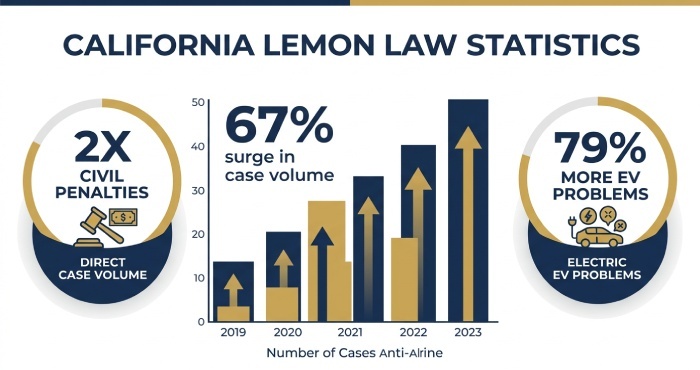
- Civil penalties up to 2x actual damages. Under Civil Code §1794, a court can award civil penalties of up to two times the consumer’s actual damages when the manufacturer’s failure to comply was willful. In practice, this turns a $40,000 buyback into a potential six-figure recovery.
- Manufacturer-paid attorney fees. The statute requires manufacturers to pay reasonable attorney fees and costs to consumers who prevail. This is why nearly all California lemon law firms operate on contingency with no out-of-pocket cost to the client.
- No mileage cap on substantial defects. Unlike many states, California does not impose a hard mileage limit on lemon law claims. The 18-month/18,000-mile presumption only creates a stronger inference that defects qualify; cases beyond that window can still succeed.
- Coverage of CPO vehicles. Certified pre-owned vehicles sold with a manufacturer’s CPO warranty are protected. This is critical because used-car buyers are often the most vulnerable consumers.
- RV and motorhome coverage. The Song-Beverly Act covers RVs and motorhomes, including their chassis and propulsion components—a category many state lemon laws exclude entirely.
|
BY THE NUMBERS: California Lemon Law Volume • 25,000+ lemon law cases filed statewide in 2024, up from approximately 15,000 in 2022 — a 67% increase in two years (per Bowman & Brooke LLP analysis of state court data). • Approximately 10% of all civil filings in Los Angeles County are now lemon law cases (per the California Judges Association). • NHTSA data shows California vehicle recalls rose 8% in 2024, affecting over 27 million vehicles. • A 2025 Consumer Reports survey found that electric vehicles have 79% more reported problems than gas-powered cars — a major driver of recent claims. |
Part 3: How AB 1755 and SB 26 Changed the Process in 2025–2026
On September 29, 2024, Governor Newsom signed Assembly Bill 1755 into law. It is the most significant procedural overhaul of California’s lemon law in more than a decade. Then, on April 2, 2025, Senate Bill 26 was enacted as a cleanup bill, restructuring AB 1755 into an opt-in framework. Together, these laws created a two-track system that took full effect in mid-2025 and continues to govern claims in 2026.
What Changed Under AB 1755
- New statute of limitations. Claims must now be filed within one year after the express warranty expires, and in any case within six years of the vehicle’s original delivery date. The previous standard was effectively four years from discovery of the unrepairable defect.
- Mandatory 30-day pre-suit notice. Before filing a lawsuit seeking civil penalties, consumers must send a written notice to the manufacturer with the VIN, repair history, and an explicit demand for buyback or replacement. The manufacturer has 30 days to respond.
- Mandatory mediation within 150 days. Once the manufacturer files an answer to a lawsuit, the parties must complete mediation within 150 days. Most discovery is stayed during this window.
- $50/day penalties for delay. Manufacturers who fail to comply with the new timelines face automatic daily penalties.
- Limited deposition windows. Depositions during the pre-mediation phase are capped at two hours.
How SB 26 Created an Opt-In System
Following pushback from electric vehicle automakers and consumer groups, SB 26 made the AB 1755 procedures opt-in for manufacturers. The California Department of Consumer Affairs‘ Arbitration Certification Program publishes a list of manufacturers who have elected to use the new procedures, updated every December 15. Once a manufacturer opts in, the new rules govern its vehicles for a five-year period, renewable in five-year blocks.
This means that as of 2026, your case may proceed under one of two frameworks depending entirely on which manufacturer made your vehicle. The substantive rights are identical—same refund, same civil penalties, same attorney fee recovery. But the procedural mechanics differ in important ways.
| Procedural Element | AB 1755 Track (Opted-In Manufacturers) | Pre-AB 1755 Track (Non-Opted-In) |
| Statute of limitations | 1 year after warranty expires; capped at 6 years from delivery | 4 years from discovery of unrepairable defect |
| Pre-suit notice | 30-day written notice required before filing for civil penalties | Not required |
| Mediation | Mandatory within 150 days of answer; discovery stayed | Voluntary; full discovery proceeds |
| Discovery scope | Initial disclosures within 60 days; depositions capped at 2 hours pre-mediation | Standard California Code of Civil Procedure rules |
| Daily penalties | $50/day automatic for missed manufacturer deadlines | Not applicable |
| Civil penalties (up to 2x) | Available — but only if pre-suit notice was sent | Available without pre-suit notice |
Source: AB 1755 (Cal. Civ. Code §§ 871.20–871.26); SB 26; California DCA Arbitration Certification Program list (updated December 2025).
What This Means for You as a Consumer
The most important practical implication is that you cannot afford to wait. The new statute of limitations is unforgiving—if your warranty has been expired for more than one year, your right to sue may already be gone, even if you have been struggling with the same defect the whole time. The second is that the 30-day pre-suit notice is a strict prerequisite for civil penalties. Skipping it means leaving the largest portion of your potential recovery on the table.
This is also why having an attorney early matters more than it used to. Under the old system, you had time to try DIY arbitration, lose, and then hire a lawyer. Under AB 1755, that path is procedurally riskier. An experienced lemon law attorney will know whether your manufacturer has opted in, send the pre-suit notice correctly, preserve your right to civil penalties, and meet the mediation timeline.
Part 4: Key Features to Look for in a Lemon Law Attorney
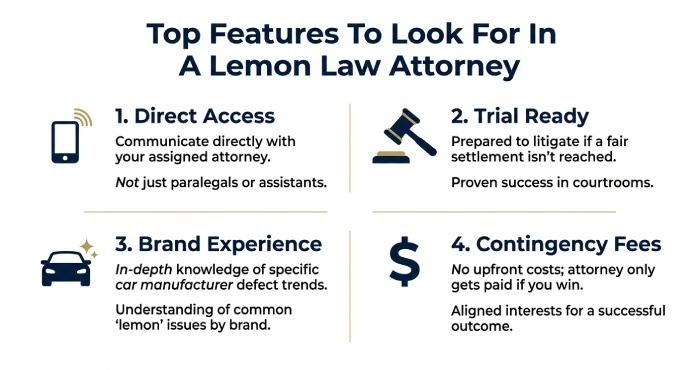
Not every consumer protection lawyer is a lemon law specialist, and not every lemon law specialist is the right fit for every case. Here are eight features to evaluate when choosing representation.
1. Direct attorney access throughout the case
Many high-volume firms route clients through paralegals, intake specialists, and case managers, with the named attorney appearing only at signing or trial. While this scales well for the firm, it can leave clients confused about case status and unable to get strategic answers when they need them. Boutique firms typically offer direct attorney access from intake through resolution, which becomes especially valuable when manufacturer counsel pushes back during mediation.
2. Trial readiness, not just settlement volume
Manufacturers track which firms actually take cases to trial. Firms with a documented trial record extract better settlement offers because the defense knows the threat is real. Firms that exclusively settle—even at high volume—tend to accept lower settlement amounts to keep cases moving.
3. Vehicle-type breadth (cars, RVs, motorcycles, boats)
California’s lemon law covers more than just passenger cars. RVs and motorhomes operate under specialized provisions related to chassis vs. propulsion components, and many firms simply don’t accept those cases. If you own anything other than a standard car or truck, confirm the firm has handled your vehicle category before.
4. Geographic statewide reach
Lemon law cases are filed in the consumer’s home county. A San Diego firm representing a Bay Area client can absolutely do so, but venue strategy matters: some firms prefer LA County (highest case volume, judges familiar with the law) while others avoid it (longest dockets). A firm that operates statewide gives you flexibility on this question.
5. Specific brand experience
Each manufacturer has its own legal posture. Toyota tends to settle quickly. Ford and GM litigate aggressively. Tesla has unusual contractual terms. RV manufacturers like Thor Motor Coach try to invoke forum-selection clauses that send California buyers to Indiana courts. A firm with documented experience against your specific manufacturer will know which playbook to use.
6. Contingency fee structure with manufacturer-paid fees
Under Civil Code §1794(d), a prevailing consumer is entitled to recover reasonable attorney fees from the manufacturer. Reputable lemon law firms operate on contingency: you pay nothing out of pocket, and the manufacturer covers fees if you win. Be cautious of firms that ask for retainers, hourly billing, or any upfront payment in standard lemon law cases.
7. Transparent communication and case tracking
Lemon law cases can take 4–18 months depending on the manufacturer’s behavior, court, and whether mediation succeeds. Firms vary widely in how often they update clients. Some larger firms have built portal apps; smaller firms often rely on direct attorney calls. Neither is automatically better—what matters is that you know when to expect updates.
8. Appellate and procedural depth
Lemon law has been heavily shaped by appellate decisions in the past three years, including the California Supreme Court’s 2024 ruling in Rodriguez v. FCA US LLC, which narrowed used-car coverage in some scenarios, and Niedermeier v. FCA on civil penalties. Firms that cite these precedents in their case materials typically have the procedural depth to handle complex defense arguments.
Part 5: New Vehicles vs. Used / CPO Vehicles vs. RVs
California lemon law applies differently depending on the type of vehicle and how it was purchased. The differences matter when choosing an attorney, because not every firm has experience across every category.
| Factor | New Vehicles | Used / CPO Vehicles | RVs / Motorhomes |
| Coverage | Full Song-Beverly protection during original warranty | Covered if sold with active manufacturer or CPO warranty | Chassis and propulsion components covered; “house” components vary |
| Typical Defect | Engine, transmission, electrical, software | Same as new + dealer-concealed prior damage | Slide-out failures, generator, water systems, chassis defects |
| Defendant | Manufacturer | Manufacturer (CPO) or dealer (private) | Often multi-defendant: chassis maker + RV builder |
| Common Tactic | “Operating as designed” defense | “Damage caused by prior owner” defense | Forum-selection clauses sending case out of state |
| Typical Recovery | $25K–$80K + attorney fees | $15K–$50K + attorney fees | $80K–$300K+ + attorney fees |
Recovery ranges are general benchmarks based on aggregate California settlement data; individual outcomes vary substantially.
Part 6: Common Defect Categories That Trigger Lemon Law Claims
Not every vehicle defect qualifies under the lemon law. The defect must “substantially impair” the use, value, or safety of the vehicle—a phrase that has been interpreted by California courts over decades. Understanding the categories that consistently meet this threshold helps consumers identify whether their situation is likely to qualify.
Engine and Powertrain Defects
Engine defects remain the single largest category of California lemon law claims. Recurring stalling, failure to start, oil consumption beyond normal limits, head gasket failures, and timing chain issues consistently meet the substantial-impairment threshold. The General Motors V8 “lifter tick” issue affecting 2019–2024 trucks and SUVs has generated thousands of California claims, as have transmission shudder issues in Ford Focus, Fiesta, and certain F-150 models.
Transmission Issues
Transmission defects—particularly in vehicles with continuously variable transmissions (CVTs) or dual-clutch designs—have driven a significant volume of recent claims. Common symptoms include rough shifting, hesitation, gear slippage, and sudden loss of drive. Audi DSG transmissions, Volkswagen DCT transmissions, and Nissan CVTs are frequent subjects of California lemon law actions.
Electrical and Software Defects
As vehicles have become more software-driven, electrical and software defects have grown into a major category. Touchscreen failures, infotainment system crashes, false warning lights, electronic control module (ECM) failures, and over-the-air update failures all qualify when they affect the vehicle’s safety or use. Tesla’s autopilot-related complaints, Hyundai and Kia infotainment issues, and Ford SYNC system defects have been particularly common recent grounds.
Battery and Charging System Failures (EVs)
Electric vehicle defects represent the fastest-growing category. Battery degradation faster than warranted, charging system failures, sudden range loss after software updates, and thermal management defects have triggered claims against Tesla, Ford (Mustang Mach-E), Chevrolet (Bolt EUV), Rivian, and others. As noted earlier, Consumer Reports found in 2025 that EVs have 79% more reported problems than gas-powered vehicles—a key driver of the 2024 surge in California filings.
Brake, Steering, and Suspension Defects
Safety-system defects almost always meet the substantial-impairment threshold because they directly affect operator and passenger safety. Premature brake wear (when not caused by aggressive driving), steering rack failures, electronic power steering loss, and suspension component failures are routine grounds for lemon law claims. The substantial-impairment standard is most easily met when the defect creates a documented safety risk.
RV-Specific Defects
RVs and motorhomes generate distinctive defect categories: slide-out mechanism failures, generator faults, water system leaks, propane system defects, and chassis-level powertrain issues. Because RVs combine a chassis warranty (from Ford, Mercedes, Freightliner, etc.) and a builder warranty (from Thor, Winnebago, Forest River, etc.), claims often involve multiple defendants. The McMillan v. Thor Motor Coach forum-selection ruling discussed earlier in this guide is particularly relevant here.
Part 7: Documenting Your Claim Effectively
The single most important factor in a successful California lemon law case is documentation. Manufacturers’ defenses almost always center on the argument that the defect either does not exist, does not substantially impair the vehicle, or has been adequately repaired. Strong documentation defeats each of these defenses.

Repair Orders Are the Foundation
Every time the vehicle is taken in for warranty service, the dealership must produce a repair order (RO). Get a copy of every RO. Check that the RO accurately describes the problem you reported, in your own words. Dealerships sometimes paraphrase consumer complaints in ways that minimize them—”customer states intermittent noise” instead of “customer states transmission failed to engage at 30 mph.” If the RO does not match what you reported, ask for it to be corrected before you leave.
Track Days Out of Service
Under California’s lemon law presumption, a vehicle that has been out of service for repairs for more than 30 cumulative days within the warranty period is presumed to be a lemon. Track these days carefully. Loaner-car receipts, dealership drop-off and pickup receipts, and dated repair orders all establish the count.
Communication Records Matter
Save every email, text message, and voicemail with the dealership and manufacturer customer service. When you make phone calls to manufacturer hotlines, follow up in writing summarizing what was discussed. These records become critical when establishing a timeline of repair attempts and manufacturer awareness.
Photos and Videos of Defects
If the defect is visual or audible (a leak, an unusual noise, a malfunctioning display, a smoke from the exhaust), document it with photos and videos. Date-stamped media has won more lemon law cases than oral testimony alone.
Part 8: How to Choose a California Lemon Law Attorney
Before contacting any firm, work through these five questions. The answers will determine which firms are a fit and which are not.
- What kind of vehicle do you own? If it is a car or light truck, almost any California lemon law firm can handle it. If it is an RV, motorhome, motorcycle, or boat, narrow your search to firms that explicitly list those categories.
- Has the manufacturer opted into AB 1755? Check the California DCA’s published list. If yes, your case is on the new fast track and you need an attorney immediately—the deadlines are unforgiving. If no, you have more time, but the older rules still apply.
- Do you want direct attorney access or are you comfortable with a team-based model? High-volume firms with 100+ employees typically use intake teams and case managers. Boutique firms typically have you working directly with the named attorney. Both work; the question is which feels right for you.
- How much is at stake? For vehicles under $35,000 in cash value, court restrictions under SB 71 may limit your venue options. Higher-value vehicles (luxury cars, RVs) make trial-ready firms more valuable because the manufacturer is more likely to fight.
- Where do you live? The lawsuit will typically be filed in your home county. If you are in San Diego, a San Diego firm has logistical and judicial-familiarity advantages. If you are in LA, you have the most options because the LA County bar concentrates lemon law specialists.
Part 9: At-a-Glance Comparison of the Top 10 California Lemon Law Firms
Below is a summary table of the ten firms reviewed in this guide, drawn from California SERP rankings, peer-recognition databases (Super Lawyers, National Trial Lawyers), and third-party review platforms (Google, Yelp, Avvo). Pricing is uniform across the category—every firm listed operates on contingency, and California’s lemon law statute requires the manufacturer to pay reasonable attorney fees when the consumer prevails. The differentiation is in fit, model, and specialty.
| Firm | Best For | Not Ideal For | Fee Model | Notable Recognition |
| McMillan Law Group | Consumers wanting direct attorney access; RV/motorhome owners; CPO/used vehicle cases statewide | Buyers who prefer a large firm with online portals and 24/7 intake centers | Contingency; manufacturer pays fees | Super Lawyer 2014–2025; NTL Top 100; San Diego Magazine Top Attorneys |
| Wirtz Law APC | Trial-bound cases; willful violation claims with significant civil penalty potential | Consumers seeking the fastest possible settlement | Contingency | Super Lawyers; reports $76M recovered |
| Quill & Arrow Law | Clients who prefer large-firm infrastructure (220+ employees, mobile case-tracking app) | Clients who want a single attorney on their case from start to finish | Contingency | NTL Top 100; Top 40 Under 40; Super Lawyers |
| The Lemon Law Experts | High-volume case processing; consumers comfortable with phone-only interaction | Complex multi-defendant or trial-bound cases | Contingency | Reports $100M+ in settlements; 20,000+ clients since 2009 |
| Strategic Legal Practices (SLP) | Cases against manufacturers where SLP has former-defense-counsel insider knowledge (e.g., Ford) | RV/motorhome cases; smaller-value standard claims | Contingency | Founder previously represented Ford in lemon law defense |
| Knight Law Group | LA-based clients; high-volume passenger-vehicle cases | Out-of-state RV manufacturers with forum disputes | Contingency | Frequently cited in CA lemon law rankings |
| Lemon Law Now (Shainfeld Law) | LA-area clients wanting solo-practitioner-style direct contact | Northern California clients; complex commercial vehicle cases | Contingency | Reports 99% success rate; LA-focused practice |
| California Lemon Law Group, Inc. | Clients seeking boutique service with model-year-restricted intake (2022–2026 only) | Owners of older qualifying vehicles | Contingency | Boutique firm; no-fee model with early-stage costs covered |
| Young & Young APC | LA County clients wanting a 100% lemon-law-focused practice | RV, motorcycle, or boat cases (auto-only focus) | Contingency | 100% lemon law practice; statewide service |
| Law Offices of Douglas D. Law | San Diego–area clients wanting a small firm with broader consumer-protection scope | Clients needing a pure lemon-law boutique | Contingency | 33+ years combined legal experience; San Diego–based |
Recognition data sourced from each firm’s published bios, Super Lawyers Magazine, and the National Trial Lawyers organization, accessed May 2026. “Best For” and “Not Ideal For” categorizations are based on each firm’s own published positioning, geography, and case-type focus.
Part 10: Detailed Reviews
The reviews below follow a consistent format. Each firm receives the same headers (Overview, Top Features, Pricing, Best For, How does it compare). McMillan Law Group, as the firm publishing this guide, is reviewed in deeper detail because we have first-party knowledge of our own operations; competitor reviews are based on public information from the firms’ websites and third-party review platforms (G2, Avvo, Google Reviews, Yelp). All competitor limitations are sourced from third parties, never characterized in our own voice.
1. McMillan Law Group
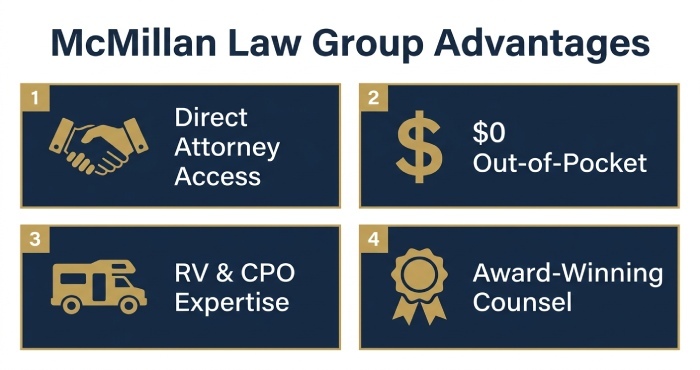
McMillan Law Group is a San Diego–based consumer advocacy law firm built for California vehicle owners who want direct attorney access on every lemon law case. The firm is led by founding attorney Julian McMillan, who has been recognized as a Thomson Reuters Super Lawyer for twelve consecutive years (2014–2025), named to the National Trial Lawyers Top 100 Civil Plaintiff Lawyer list, and listed among San Diego Magazine’s Top Attorneys every year since 2016.
What separates McMillan Law Group from larger lemon law operations is structural: there is no intake call center, no case manager queue, and no paralegal-led negotiation. From the first free consultation through final settlement or trial, clients work directly with Julian McMillan. This model exists because lemon law cases turn on procedural detail—when to send the AB 1755 pre-suit notice, how to respond to a manufacturer’s “operating as designed” defense, whether to push for civil penalties or accept a clean buyback—and those decisions are most effectively made by the attorney who actually knows the case file.
The firm’s practice covers the full breadth of California’s lemon law jurisdiction: new and certified pre-owned (CPO) cars, leased vehicles, motorcycles, boats, and—notably—RVs and motorhomes. McMillan Law Group has secured a procedural victory against Thor Motor Coach in a case where the Indiana-based RV manufacturer attempted to use a forum-selection clause to transfer California consumer cases to Indiana courts. Julian McMillan opposed the motion and won; the judge ruled the case would be adjudicated in California. This precedent is cited beyond McMillan’s own client base because it confirms that out-of-state RV manufacturers cannot evade California’s consumer protections through warranty fine print.
On used vehicles specifically, the firm has built one of the more developed CPO-focused content libraries in the state. Julian McMillan’s published guidance on certified pre-owned purchasing—particularly the “buy a Chevy from a Chevy dealership” rule—reflects a recurring pattern in the firm’s case files: consumers who buy a vehicle of one brand from a dealership of another (e.g., a used Chevrolet from a Ford dealer) often discover that neither manufacturer accepts lemon law accountability. Working with a CPO program from the original manufacturer’s authorized dealer preserves the strongest legal position.
McMillan Law Group also publishes a Lemon Law Refund Calculator, an online tool that estimates potential recovery based on vehicle price, mileage, and time of use. While no online calculator can substitute for an attorney’s case evaluation, the tool helps consumers understand the buyback-formula deductions (the “mileage offset for use” under Civil Code §1793.2(d)(2)(C)) before contacting the firm.
The firm operates on a no-out-of-pocket-cost contingency model. Under California Civil Code §1794(d), the manufacturer is required to pay the consumer’s attorney fees when the consumer prevails. McMillan Law Group does not charge clients hourly rates, retainers, or any upfront costs. If the case does not result in a recovery, the client owes nothing.
Top Features
- Direct attorney access from intake through resolution—every client works with Julian McMillan personally, not a paralegal or case manager.
- Twelve consecutive years of Super Lawyer recognition (2014–2025), reflecting sustained peer evaluation by Thomson Reuters.
- Documented forum-selection precedent against Thor Motor Coach, preserving California jurisdiction for out-of-state RV cases.
- Multi-vehicle expertise: cars, RVs, motorcycles, boats, and CPO/used vehicles—not limited to standard passenger vehicles.
- Brand-specific knowledge bases for General Motors, Volkswagen, Audi, and Porsche, accumulated over 15+ years of California lemon law practice.
- Free Lemon Law Refund Calculator that applies the Civil Code §1793.2(d)(2)(C) mileage-offset formula transparently.
- Statewide representation from a San Diego base, with attorney travel for clients across California.
- National Trial Lawyers Top 100 Civil Plaintiff Lawyer recognition and America’s Most Honored Professionals listing (2018–2025).
Pricing
Standard contingency: $0 to the client, manufacturer pays attorney fees on successful claims. No retainer, no hourly billing. McMillan Law Group does not collect a fee unless the firm helps the client obtain compensation, replacement, or refund.
Best For
California consumers who want a senior trial attorney personally handling their case rather than a layered intake team—particularly RV and motorhome owners (where the Thor precedent matters), CPO/used-vehicle buyers (where the firm’s published guidance and case experience are most concentrated), and clients with cases against German luxury brands (where the firm has built dedicated practice content for Audi, VW, and Porsche cases).
How does it compare?
McMillan Law Group is positioned as a versatile boutique firm rather than a high-volume operation. Larger California lemon law firms—some with 200+ employees—offer infrastructure advantages like portal apps and 24/7 intake. McMillan Law Group’s deliberate trade-off is the opposite: a smaller caseload per attorney, no intake-team handoffs, and direct senior-attorney involvement at every stage. This works well for consumers who value personal attention and procedural depth; it is less of a fit for those who prefer the structure and self-service options of a larger firm.
2. Wirtz Law APC
Wirtz Law APC is a San Diego–based California lemon law firm built around trial litigation. The firm reports it has recovered $76 million for California consumers and explicitly positions itself as the firm that takes cases to juries when manufacturers refuse to settle on fair terms. Wirtz Law represents clients statewide.
According to the firm’s own materials, Wirtz Law’s competitive edge is jury-trial experience—the argument being that manufacturers offer better settlements to firms with documented trial willingness. The firm advertises that it consistently recovers more than just a buyback, including actual damages and civil penalties under Civil Code §1794.
Top Features
- Reported $76 million recovered for California consumers (per firm’s published case-result page).
- Statewide representation from San Diego to Sacramento.
- Positioned as a trial firm, with explicit emphasis on willful-violation civil penalty recovery.
- Multiple Super Lawyer recognitions for individual attorneys.
Pricing
Contingency basis with no out-of-pocket cost; manufacturer-paid fees on prevailing claims (per Wirtz Law’s published fee disclosure).
Best For
Consumers with strong willful-violation cases where civil penalties up to 2x actual damages are likely on the table, and clients who want a firm that has demonstrated jury-trial experience.
How does it compare?
According to client feedback aggregated across Google Reviews and Yelp, Wirtz Law’s trial-focused approach can produce stronger recoveries on willful-violation claims, while consumers seeking the fastest possible buyback sometimes report longer timelines than firms that prioritize early settlement. Cases under the firm tend to be resolved “within a year” per the firm’s own published timeline guidance, though some can be expedited.
3. Quill & Arrow Law
Quill & Arrow Law is one of the largest dedicated lemon law firms in California, with over 220 employees and offices across the state. The firm has built significant infrastructure around case management, including a real-time case-tracking mobile app and dedicated client support teams.
The firm’s recent published case results include settlements involving high-value vehicles, including a 2022 Maserati MC20 case valued at $257,045. Quill & Arrow positions itself as a firm that prepares every qualifying case for trial, signaling to manufacturers that lowball offers will not be accepted.
Top Features
- 220+ employees and statewide office network, supporting high case volume.
- Real-time case-tracking app for client transparency.
- National Trial Lawyers Top 100 and Top 40 Under 40 honorees on staff.
- Published case results include high-value luxury vehicles (Maserati, etc.).
- Trial preparation as a default posture, even on cases that ultimately settle.
Pricing
Contingency basis; the manufacturer pays attorney fees when the consumer prevails (per Quill & Arrow’s published fee structure).
Best For
Clients who prefer a large-firm experience with structured client portals, dedicated support teams, and statewide office access. Particularly suited to high-value vehicle cases where infrastructure-supported case management is valuable.
How does it compare?
Per aggregated client reviews on Google and Yelp, Quill & Arrow’s scale offers strong infrastructure but some clients report feeling like a case number rather than an individual client—a recurring trade-off with firms of this size. According to Avvo client reviews, communication can occasionally be slowed by the firm’s tiered staffing model, where intake, paralegal, and attorney handoffs introduce additional touchpoints.
4. The Lemon Law Experts
The Lemon Law Experts is one of the highest-volume California lemon law firms, reporting more than $100 million in settlements for over 20,000 clients since 2009. The firm operates statewide with a phone-based intake and case-management model, and reports a 99% success rate.
Top Features
- Reports $100M+ in total settlements and 20,000+ clients (per firm’s published statistics).
- Multilingual staff for non-English-speaking clients.
- Phone-based intake and case-management with 24/7 contact lines.
- Reports a 99% success rate (firm’s own published figure).
Pricing
Contingency; manufacturer pays attorney fees on successful claims.
Best For
Consumers with relatively standard new-vehicle lemon law cases who want a high-volume, fast-throughput firm and are comfortable with primarily phone-based communication.
How does it compare?
Per Google Reviews and Yelp aggregate feedback, The Lemon Law Experts is highly rated for speed and client communication on standard cases. According to several published client testimonials, the firm operates primarily over the phone, which suits some clients but leaves others wanting more direct in-person attorney contact, particularly on complex or trial-bound cases.
5. Strategic Legal Practices (SLP)
Strategic Legal Practices, often referred to as SLP, has an unusual founder profile: lead attorney Payam Shahian previously worked at a defense firm representing Ford in lemon law cases before founding SLP to represent consumers. SLP secured a precedent-setting ruling allowing it to continue representing consumers against Ford despite the prior representation. The firm reports a 99%+ success rate.
Top Features
- Founder’s prior experience defending Ford gives the firm insider knowledge of manufacturer defense playbooks.
- Precedent-setting ruling preserving consumer representation despite former defense role.
- Reports 99%+ success rate.
- Strong appellate-level expertise.
Pricing
Contingency basis with manufacturer-paid attorney fees on successful claims.
Best For
Cases against Ford (where SLP’s insider knowledge has the most leverage) and other major manufacturers where understanding the defense’s likely playbook offers strategic value.
How does it compare?
According to public Avvo and Google Reviews, SLP is highly rated for cases against major automakers but has a narrower vehicle-type focus than firms like McMillan Law Group; the firm’s published case results emphasize standard passenger vehicles rather than RVs or motorcycles.
6. Knight Law Group
Knight Law Group is a Los Angeles–based lemon law firm frequently named alongside Wirtz Law, Quill & Arrow, and SLP in California top-firm rankings. The firm focuses primarily on passenger vehicle cases and has developed a high-volume LA County practice.
Top Features
- LA County–focused practice with deep local court familiarity.
- Frequently cited in third-party California lemon law rankings.
- Strong record on standard passenger-vehicle cases.
Pricing
Contingency; no out-of-pocket cost to the consumer.
Best For
LA County residents with passenger-vehicle cases who want a firm with deep local court familiarity.
How does it compare?
Per third-party listings on FindUSLawyers and Super Lawyers, Knight Law Group is well-regarded for high-volume passenger-vehicle work. According to client reviews aggregated across Google and Yelp, complex cases involving out-of-state manufacturers—particularly RV manufacturers using forum-selection clauses—are not the firm’s primary focus area.
7. Lemon Law Now (Shainfeld Law)
Lemon Law Now, also operating as Shainfeld Law, is a Los Angeles–based firm led by founding attorney Brett Shainfeld. The firm advertises a 99% success rate and emphasizes solo-practitioner-style direct contact: “You’ll always be dealing directly with the lawyer on your case.”
Top Features
- Direct attorney access (founding attorney handles cases personally).
- Sole-focus lemon law practice.
- Reports 99% success rate.
- Covers cars, RVs, boats, planes, and motorcycles.
Pricing
Contingency basis; manufacturer pays fees on successful claims.
Best For
Los Angeles–area clients who want a small-firm, direct-attorney experience similar to McMillan Law Group’s model.
How does it compare?
Per client reviews aggregated across Google and Avvo, Lemon Law Now is well-regarded for its direct-attorney experience. The firm’s geographic concentration is in Los Angeles; according to the firm’s published service-area information, Northern California cases are accepted but the operational base is LA-centric.
8. California Lemon Law Group, Inc.
California Lemon Law Group, Inc. is a boutique firm led by attorney Debbie Horowitz. The firm explicitly accepts only model-year 2022–2026 vehicle cases and operates a multi-office California presence with traveling-attorney service for clients outside its immediate office areas.
Top Features
- Boutique firm with personalized one-on-one attention.
- “No fees ever, even on winning cases” model — the firm advertises that clients pay nothing whether or not the case wins.
- Traveling-attorney service to clients across California at no additional cost.
- Recurring published content on common defects (Nissan Rogue reliability, Suburban/Escalade transmission, etc.).
Pricing
Contingency; the firm’s published fee disclosure states no client fees on either win or loss.
Best For
Owners of model-year 2022–2026 vehicles who want a boutique firm with personalized service.
How does it compare?
Per the firm’s own published intake restrictions, owners of qualifying vehicles outside the 2022–2026 model-year window are not currently accepted as clients. According to client reviews on Google, the firm is well-regarded for the cases it does take.
9. Young & Young APC
Young & Young APC is a Los Angeles–based firm with a 100% lemon law practice focus. The firm represents clients statewide and emphasizes that clients work directly with experienced attorneys rather than through tiered staffing.
Top Features
- 100% practice-area focus on California lemon law.
- Direct attorney-client relationship from the start.
- Statewide representation.
- Decades of trial experience among partners.
Pricing
Contingency; manufacturer pays fees on successful claims.
Best For
LA County clients who want a 100% lemon-law-focused practice with attorney-direct service.
How does it compare?
Per the firm’s published practice description and Avvo reviews, Young & Young APC focuses on automotive lemon law and does not advertise dedicated RV, motorcycle, or boat practice areas. Auto-only clients have generally been satisfied with the firm’s responsiveness, per client reviews.
10. Law Offices of Douglas D. Law, Esq.
The Law Offices of Douglas D. Law is a San Diego–based consumer protection firm with over 33 years of combined legal experience. The firm handles lemon law alongside broader consumer protection matters including dealer fraud and odometer rollback cases.
Top Features
- 33+ years combined legal experience.
- Handles lemon law plus adjacent consumer protection (dealer fraud, odometer rollback).
- Reports 99% success rate.
- Multi-state-court trial experience including jury verdicts with civil penalties.
Pricing
Contingency basis; the firm reports that all hourly legal fees are paid by the defendant after a winning case.
Best For
San Diego–area clients whose case may involve dealer fraud or other consumer protection claims alongside the lemon law issue.
How does it compare?
Per the firm’s published case results and Google Reviews, Douglas D. Law is well-regarded for hybrid lemon-law-plus-fraud cases. Per Avvo client feedback, clients seeking a pure lemon-law boutique typically prefer firms with 100% lemon law focus, while those whose case has multiple consumer-protection angles often prefer the broader scope.
Part 11: How to Choose the Right Firm — Decision Table
After reviewing the ten firms above, work through this decision framework to narrow your shortlist. The columns are designed so that a “yes” in your situation maps to a specific category of firm.
| Question to ask yourself | If yes, prioritize firms with… | Example fits |
| Is your vehicle an RV, motorhome, motorcycle, or boat? | Multi-vehicle expertise and out-of-state forum-selection experience | McMillan Law Group; Lemon Law Now |
| Do you want to work directly with the lead attorney? | Boutique structure (under 25 employees) and named-attorney case ownership | McMillan Law Group; Lemon Law Now; California Lemon Law Group, Inc |
| Do you want large-firm infrastructure (apps, portals, 24/7 intake)? | 100+ employee firms with technology investment | Quill & Arrow Law; The Lemon Law Experts |
| Is your manufacturer Ford specifically? | Insider knowledge of Ford’s defense playbook | Strategic Legal Practices (SLP) |
| Is your case likely to require a jury trial? | Documented trial-experienced partners | Wirtz Law APC; McMillan Law Group; Quill & Arrow Law |
| Are you in San Diego County? | San Diego–based offices with local court familiarity | McMillan Law Group; Wirtz Law APC; Douglas D. Law |
| Are you in LA County? | LA-based firms with high-volume LA County experience | Knight Law Group; Lemon Law Now; Young & Young APC |
| Do you also have dealer fraud or odometer issues? | Broader consumer protection scope | Douglas D. Law |
| Is your CPO/used vehicle the central issue? | Published guidance and case experience on CPO claims | McMillan Law Group; Quill & Arrow Law |
Part 12: Role-Based Guidance
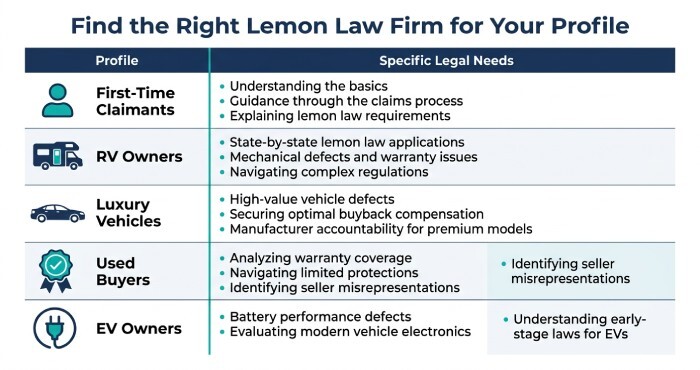
Different consumer profiles benefit from different firm structures. Use this section to align your shortlist with your priorities.
For First-Time Lemon Law Claimants
If this is the first time you have considered legal action against a manufacturer, prioritize firms with direct attorney access and clear, plain-English communication. The lemon law process is procedurally complex under AB 1755, and being able to ask questions of the attorney handling your case—not a paralegal or intake specialist—reduces the friction substantially. Boutique firms tend to score better on this dimension.
For RV and Motorhome Owners
RV cases often involve multiple defendants and aggressive forum-selection clauses that try to send California consumers to courts in Indiana or Florida. Look for firms with documented experience in this category—ideally including procedural rulings on forum-selection clauses.
For Owners of Luxury and European Vehicles
Audi, BMW, Mercedes, Porsche, Land Rover, and Jaguar cases tend to involve higher-value claims, more complex defects (transmission software, advanced driver assistance, electric drivetrains), and more aggressive litigation by the manufacturer. Firms with brand-specific practice content typically have the technical depth to handle these defects effectively.
For CPO and Used Vehicle Buyers
Used and CPO vehicle cases shifted under the California Supreme Court’s 2024 ruling in Rodriguez v. FCA US LLC. The decision tightened conditions under which used-vehicle buyers can pursue claims, making the distinction between active manufacturer warranties and dealer-only warranties critical. Firms with published guidance on CPO purchasing and Rodriguez-aware case strategies are better positioned.
For Tesla and EV Owners
Electric vehicle cases have unique features: software-driven defects, over-the-air update issues, and battery degradation. Tesla has not opted into AB 1755, so Tesla cases proceed under the older procedural framework. Firms that have handled multiple EV cases in recent years are best positioned to know which playbook applies.
Part 13: Implementation Considerations and Trade-offs
Choosing a lemon law firm involves real trade-offs, not just “better vs. worse” comparisons. Here are the most consequential considerations.
Speed vs. Recovery Maximum
High-volume firms typically resolve cases faster, often within 60–120 days, by accepting the manufacturer’s first reasonable settlement offer. Trial-ready firms tend to take longer (6–18 months) but can often extract higher recoveries by signaling willingness to litigate civil penalties to verdict. There is no universally correct answer—it depends on whether your priority is closure or maximum compensation.
Direct Attorney Access vs. Infrastructure
Boutique firms offer a single point of contact and personalized strategy but lack the staff infrastructure of large firms. Large firms offer apps, portals, 24/7 intake lines, and structured case-management—but introduce handoffs that can dilute the attorney-client relationship. Both models have produced excellent outcomes; the question is which feels right for you.
Specialty Focus vs. Broad Practice
Some firms practice 100% lemon law (Quill & Arrow, Young & Young, The Lemon Law Experts). Others combine lemon law with adjacent consumer protection (Douglas D. Law). Pure-focus firms have deeper procedural muscle on lemon-specific issues; broad-practice firms can address overlapping fraud, financing, or odometer claims in a single case. If your situation has multiple consumer-protection issues, broader-practice firms may consolidate them more efficiently.
Manufacturer Opt-In Status (AB 1755)
If your manufacturer has opted into AB 1755, the case will proceed on a fast track with mandatory mediation and tighter timelines. This rewards firms with strong procedural discipline. Confirm with the firm that they have the operational systems to handle AB 1755 deadlines reliably—missed deadlines can cost civil penalty rights.
Part 14: Frequently Asked Questions
Q: Does it really cost $0 to hire a lemon law attorney in California?
Yes—when the case is handled on contingency. California Civil Code §1794(d) requires the manufacturer to pay the consumer’s reasonable attorney fees when the consumer prevails. Reputable lemon law firms charge no retainer, no hourly rate, and no upfront cost. If the case loses, the consumer typically owes nothing.
Q: How long does a California lemon law case take in 2026?
Cases against AB 1755 opted-in manufacturers typically resolve within 6–9 months. Cases against non-opted-in manufacturers can take 9–18 months, sometimes longer at trial. Some cases settle within weeks of the firm’s initial demand letter.
Q: Can I file a claim if my warranty has already expired?
Possibly. Under AB 1755, you must file within one year after the warranty expires (or within six years of original delivery, whichever comes first). If the defect was first reported during the warranty period, the case may still be timely. Consult an attorney quickly—the deadlines are unforgiving.
Q: What if the manufacturer offers me a settlement directly?
Direct settlements are sometimes lower than the consumer’s full statutory entitlement and typically require signing a release that waives further claims, including civil penalty rights. Run the offer past an attorney during a free consultation before accepting.
Q: Does California lemon law cover used vehicles?
Yes, in two scenarios: certified pre-owned (CPO) vehicles sold with a manufacturer’s CPO warranty, and used vehicles still under the original manufacturer’s warranty at purchase. The 2024 Rodriguez v. FCA US LLC ruling narrowed certain used-vehicle scenarios, so specifics depend on your warranty paperwork.
Q: How is the buyback amount calculated?
Under Civil Code §1793.2(d)(2)(C), the buyback equals the full purchase price plus collateral charges (sales tax, registration, finance charges), less a mileage offset: (purchase price) × (miles before first repair attempt) ÷ 120,000. Civil penalties up to 2x actual damages can apply on willful violations.
Final Thoughts
California’s lemon law remains the strongest in the country, but the procedural landscape changed meaningfully with AB 1755 and SB 26. The right attorney for your case is no longer simply the one with the most settlements or the loudest advertising—it is the one whose model, geography, vehicle expertise, and procedural discipline match your situation. Each of the ten firms reviewed in this guide has earned its place in California’s lemon law practice. Each one is the right answer for a particular type of consumer.
We hope this guide has helped you narrow your shortlist. If you would like a free case evaluation from McMillan Law Group, you can reach our team at the link below. Whether or not you decide to work with us, we hope you have a clearer view of the questions to ask before signing an engagement letter.
→ Free Lemon Law Case Evaluation – McMillan Law Group
Sources cited in this guide include: California Civil Code §§ 1790–1795 (Song-Beverly Consumer Warranty Act); AB 1755 (Cal. Civ. Code §§ 871.20–871.26); SB 26; California Department of Consumer Affairs’ Arbitration Certification Program; Bowman & Brooke LLP analysis of state court data (2024); California Judges Association (2024); NHTSA recall statistics (2024); Consumer Reports EV reliability survey (2025); Rodriguez v. FCA US LLC, Cal. Supreme Court (2024); each firm’s own published case results and fee disclosures; aggregated client reviews from Google, Yelp, Avvo, and Super Lawyers, accessed May 2026.