
Nobody budgets for a lemon. You walk onto a dealership lot, negotiate a price, sign your name a dozen times, and drive home expecting reliable transportation for the next several years. But for a rapidly growing number of Californians, that new car turns into a recurring nightmare of repair appointments, loaner vehicles, and the slow realization that the manufacturer simply cannot fix what’s wrong.
California Lemon Law—formally the Song-Beverly Consumer Warranty Act—has protected buyers of defective vehicles for over 40 years. It requires manufacturers to repurchase or replace a vehicle when they can’t repair a substantial warranty defect after a reasonable number of attempts. It is widely considered one of the strongest consumer protection statutes in the country. But the sheer volume of defective vehicles now flooding California’s courts tells us something important: the law is being tested at a scale its authors never imagined.
Between 2022 and 2023, lemon law case filings in California nearly doubled, jumping from 14,892 to 22,655 according to a California Assembly Judiciary Committee legislative analysis of AB 1755. By 2024, the count exceeded 25,000 (Bowman and Brooke LLP). One legal analysis estimates filings surpassed 35,000 by 2025—a 75% increase in five years (CA Lemon Law Guys).
In Los Angeles County, nearly 10% of all civil court filings are now lemon law disputes. One in ten lawsuits—not about contracts, not about property, not about personal injury—but about cars that don’t work.
That statistic, drawn directly from the California legislature’s own analysis, captures the severity of the crisis. But the question that matters most to anyone shopping for a car in California is straightforward: which brands are most likely to land you here?
The data paints a remarkably clear picture. And the actionable steps that follow from it could save you tens of thousands of dollars.
The Big Four Own 70% of the Problem
According to a CalMatters investigative report, just four companies—General Motors, Ford, Stellantis (Chrysler/Jeep/Ram), and Nissan—account for more than 70% of all California lemon law cases. Dozens of automakers sell vehicles in the state. Four of them generate seven out of ten lawsuits.
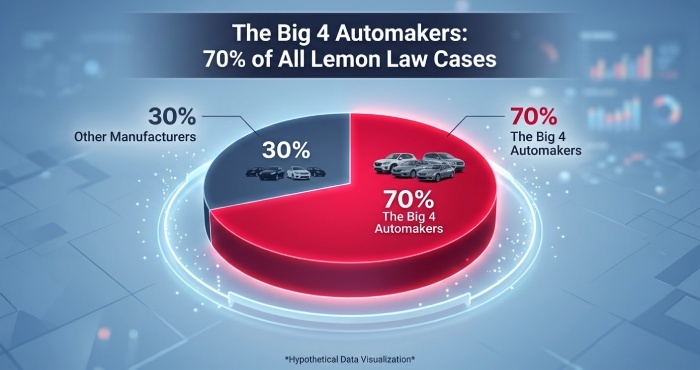
This concentration is not a statistical quirk. It reflects deep, persistent patterns in vehicle quality, warranty responsiveness, and corporate decision-making. These same four manufacturers supported the passage of AB 1755 in 2024—the controversial law that tightened filing timelines and added procedural hurdles for consumers bringing lemon law claims. Tesla, Toyota, Volkswagen, and other manufacturers with fewer lawsuits opposed the bill, calling it unfairly negotiated behind closed doors (Cline APC).
What this means for you: The brands generating the most lawsuits are also the ones that pushed hardest to make it harder for consumers to file claims. That political dynamic is worth understanding because it shapes the legal landscape you’ll navigate if your vehicle turns out to be defective. Before purchasing any vehicle from these four manufacturers, check the specific model’s recall history at NHTSA.gov/recalls and review owner-reported complaints for patterns of recurring defects.
General Motors: The Numbers Are Staggering
The single most powerful data point in this analysis comes from the CALPIRG Auto Lemon Index, a 2022 report published jointly by the CALPIRG Education Fund, the Consumers for Auto Reliability and Safety (CARS) Foundation, and Frontier Group. The researchers analyzed California electronic court filings alongside new vehicle registration data from 2018 through 2021 and found a striking disparity:
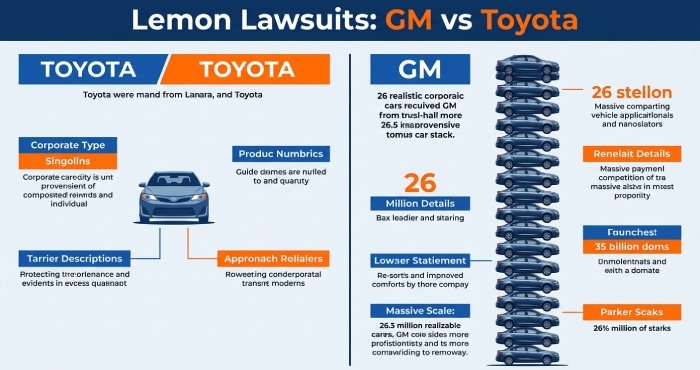
Toyota was taken to court under the Lemon Law once for every 2,029 new vehicles registered in California. General Motors was sued once for every 78 vehicles. GM buyers were approximately 26 times more likely to file a lemon lawsuit than Toyota buyers.
This is not a marginal gap. It is a 26-to-1 ratio that separates the best-performing major manufacturer from the worst. And GM was responsible for nearly one-third of all California lemon lawsuits during that period (Cline APC).
Consumer Reports’ reliability rankings reinforce the pattern. In the organization’s 2025 brand reliability survey of approximately 380,000 vehicles, three of GM’s four brands ranked near the bottom: GMC scored 33 out of 100, Cadillac scored 27, and Buick fell below average. Chrysler, the fourth GM brand, could not be rated due to insufficient data (CarEdge / Consumer Reports analysis). The Chevrolet Equinox, GMC Terrain, GMC Acadia, Buick Enclave, and Cadillac Lyriq all received below-average or well-below-average reliability scores in the most recent survey (Consumer Reports brand rankings).
The financial picture is equally telling. GM’s warranty payouts jumped 23% year-over-year in early 2025, and the company now holds more in warranty reserves than at any prior point in its history (LemonLawAid.com).
What to do if you own a GM vehicle with recurring defects: Under California law, your vehicle may qualify as a lemon if the manufacturer has been unable to repair a substantial defect after two or more attempts for safety-related issues, four or more attempts for other warranty defects, or if the vehicle has been out of service for repair for 30 or more cumulative days. Document every repair visit in writing: note the date, mileage, symptoms reported, diagnostic codes pulled, and work performed. Do not rely on the dealership’s verbal assurances—insist on detailed written repair orders. If you’ve met these thresholds, consult a lemon law attorney. Under the Song-Beverly Act, the manufacturer—not you—is required to pay your attorney’s fees if you prevail, so there is no out-of-pocket cost for legal representation in most cases.
Ford: $4.8 Billion in Warranty Costs and the Most Complaints of Any Brand
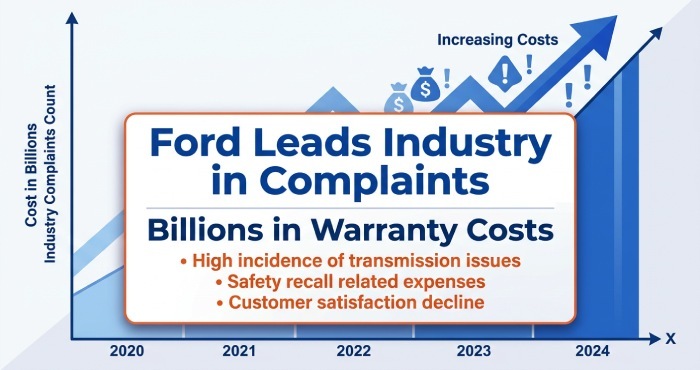
Ford’s defect problem is so severe that it is visibly eroding the company’s bottom line. According to WardsAuto, citing Warranty Week data, Ford paid $4.8 billion in warranty claims in 2023—up 15% from 2022. The company’s CEO Jim Farley has been trying to get warranty costs under control for four years, publicly admitting on earnings calls that defects and quality problems are costing Ford billions and that the company has a $7 billion cost gap with competitors. By early 2025, Ford was paying roughly $1.4 billion per quarter in warranty claims (LemonLawAid.com).
The complaint data is equally stark. A 2026 analysis of NHTSA records found that Ford accounted for 110,011 complaints—17.6% of all complaints filed with NHTSA between 2015 and 2024—more than any other manufacturer. Chevrolet was a distant second at 61,307 complaints (9.8%), and Toyota third at 41,465 (6.6%). Ford’s complaint volume is nearly double that of the next-closest brand.
The F-150 and Explorer are the models most frequently appearing in Ford lemon law claims. In 2024, Ford recalled 1.89 million Explorer SUVs for A-pillar trims that could detach at highway speed. The F-150 has been plagued by transmission defects, steering column failures, windshield bonding issues, and oil leaks across multiple model years, with the 2025 model generating 31 NHTSA complaints and 10 recalls (Wirtz Law).
What to do: Ford owners dealing with recurring transmission shudder, electrical gremlins, or engine stalling should demand detailed technician notes at every service visit. Vague repair orders—like “customer states vehicle runs rough; could not duplicate concern”—actively undermine lemon law claims. Insist that the dealership’s written record describes the exact symptoms you reported, the specific diagnostic trouble codes retrieved, and the repairs attempted or parts replaced. Video evidence of intermittent problems, such as the F-150’s well-documented “death wobble” at highway speeds, is powerful in building your case. If you have three or more repair visits for the same issue, you are likely approaching the threshold for a lemon law claim.
Stellantis: 72 Recalls in a Single Year
Stellantis, the parent company of Chrysler, Jeep, Ram, and Dodge, holds the distinction of issuing more recalls than any other manufacturer in 2024: 72 separate recall orders, according to a comprehensive NHTSA data study. Ford was close behind at 67. For contrast, Mazda issued just 6 recalls that year—the fewest of any major manufacturer.
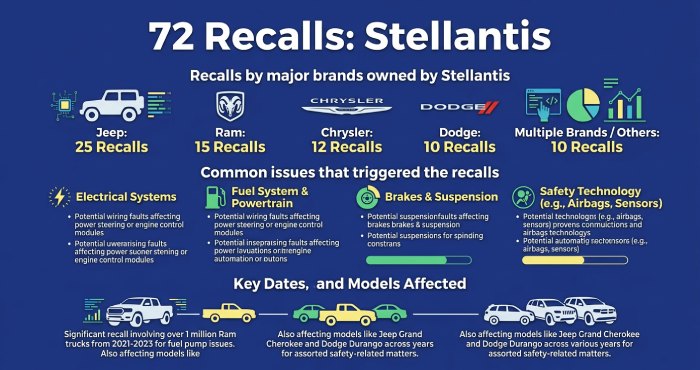
The long-term record is similarly concerning. Between 2010 and 2024, Chrysler issued 545 recalls, second only to Ford’s 569, while GM logged 468 (The Lemon Law Experts / NHTSA data). Jeep and Ram products consistently appear in lemon law filings for transmission defects, electrical system failures, and engine stalling. The Jeep Grand Wagoneer, Chrysler Pacifica Hybrid (which Consumer Reports scored at just 14 out of 100 for reliability), and the Jeep Wrangler are among the most frequently cited models (Wirtz Law lemon list).
What to do: Stellantis vehicle owners should pay close attention to the new procedural landscape under AB 1755 and SB 26. As of 2025, consumers must send a formal written demand to the manufacturer at least 30 days before filing a lawsuit. This pre-suit notice requirement is new, and failing to comply can delay or jeopardize your claim. Send your notice via certified mail with return receipt requested, and include your name, VIN, a description of each defect, and a clear demand for repurchase or replacement. Check the California DCA’s website to determine whether your vehicle’s manufacturer has opted into the AB 1755 process or remains under the older rules.
Nissan: Part of the Problem, Slowest to Fix Recalls
Nissan rounds out the Big Four and brings a unique dimension to the problem: the slowest recall remedy timeline of any major manufacturer. According to the NHTSA’s 2024 Annual Recalls Report, Nissan averaged 291 days between filing a recall report and notifying owners that a remedy was available—nearly ten months. The industry average for lengthy-remedy recalls ranged from 98 days (Mercedes-Benz) to 291 days (Nissan), placing Nissan at the absolute bottom of the response chart.
That delay is not academic. Every day a recalled vehicle goes unrepaired is a day a consumer is driving a car with a known safety defect. And for lemon law purposes, a manufacturer’s failure to provide a timely recall fix can strengthen a consumer’s case by demonstrating that the company acknowledged a defect but did not act on it promptly.
What to do: If you own a Nissan with an outstanding recall and no remedy has been offered, document the timeline carefully. Enter your VIN at NHTSA.gov/recalls and note the date the recall was issued. If months pass without a fix, this evidence can support both a lemon law claim and a complaint to NHTSA’s Office of Defects Investigation.
The Electric Vehicle Factor: New Technology, New Failure Modes
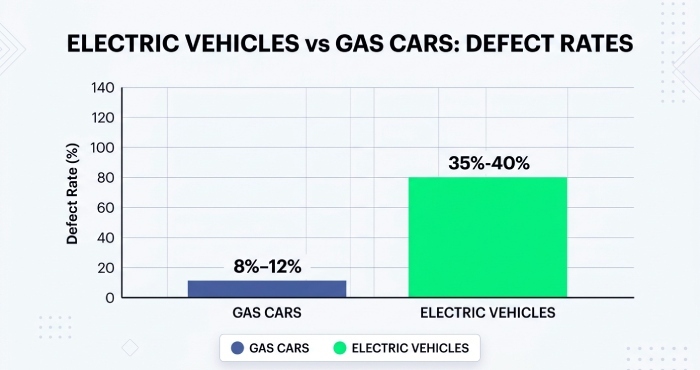
Electric vehicles were supposed to simplify things—fewer moving parts, less maintenance, less that could go wrong. The data tells a different story. According to Consumer Reports’ latest reliability survey, EVs and plug-in hybrids have about 80% more problems on average than gas-only cars (Consumer Reports 2026 reliability report). The gap has been narrowing—the prior year’s data showed 79% more problems for EVs, and the latest pure-EV data shows 42% more—but it remains substantial.
The scale of EV recalls has grown in parallel. The NHTSA’s 2024 Annual Report on Safety Recalls shows that EV-specific component recalls jumped from 12 in 2020 to 74 in 2024, covering 2.9 million vehicles. That is a sixfold increase in four years, reflecting both the rapid growth of EV sales and the growing pains of an industry still learning how to mass-produce electric powertrains reliably.
Consumer Reports’ Jake Fisher offered a useful analogy: imagine if the auto industry had been making electric cars for a century and then suddenly switched to gasoline. The gas engines would be riddled with problems because the technology would be new. That is essentially where EVs are today—legacy automakers are new to EV technology, and startup companies like Rivian and Lucid are new to making cars altogether.
Tesla: High Volume, Important Context
In 2024, Tesla led all automakers in total recalled vehicles with 5.1 million units, ahead of Ford’s 4.8 million and GM’s 3.2 million (Wirtz Law / NHTSA data). But context matters: a large share of Tesla’s recalls are resolved through over-the-air software updates rather than physical dealership visits. The NHTSA report shows Tesla leading all manufacturers in OTA-remedied recalls.
That said, Tesla owners still face legitimate lemon law issues. The Tesla Model 3 generated 67 NHTSA complaints and was the subject of 3 recalls and 3 active investigations for the 2025 model year. The Model Y logged 49 complaints with 2 recalls and 3 investigations (Wirtz Law). Reported defects include steering and suspension problems, software glitches, and battery connection failures. Interestingly, Consumer Reports now rates the Tesla Model Y as the most reliable new EV on the market (Consumer Reports), a significant turnaround that suggests Tesla’s designs have matured.
What to do: Tesla’s purchase agreements include a mandatory arbitration clause that limits your right to a jury trial. However, Tesla offers a 30-day opt-out window from the date of purchase. If you want to preserve your right to bring a Lemon Law claim in court, send a written opt-out notice via certified mail within that window. Courts generally offer more favorable outcomes for consumers than arbitration: one study found that arbitration resolves in the manufacturer’s favor roughly 70% of the time. Opting out costs nothing and gives you significantly more leverage.
Hyundai, Kia, and Genesis share a critical EV component called the integrated charging control unit (ICCU), which has been recalled across all three brands for failures that can cause a complete loss of drive power while the vehicle is in motion. In November 2024, Hyundai recalled over 145,000 Ioniq and Genesis models for this defect, covering model years 2023 through 2025.
The Hyundai Tucson topped the 2025 lemon law complaint charts with 87 NHTSA complaints and 3 recalls, driven by transmission failures, fuel pump problems, and false forward-collision avoidance warnings that could actually cause accidents rather than prevent them (Wirtz Law).
What to do: If you own a Hyundai, Kia, or Genesis EV and have experienced sudden loss of power, charging failures, or dashboard warning storms, check whether your vehicle is subject to the ICCU recall. Even if a recall fix has been applied, document any recurrence of the issue—a failed recall repair can form the basis of a strong lemon law claim because it demonstrates that the manufacturer’s own acknowledged fix did not solve the problem.
The 2025 Lemon Law Watch List: Models Generating the Most Claims
Based on NHTSA complaint data, recall frequency, and lemon law court filings compiled by Wirtz Law and Alex Cha Law, these 2025 model-year vehicles are generating the highest lemon law activity:
- Hyundai Tucson — 87 complaints, 3 recalls. Transmission failures, fuel pump defects, brake malfunctions, and phantom collision warnings.
- Tesla Model 3 — 67 complaints, 3 recalls, 3 investigations. Steering and suspension issues, software glitches, battery connection defects.
- Tesla Model Y — 49 complaints, 2 recalls, 3 investigations. Steering control problems, autopilot defects, electrical failures.
- Ford Explorer — 44 complaints, 13 recalls. Powertrain failures, engine stalling, electronic door latches, and the 1.89-million-unit A-pillar trim recall.
- Ford F-150 — 31 complaints, 10 recalls. Brake defects, engine knocking, airbag malfunctions, transmission and steering column failures.
- Jeep Wrangler — 24 complaints, 2 recalls. Engine stalling and persistent steering shimmy that dealerships cannot resolve.
What to do: If you own one of these models and are experiencing recurring problems, start a dedicated documentation file today. Keep every repair order, photograph warning lights and defect symptoms, and note dates and odometer readings. Under California’s Lemon Law, the quality of your documentation is often the single biggest factor separating successful claims from unsuccessful ones. Vague or missing records can sink an otherwise strong case.
The Recall Completion Gap: 31% of Recalled Vehicles Never Get Fixed
Even when a manufacturer acknowledges a defect and issues a recall, the problem frequently goes unresolved. According to the NHTSA’s 2024 Annual Recalls Report, the average vehicle recall completion rate was approximately 69% across 2020–2023. That means roughly 31% of recalled vehicles—millions of cars on California roads—have known safety defects that have never been repaired.
The report also shows that nearly 80% of vehicle recalls have a final remedy available within 60 days. But a meaningful subset take far longer. Among manufacturers filing at least 75 recalls between 2020 and 2024, the average time between recall filing and remedy notification ranged from 98 days (Mercedes-Benz) to 291 days (Nissan). Ford averaged 139 days, and FCA/Stellantis averaged 179 days.
What to do: Check your vehicle’s recall status by entering your VIN at NHTSA.gov/recalls. If a recall exists but no remedy is available, keep records of the recall notice date and all subsequent communications. A manufacturer’s extended failure to provide a recall fix can strengthen a lemon law claim and may also support a complaint to NHTSA. Download the free SaferCar app to receive automatic alerts when new recalls are issued for your vehicle.
Should You Use California’s Free Arbitration Program?
California offers a state-certified arbitration program through the Department of Consumer Affairs’ Arbitration Certification Program (ACP). It is free to consumers, typically resolves within 40 days, and does not require an attorney. But the data suggests that satisfaction with the process is mixed at best.
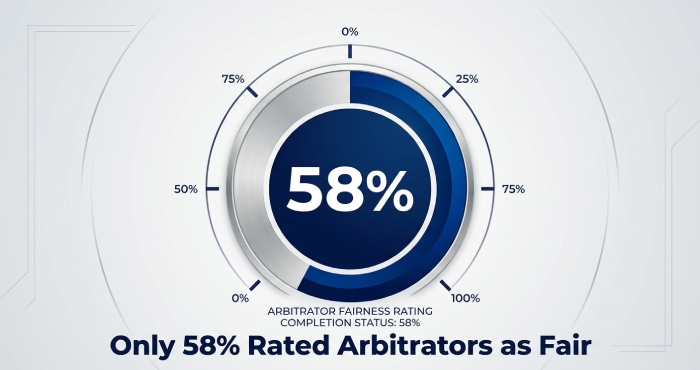
The 2024 ACP Consumer Satisfaction Survey, published in April 2025, contacted 944 consumers who used the arbitration process in 2024. Of those who responded, 51% rated their satisfaction as “poor” or “very poor,” while 48% rated it as “excellent,” “good,” or “satisfactory.” Only 58% rated the arbitrator’s fairness and neutrality favorably.
These numbers tell you that arbitration can work, but roughly half of consumers who use it walk away dissatisfied. The program has structural limitations: the arbitrator may have limited legal or automotive expertise, the manufacturer’s representative is typically experienced in dealing with these cases, and an unfavorable arbitration decision can be used against you in any future court proceeding.
What to do: Arbitration is voluntary in California—it is not a prerequisite for filing a lemon law lawsuit. If your case involves a clear pattern of failed repairs for a serious defect, consider consulting a California Lemon Law attorney before entering arbitration. Attorneys who specialize in lemon law cases typically work on contingency, meaning you pay nothing unless you win, and the manufacturer pays your legal fees if you prevail under the Song-Beverly Act. For straightforward cases with strong documentation, arbitration can be a fast resolution. For complex cases or those involving safety defects, litigation may yield a significantly better outcome.
The Shifting Legal Landscape: AB 1755, SB 26, and the Rodriguez Ruling
The California Lemon Law went through seismic changes in 2024 and 2025 that every car buyer and current vehicle owner needs to understand.
AB 1755: Tighter Timelines, New Requirements
Signed by Governor Newsom in September 2024, AB 1755 introduced a six-year statute of limitations from the date of vehicle delivery, required pre-suit written notice to the manufacturer, and mandated early discovery and mediation timelines for cases that reach court. Consumer advocates warned that these changes benefit manufacturers more than consumers (CalMatters), particularly the six-year cap, which could effectively cut off claims on vehicles with longer warranties, such as EV battery warranties that often extend to 8 or 10 years.
SB 26: The Opt-In Compromise
In response to backlash, SB 26 was signed in April 2025. It allows manufacturers to opt into the AB 1755 procedures or remain under the pre-existing lemon law rules. This creates a two-track system where the rules governing your claim depend on which manufacturer built your vehicle. Check the California DCA’s published list to determine which framework applies.

Rodriguez v. FCA: Used Car Protections Gutted
In October 2024, the California Supreme Court ruled in Rodriguez v. FCA US, LLC that used vehicles with remaining manufacturer warranties do not qualify as “new motor vehicles” under the Song-Beverly Act unless a new warranty was issued at the time of sale, as with certified pre-owned (CPO) vehicles. This ruling stripped lemon law protections from the vast majority of used car buyers. In 2024, only 10% of used car lemon law cases involved CPO vehicles (CA Lemon Law Guys / CA DMV data), highlighting how dramatically the ruling narrowed the scope of coverage.
What to do: If you are buying a used vehicle in California, insist on CPO certification with a new manufacturer warranty issued at the time of sale. This is now the only reliable path to full lemon law protection for used car buyers. Retain all CPO certification documents and warranty terms—they are critical if you need to file a claim. For non-CPO used vehicles, your remedies are limited to breach-of-warranty claims under the federal Magnuson-Moss Act or implied warranty claims under the California Uniform Commercial Code, both of which offer weaker remedies than the Song-Beverly Act.
Your Practical Action Plan
Whether you are shopping for a new vehicle or already dealing with a defective one, here is a consolidated set of steps drawn from the data and analysis above:
Before You Buy
- Check the specific model and year’s recall history at gov/recalls.
- Review Consumer Reports’ brand and model reliability ratings. Brands scoring below 40 out of 100 have substantially elevated defect risk.
- Be especially cautious with first-model-year vehicles and newly redesigned models. Consumer Reports data consistently shows these have the most reliability problems.
- If buying a used vehicle, insist on CPO certification with a new manufacturer warranty to preserve lemon law eligibility after the Rodriguez v. FCA
- For Tesla purchases, send a written arbitration opt-out notice via certified mail within 30 days of purchase.
If You Suspect You Have a Lemon
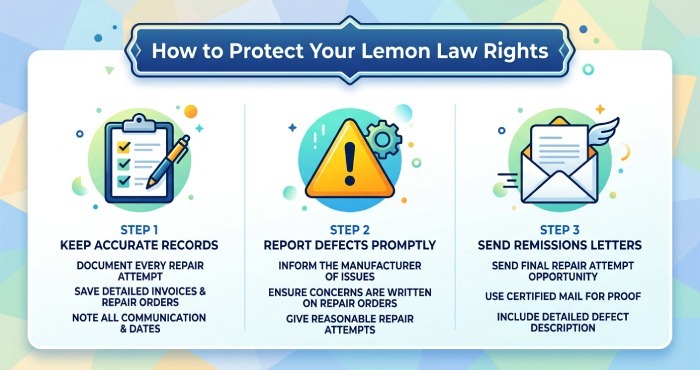
- Create a dedicated documentation folder. Keep every repair order, communication, photo, and video of defect symptoms.
- Insist on detailed written repair orders at every service visit. Require the dealership to describe the specific symptoms, diagnostic codes, and repairs in writing.
- Track cumulative days out of service. If your vehicle has been in the shop for 30 or more total days for warranty repairs, it likely qualifies as a lemon.
- Count your repair attempts. Two or more for the same safety defect, or four or more for any warranty defect, typically meets the threshold.
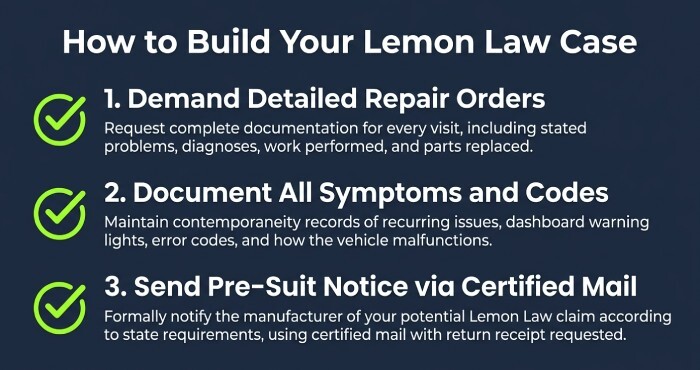
- Send a formal written demand to the manufacturer via certified mail before filing a lawsuit. Under the new AB 1755 rules, this pre-suit notice is mandatory for many manufacturers.
- Consult a lemon law attorney. Under the Song-Beverly Act, the manufacturer pays your attorney’s fees if you win, so most lemon law attorneys work on contingency at no cost to you.
Ongoing Vigilance
- Download the NHTSA SaferCar app to receive automatic recall alerts for your vehicle.
- Check the California DCA arbitration page to understand whether your manufacturer has opted into the AB 1755 process.
- Monitor legislative updates. Consumer advocates are pushing for further amendments to restore protections weakened by AB 1755 and the Rodriguez
The Bottom Line
The numbers in this analysis are not abstractions. They represent real people stuck with vehicles that stall on freeways, that lock up their rear wheels while towing, that flash warning lights every time the engine starts. They represent families who depended on a vehicle that the manufacturer cannot or will not fix.
The data tells us that General Motors, Ford, Stellantis, and Nissan are responsible for an outsized share of this problem. It tells us that electric vehicles, while improving, still carry elevated defect risk. It tells us that even when manufacturers issue recalls, nearly a third of affected vehicles never get repaired. And it tells us that the legal landscape for consumer protection in California is shifting in ways that make it harder—not easier—for buyers to get recourse.
But the data also tells us what to do about it. Research before you buy. Document everything if something goes wrong. Understand the new procedural requirements. And know your rights. California’s Lemon Law, even in its current, contested form, remains one of the most powerful consumer protection tools in the country. The question is whether you’re prepared to use it.
Sources and References
All sources listed below are cited inline throughout this article. URLs are provided as clickable hyperlinks and in plain text for portability.
Government and Legislative Sources
[1] California Assembly Judiciary Committee. AB 1755 Legislative Analysis, August 2024. https://ajud.assembly.ca.gov/system/files/2024-08/ab-1755-analysis.pdf
[2] NHTSA. 2024 Annual Report on Safety Recalls, Published April 2025. https://www.nhtsa.gov/sites/nhtsa.gov/files/2025-04/2024-annual-recalls-report.pdf
[3] California Department of Consumer Affairs. 2024 ACP Consumer Satisfaction Survey Results, April 2025. https://www.dca.ca.gov/acp/pdf_files/survey2024.pdf
[4] California DCA Arbitration Certification Program. New Lemon Law Procedures (AB 1755 / SB 26). https://www.dca.ca.gov/acp/new_lemon_law.shtml
[5] NHTSA. Recall Lookup Tool. https://www.nhtsa.gov/recalls
[6] Governor Newsom. AB 1755 Signing Message, September 2024. https://www.gov.ca.gov/wp-content/uploads/2024/09/AB-1755-SIGNING-Message.pdf
Nonprofit and Research Sources
[7] CALPIRG Education Fund / CARS Foundation / Frontier Group. The Auto Lemon Index, May 2022. https://publicinterestnetwork.org/wp-content/uploads/2022/05/Auto-Lemon-Index-CAP-CARS-FG-May22-1.pdf
[8] Consumer Reports. Who Makes the Most Reliable New Cars? (2026 Survey), December 2025. https://www.consumerreports.org/cars/car-reliability-owner-satisfaction/who-makes-the-most-reliable-cars-a7824554938/
[9] Consumer Reports. Electric Vehicles Are Less Reliable Than Conventional Cars (2026 Report), December 2025. https://www.consumerreports.org/cars/car-reliability-owner-satisfaction/electric-vehicles-are-less-reliable-than-conventional-cars-a1047214174/
Investigative Journalism
[10] CalMatters. California lemon law changes may weaken car buyer protections, February 2025. https://calmatters.org/politics/2025/02/california-car-warranty-claims-consumer-rights/
Industry and Legal Data Sources
[11] Bowman and Brooke LLP. California Lemon Law Update: Key Changes Under AB 1755. https://www.bowmanandbrooke.com/insights/lemon-law-update-ab-1755
[12] WardsAuto / Warranty Week. Warranty spend weighs on Ford’s Q3 profit, October 2024. https://www.wardsauto.com/news/archive-auto-ford-warranty-costs-impact-q3-2024/731382/
[13] LemonLawAid.com. Why California Lemon Law Claims Are Exploding, December 2025. https://www.lemonlawaid.com/california-lemon-law-crappy-cars/
[14] Brady Reilly & Cardoso, LLC. U.S. Car Recall Statistics 2025, NHTSA data study. https://brclegal.com/us-car-recall-statistics/
[15] Alex Cha Law. Lemon Law Claim Statistics in 2026, NHTSA complaint analysis. https://alexchalaw.com/2026-lemon-law-claim-statistics/
[16] CarEdge / Consumer Reports. The Least Reliable Car Brands in 2025. https://caredge.com/guides/10-least-reliable-car-brands
[17] Cline APC. California’s Lemon Law Controversy, March 2025. https://www.lemonlawlawyerscalifornia.com/2025/03/californias-lemon-law-controversy/
[18] Seven Law Group. Top 5 Most Common Lemon Law Cars and the Manufacturers Behind Them. https://sevenlaw.com/blog/top-5-most-common-lemon-law-cars-the-manufacturers-behind-them/
[19] The Lemon Law Experts. The California Lemon Law Got Squeezed This Year, July 2025. https://lemonlawexperts.com/california-lemon-law-got-squeezed-this-year/
[20] Wirtz Law. Tesla Recall Surge in 2024 Raises Questions About Lemon Law Protections. https://www.wirtzlaw.com/tesla-recall-surge-in-2024-raises-questions-about-lemon-law-protections-in-california/
[21] Wirtz Law. The Top 7 Vehicles That Appeared in 2025 Lemon Law Claims, December 2025. https://www.wirtzlaw.com/the-top-7-vehicles-that-appeared-in-2025-lemon-law-claims/
[22] Wirtz Law. 2025 Lemon List: Top 12 EVs and Hybrids That Aren’t Worth the Hype. https://www.wirtzlaw.com/2025-lemon-list-top-12-evs-and-hybrids-that-arent-worth-the-hype/
[23] CA Lemon Law Guys. California Lemon Law Filings Surge: Impacts on New Vehicle Buyers, January 2026. https://calemonlawguys.com/california-lemon-law-filings-surge-impacts-on-new-vehicle-buyers-2/
[24] CA Lemon Law Guys. California Used Car Lemon Law 2025: Rodriguez v. FCA Ruling. https://calemonlawguys.com/california-used-car-lemon-law-2025-what-the-supreme-court-ruling-means-for-your-rights/
[25] West Coast Trial Lawyers. Why Are Lemon Law Cases Increasing in California?, September 2025. https://westcoasttriallawyers.com/why-are-lemon-law-cases-increasing-in-california