
California EV owners should view long repair delays as more than an inconvenience. Under the California Lemon Law, extended delays involving battery, charging, software, or other defects may help show an unresolved warranty problem that substantially affects the vehicle’s use, value, or safety.
Keep repair orders, invoices, service records, emails, texts, and dealer communications. A lemon law lawyer can review the repair history, downtime, and repeated complaints to determine whether a buyback, replacement, or refund may be available.
Repair Delay #1: Waiting Weeks for EV Battery Diagnostics or Capacity Testing
Battery diagnostics are often the first major delay in an EV case. A dealership may need specialized equipment, trained technicians, or manufacturer authorization before confirming battery failure, battery degradation, an electrical system fault, or a thermal-management problem. If your car sits in the service bay for weeks waiting for capacity testing, that delay should become part of your repair history.
Why battery testing delays matter
A high-voltage battery problem can create recurring warning lights, reduced range, loss of power, or a serious drivability issue. These symptoms may indicate a substantial defect under the California Lemon Law if the problem continues during the warranty period and affects the vehicle’s use, value, or safety.
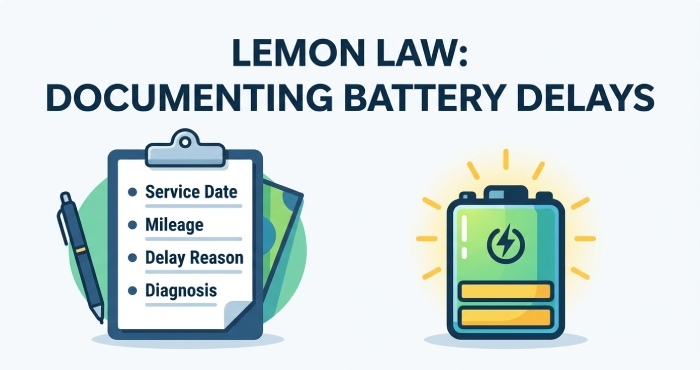
For documentation for Lemon Law, note:
- The date the EV entered the service bay
- The mileage at drop-off
- The stated reason for delay
- Whether the manufacturer required extra testing
- Any diagnosis of battery failure or capacity loss
- Whether warranty coverage was approved or denied
A qualified Lemon Law attorney can use this technical evidence to evaluate whether the delay supports an EV Lemon Law claim.
Repair Delay #2: Backordered High-Voltage Battery Packs, Modules, or Cooling Components
What to document when parts are delayed
If the dealership says a battery pack, module, or cooling component is on backorder, ask for that statement in writing. A lemon law lawyer will want to see whether the vehicle remained out of service due to a defect covered by warranty coverage. This is especially important where battery failure creates safety concerns or prevents normal driving.
Backordered parts can affect Lemon Law eligibility
The Song-Beverly Act covers eligible cars, trucks, SUVs, vans, and certain used vehicles with remaining warranty coverage. California consumers may have rights when an electric vehicle cannot be repaired after a reasonable number of attempts or repair delays become excessive, but applicable deadlines may also apply, making early review by an electric car attorney important.
Repair Delay #3: Software Updates, Calibration Failures, or Over-the-Air Fixes That Do Not Resolve the Defect
EVs depend heavily on software, and defects can affect battery management, charging, braking, regenerative systems, driver assistance, infotainment, or power delivery, while an unsuccessful over-the-air update may not fully resolve the issue.
When software fixes become repeated repair attempts
A pattern of updates, recalibrations, module resets, or failed programming attempts may show repeated repair attempts. If the same software defect returns, document every visit, update, and manufacturer instruction. Keep screenshots of alerts, app notifications, and dashboard messages.
Preserve digital proof of software failures
Save photos, videos, app logs, and service notes. This technical evidence can help a lemon law lawyer or electric car attorney connect the software defect to the vehicle’s broader repair history and evaluate whether the electric vehicle Lemon Law applies.
Repair Delay #4: Charging System Repairs Delayed by Parts, Technician Availability, or Repeated Testing
Charging problems can make an EV difficult or impossible to use and may involve the charger, port, high-voltage system, or charging communication. Repeated testing and delays may occur due to parts, technician availability, or manufacturer instructions.
Document:
- Failed charging sessions
- Charging error messages
- Dealer testing dates
- The manufacturer response
- Any replaced charge port, cable, module, or onboard charger
- Continued charging malfunction after repair
A California EV owner should not rely only on verbal explanations. Ask for complete service records and repair orders after every visit. If you are comparing legal options, a california lemon law lawyer can assess whether the charging malfunction, downtime, and warranty coverage support the claim process.
Repair Delay #5: Drive Unit, Inverter, or Power Electronics Repairs That Keep the Vehicle Out of Service
Drive units, inverters, converters, and other power electronics are essential to EV operation. Failures can cause no-start conditions, reduced propulsion, warning lights, overheating, vibration, or sudden power loss.
If your EV requires repeated inverter testing, drive unit replacement, or high-voltage fault diagnosis, keep all repair records. Under the California Lemon Law, both repeated repair attempts and time spent out of service may be relevant.
Manufacturers may point to complex EV diagnostics as a reason for delays. However, the Song-Beverly Consumer Warranty Act focuses on whether the defect was repaired within a reasonable opportunity, which may support a buyback or other available remedy.
For owners in Southern California, consulting a lemon law attorney san diego may help clarify whether repeated drive-unit failures, power electronics faults, or ongoing EV defects support a claim.
Repair Delay #6: Safety-Related EV Issues Delayed by Manufacturer Approval or Escalation
EV repairs may be delayed when dealerships need manufacturer approval or engineering review for serious issues. Keep written records of all delays, including messages about engineering assistance, technical support, or replacement-part approval.
A safety-related defect may involve:
- Battery failure with overheating warnings
- A high-voltage electrical system fault
- Repeated propulsion shutdowns
- Braking or steering warnings
- A persistent software defect affecting vehicle control
- A severe drivability issue that returns after repair
Repair Delay #7: Repeated Dealer Visits for the Same EV Defect That a California Lemon Law Lawyer Can Review
Repeated dealer visits for the same EV problem may show that the manufacturer has not repaired the defect after reasonable opportunities.
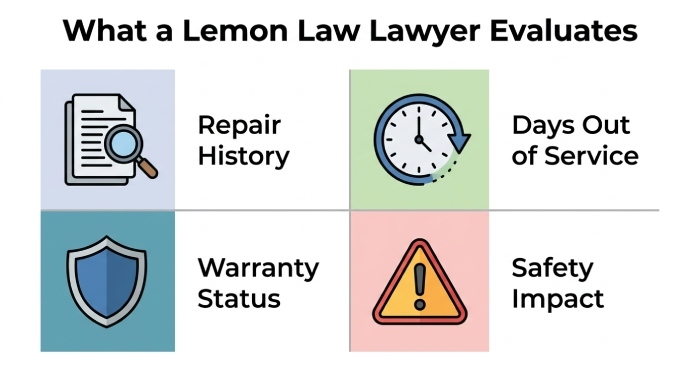
A lemon law lawyer will typically examine:
- The complete repair history
- Number of repeated repair attempts
- Total days out of service
- Whether the defect is covered by warranty coverage
- Whether the problem continues after repair
- Whether the defect affects use, value, or safety
- The manufacturer’s response to the claim
The same documentation principles may apply to other covered vehicles, and owners of motor homes or recreational vehicles may consult an rv lemon law attorney when repeated warranty defects arise.
Before a case evaluation, collect repair orders, invoices, messages, emails, photos, videos, app screenshots, and California DMV registration records. An experienced Lemon Law attorney can review these documents and determine whether the California Lemon Law may provide a refund, replacement, or another remedy for a defective EV.