
On September 29, 2024, Governor Gavin Newsom signed AB 1755 into law. It was the most significant overhaul of California’s lemon law in decades—a bill that its authors said would “improve current procedures so consumers can get their car replaced or refunded faster” (AB 1755 Author Fact Sheet) and its critics said would “drastically weaken protections for California lemon owners” (CARS Foundation, via SB 26 Senate Judiciary Analysis).
One year later, the data is beginning to tell us which side was right. And the answer is more complicated than either side predicted.
AB 1755 did not reduce the total number of lemon law claims. Filings continued to rise, from approximately 22,000 in 2023 to over 22,000 in 2024 (EIN Presswire / Advocate Magazine review). The law did not take full effect until January 1, 2025 (with some provisions effective April 1, 2025), so the true impact on filing volume will not be measurable until late 2025 or early 2026 court data becomes available.
But what the law has already done—measurably, documentably, and in its own government records—is create a two-track legal system that no one fully anticipated, split the auto industry into opposing camps, prompt a follow-up bill within seven months of the original’s signing, and generate opposition from consumer groups, foreign automakers, and consumer attorneys who were excluded from the negotiating table.
This article traces the full arc: what AB 1755 promised, what it actually delivered, who won, who lost, and what happens next.
What Problem Was AB 1755 Trying to Solve?
The AB 1755 Assembly Judiciary Committee analysis—the most comprehensive government PDF documenting the bill’s rationale—lays out the crisis that prompted the legislation:
Between 2022 and 2023, the number of lemon law case filings in California courts nearly doubled from 14,892 filings in 2022 to 22,655 filings in 2023. In Los Angeles County, post-pandemic lemon law filings represented nearly 10% of all new civil filings in the superior court.
The California Judges Association reported that the lemon law caseload was creating backlogs across the entire civil justice system. The legislative analysis identifies a specific culprit: discovery disputes. “At their core, lemon law disputes are largely paperwork driven cases,” the analysis states. “Prior to the adoption of the AB 1755 procedures, parties squabbled over what maintenance records must be disclosed, what warranty documents must be provided to opposing parties, and how depositions could be conducted. Every time one of these disputes arose, the court was forced to calendar a motion hearing” (SB 26 Assembly Floor Analysis).
The filing trendline tells the story concisely:
| Year | CA Lemon Law Filings | YoY Change | Source |
| 2015 | ~4,500 | – | Advocate Magazine PDF |
| 2022 | 14,892 | – | AB 1755 Analysis PDF |
| 2023 | 22,655 | +52% | AB 1755 Analysis PDF |
| 2024 | ~22,000+ | Stable/growing | EIN Presswire / Advocate |
Sources: AB 1755 Assembly Judiciary Analysis (PDF), Advocate Magazine Feb 2025 (PDF), EIN Presswire court data review.
The key question for policymakers was: are these 22,000+ filings all legitimate consumer claims—or are some of them attorney-driven cases filed to generate fees rather than remedy actual defects? The bill’s supporters argued the latter. Its opponents argued the former. The truth is almost certainly somewhere in between, but the legislative process did not wait for data to find out.
What AB 1755 Actually Changed: The Seven Key Provisions
Drawing from the AB 1755 bill text, the Assembly Judiciary analysis, and the Advocate Magazine practitioner guide, here are the seven changes that matter:
1. Six-Year Statute of Limitations
AB 1755 imposed an absolute six-year statute of limitations from the date of vehicle delivery. Previously, California used a four-year-from-discovery standard, meaning the clock started when the consumer discovered (or should have discovered) the defect. The new cap is measured from delivery, regardless of when the defect appears. The legislative analysis acknowledges that this “effectively nullifies 10-year emission warranties and 8 to 10-year electric vehicle battery warranties after just 6 years” for claims brought under the lemon law.
2. Mandatory Pre-Suit Written Notice
Before filing a lawsuit seeking civil penalties, consumers must now send a written notice to the manufacturer at least 30 days before filing, laying out the problems, repair history, and demanding a buyback or replacement. This provision does not apply if the consumer is only seeking restitution or replacement without civil penalties—in that case, the consumer may proceed directly to court. This distinction is critical and widely misunderstood.
3. Expedited Discovery Timelines
Both parties must disclose specified documents—maintenance records, warranties, repair orders—within 60 days of the defendant’s answer. This was designed to eliminate the discovery disputes that were clogging courts. Early depositions are mandated on an expedited schedule.

4. Standardized Release Template
For the first time, the law created a mandatory standardized settlement release. No remedy may be contingent on the consumer signing any release other than this template (RVIA Fact Sheet PDF). The template requires restitution checks at vehicle return and releases take effect at return, not at signing.
5. $50/Day Penalty for Delayed Settlements
Manufacturers must complete a buyback within 30 days of receiving the signed release. Failure triggers a mandatory $50/day penalty. The legislative analysis notes this may need to be adjusted if $50 proves insufficient as a deterrent.
6. Negative Equity and Restitution Formulas
The bill codified how to handle negative equity (when a consumer owes more on a trade-in than it’s worth) and established clear formulas for calculating restitution, including which dealer additions count toward the purchase price. The Advocate Magazine analysis notes this resolved a major source of settlement disputes.
7. Pre-Litigation Attorney Fees
Consumer attorneys can now recover fees for pre-litigation work, including the 30-day notice period. The legislative analysis notes this “mirrors existing civil litigation practice” and ensures attorneys are compensated even when a manufacturer resolves the claim before a lawsuit is filed.
The Backlash: Why the Governor Had to Sign a Follow-Up Bill Seven Months Later
AB 1755 was jointly sponsored by General Motors and the Consumer Attorneys of California (AB 1755 Concurrence Analysis). It was opposed by a coalition of foreign automakers including Toyota, Honda, Volkswagen, Subaru, Rivian, Kia, and Lucid—and by consumer safety organizations including the CARS Foundation.
This created an unusual political dynamic: the domestic automaker with the worst lemon law record (GM was sued 26x more often than Toyota per the CALPIRG Auto Lemon Index) co-sponsored the reform, while the automaker with the best lemon law record (Toyota) opposed it. Consumer attorneys supported the bill because it included pre-litigation fee recovery and the $50/day penalty. Consumer safety advocates opposed it because of the six-year statute of limitations and the pre-suit notice requirement.
Governor Newsom signed the bill but issued a remarkable signing message—a government PDF in which he essentially acknowledged that the law he just signed needed to be fixed:
While AB 1755 aims to speed resolution of Lemon Law claims and reduce litigation, many automakers, including smaller electric-vehicle automakers, have expressed serious concerns that some of the specific procedures prescribed in AB 1755 are unworkable for them. In light of those concerns, the authors have agreed to introduce a bill early in the 2025-2026 legislative session that would amend the statute enacted by this bill to make its new procedures subject to election by a given automaker.
That follow-up bill was SB 26, signed in April 2025—just seven months after AB 1755. The SB 26 Senate Judiciary analysis explains the compromise: manufacturers make an irrevocable five-year election to operate under the AB 1755 procedures or remain under pre-existing lemon law rules. This created the two-track system that governs California lemon law today.
An experienced RV lemon law attorney can help you pursue a refund, replacement, or compensation for a defective recreational vehicle.
Who Opted In, Who Stayed Out
The SB 26 analyses document which manufacturers opted in. The coalition that opposed AB 1755 but supports SB 26’s opt-in structure includes:
- Opted into AB 1755: American Honda, Kia America, Lucid USA, North American Subaru, Rivian Automotive, Scout Motors, Tesla Motors, Toyota Motor North America, Volkswagen Group of America
- Original co-sponsor (pre-existing alignment): General Motors
The irony is stark. The foreign automakers that opposed AB 1755 are now the ones opting into it, because SB 26 made the procedures voluntary. GM, which co-sponsored the original bill, was already aligned. The two-track system means that the rules governing your lemon law claim now depend entirely on which manufacturer built your car.
A skilled California lemon law lawyer can help evaluate your lemon law claim and pursue the compensation, refund, or vehicle replacement you may be entitled to under state law.
The Consumer Advocacy Critique: “Drastically Weakened Protections”
The Consumers for Auto Reliability and Safety (CARS) Foundation, one of the most prominent consumer safety organizations in California, opposed both AB 1755 and SB 26. Their position, documented in the SB 26 Senate Judiciary analysis, is unequivocal:
Unfortunately, this bill fails to address any of the concerns raised by consumer organizations throughout California and across the nation that opposed AB 1755 because it drastically weakened protections for California lemon owners.
CARS raised specific concerns about AB 1755’s impact:
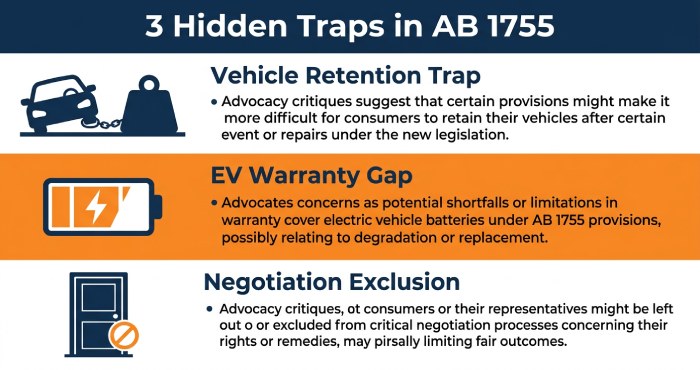
- The vehicle retention trap: Under AB 1755, consumers must send written notice to the manufacturer before they can sell or trade in a defective vehicle. CARS warns this forces consumers to keep driving—and making payments on—a car they know is defective, because selling it could jeopardize their lemon law claim.
- The EV warranty gap: The six-year statute of limitations effectively creates a two-year gap for consumers with 8-year EV battery warranties, as documented in the legislative analysis.
- The negotiation exclusion: AB 1755 was negotiated between GM and the Consumer Attorneys of California without meaningful participation from consumer safety organizations or the foreign automakers that would be bound by it. CARS and the opposing manufacturer coalition were “not at the negotiating table.”
The SB 26 analysis also cites case law that supports the consumer advocates’ position. In Niedermeier v. FCA (2024), the California Supreme Court held that “allowing a reduction to the statutory restitution remedy in actions pursuant to section 1794 would reward manufacturers for delaying refunds.” In Figueroa v. FCA US, LLC (2022), the Court of Appeal admonished manufacturers for “forcing consumers to trade in or sell defective vehicles rather than timely repurchasing them.” These decisions suggest that AB 1755’s vehicle retention requirements may conflict with existing judicial precedent.
The Practitioner’s View: What Has Actually Changed in the Courtroom
The Advocate Magazine analysis—a legal publication PDF written by Michelle Fonseca-Kamana of West Coast Lemons APC—provides the closest thing to a boots-on-the-ground assessment of AB 1755’s first months in practice:
On the positive side, the practitioner identifies several consumer-friendly provisions that AB 1755 introduced for the first time:
- The standardized release template prevents manufacturers from inserting non-disparagement, non-disclosure, or additional waiver clauses into settlement agreements.
- The requirement that restitution checks be ready at vehicle return eliminates a common manufacturer delay tactic.
- The release takes effect at vehicle return, not at signing, protecting consumers who might be injured by the defective vehicle during the processing period.
- Pre-litigation attorney fees ensure lawyers are compensated for the mandatory 30-day notice period, preventing manufacturers from settling during that window to avoid paying fees.
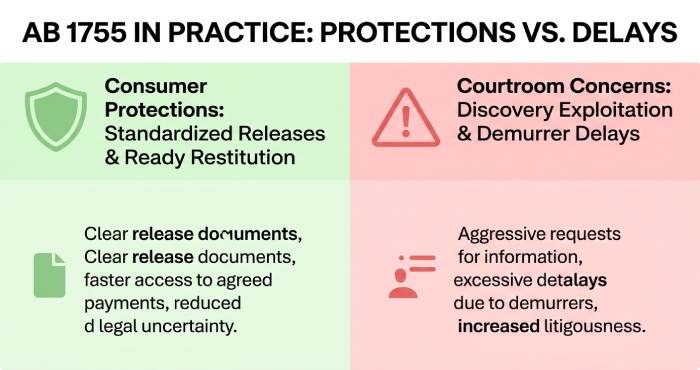
On the concerning side, the practitioner warns that the 60-day expedited discovery timeline may itself become a source of disputes, as manufacturers file demurrers and motions to strike “simply for the purpose of delay.” The legislative analysis itself anticipated this concern, quoting Strategic Legal Practices: the new discovery rules are “ripe for exploitation by manufacturers, who will be filing demurrers, motions to strike, etc., simply for the purpose of delay.”
The practitioner also cautions that “although the reforms in AB 1755 passed and most of them took effect January 1, 2025, or will take effect April 1, 2025, practitioners should still exercise caution as the reforms came with a caveat from Governor Gavin Newsom”—referring to the signing message’s commitment to the SB 26 follow-up.
The Arbitration Baseline: What the Government Data Shows
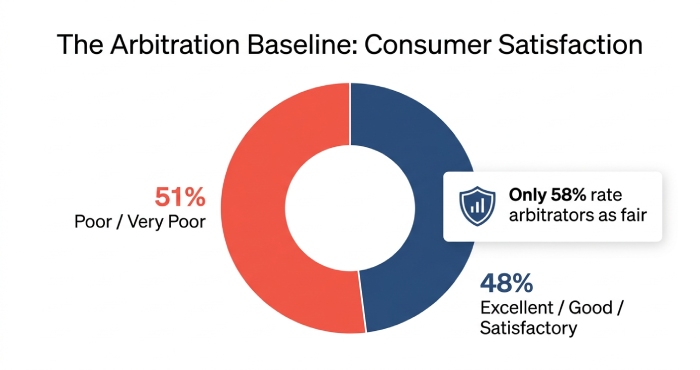
The California DCA’s 2024 ACP Consumer Satisfaction Survey provides the only government-collected data on how consumers experience the lemon law dispute resolution process. Of 944 consumers contacted who participated in arbitration in 2024:
- 51% rated overall satisfaction as “poor” or “very poor”
- 48% rated it “excellent,” “good,” or “satisfactory”
- Only 58% rated the arbitrator’s fairness and neutrality favorably
The 2023 survey showed that of 1,368 consumers contacted, 73% used BBB AUTO LINE, 26% used the California Dispute Settlement Program, and less than 1% used CAP-Motors. The response rate was just 9.3%, meaning these satisfaction scores reflect a small—and potentially skewed—sample.
This data is the baseline against which AB 1755’s impact should be measured. If the new procedures are working as intended, future surveys should show higher satisfaction rates, faster resolution times, and fewer consumers escalating from arbitration to litigation. If they are not working, the data will show the opposite. The 2025 and 2026 surveys will be the first to reflect the full impact of the new law.
The Scorecard: What AB 1755 Promised vs. What It Delivered
Promise: Reduce Frivolous Filings
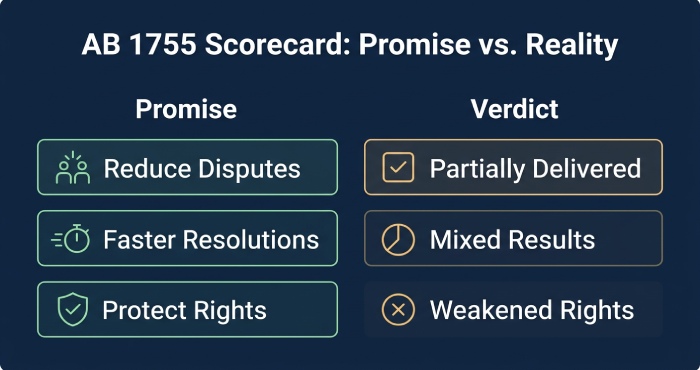
Verdict: Too early to tell. Filings did not decline in 2024, but the law did not take full effect until January 2025. The true test will be 2025–2026 court data. The pre-suit notice requirement may filter out weaker claims, but it may also delay legitimate ones.
Promise: Reduce Discovery Disputes
Verdict: Partially delivered. The 60-day mandatory disclosure timeline eliminates many routine discovery fights. But practitioners warn that manufacturers may use procedural motions to delay compliance with the new timelines, creating a new category of disputes.
Promise: Faster Consumer Resolutions
Verdict: Mixed. The standardized release, $50/day penalty, and restitution-check-at-return provisions are genuine consumer wins that did not exist before. But the 30-day pre-suit notice adds 30–60 days to the timeline before a consumer can file suit, and the legislative analysis acknowledges that consumers “must retain that vehicle for 30 to 60 days longer than they are required to do under existing law.”
Promise: Protect Consumer Rights
Verdict: Weakened in specific areas. The six-year statute of limitations objectively narrows the window for EV battery claims. The vehicle retention requirement constrains consumers’ ability to mitigate their damages by trading in or selling a defective vehicle. These are not minor procedural adjustments—they are substantive reductions in consumer rights that the legislative analysis itself acknowledges.
Unintended Consequence: The Two-Track System
Verdict: Created confusion. SB 26’s manufacturer opt-in system means consumers must now determine which set of rules applies to their vehicle before taking any legal action. A consumer with a Ford may operate under different procedures than a consumer with a Toyota, even in the same courthouse, for the same type of defect. This complexity was not part of the original design and increases the informational burden on consumers.
What Happens Next
These are the developments to monitor over the next 12–24 months:
- 2025–2026 court filing data: The definitive measure of whether AB 1755 reduced total filings, reduced frivolous filings specifically, or simply delayed legitimate claims.
- DCA 2025 and 2026 ACP surveys: Will consumer satisfaction with arbitration improve under the new procedures? The 51% “poor” baseline is the number to beat.
- Manufacturer opt-in patterns: Will more manufacturers opt into AB 1755 over the next five years, or will the two-track system shrink as manufacturers choose to stay under the pre-existing rules?
- EV battery claim outcomes in years 5–6: As the first wave of mass-market EVs (2019–2020 model years) approaches the six-year statute of limitations window, will a gap in coverage become visible?
- Further legislative amendments: Consumer groups are pushing for amendments to restore protections weakened by AB 1755. Watch for bills in the 2026–2027 session that address the EV warranty gap and the vehicle retention requirement.
- Judicial interpretation: Courts will begin interpreting AB 1755’s provisions in contested cases. Key questions include whether the 60-day discovery timeline is enforceable, whether OTA updates count as repair attempts, and how the six-year cap interacts with CARB’s eight-year battery warranty mandate.
The Bottom Line
AB 1755 is neither the consumer-friendly reform its sponsors promised nor the consumer-silencing disaster its critics feared. It is a messy, hastily negotiated compromise that introduced genuine improvements (the standardized release template, the $50/day penalty, pre-litigation fee recovery) alongside genuine setbacks (the six-year statute of limitations, the vehicle retention requirement, the pre-suit notice delay).
The most telling fact about AB 1755 is that the Governor who signed it immediately committed to amending it. A signing message that says “the authors have agreed to introduce a bill early in the 2025-2026 legislative session that would amend the statute” is not the language of confidence in a well-crafted law. It is the language of political expedience—a deal struck between powerful interests that left important stakeholders at the table and left critical questions unresolved.
The 22,000+ consumers who file lemon law claims in California each year—real people facing genuine vehicle defects—are increasingly relying on a lemon law attorney San Diego residents trust to navigate a system that has become more complex, more procedurally demanding, and more dependent on the manufacturer involved than it was just a year ago. Some of those consumers will benefit from the new settlement protections. Others will be harmed by the shortened statute of limitations or the vehicle retention requirement. All of them will need better information about which set of rules applies to their claim.
This article is a start. The data that will tell the full story is still being generated—in courtrooms, in arbitration hearings, and in the DCA surveys that will measure whether the system is actually working. We will update this analysis as that data becomes available.
Sources and References
All sources are downloadable PDFs from government agencies, legal publications, or institutional sources. Every URL links directly to the source document.
California Legislative PDFs
[1] CA Assembly Judiciary Committee. AB 1755 Legislative Analysis, August 30, 2024. https://ajud.assembly.ca.gov/system/files/2024-08/ab-1755-analysis.pdf
[2] CA Senate Judiciary Committee. AB 1755 Bill Text (Kalra and Umberg), August 26, 2024. https://sjud.senate.ca.gov/system/files/2024-08/ab-1755-kalra-aug-26-bill-text.pdf
[3] CA Assembly Judiciary Committee. AB 1755 Concurrence in Senate Amendments Analysis. https://billtexts.s3.amazonaws.com/ca/ca-analysishttps-leginfo-legislature-ca-gov-faces-billAnalysisClient-xhtml-bill-id-202320240AB1755-ca-analysis-381590.pdf
[4] Assemblymember Kalra’s Office. AB 1755 Author Fact Sheet, August 20, 2024. https://kalra.asmdc.org/sites/a25.asmdc.org/files/2024-08/AB%201755%20(Kalra%20and%20Umberg)_Lemon%20Law_%20Fact%20Sheet_8-20-24.pdf
[5] Governor Gavin Newsom. AB 1755 Signing Message, September 29, 2024. https://www.gov.ca.gov/wp-content/uploads/2024/09/AB-1755-SIGNING-Message.pdf
[6] CA Senate Judiciary Committee. SB 26 Analysis, February 11, 2025. https://trackbill.com/s3/bills/CA/2025/SB/26/analyses/senate-judiciary.pdf
[7] CA Assembly Floor. SB 26 Third Reading Analysis. https://trackbill.com/s3/bills/CA/2025/SB/26/analyses/assembly-floor-analysis.pdf
Government Consumer Data PDFs
[8] CA DCA. 2024 ACP Consumer Satisfaction Survey Results. https://www.dca.ca.gov/acp/pdf_files/survey2024.pdf
[9] CA DCA. 2023 ACP Consumer Satisfaction Survey Results. https://www.dca.ca.gov/acp/pdf_files/survey2023.pdf
[10] CA DCA. Lemon Law Q&A Brochure, Revised September 2024. https://www.dca.ca.gov/acp/pdf_files/lemonlaw_qa.pdf
Legal Publication and Industry PDFs
[11] Advocate Magazine (Michelle Fonseca-Kamana). When Life Gives You Lemon…Law Reform, February 2025. https://www.advocatemagazine.com/images/issues/2025/02-february/reprints/Fonseca-Kamana-Feb25-article-Advocate-magazine.pdf
[12] RVIA (RV Industry Association). AB 1755 Fact Sheet, 2024. https://www.rvia.org/system/files/media/file/California%20AB%201755%20Fact%20Sheet_Final_1.pdf
Filing Data
[13] EIN Presswire / Advocate Magazine Review. California’s Lemon Law Filings Surge as New Data Shows Significant Growth. https://www.einpresswire.com/article-pdf/874955218/california-s-lemon-law-filings-surge-as-new-data-shows-significant-growth-in-consumer-defect-claims
Disclaimer: This article is provided for informational purposes only and does not constitute legal advice. AB 1755 and SB 26 created a complex two-track system. The rules governing your specific lemon law claim depend on which manufacturer built your vehicle and when the vehicle was delivered. Consult a qualified California lemon law attorney for guidance specific to your situation.