
If your car meets the criteria for a lemon, you might be curious about the possibility of reclaiming the money spent on loan payments under California’s Lemon Law buyback. Many people are taken aback to find out that a favorable claim can lead to the refund of payments made, including down payments and other associated expenses. Grasping how loan amounts and payments are managed in a Lemon Law buyback can provide clarity on the compensation you could potentially receive.
Can you get loan payments back in a California lemon law buyback?
Yes—under the California Lemon Law, many loan-related payments are recoverable in a qualifying lemon law buyback. If your vehicle meets the lemon law criteria under CCC §1793.22 (the Song-Beverly Consumer Warranty Act), the manufacturer must typically unwind the deal through a vehicle buyback that restores you, as nearly as possible, to your pre-purchase position. That refund process usually includes the down payment, monthly payments already made (principal and interest), and a payoff of the remaining auto loan, minus a statutory use/mileage offset.
For leases, the structure differs, but a comparable remedy applies. The core goal is consumer protection when warranty repairs fail to fix a defective vehicle despite reasonable attempts.
Because the return process also triggers title branding and registration procedures, the California Department of Motor Vehicles plays a key role. The DMV will brand the title of the buyback vehicle as a “lemon law buyback,” ensuring future disclosure and vehicle history integrity. Understanding how all of this works from warranty returns to loan payoff is essential to maximizing your recovery.

How California Lemon Law Buybacks Work: Refund vs. Replacement
Under California Civil Code provisions and CCC §1793.22, auto manufacturers must offer either:
- A refund (the classic vehicle buyback), or
- A replacement vehicle of comparable value and options.
Both remedies stem from warranty protection failures after repeated warranty repairs or extended out-of-service days. The manufacturer buyback is more common because it cleanly resolves the transaction and supports clear disclosure and title branding for the buyback vehicle.
Refund (Vehicle Buyback)
In a lemon law buyback, the manufacturer refunds:
- The actual price paid or payable, including the down payment and monthly payments made
- Collateral charges such as sales tax, vehicle registration fees, and title charges
- Incidental damages reasonably related to the defective vehicle (e.g., towing, rental)
The manufacturer also pays off the remaining loan balance directly to the lender. The refund is reduced by a use/mileage offset tied to when the defect first appeared.

Replacement Vehicle
A replacement vehicle is a swap for a new vehicle that is substantially identical, with comparable warranty protection. You do not restart the finance terms from scratch unless you agree; the deal is recalibrated to reflect the original financial inputs. A replacement still triggers DMV notification requirements and the original lemon vehicle receives a branded title to protect future buyers.
Where Loan Payments Fit: Down Payment, Monthly P&I, Payoff, and Lease Differences
- Down Payment: Recoverable in a vehicle buyback, subject to the use offset.
- Monthly Principal and Interest Already Paid: Recoverable as part of the refund process. Interest paid on the retail installment contract is generally included because the financing cost was part of obtaining the lemon vehicle under warranty protection.
- Remaining Loan Payoff: The manufacturer pays the lender directly using a current payoff quote. Any overage or shortfall is reconciled in your final check.
- Lease Differences: For leases, the lemon law buyback returns payments made (including the capitalized cost reduction/down payment), registration charges, and other qualifying fees, and the lessor is paid the remaining obligations. Some lease-specific charges (e.g., disposition fees) may be contested and turn on the contract terms and compliance requirements.
Deductions, Exclusions, and Gray Areas
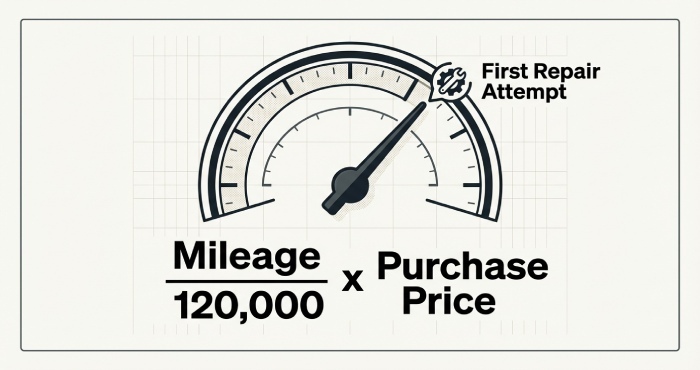
The California Lemon Law requires a use/mileage offset calculated from the odometer reading at the first warranty repair attempt for the defect. This deduction reflects your use before the substantial defect manifested.
Common exclusions and disputed items include:
- Late Fees and Penalties: Typically not reimbursed because they’re unrelated to the defect or warranty returns.
- Negative Equity: Rolling prior loan debt into a new vehicle deal is often not recoverable. This gray area depends on how the contract was structured and whether the negative equity was clearly disclosed.
- GAP and Add-Ons: GAP coverage, service contracts, alarms, window etching, and other aftermarket add-ons may be recoverable if they were manufacturer-sold or required as part of the sale, but many are contested and hinge on documentation and dealer obligations. Some GAP policies may provide prorated refunds separately.
- Insurance and Fuel: Ordinary insurance premiums and fuel are not part of the statutory provisions for restitution.
An experienced Lemon Law attorney will explain that the DMV’s branded title regulations and Vehicle Code §11713.12 require car dealers and auto dealerships to provide strict disclosures when reselling a lemon vehicle. While title branding and resale restrictions play a critical role in protecting consumers and enforcing compliance, they do not increase or expand the monetary recovery available in a lemon law buyback claim.
Calculating Your Likely Refund
A straightforward calculation includes:
- Vehicle Price Paid or Payable (down payment + financed principal)
- Collateral Charges: Sales tax, title, and vehicle registration fees under VC §4453
- Incidental Damages: Reasonable towing, rental, and repair-related costs
- Interest Paid: Typically included in the refund process because it is part of the financing cost
Then subtract:
- Use/Mileage Offset: Based on the odometer reading at the first nonconformity repair attempt
- Excluded/Disputed Items: Late fees, penalties, and negative equity, unless otherwise negotiated
Timing of Interest
- Interest generally runs on payments actually made to date, not on future installments. If the transaction is unwound promptly, there’s less interest paid and therefore less to recover. Delays can increase recoverable interest, but also complicate the return process.

Harmonizing with DMV and Title Branding
- The California Department of Motor Vehicles will require title branding for the buyback vehicle. Registration procedures ensure the branded title flows to the next owner. This protects vehicle identification, captures accurate vehicle history, and supports consumer protection under the California Vehicle Code and State of California policy.
Simple Example
- Purchase price: $35,000; down payment $3,000; financed $32,000 at interest
- Payments made: 10 payments totaling $5,000 (of which $800 is interest)
- Collateral charges: Sales tax/registration/title = $3,600
- Incidental damages: Towing/rental = $300
- Use offset: $1,200 (based on first-repair mileage)
- Remaining loan payoff at buyback: $28,100
Refund flow:
- Manufacturer pays lender $28,100
- You receive: $3,000 (down) + $5,000 (payments) + $3,600 (tax/title/vehicle registration) + $300 (incidental) – $1,200 (use) = $10,700
- The DMV processes title branding; the branded title marks it a lemon law buyback to inform future buyers.
Note on Statutory References
- CCC §1793.22 defines lemon law rights, lemon law claims, and remedies.
- VC §4453 addresses certificate of ownership and related registration procedures.
- VC §11713.12 governs dealer disclosure statement duties and resale of a manufacturer buyback.
Steps to Maximize Recover
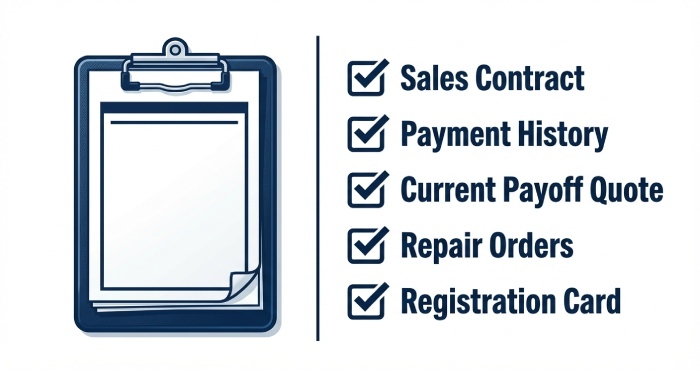
- Gather Documents
-
-
- Purchase/lease contract, retail installment sales contract
- Repair orders and warranty repairs history (dates, mileage, concerns, outcomes)
- Proof of payments, vehicle identification info (VIN), and vehicle history reports
- Registration cards and DMV correspondence to align collateral charges
- Any aftermarket add-on contracts, GAP policy, and disclosure statement
-
- Get a Current Payoff Quote
-
-
- Request a good-through date from your lender. Share it with the manufacturer to ensure precise payoff in the vehicle buyback and avoid interest accrual mismatches.
-
- Verify the Buyback Math
-
-
- Confirm use/mileage offset uses the first nonconformity repair mileage.
- Ensure collateral charges include sales tax, title fees, and vehicle registration.
- Check whether incidental damages are fully captured. Challenge improper deductions such as late fees or unrelated penalties.
-
- Coordinate Lender Payoff and DMV Steps
-
-
- Verify the lender received the payoff and released the title. Follow the Department of Motor Vehicles instructions for the return process. Expect title branding to reflect “lemon law buyback,” consistent with VC §11713.12 and vehicle industry procedures.
- Keep copies of all DMV records; accurate registration procedures promote compliance requirements and smooth enforcement if issues arise.
-
- Consider Counsel When:
-
- The manufacturer disputes lemon law criteria, refuses a refund, or miscalculates the buyback vehicle numbers
- There are complex add-ons, negative equity, or lease charges
- There are disputes over notification requirements or title branding under the California Vehicle Code
If you need personalized legal guidance, consult experienced lemon law attorneys—starting with a knowledgeable Lemon Law Lawyer San Diego who understands the California Lemon Law, local DMV procedures, and oversight by the Department of Consumer Affairs.
Key Reminders
- The Song-Beverly Consumer Warranty Act enables an adept Lemon Law Lawyer to assist purchasers of new cars, as well as some used vehicles that remain under a manufacturer’s warranty, when ongoing attempts to repair significant defects under warranty prove unsuccessful.
- A lemon law buyback restores your finances through a structured refund process, lender payoff, and DMV title branding.
- The State of California relies on statutory provisions like CCC §1793.22, VC §4453, and VC §11713.12 to regulate the return process, disclosure, and resale restrictions of a manufacturer buyback safeguarding the marketplace for future buyers.