
Contemporary automobiles are increasingly dependent on software, enabling manufacturers to address problems via over-the-air (OTA) updates rather than requiring a trip to the dealership. Although these updates can enhance functionality and rectify faults, they introduce a significant legal concern: do OTA updates alter the timeframe for initiating a claim under Lemon Law? It’s crucial for vehicle owners facing ongoing issues to grasp how these remote software interventions influence repair efforts, warranty durations, and their rights as consumers.
How Lemon Law “Clocks” Work: Time/Mileage Windows, Repair-Attempt Thresholds, and Days-Out-of-Service
.
Time and Mileage Windows
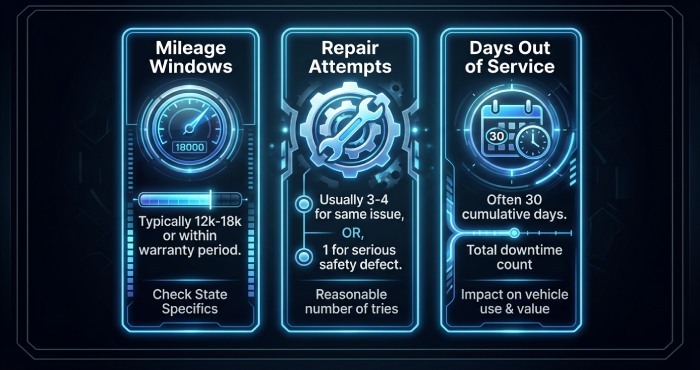
Most state lemon laws, including California Lemon Law, Texas Lemon Law, and New York Lemon Law, start the “presumption” period at delivery and run for a defined time and/or mileage (for example, 18 months/18,000 miles in some states). A qualifying vehicle defect discovered within this window that affects the vehicle’s use, value, or safety can support a lemon law claim if the manufacturer cannot fix it after a reasonable number of repair attempts.
Repair-Attempt Thresholds
The “reasonable number” of repair attempts often means:
- 2–4 repair attempts for a substantial defect
- 1 attempt if the defect poses a serious safety hazard
- Or a cumulative number of days out of service, typically 30+ days during the first year or warranty term
State lemon laws vary, but the theme is consistent: once a substantial defect persists after a reasonable number of repair attempts, the consumer may be entitled to a refund or replacement.
Days Out of Service
Days the car is unavailable due to diagnosis, parts, or software failure remediation may count toward the statutory total. With OTA updates, the dispute is whether a remote push that fails or requires prolonged “safe mode” periods counts as downtime. Documenting each instance is key to the lemon law claim and the eventual claim process.
What Counts as a “Repair” in the OTA Era: Software Patches vs. Hardware Fixes, Recalls vs. Service Campaigns
Software vs. Hardware
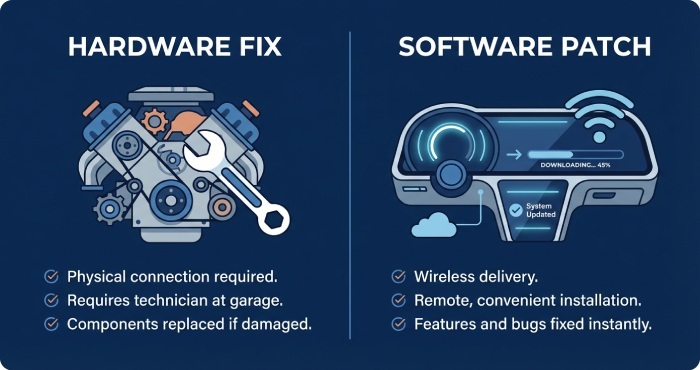
- Software patches: OTA updates designed to cure a software failure in the infotainment system, braking software, steering software, or driver assist features can qualify as repair attempts if the update is targeted to remedy a specific vehicle defect. A software glitch in a dashboard touchscreen or rearview camera that is patched and verified may be considered an official repair in many jurisdictions.
- Hardware fixes: When a technology malfunction exposes an underlying mechanical problem (e.g., sensor misalignment causing ABS malfunction), a physical visit may be necessary. Remote resets without component replacement may not end the clock if the substantial defect persists.
Recalls vs. Service Campaigns
- Recalls are safety-driven and mandatory; they typically pause normal use and can bolster the argument that the defect has a substantial impact on safety.
- Service campaigns and Technical Service Bulletins (TSB) signal known problems but are not recalls. A Technical Service Bulletin can be persuasive evidence that the manufacturer knew of the defect; however, a TSB alone doesn’t reset the lemon law clock unless accompanied by repair attempts tied to your VIN.
Can OTA Updates Restart or Toll the Clock? State Nuances, Emerging Case Law, and Manufacturer Arguments
Manufacturers increasingly argue that over-the-air (OTA) updates count as repairs that restart or toll the lemon law presumption. However, consumers and a lemon law attorney often counter that a remote software patch does not erase prior failed repair attempts or the days a vehicle was out of service, especially if the same software-related defect returns.
State Snapshots and Trends
- California Lemon Law: California courts look at the whole timeline of events. Multiple OTA updates for the same substantial defect generally count toward the “reasonable number” of repair attempts, particularly if the update release notes or service records identify the same symptom (e.g., power loss or stalling during adaptive cruise). Some arbitration programs accept screenshot logs and update notes as evidence.
- Texas Lemon Law: Texas emphasizes repeat repair attempts and days out of service. If OTA updates are pushed repeatedly for the same vehicle defect without a durable fix, each attempt can count. However, manufacturers may argue that short, at-home update windows are not “out of service,” making documentation crucial.
- New York Lemon Law: New York focuses on persistent defects affecting use, value, or safety. Remote fixes may be counted as repair attempts, but the outcome often hinges on whether the update was targeted to your VIN and whether the defect recurred.
How Manufacturers Frame OTA Updates
Manufacturers often claim:
- Each OTA update equals a repair attempt, restarting the presumption.
- Remote fixes reduce days out of service to near-zero.
- A version rollback or configuration change “resolves” symptoms, even if functionality is degraded.
Emerging commentary from firms like Allen Stewart P.C. and discussions across the Lemon Law Blog and Justice Blog suggest tribunals increasingly scrutinize whether OTA updates actually remedied the root cause or merely masked the issue.
Understanding Substantial Defects in Connected Vehicles
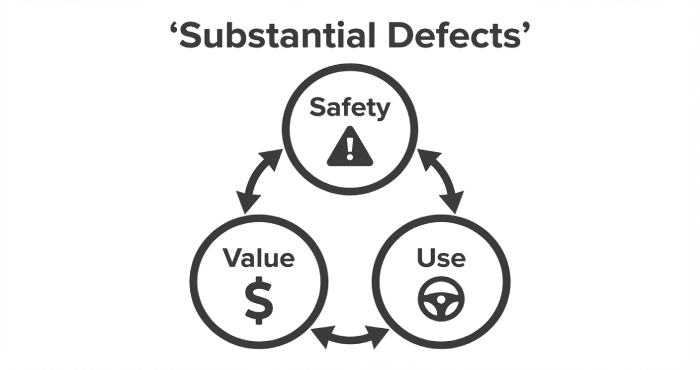
A substantial defect is one that significantly impairs use, value, or safety. In connected vehicles, this can be software-driven as much as mechanical.
- Safety: ABS malfunction due to corrupted code, braking software that lengthens stopping distances, or steering software that pulls intermittently can be a safety hazard even if no parts break.
- Use/Value: An infotainment system that repeatedly crashes, a dashboard touchscreen that freezes navigation, or persistent connectivity issues affecting driver assist features can degrade use and value. Power loss, battery drain, and stalling after OTA updates further illustrate substantial impact.
Industry surveys (e.g., Statista) show rising complaints related to connectivity and software failure. These are not minor annoyances when they affect core vehicle functions.
Real-World Scenarios and Pitfalls: Intermittent Defects, Version Rollbacks, Feature Deletions, and Safety-Critical Bugs
- Intermittent defects: A software glitch that appears only after the car wakes from sleep is hard to replicate. Capture video, timestamps, and any fault codes. Even a Ford Mustang GT or BMW M3 Coupe packed with tech can exhibit elusive bugs after OTA updates.
- Version rollbacks: If the manufacturer rolls you back to an earlier build to avoid a crash, the clock should not restart; the underlying substantial defect remains, and repair attempts continue to accrue.
- Feature deletions: Some OTA updates disable driver assist features or limit performance to avoid failures. Limiting features to avoid power loss is not a fix; it can reinforce that the defect impairs use, value, or safety.
- Safety-critical bugs: A rearview camera blackout, errant lane-centering, or ABS errors after updates deserve immediate escalation. Capture evidence; consider a dealership visit for a formal record even if the issue began with over-the-air updates.
Photos or screen captures stored from sources like Unsplash or Pexels are not legal proof, but clear owner-captured images and logs help build evidence for a lemon law claim.

Evidence and Timeline Strategies for OTA Issues
Building a meticulous record wins cases.
- Keep a timeline of events: delivery date, each symptom, every OTA update version, and results (e.g., “v2024.10.3 increased stalling events”).
- Save release notes, update prompts, and any in-app messages. If a TSB references your issue, attach it.
- Convert remote pushes into documented repair attempts: request service records reflecting the update as a remedy for a specific vehicle defect.
- Track days out of service: include time when the vehicle is in “restricted” mode because of an update-related software failure.
- Preserve hardware findings: if a technology malfunction reveals a mechanical problem (e.g., sensor harness failure causing ABS alerts), ensure the invoice lists replaced parts.
Protecting Your Claim: Documentation Checklists, Escalation Paths, and When to Seek Legal Help
Documentation checklist:
- VIN, in-service date, and warranty booklet
- Full timeline of events with mileage and dates
- Copies of every OTA update notice, version, and result
- Dealer invoices, TSBs, recall notices, and any manufacturer emails
- Videos/screenshots of software failure, instrument cluster warnings, and driver assist features misbehavior
 buyback-value-6683.jpg” alt=”OTA Documentation Checklist” width=”700″ height=”370″ />
Escalation path:
- Open a case with the manufacturer; request written acknowledgment of the specific defect and all repair attempts.
- Ask the dealer to associate OTA updates with your VIN work history.
- If the defect recurs, request inspection; reference any Technical Service Bulletin to show known problems.
- Consider arbitration if offered, but do not let it delay deadlines under your state lemon laws.
When to seek help:
- If a safety hazard exists (e.g., braking software anomaly, steering software pull, ABS errors), fast-track a legal consultation.
- If the manufacturer claims over-the-air updates “reset” the clock, get counsel to preserve your claim process and evidence.
Software updates delivered over the air do not inherently restart the lemon law timeline, particularly if the same issue persists, affecting the vehicle’s safety, worth, or functionality. Although manufacturers might contend that remote repairs are regarded as new attempts at fixing the problem, numerous consumers have successfully disputed this with the assistance of experienced lemon law lawyers familiar with the evaluation processes involved.
If you’re facing ongoing software problems or frequent repairs that are impacting your vehicle, reaching out to a Lemon Law Lawyer San Diego, CA can help safeguard your rights and assess whether your vehicle is still eligible for compensation, replacement, or a refund under the state’s lemon law protections.