
Car owners facing issues with a faulty vehicle often seek assistance from various repair shops to find a resolution. Factors such as ease of access, availability at dealerships, or dissatisfaction with earlier services can prompt repairs at multiple venues. This situation brings up a crucial question: does having repairs done at different locations disqualify you from lemon law protection?
The brief answer is no — but specifics are important. Claims under lemon laws heavily rely on proper documentation, consistency, and adherence to legal stipulations. Let’s take a closer look at how utilizing multiple repair shops might influence your eligibility and what steps you should take to strengthen your case.
Understanding Lemon Law Basics
Lemon laws aim to safeguard buyers and lessees of vehicles that have serious defects that the manufacturer cannot remedy after several attempts. Though details may differ by location, the majority of lemon laws stipulate the following criteria:
- A major defect impacting the vehicle’s usability, safety, or worth
- An adequate number of repair attempts
- The defect arising within a certain period or warranty
The critical aspect isn’t the location of the repairs, but rather if the manufacturer was provided a reasonable chance to resolve the issue.
Does Using Multiple Repair Shops Affect Your Claim?
Utilizing several repair shops doesn’t necessarily remove your lemon law protections, but it can complicate your situation if not managed correctly.
\
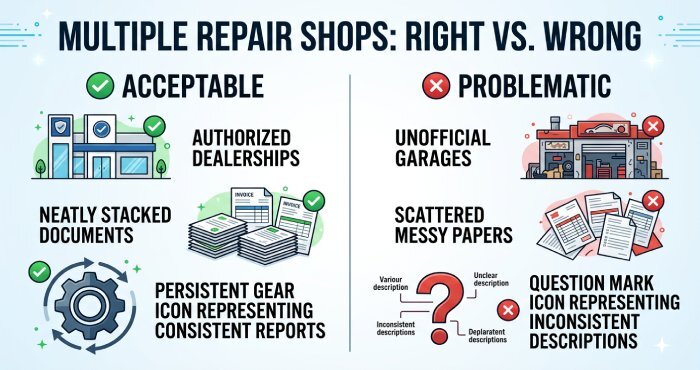
When It’s Acceptable
You are still eligible if:
- All repairs took place at authorized dealerships or certified centers
- There is thorough documentation of each repair
- The same issue was reported consistently at all locations
In fact, going to multiple authorized service centers can sometimes bolster your case by demonstrating that the defect remained unresolved despite various technicians’ efforts.
When It Can Be a Problem
Complications occur when:
-
- Repairs are carried out at unauthorized or independent garages
- Documentation is inconsistent
- Descriptions of the problem vary between visits
- The manufacturer wasn’t adequately informed
Manufacturers may contend that they weren’t given a proper opportunity to address the issue if repairs occurred outside their approved network.
Why Authorized Repair Centers Matter
One of the most important aspects of a lemon law claim is proving that the manufacturer had the opportunity to repair the defect. Authorized dealerships act as representatives of the manufacturer.
Benefits of Authorized Repairs
- Work done at approved service centers is logged in the manufacturer’s official database, guaranteeing an accurate service record.
- Technicians at these centers adhere to specific brand protocols, promoting uniformity and high standards in the repair process.
- The paperwork from these authorized repairs is consistent, simplifying verification and facilitating its use for records, warranty claims, or legal matters.
When selecting various locations, make sure that they are all included in the manufacturer’s authorized network. This will help preserve your claim and prevent any potential conflicts.
The Role of Documentation
When there are several repair facilities involved, thorough documentation becomes essential. Every visit needs to substantiate your claim effectively.
What to Document:
- Retain copies of all invoices and work orders associated with your vehicle.
- Record the precise date of each service or repair visit.
- Note the mileage of the vehicle at the time of each repair.
- Clearly detail the issue you reported during each visit.
- Keep track of all specific attempts made to resolve the problem.
Maintaining consistency is crucial. If one repair order refers to a “strange noise” while another indicates a “transmission failure” without connecting the two, it could undermine your case.
Consistency Across Repair Attempts
No matter which service center you decide to go to, it’s important that your complaint stays the same. Lemon law claims require a documented track record of ongoing issues.
Why Consistency Matters:
- It proves that the defect persists despite attempts to fix it.
- It stops manufacturers from claiming that the issues are independent or disconnected.
- It bolsters your case by clearly showing that you’ve repeatedly sought repairs for the same problem.
Make sure to consistently communicate the issue and verify that service advisors document it accurately.
How Many Repair Attempts Are Enough?
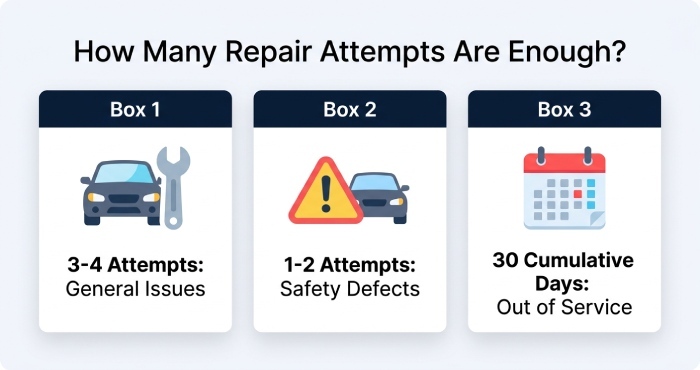
The number of repair attempts necessary can differ based on local laws and the specific type of defect. Generally:
3–4 attempts for the same issue could qualify
If your vehicle has been brought in for the same problem three to four times, you might be eligible for a claim. This indicates that the problem persists and hasn’t been adequately fixed after several tries.
1–2 attempts might suffice for serious safety defects
For significant safety-related issues, just one or two repair attempts may be enough to qualify. This is due to the fact that safety defects are addressed with more urgency.
30 cumulative days out of service may also qualify
If your vehicle has been out of action for a total of 30 days or more because of repairs, it could be eligible. This applies even if the days are not all in a row, as long as the cumulative time adds up.
These attempts can take place at different repair shops, provided they adhere to legal requirements and are well-documented.
Manufacturer Notification Requirements
Certain lemon laws mandate that you must inform the manufacturer directly prior to initiating a claim. This crucial step is frequently missed, particularly when engaging with several repair facilities.
Importance of Notification
- Reaching out to the manufacturer offers them one last chance to address the problem before you pursue legal remedies.
- It shows that you’ve adhered to necessary legal protocols.
- Moreover, it bolsters your argument if the issue persists post-notification.
Neglecting to inform the manufacturer may postpone your claim or potentially compromise your case.
How Multiple Locations Can Strengthen Your Case
At first glance, utilizing several authorized repair centers may appear to undermine your case, but, in fact, it can bolster it if managed properly. When technicians from different locations try to resolve the same problem without success, it indicates that the issue isn’t simply the result of one misdiagnosis or repair mistake. Rather, it illustrates that the defect continues to exist despite various levels of expertise and methods, thus enhancing the validity of your claim.
Moreover, multiple failed repair attempts at different centers emphasize the severity of the defect and the manufacturer’s inability to address it effectively. When this pattern of failure is thoroughly documented, it creates a strong case that the issue remains unresolved. Consequently, your argument gains more weight, providing clear proof that reasonable attempts were made to fix the problem, all to no avail.
Tips for Building a Strong Lemon Law Claim
If your vehicle has been repaired at multiple locations, follow these best practices:
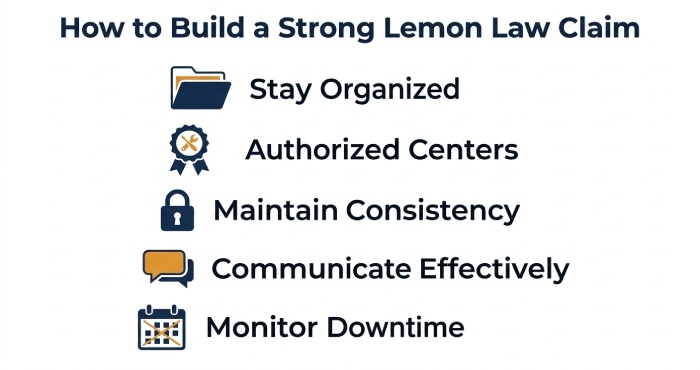
Stay Organized
Consolidate all your repair documentation in a single location for easy retrieval as needed. Keeping a well-documented timeline enables you to identify patterns and effectively support your claims.
Utilize Authorized Service Centers
Ensure that all repairs are performed exclusively by authorized service providers within the manufacturer’s network. This guarantees that all work is officially documented and acknowledged by the manufacturer.
Maintain Consistency
When discussing the issue at the repair facility, describe it consistently each time. This uniformity helps prevent misunderstandings and reinforces that the problem remains persistent and unresolved.
Communicate Effectively
Articulate your concerns to the service advisors clearly so they can fully grasp the issue. Verify that your complaint is accurately noted on all service paperwork.
Monitor Downtime
Document the number of days your vehicle is out of commission for repairs. This record can be vital in illustrating the level of inconvenience you’ve experienced.
When to Seek Legal Help
Should your car persist in having problems after several repair efforts, it might be wise to consult a Lemon Law attorney. A skilled lawyer can thoroughly analyze your repair records, spot any documents that may be lacking or inconsistent, and make sure that all essential information is arranged properly to bolster your claim.
Moreover, experienced lemon law attorneys can handle all communication with the manufacturer while building a strong, well-structured case on your behalf. Working with Expert Lemon Law lawyers is especially valuable when repairs have been carried out at multiple locations, as they can organize scattered records into a clear, cohesive narrative that significantly strengthens your claim.
Final Thoughts
Qualifying for lemon law protection is still entirely possible—even if your vehicle has been repaired at multiple locations. What truly matters is that all repairs were carried out by authorized service centers, your documentation remains consistent, and you can clearly show that the issue has not been resolved.
Instead of focusing on where the repairs occurred, lemon law claims emphasize whether the manufacturer was given a fair opportunity to fix the defect and failed to do so. In fact, with proper records and a consistent approach, having repairs done at multiple locations can sometimes strengthen your case rather than weaken it.
If you believe your vehicle may qualify as a lemon, it’s important to start organizing your repair history right away. Keeping thorough and accurate records will significantly improve your chances of a successful claim—especially when working with the Best Lemon Law attorney in San Diego, who can help present your case effectively and ensure all legal requirements are met.