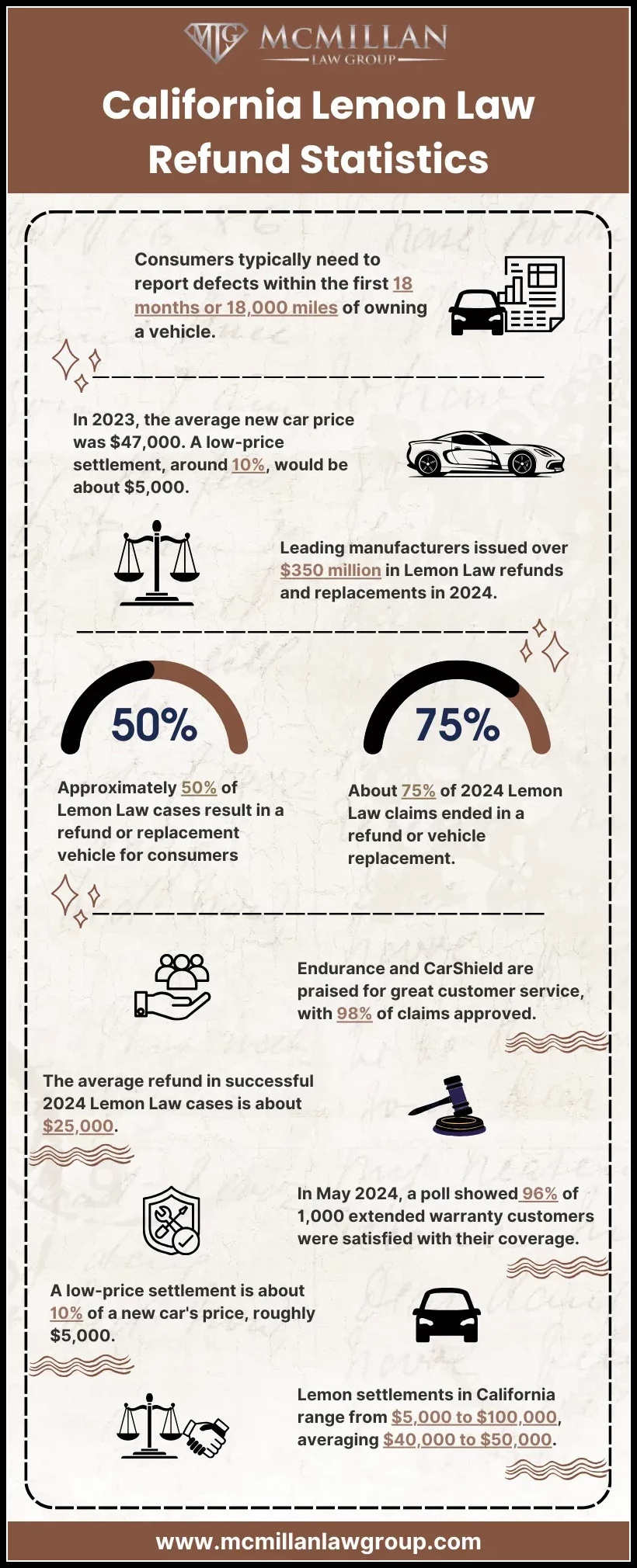
Every day, countless Californians purchase new cars with the expectation that they will be reliable and functional for years to come. Unfortunately, some consumers find themselves dealing with persistent problems that simply are not resolved by repeated trips to the dealership. This is where the California Lemon Law comes into play. Despite its catchy name, the Lemon Law is actually a serious legal mechanism designed to protect consumers from faulty vehicles. Whether you have experienced repeated breakdowns, safety concerns, or other issues with your car, it is important to understand your rights under this important law.
Here, we’ll explain the California Lemon Law for cars. We’ll cover how it works, which vehicles are included, and what you can do if you think your car is a lemon. To take control of a frustrating and potentially expensive situation and fight for the compensation you deserve, it is important to understand Lemon Law and work with an experienced lemon law attorney.
What is the California Lemon Law?
The California Lemon Law, officially known as the Song-Beverly Consumer Warranty Act, protects consumers who purchase or lease new or used vehicles with serious warranty defects that the dealer or manufacturer cannot fix after a reasonable number of tries.This legislation extends its protection to various types of vehicles, including cars, trucks, SUVs, RVs, motorcycles, and certain other forms of transportation.
Coverage and Eligibility
To be eligible for protection under California’s Lemon Law, the following conditions must generally be met:
It is necessary for the vehicle to possess a warranty, which may either be a new vehicle warranty provided by the manufacturer (in the case of new cars) or a used vehicle warranty offered by the dealer (for used cars).
The vehicle must have defects that significantly hinder its functionality, worth, or safety.
The dealer or manufacturer is required to have made a sufficient number of efforts to rectify the defect(s). The definition of sufficient may vary depending on the situation, but typically it entails a minimum of two attempts to fix a significant safety flaw or four attempts to address other substantial defects.
It is imperative that the vehicle remains within the warranty period at the time of the consumer’s initial report of the issue to the dealer or manufacturer.
The Lemon Law Process
If a vehicle meets the Lemon Law criteria, the owner should take the following steps:
Please promptly notify the dealer or manufacturer of any defect(s) encountered.
If the defect(s) continue even after several attempts to fix it, it’s best to ask the manufacturer for a replacement or refund, or manufacturer.
If the defect(s) continue even after several attempted repairs, it is recommended to ask the manufacturer for a replacement or refund.
Your Rights and Remedies
Under the California Lemon Law, if your vehicle is determined to be a lemon, you are entitled to either:
The vehicle will be bought back, encompassing the initial payment, monthly installments, and all expenses related to repairs, such as towing or rental car charges.
Resolving Disputes and Arbitration
In the event that the manufacturer declines to adhere to the Lemon Law, consumers have the option of pursuing either arbitration or legal recourse. Numerous manufacturers offer arbitration programs that are certified by the state, aimed at resolving lemon law disputes. If arbitration doesn’t solve the problem or if the consumer isn’t happy with the result, it’s a good idea to talk to a lawyer and think about starting a court case.
Finding Legal Assistance
The vehicle will be repurchased, including the initial payment, monthly installments, and all repair expenses like towing or rental car charges. State’s Lemon Law offers legal rights and safeguards for you. Nevertheless, comprehending and maneuvering through the intricate legal procedure can be intimidating and demanding in itself. This is where legal aid becomes essential, as it aids in comprehending, utilizing, and safeguarding your rights under the California Lemon Law.
Why Seek Legal Assistance?
While it’s not absolutely necessary to hire a lawyer to handle your Lemon Law claim, having legal assistance can be invaluable for the following reasons:
Understanding the Law: The California Lemon Law encompasses distinct provisions and prerequisites. Seeking the guidance of a lawyer can aid in comprehending these intricacies and assessing whether your circumstances meet the criteria for seeking redress according to the law.
Documenting Your Case: A lawyer possesses the expertise to provide guidance on the necessary documents and evidence required to construct a strong legal case.
Negotiating With Manufacturers: Engaging with manufacturers or dealers may evoke feelings of intimidation. However, by enlisting the expertise of a seasoned lawyer, negotiations can be effectively managed on your behalf.
Taking Legal Action: In the event that your claim remains unresolved after attempts at negotiation or arbitration, a lawyer can provide expert guidance in navigating the legal proceedings.
How to Find Legal Assistance?
When seeking legal assistance for your California Lemon Law claim, consider the following steps:
Research: To begin, conduct thorough research on attorneys who have expertise in California Lemon Law. You may utilize online legal directories, seek recommendations, or reach out to your local bar association for referrals.
Check Credentials and Experience: It is imperative to verify that any lawyer you contemplate hiring possesses a valid California license to practice law and holds expertise in handling Lemon Law cases.
Consultation: The majority of lawyers provide a complimentary first meeting, during which you can take advantage of the chance to converse about your case, comprehend your alternatives, and assess if the lawyer is suitable for your needs.
Ask About Fees: It is imperative to have a clear understanding of the fee structure from the beginning. A significant number of Lemon Law attorneys work on a contingency fee arrangement, wherein they receive payment only upon winning your case. In numerous instances of successful Lemon Law claims, the manufacturer is obligated to cover your attorney’s fees.
Legal Aid and Clinics
In the event that you are unable to afford legal representation, it is possible to obtain support from legal aid societies or law clinics. Certain universities provide law clinics where law students, overseen by seasoned attorneys, offer complimentary or affordable legal assistance.
In summary, the California Lemon Law is a powerful tool for consumers who find themselves stuck with a defective vehicle. If you believe that you may have a lemon, it’s important to understand your rights and the legal process involved in pursuing a claim. By working with an experienced attorney, you can navigate the complexities of the California Lemon Law and pursue the compensation that you deserve. Consulting with a lemon law lawyer before taking action is always wise. They can provide valuable guidance and support throughout the process.
The California Lemon Law was enacted in 1982 to help protect consumers who purchase or lease defective vehicles. This law helps people who have bought or rented a new or used vehicle that has big problems or safety issues which cannot be fixed after trying many times. Filing a California Lemon Law claim may seem difficult, but it can be very helpful for people affected by a faulty car. In this blog post, we will be evaluating the benefits of pursuing a California Lemon Law claim.
Understanding the California Lemon Law
The Song-Beverly Consumer Warranty Act, commonly referred to as the California Lemon Law aims to safeguard consumers who have bought or leased a new or pre-owned vehicle that exhibits significant warranty defects. If the dealer or manufacturer doesn’t fix the defects after a reasonable number of tries, the consumer can get a new vehicle or their money back.
Benefits of Pursuing a Lemon Law Claim
The process of filing a Lemon Law claim may seem intimidating, but the benefits can be significant:
Legal Recourse for Consumers
The California Lemon Law offers a significant advantage by offering legal options to consumers dealing with defective vehicles. Consequently, individuals facing continuous vehicle problems may have the opportunity to receive a replacement or refund, effectively resolving their automotive issues.
Cost Savings and Expense Reimbursement
The pursuit of a Lemon Law claim can result in substantial financial benefits. In the event of a successful claim, the manufacturer is obligated to either provide a replacement vehicle or reimburse you for its purchase price. The law says that the manufacturer must pay for extra expenses like towing and renting a car if there are problems with your vehicle.
Consumer Rights and Protections
Consumers are granted substantial safeguards under the California Lemon Law, which shifts the responsibility of proof from the consumer to the manufacturer. The manufacturer needs to show that they have made enough repair attempts, instead of making the consumer prove that the vehicle is defective.
Speedy Resolution of Disputes
In order to expedite the resolution of disputes, the Lemon Law strives to offer swift solutions. In pursuit of this objective, numerous car manufacturers provide arbitration programs that are certified by the state. These programs are specifically designed to expedite the resolution of Lemon Law disputes, surpassing the time-consuming nature of traditional litigation. As a result, they often provide a resolution within 40 days of initiating a claim.
Professional Legal Assistance
If you are making a Lemon Law claim, you can hire a lawyer to represent you. Numerous Lemon Law attorneys work on a contingency basis, which implies that they will only receive payment if they secure a victory in your case. The Lemon Law often requires the manufacturer to pay for your attorney’s fees if your claim is resolved successfully.
Understanding Manufacturer Defenses
Having knowledge of typical strategies employed by manufacturers can assist you in building a strong Lemon Law case. Manufacturers might contend that the flaw is insignificant and does not substantially affect the vehicle’s functionality, worth, or safety. Additionally, they may assert that the consumer is responsible for the defect due to misuse or unauthorized alterations.
Pursuing a California Lemon Law claim has many advantages. It gives you access to legal remedies, helps you save on costs, and offers strong consumer protections. Familiarizing yourself with these benefits can assist you in successfully navigating the claim procedure and obtaining the appropriate compensation guaranteed by the law.
Important Considerations Before Filing a Lemon Law Claim
Before filing a California Lemon Law claim for a defective vehicle, it is important to remember some key factors. Being adequately prepared can effectively streamline the claim procedure and enhance the chances of a favorable resolution.
Determine If Your Vehicle Qualifies
The scope of the California Lemon Law encompasses both new and pre-owned vehicles, provided they are accompanied by the manufacturer’s new vehicle warranty. This broad coverage extends to various types of vehicles, including cars, trucks, SUVs, as well as select motorhomes and motorcycles. The legislation ensures protection for vehicles afflicted with persistent defects that remain unrectified despite repeated repair attempts, thereby compromising their functionality, worthiness, or safety.
Keep Detailed Records
It is essential to keep comprehensive documentation of all repairs, communications, and transactions associated with the defect in your vehicle. This should include:
Repair orders and invoices
Receipts for any related expenses (e.g., rental cars, towing)
Written communications with the dealer or manufacturer
Dates and details of phone conversations
If you choose to proceed with a Lemon Law claim, these documents will be crucial evidence.
Report Defects Promptly
Notify the dealer or manufacturer about any defects immediately and request repairs, even if they claim the problem cannot be fixed. The California Lemon Law only applies to vehicles that are still under the manufacturer’s warranty when reporting defects.
Understand “Reasonable” Repair Attempts
To file a Lemon Law claim, the vehicle’s defect must not be resolved after several repair attempts. The determination of what constitutes a reasonable number can vary depending on the nature and severity of the defect. Normally, it is reasonable to attempt to repair a serious safety hazard twice, while for other significant defects, it is considered reasonable to make up to four repair attempts.
Consult a Lemon Law Attorney
The process of filing a Lemon Law claim can be intricate. Consulting with a knowledgeable Lemon Law lawyer can yield numerous benefits. They will provide guidance throughout the process, assist in claim preparation, and advocate for your interests during negotiations or conflicts. Numerous attorneys operate on a contingency basis, ensuring payment solely upon a successful claim outcome.
Prepare for Possible Defenses
Manufacturers often defend against Lemon Law claims by arguing that the defects are minor, don’t affect the vehicle’s functionality, value, or safety, or were caused by the owner’s mishandling or unauthorized changes. It is crucial to be adequately equipped to refute these justifications.
In conclusion, pursuing a California Lemon Law claim can be a beneficial option for consumers who have purchased a defective vehicle. The law provides protection for consumers and ensures that they receive proper compensation for their losses. With the help of a knowledgeable attorney who provides free lemon law consultation, consumers can easily navigate the complex and time-consuming process. If you think your vehicle has issues that may qualify for a Lemon Law claim, it’s crucial to get legal help promptly. By taking action, you can protect your rights and receive the compensation you deserve.
When purchasing a new vehicle, consumers expect their purchase to be of high quality, without any defects or malfunctions. However, not all vehicles meet this expectation, and sometimes, consumers are left with faulty cars that do not meet their needs. This is where the Lemon Law comes into play. The Lemon Law helps consumers when they buy a defective or used vehicle. In such situations, consumers can seek the help of a Lemon Law firm to ensure their consumer rights are protected.
A California Lemon Law firm specializes in protecting consumers and helping those who have purchased defective or malfunctioning vehicles.In this blog post, we will explore the role of a Lemon Law firm in protecting consumer rights.
What Is A Lemon Law Firm?
A Lemon Law Firm is a professional legal establishment that focuses on providing assistance to consumers who have acquired defective vehicles, commonly known as lemons. The lemon laws in many countries, including the United States, protect consumers who bought defective automobiles.
If you find big problems with your car that affect its safety, value, or how it works, you might have the right to get money back, a new car, or a refund under Lemon laws. Lemon Law Firms are equipped with specialized attorneys and legal experts who focus on this particular domain of consumer protection law.
These companies offer professional legal services to individuals who have purchased a defective vehicle and require help in dealing with the lemon law procedure. They work with clients to gather evidence, document vehicle problems, negotiate with manufacturers or dealerships, and, if necessary, take legal action for their clients.
The main goal of Lemon Law firms is to protect consumers’ rights and make sure they get proper compensation or suitable solutions for their defective vehicles. These firms possess expertise in the distinct lemon laws applicable across various jurisdictions and possess substantial experience in handling automobile manufacturers and dealerships.
If you believe you bought a defective product and want to file a claim under lemon laws, seeking guidance from a lemon law firm can provide the legal knowledge and support you need to navigate the process successfully.
In the U.S., each state has its own Lemon Law, which varies. However, they all define what constitutes a ‘lemon,’ the remedies available to consumers, and the necessary steps to enforce these rights.
The Role Of A Lemon Law Firm In Protecting Consumer Rights
The Lemon Law is a set of statutes that provide legal remedies to buyers of defective vehicles and other products. With the help of a lemon law lawyer, consumers can fight for their rights and get the compensation they deserve.
Expert Advice and Representation
Interpreting Complex Legislation: The complexities of Lemon Laws can pose a challenge for individuals without legal expertise. However, a specialized Lemon Law firm simplifies these intricacies, enabling consumers to grasp their legal rights and explore the various options at their disposal.
Legal Representation: Legal representation is necessary for consumers who have bought a defective product, commonly referred to as a ‘lemon’, in order to effectively handle the legal processes involved. Lemon Law attorneys fulfill this requirement by liaising with manufacturers, engaging in settlement negotiations, and, if necessary, representing the consumer in a court of law.
Investigation and Validation
Identifying Lemon Products: Lemon Law firms assist in determining whether a purchased product qualifies as a ‘lemon’ under the legal definition, by considering the number of repair attempts made or the duration of its non-operational status.
Documenting Cases: Lemon Law firms play a crucial role in ensuring the accurate documentation of cases by meticulously maintaining and presenting all essential records, including repairs, and communication with the seller or manufacturer.
Validating Claims: These firms are responsible for verifying the legitimacy of consumer claims and ensuring that they comply with the established legal criteria. They offer guidance to consumers regarding their warranty rights, the obligations of manufacturers, and the entitlements they have, depending on the unique circumstances of each case.
Litigation and Compensation
Negotiation: In the event that the product is labeled as a ‘lemon,’ the Lemon Law firm assumes responsibility for engaging in negotiations with the manufacturer in order to secure a refund, replacement, or monetary compensation.
Litigation: In the event that negotiations prove unsuccessful, these firms assume the responsibility of advocating for consumers in a court of law. Equipped with their expertise in this specific field of law, they skillfully present the case to guarantee the attainment of justice.
Securing Compensation: The primary objective of the Lemon Law firm is to secure the highest possible compensation for its clients. This includes seeking reimbursement for the faulty product, covering the costs of legal representation, and pursuing potential damages in cases of warranty violation.
A lemon law firm is important for protecting consumer rights. They advocate for their clients and make sure they get fair compensation for defective products.Lemon law attorneys are experts in state and federal consumer protection laws. They help consumers understand and handle the complex legal process. These attorneys make sure that manufacturers are held responsible for their actions. Choosing a reliable lemon law firm ensures consumer rights are protected, and fair compensation is received.
As car owners, we rely on our vehicles to get us from point A to point B safely and efficiently. However, what happens when our car turns out to be a lemon? It can be a frustrating and stressful experience. Fortunately, California has a Lemon Law that protects consumers who purchase or lease defective vehicles from manufacturers. Understanding the intricacies of this law can be complex and overwhelming, which is why it’s important to have a knowledgeable attorney by your side. This blog post will cover California Lemon Law and how an attorney can assist you with legal matters.
What is California Lemon Law?
The California Lemon Law is applicable to both new and used vehicles that are still covered by a warranty. The purpose of lemon laws is to make sure that consumers are fairly compensated if they buy a defective vehicle, also known as a lemon. A lemon is a vehicle that has significant safety, usability, or value-related problems that the manufacturer or dealer doesn’t fix even after reasonable attempts. This legislation grants consumers the entitlement to either a refund or a replacement vehicle in cases where they find themselves burdened with a lemon.
Understanding Your Rights as a Car Owner
As a car owner in accordance with California law, you are entitled to certain rights that safeguard you from defective vehicles. Notably:
If your vehicle is determined to be a lemon and the manufacturer is unable to rectify the issue after a reasonable number of attempts, you have the right to receive either a replacement or a refund.
You are entitled to file a lemon law complaint within a period of four years starting from the date of the initial discovery of the defect.
The repair expenses for any defects under warranty are the responsibility of the vehicle’s manufacturer.
The Role of Attorneys in Lemon Law Cases
A lemon law case can benefit from the expertise of an attorney in various aspects. A professional can help you with legal matters, such as explaining the law, negotiating with the manufacturer, preparing legal documents, and guiding you through the legal process if needed. Find a knowledgeable lemon law attorney with experience in consumer protection laws, a deep understanding of the auto industry, and the ability to strongly advocate for your rights.
Finding the Right Lemon Law Attorney
When seeking an attorney for a lemon law case, consider the following:
Experience: Select an individual with extensive knowledge of California’s Lemon Law and a proven history of success in handling comparable cases.
Communication: It is essential for a competent lawyer to provide regular updates and simplify intricate legal jargon into easily comprehensible terms for their clients.
Cost: It is important to familiarize yourself with their fee structure. Lemon law attorneys often work on a contingency fee basis. This means that they will only get paid if they win your case.
The Lemon Law Claim Process
The claim process typically involves the following steps:
If you suspect that your vehicle is a lemon, seeking assistance from a California lemon law lawyer can aid in assessing its status.
Inform the manufacturer regarding the problem with the vehicle and indicate your intention to submit a claim.
Collect and provide the required documentation, including repair records and warranty information.
In the event that the manufacturer declines to provide fair compensation, your attorney has the option to elevate the matter to court.
Potential Defenses from Manufacturers
Manufacturers may employ various strategies to evade their obligations under the Lemon law, such as asserting that:
The issue with the vehicle has no substantial impact on its value, safety, or usability.
The problem arises from the owner’s unauthorized alterations or improper use of the vehicle.
The vehicle does not meet the criteria for being considered a lemon due to the inadequate number of repair attempts.
Mediation, Arbitration, and Litigation
In the event that an agreement cannot be reached with the manufacturer, the matter may proceed to mediation, arbitration, or litigation. Your attorney will assist you throughout these procedures, effectively presenting your case.
The Cost of Hiring a Lemon Law Attorney
Numerous lemon law attorneys operate on a contingency arrangement, implying that you are only obligated to pay if they successfully resolve your case. Moreover, according to the California Lemon Law, the manufacturer is responsible for covering attorney’s fees, thereby enabling consumers to pursue legal action without financial burden. Nevertheless, it is crucial to have an upfront conversation with your attorney regarding the fee structure to prevent any potential misunderstandings.
In the end, understanding the intricacies of California Lemon Law can be a daunting task for car owners. However, with the right legal guidance, car owners can navigate the legalities surrounding the law and seek the justice they deserve. An experienced attorney can provide invaluable assistance and offer free lemon law consultation in negotiating with car manufacturers and pursuing legal action if necessary. Car owners can protect their investments and hold manufacturers accountable for faulty products by knowing their rights under the law and working with a competent legal team.
When purchasing a new car, the last thing anyone wants is to end up with a lemon. Unfortunately, even in California, where strict lemon laws are in place, it can happen to the best of us. A lemon car is a car with a problem that significantly affects its use, value, or safety, and cannot be fixed even after several repair attempts by the manufacturer or dealer. To protect your rights and get the refund or replacement you’re entitled to under the law, follow these steps.
Understanding Lemon Car Laws In California
Having knowledge of the California Lemon Law is essential for car owners facing recurring vehicle problems. Here are the important aspects that you should be aware of:
Definition of a Lemon
A vehicle is considered a lemon in California if it has serious problems that have not been fixed after a certain number of repair attempts. For critical safety defects, this requires at least two repair attempts, and for other defects, it requires at least four repair attempts.If the vehicle is in the repair shop for more than 30 days in the first 18 months or before reaching 18,000 miles, it is considered a lemon.
Coverage
The California Lemon Law covers new and used vehicles sold or leased in California with the manufacturer’s new vehicle warranty.
Manufacturer’s Responsibility
If the manufacturer or its authorized repair facility cannot fix the defects in the vehicle, even after trying a reasonable number of times, they must give you either a new vehicle or refund the money you paid for it.
Legal Help
Consumers in California can hire a lemon law lawyer under the Lemon Law. They can also get their attorney’s fees and expenses paid, so they don’t have to worry about the cost.
Mileage Offset
If the manufacturer refunds the purchase cost, they can deduct a suitable amount for the mileage before the first repair for the same problem.
Clear Communication
It is essential to effectively communicate the issue to the service provider and retain all repair order invoices. It is imperative to possess documented evidence of recurring visits for the identical problem.
Arbitration Programs
Some manufacturers have dispute resolution programs, called arbitration programs, where a neutral arbitrator or group of arbitrators listens to both sides and makes a decision. Participating in these programs can be optional or mandatory. The result can have legal consequences or just be a recommendation, depending on the program’s guidelines.
The Song-Beverly Consumer Warranty Act, also known as California’s lemon law, includes a presumption guideline stating that a vehicle is considered a lemon if the manufacturer or its agents have made two or more unsuccessful attempts to repair a warranty problem that could potentially lead to severe bodily harm or death if the vehicle is driven.
Steps To Take For A Refund Or Replacement
The California Lemon Law allows you to seek a refund or a replacement vehicle if your car is found to be defective. The process of making a successful claim can be complicated and time-consuming. It’s important to understand the necessary steps.
Identify the Issue
It is essential to identify the issue with the product or service as this is crucial for effectively conveying your complaint to the company.
Check the Return Policy
It is important to collect all essential paperwork, such as receipts, warranties, or any other evidence of purchase. In case the problem pertains to a service, having statements or contracts would be beneficial.
Contact Customer Service
Contact customer service and explain your issue. Request either a refund or a replacement. Ensure that your communication is clear, courteous, and succinct while maintaining a professional tone.
Follow up in Writing
Following the initial correspondence, it is advisable to send a written email or letter outlining the matter and the desired resolution. It is important to retain a copy for future reference.
Escalate the Issue
If the company doesn’t respond or refuses to address the issue, it’s best to talk to a supervisor or manager.
Contact Third-Party Dispute Resolution
If the company doesn’t address your concern, you should contact a consumer protection agency for help.
Legal Action
If the product or service is very expensive and the company won’t give your money back or replace it, you can think about getting legal help or contacting a consumer protection organization in your area.
Share Your Experience
Consider the notion of sharing your experience on online review platforms. By doing so, you can greatly aid fellow consumers in making informed decisions and potentially encourage the company to address any concerns you may have.
In closing, if you have purchased a lemon car in California, it is important to know your legal rights and options. The steps outlined in this post can help you navigate the process of seeking a refund or replacement. It is always best to seek the guidance of an experienced lemon law attorney who can provide you with further assistance and representation. Remember, you have the right to a vehicle that meets certain quality standards and the law is on your side.
When it comes to purchasing a car, consumers have certain expectations and rights. However, what happens when a vehicle fails to meet those expectations and becomes a persistent problem? In California, consumers have a powerful tool in the form of the California Lemon Law. This law provides protection for consumers who purchase or lease a defective car, truck, or motorcycle. With the help of this law, consumers can seek remedies that include a refund or replacement of the vehicle.
Understanding The California Lemon Law
The Song-Beverly Consumer Warranty Act, commonly referred to as the California Lemon Law aims to safeguard consumers who encounter issues with their purchased or leased vehicles. Below is a concise overview of this legislation.
Applicability
The jurisdiction of the law extends to vehicles that remain covered by the manufacturer’s initial factory warranty. This encompasses both brand-new and pre-owned automobiles, trucks, and SUVs, in addition to the drivetrain component of recreational vehicles (RVs).
Lemon Definition
A lemon refers to a vehicle that, despite numerous repair attempts, cannot be brought into compliance with the warranty. This means that either the same problem has been fixed four times or the vehicle has been unusable for a total of 30 days or more during the warranty period.
Manufacturer’s Responsibility
If a vehicle is found to be defective, the manufacturer must either give the consumer a new vehicle or refund the entire purchase price.
Presumption
In the state of California, the Lemon Law operates under the assumption that if the manufacturer or its representative is unable to adequately service or repair a new motor vehicle to fulfill the terms of a written warranty after a reasonable number of attempts, the manufacturer is obligated to promptly replace the vehicle or refund the buyer’s purchase price.
Legal Representation
It is recommended that consumers who suspect they have purchased a defective vehicle should consider obtaining legal counsel. According to the California Lemon Law, in the event of a successful outcome, the manufacturer is obligated to cover the expenses of your legal representation.
Leased Vehicles
Leased vehicles are also subject to this law.
Used Vehicles
If a used car is bought with a written warranty and has a defect during the warranty period, it can be considered eligible under this law.
Arbitration
Typically, consumers are required to undergo a manufacturer’s arbitration process before considering legal action, although this is not always mandatory.
Consumer Rights Under The California Lemon Law
The California Lemon Law protects consumers who have purchased or leased a vehicle or consumer goods that are considered lemons because of ongoing defects that cannot be fixed after a reasonable number of repair attempts.
Here are some key rights provided to consumers under the California Lemon Law:
Right to a refund or replacement
If the manufacturer cannot fix a vehicle or consumer goods after trying many times, the consumer can get a refund or a replacement. The manufacturer must refund the purchase price, subtract a fair amount for any previous use, or give the consumer a new product of the same value.
Right to a free remedy
The law mandates that repair, refund, or replacement should be provided without any cost.
Right to use any manufacturer’s repair facility
You can use any authorized repair facility from the manufacturer to fix any problems with the goods.
Right to recover costs and expenses
If the consumer wins the lawsuit, they can get their money back for the expenses they had to pay for the court, the lawyer, and any other costs related to the faulty product.
Right to damages for breach of warranty
If a manufacturer or its representative doesn’t fix a problem, the consumer can ask for payment for any violation of a clear warranty.
Presumption of a reasonable number of attempts
Assuming a reasonable number of attempts: If a vehicle or consumer goods have been repaired for the same problem four or more times within the first 18 months or 18,000 miles, or if the goods have been non-functional for over 30 days within the same period, it is considered that enough efforts have been made.
Remedies Available To Consumers
Consumers who purchase or lease a defective vehicle in California are entitled to various remedies under the state’s lemon law. This law safeguards consumers who acquire new or used vehicles with significant defects that hinder their functionality, worth, or safety. The following are a few of the remedies that consumers can seek:
Repurchase or Replacement
If the manufacturer or authorized dealer fails to fix the defect(s) even after trying multiple times, the consumer might be eligible for a vehicle repurchase or replacement. The manufacturer must fully reimburse the consumer for the entire purchase or lease amount, including taxes, registration fees, and additional charges.
Cash Compensation
Consumers can get money back for expenses caused by the problem with the product. The expenses can include towing fees, rental car charges, and repair costs. They can also choose to buy a new product or get a replacement.
Warranty Extension: In the event that the defect is deemed insufficient for repurchase or replacement, the consumer may still qualify for a warranty extension. It is the responsibility of the manufacturer to grant an extension of the warranty duration to encompass the said defect.
Attorney’s Fees and Costs: In the event that the consumer succeeds in a lemon law claim, it is possible for the manufacturer to bear the responsibility of covering the attorney’s fees and expenses incurred by the consumer during the claim process.
Civil Penalties: Consumers may be eligible for further civil penalties in situations where the manufacturer deliberately breaches the lemon law.
For detailed and accurate information, consumers should consult an experienced lemon law lawyer or refer to the California lemon law statutes. The remedies and requirements for filing a claim may vary depending on the situation and type of vehicle.
In summary, the California Lemon Law is a powerful tool that provides protection and remedies for consumers who find themselves stuck with a defective vehicle. You can seek compensation for your losses and avoid dealing with a lemon by understanding your rights and acting quickly. It’s important to work with an experienced lemon law attorney if you want to pursue a repurchase or a replacement. They can guide you through the process and help you get the best outcome possible. With the right legal representation, you can hold automakers accountable and get the justice you deserve.