
Your car is your paycheck. If you drive for Uber, Lyft, DoorDash, Instacart, or Amazon Flex—or if you own a small business that depends on one or two vehicles—a defective car is not just an inconvenience. It is a direct, immediate, and ongoing loss of income.
When a rideshare driver’s transmission fails on day two of ownership, they are not just dealing with a broken car. They are dealing with lost fares, a loan payment on a vehicle they cannot use, insurance premiums on a car sitting in a dealer’s service bay, and the scramble to find alternative transportation so they can keep earning. Every day the car is in the shop is a day without income.
And yet, almost no lemon law content addresses this population at all. The entire internet’s library of lemon law guides is written for consumers who use their cars for personal commuting and family errands. If you search for whether a commercially used vehicle qualifies under California’s Song-Beverly Act, you will find almost nothing—despite the fact that the answer is clearly documented in the California Department of Consumer Affairs’ own government brochure.
This article fills that gap. It answers the questions that gig workers and small business owners actually need answered: Does the lemon law cover my vehicle? How does high mileage affect my claim? Can I recover lost income? And what traps do I need to avoid?
The First Question: Does the Lemon Law Cover Your Vehicle?
The answer, for most gig workers and small business owners, is yes. But the qualification comes with specific conditions that you need to understand.
The California DCA’s Lemon Law Q&A brochure—a government PDF revised in September 2024—explicitly lists the vehicles covered by the lemon law. The list includes:
- Cars, pickup trucks, vans, and SUVs
- Dealer-owned vehicles and demonstrators
- Vehicles purchased or leased primarily for business use (with fleet requirements of less than five vehicles and gross vehicle weight of less than 10,000 lbs.)
- Vehicles purchased or leased for personal, family, or household purposes
That third bullet point is the one most gig workers and small business owners don’t know about. The BBB National Programs California Lemon Law Summary elaborates: the vehicle must “have a gross vehicle weight under 10,000 pounds and be bought or used primarily for business purposes by any person or business to which at least one but not more than five motor vehicles are registered in California.”
If you are an Uber driver, a DoorDash delivery worker, or a small business owner with fewer than five vehicles, your car is almost certainly covered by California’s Lemon Law—even though you use it commercially.
This is a powerful protection that most gig workers do not realize they have. The 10,000-pound GVW threshold covers essentially every sedan, SUV, minivan, and light pickup truck used for rideshare and delivery. The five-vehicle cap covers every independent contractor and most small businesses. Only large commercial fleets with six or more registered vehicles are excluded.

The GVW vs. GVWR Distinction
There is a critical technical distinction here that has been litigated in court. The statute uses Gross Vehicle Weight (GVW)—the actual weight of the vehicle—not Gross Vehicle Weight Rating (GVWR), which is the maximum weight a vehicle is designed to carry including passengers and cargo. A Ford F-250 Super Duty may have a GVWR above 10,000 pounds but a GVW well below it when unloaded. Courts have ruled that GVW, not GVWR, is the relevant measure. This distinction matters for business owners using larger pickup trucks or commercial vans.
What About Vehicles Used for Both Personal and Business?
The statute covers vehicles used “primarily” for business or “primarily” for personal use—both qualify. If you drive 60% of your miles for Uber and 40% for personal errands, your vehicle qualifies under either pathway. The law does not require you to prove that your use is 100% commercial or 100% personal. The Consumer Action fact sheet on California’s lemon law confirms this dual coverage.
The Mileage Trap: How High-Use Driving Hurts Your Claim
Here is where the lemon law’s framework begins to work against gig workers. The mileage offset formula—the deduction manufacturers take from your buyback refund—is calculated as:
(Miles at First Repair Attempt ÷ 120,000) × Purchase Price = Mileage Offset
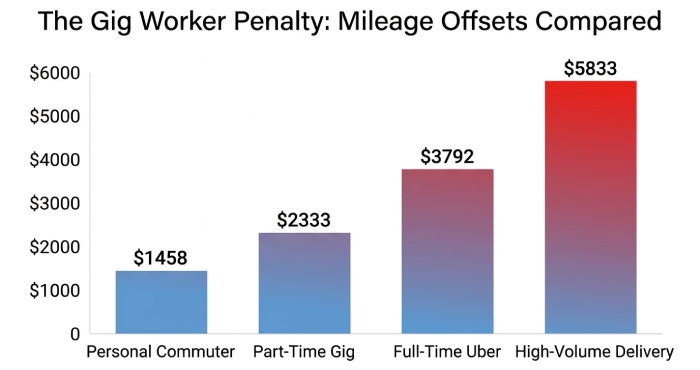
For a consumer who commutes 15,000 miles per year and notices a defect at 5,000 miles, this is manageable: on a $35,000 car, the offset is just $1,458.
But gig workers drive dramatically more miles. A full-time Uber driver can accumulate 30,000–50,000 miles per year. A delivery driver may log 40,000+ miles annually. If you drive 40,000 miles per year and notice a defect at month four (roughly 13,000 miles), your offset on that same $35,000 car is $3,792. If you don’t notice the defect until 20,000 miles—still within the first year—the offset jumps to $5,833.
Mileage Offset Impact by Driver Type:
| Driver Type | Annual Miles | Miles at First Repair | Offset ($35K Car) |
| Personal commuter | 15,000 | 5,000 | $1,458 |
| Part-time gig driver | 25,000 | 8,000 | $2,333 |
| Full-time Uber driver | 40,000 | 13,000 | $3,792 |
| High-volume delivery | 50,000 | 20,000 | $5,833 |
Calculated using California’s 120,000-mile divisor formula from the BBB CA Lemon Law Summary PDF.
What this means: The higher your mileage at the time you first report a defect, the more money you lose from your buyback. Gig workers who accumulate miles three to four times faster than average consumers will have proportionally larger deductions. This creates a perverse incentive: the more you depend on the car for income, the faster you accumulate miles, and the more the manufacturer gets to deduct from your refund.
What to do: Report defects immediately. The moment you notice a recurring problem—a transmission shudder, an electrical glitch, a braking issue—take the vehicle to the dealership and get a repair order. That repair order establishes the mileage at first repair attempt, which locks in your offset for the life of the claim. Every day you delay adds miles and increases the deduction. For a gig driver putting on 800+ miles per week, a one-month delay can cost $800–$1,000 in additional offset.
The 18-Month/18,000-Mile Presumption Window—and Why Gig Workers Exhaust It in Months
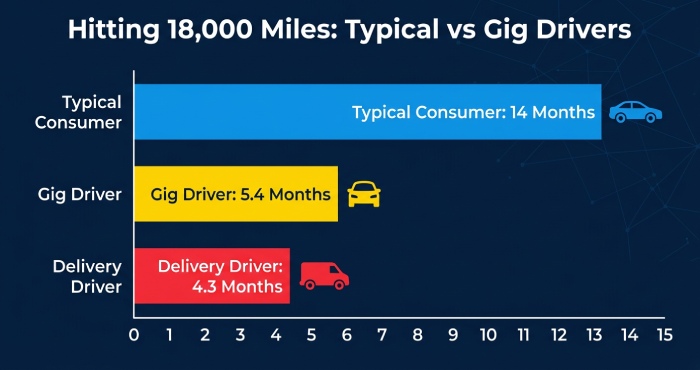
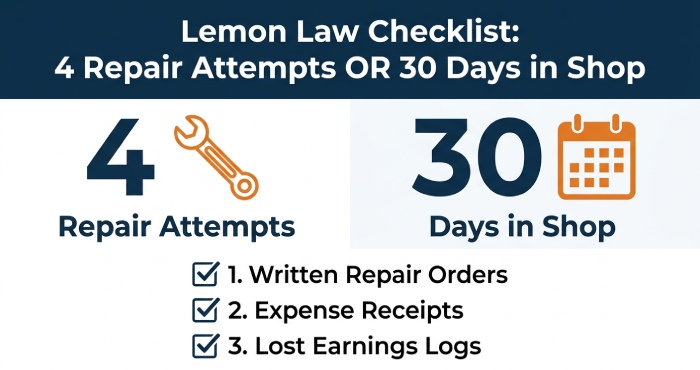
California’s lemon law presumption triggers within 18 months or 18,000 miles of delivery, whichever comes first (DCA Q&A PDF). This is the window during which the law presumes a vehicle is a lemon if the manufacturer has made four or more repair attempts, two safety-defect attempts, or the car has been in the shop for 30+ days.
For a typical consumer driving 15,000 miles per year, the 18,000-mile cap is reached after about 14 months—close to the full 18-month window. But for a full-time gig driver logging 40,000 miles per year, 18,000 miles is reached in approximately 5.4 months. For a high-volume delivery driver at 50,000 miles per year, it is reached in just 4.3 months.
This compression matters because it means gig workers have a dramatically shorter period to accumulate the four repair attempts needed to trigger the presumption. A personal-use consumer has roughly 14 months to document four failed repairs. A full-time gig driver has five months. If the defect is intermittent—appearing every few weeks rather than constantly—the gig driver may burn through the presumption window before the dealership has had enough attempts to trigger the statutory threshold.
What to do: Take the vehicle in for repair at every occurrence of the defect, even if the symptom is intermittent. Do not wait for the problem to get worse. Each visit generates a repair order that counts toward the four-attempt threshold. If the dealership says “we couldn’t duplicate the problem,” insist that they document your reported symptoms in the repair order anyway. A repair visit where the dealer “could not duplicate” still counts as an attempt if the defect later recurs. Time is not on your side—you are burning miles at 3–4x the normal rate.
Important: the lemon presumption is a shortcut, not a requirement. Even if you exceed the 18,000-mile window, you can still file a lemon law claim—you just lose the benefit of the presumption. Claims outside the presumption window require you to prove the defect and the manufacturer’s failure to repair it, rather than having the law presume it. This is harder, but not impossible, especially with strong documentation.
Recovering Lost Income: The Incidental Damages Most Gig Workers Don’t Know About
California’s Song-Beverly Act provides for recovery of incidental damages in addition to the vehicle buyback price. The BBB CA Summary PDF lists examples: towing charges, rental car costs, prepayment penalties on auto loans, and “other incidental costs.”
For gig workers, the most significant incidental damage is lost income. Every day your car is in the shop for warranty repairs is a day you cannot drive for Uber, deliver for DoorDash, or operate your small business. These lost earnings are recoverable as incidental damages under the Song-Beverly Consumer Warranty Act —but only if you can document them.
Research from the UC Berkeley Labor Center (a PDF analyzing gig driver pay in five metro areas) and the Colorado Fiscal Institute provide data on gig driver earnings that helps quantify these losses. Denver rideshare drivers averaged $30.66 per hour in gross earnings during active hours. If a full-time driver works 8 hours per day and the car is in the shop for 15 of the 30 qualifying out-of-service days, the lost gross income is approximately $3,679. After deducting vehicle costs, the net lost income is lower but still substantial.
The U.S. Census Bureau’s research on the gig economy (a PDF working paper) provides additional context: gig drivers can determine vehicle operating costs either by using the IRS mileage rate (which has ranged from 51 to 67 cents per mile in recent years) or by documenting actual expenses. For lemon law incidental damage claims, actual documented expenses are stronger evidence than estimates.
What to do: Create a daily earnings log showing your platform income for the 30–60 days before the vehicle went to the shop, during the repair period, and after. Screenshot your Uber, Lyft, or DoorDash earnings dashboards. If you rented a vehicle to continue working during repairs, keep those receipts—they are also recoverable. If you could not afford a rental and simply lost income, document the days you could not work and calculate the lost earnings based on your historical daily average. This spreadsheet becomes an exhibit in your settlement negotiation.
How AB 1755 Affects Gig Workers and Small Business Owners
The 2024 lemon law reform introduced several provisions that disproportionately affect commercial-use vehicle owners:
The Vehicle Retention Requirement
AB 1755 requires consumers to send written notice to the manufacturer before they can sell or trade in a defective vehicle without jeopardizing their claim (SB 26 Senate Judiciary Analysis). For a personal-use consumer, this is an inconvenience. For a gig worker whose income depends on the vehicle, it is a trap: you must keep driving—and making payments on—a defective car while the 30-day pre-suit notice period runs, because selling it could undermine your lemon law claim. The CARS Foundation specifically flagged this concern in their opposition to AB 1755, noting it “forces consumers to keep driving a car they know is defective.”
The Six-Year Statute of Limitations
Most gig workers drive high-mileage vehicles that may exhaust their warranty coverage before the six-year cap becomes relevant. But for small business owners with longer-warranty vehicles—especially EVs with 8-year battery warranties—the six-year cap creates the same gap documented in the AB 1755 legislative analysis: a warranty you cannot enforce through lemon law after year six.
The Pre-Suit Notice Period
The mandatory 30-day pre-suit notice adds a month to the timeline before a gig worker can file suit seeking civil penalties. During that month, the worker is either driving a defective vehicle, paying for a rental, or losing income. The Advocate Magazine practitioner analysis (PDF) notes that manufacturers must have the consumer’s restitution check ready at vehicle return under the new standardized release—but the 30 days of waiting still represent real costs for income-dependent drivers.

What Happens If Your Case Goes to Court
The Orange County Superior Court’s Song-Beverly Case Management Order—a downloadable PDF that governs how lemon law cases are managed in one of California’s busiest jurisdictions—provides a window into what litigation looks like in practice.
The order requires manufacturers to produce specific documents within set timelines, including: a list of customer complaints in the manufacturer’s database that are “substantially similar” to the alleged defects for the same year, make, and model in California; warranty coverage documents; technical service bulletins; and internal investigation reports. For gig workers, this discovery process is critical because it reveals whether other drivers of the same vehicle have experienced the same defects—pattern evidence that strengthens your case.
The order also mandates compliance with lemon law lawyer California Guidelines of Civility and warns that failure to comply “may result in sanctions, an order for further meet and confer, or the .” This procedural framework exists to prevent the discovery disputes that Aappointment of a discovery refereeB 1755 was designed to address.
Your Complete Action Plan for Gig Workers and Small Business Owners
Before You Buy
- Check recall history for your specific model and year at NHTSA.gov/recalls.
- Review the manufacturer’s warranty terms carefully. Note the mileage and time limits. If you will drive 40,000+ miles per year, a 36,000-mile bumper-to-bumper warranty may be exhausted in under a year.
- Consider purchasing an extended warranty. Your base warranty may expire quickly at gig-driver mileage rates. An extended powertrain warranty can provide coverage beyond the base period.
- Confirm your vehicle’s GVW (not GVWR) is under 10,000 pounds and that your business has fewer than five registered vehicles. If so, you qualify for Song-Beverly coverage.
At First Sign of a Defect
- Report the defect to the dealership immediately. Get a written repair order documenting symptoms, mileage, and date. Do not wait.
- Begin your daily earnings log: screenshot platform earnings for the 30 days before the defect appeared.
- Keep receipts for every out-of-pocket cost: rental cars, Uber rides to the dealership, towing charges.
- Note the date and mileage at each repair visit. Count your attempts toward the 4-attempt threshold.
During the Repair Process
- Take the vehicle in for every recurrence, even if the symptom is intermittent. Every visit counts.
- Track cumulative days out of service. If the vehicle reaches 30 days in the shop, you have met the out-of-service threshold regardless of repair attempt count.
- Calculate your lost income for each day out of service: (average daily platform earnings) × (days without vehicle). Document with earnings screenshots.
- Do not stop making loan or lease payments. Missed payments damage your credit and can trigger default.
When Filing a Claim
- Check whether your manufacturer opted into AB 1755 at the CA DCA website. This determines your procedural requirements.
- If AB 1755 applies: send a formal written demand to the manufacturer via certified mail at least 30 days before filing suit for civil penalties.
- Verify the mileage offset calculation uses 120,000 as the divisor and the correct mileage at first repair—not current mileage.
- Include all incidental damages in your claim: lost income, rental costs, towing, loan prepayment penalties.
- Consult a San Diego lemon law attorney. Under the Song-Beverly Consumer Warranty Act, the manufacturer pays your attorney fees if you win. Most San Diego lemon law attorneys work on contingency, meaning there is typically no out-of-pocket cost to you.
The Bottom Line
If your income depends on your vehicle, a lemon law defect is not just a consumer inconvenience—it is a financial emergency. The good news is that California’s Song-Beverly Act covers you, even for business-use vehicles, as long as your fleet has fewer than five vehicles and the car weighs under 10,000 pounds GVW. The bad news is that the law’s framework—built for personal-use commuters who drive 15,000 miles per year—works against high-mileage drivers at almost every step: the mileage offset takes a bigger bite, the presumption window closes faster, and the new AB 1755 vehicle retention requirement forces you to keep driving a defective car while the process plays out.
The single most important thing you can do is report defects immediately and document everything. Every mile you drive before that first repair order increases your mileage offset. Every day you work without documenting your earnings makes it harder to prove lost income. Every repair visit you skip because “it’s not that bad yet” is one fewer attempt toward the four-attempt threshold.
Your car is your livelihood. Protect it—and your legal rights—with the same urgency you bring to earning a living behind the wheel.
Sources and References
All sources are downloadable PDFs from government agencies, nonprofit organizations, academic institutions, or legal publications.
California Government PDFs
[1] CA DCA. Lemon Law Q&A Brochure, Revised September 2024. https://www.dca.ca.gov/acp/pdf_files/lemonlaw_qa.pdf
[2] CA Assembly Judiciary Committee. AB 1755 Legislative Analysis, August 2024. https://ajud.assembly.ca.gov/system/files/2024-08/ab-1755-analysis.pdf
[3] CA Senate Judiciary Committee. SB 26 Analysis, February 2025. https://trackbill.com/s3/bills/CA/2025/SB/26/analyses/senate-judiciary.pdf
BBB and Nonprofit PDFs
[4] BBB National Programs. California Lemon Law Summary. https://assets.bbbprograms.org/docs/default-source/auto-line/statelemonlaws/california-lemonlaw.pdf
[5] Consumer Action. California’s Lemon Law Fact Sheet. https://www.consumer-action.org/downloads/english/CA_lemon_law_2015_EN.pdf
Court Documents
[6] Orange County Superior Court. Song-Beverly Case Management Order. https://www.occourts.org/system/files/civil/songbeverlycasemanagementorder.pdf
Legal Publication PDFs
[7] Advocate Magazine (Michelle Fonseca-Kamana). When Life Gives You Lemon…Law Reform, February 2025. https://www.advocatemagazine.com/images/issues/2025/02-february/reprints/Fonseca-Kamana-Feb25-article-Advocate-magazine.pdf
[8] Loyola Consumer Law Review. Developments Under Song-Beverly Consumer Warranty Act. https://lawecommons.luc.edu/cgi/viewcontent.cgi?article=1808&context=lclr
Gig Economy Research PDFs
[9] UC Berkeley Labor Center. Gig Passenger and Delivery Driver Pay in Five Metro Areas, May 2024. https://laborcenter.berkeley.edu/wp-content/uploads/2024/05/Gig-Passenger-and-Delivery-Driver-Pay-in-Five-Metro-Areas.pdf
[10] U.S. Census Bureau. Driving the Gig Economy (Working Paper CES-WP-24-42), 2024. https://www2.census.gov/ces/wp/2024/CES-WP-24-42.pdf
[11] Colorado Fiscal Institute. The Gig Is Up: Hidden Economics of Rideshare Platforms, March 2023. https://www.coloradofiscal.org/wp-content/uploads/2023/03/Gig-Report-March-2023.pdf