
How Lemon Law Buybacks Work for Modified Vehicles
A lemon law buyback is designed to put the consumer back in a reasonable financial position when a vehicle has substantial defects that the manufacturer or authorized dealer cannot repair after a reasonable number of attempts. In California, the California Lemon Law is primarily governed by the Song-Beverly Consumer Warranty Act, which protects a car owner when a vehicle has persistent problems that impair use, value, or safety.
Modified vehicles are not automatically excluded from lemon law protection. Vehicle modifications can complicate the claim, but they do not erase a manufacturer’s duty to honor warranty coverage for factory defects. If a lemon vehicle has mechanical defects, safety issues, or electrical concerns unrelated to the customization, the manufacturer may still be responsible for a refund or replacement vehicle under the Song-Beverly Consumer Warranty Act.
Distinguishing Factory Defects from Problems Caused by Custom Parts
The central dispute in many modified-vehicle lemon law cases is causation. A manufacturer may argue that aftermarket modifications, performance enhancements, or non-factory parts caused the mechanical defects or safety issues. The car owner, in turn, may argue that the defect existed independently of the aftermarket parts.
Factory Defects vs. Modification-Related Failures
Factory defects are problems caused by the vehicle’s original design, manufacturing, or warranty-covered components. Common examples include engine failure, brake defects, battery problems, or transmission issues that happen during normal use. Modification-related failures, however, may result from aftermarket changes such as lift kits, engine tuning, suspension upgrades, or custom electrical systems.
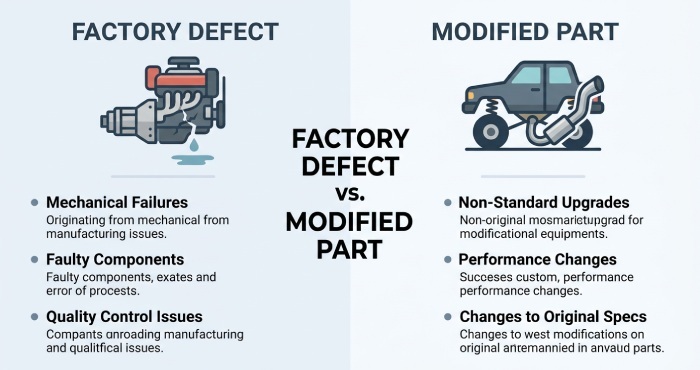
Manufacturers usually cannot cancel an entire warranty just because aftermarket parts were added. Under the Magnuson-Moss Warranty Act, they must prove the modification directly caused the damage or defect. Repair records, service history, and maintenance documents are often important in these disputes.
Why Professional Installation Matters
Professional installation by certified technicians can help prove that vehicle modifications were done correctly. Receipts, installation records, and written statements from qualified installers may support the owner if warranty coverage is challenged. Using experienced professionals instead of unverified shops can reduce the risk of disputes over aftermarket modifications.
What Happens to Financed Modifications During a Buyback
In a lemon law buyback under the Song-Beverly Consumer Warranty Act, the manufacturer generally refunds the amounts paid for the vehicle and may also satisfy the outstanding auto loan balance. However, aftermarket modifications are typically treated separately. Dealer-installed accessories included in the original sales contract are more likely to be considered as part of the refund, while modifications financed through separate third-party loans or credit accounts are often excluded from the manufacturer’s responsibility. Consumers in Borrego Springs should carefully review all financing agreements and modification records to understand how custom parts and upgrades may affect a potential lemon law claim.
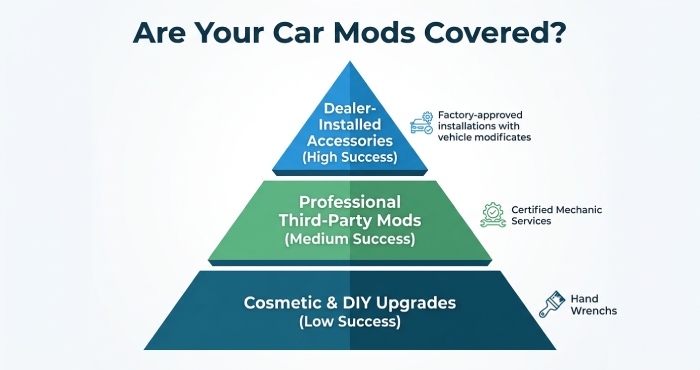
Dealer-Installed vs. Third-Party Aftermarket Modifications
Dealer-installed or manufacturer-approved accessories are more likely to be included in a lemon law refund because they are often part of the original vehicle sale and warranty coverage. However, third-party aftermarket modifications like turbochargers, suspension lifts, or tuning chips can complicate a claim, especially if the manufacturer argues they caused or contributed to the defect. Even so, consumers may still recover certain modification-related costs if a Lemon Law attorney in California can demonstrate that those expenses qualify as incidental or consequential damages under California law.
Recovering the Value of Aftermarket Parts, Labor, and Accessories
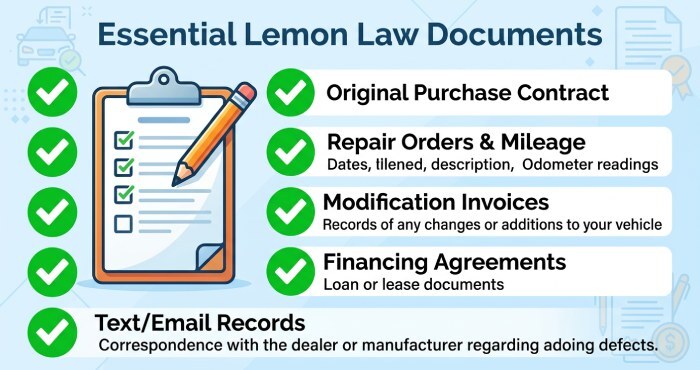
Recovering the value of aftermarket parts, labor, and accessories depends heavily on proof. The stronger the documentation, the better the argument for client compensation. Receipts, invoices, installation details, photographs, repair records, financing documents, and communications with the dealership or manufacturer can all help establish what was added, when it was added, who installed it, and whether it affected the defect.
What May Be Recoverable
Possible recoverable costs in a California Lemon Law claim may include factory-approved accessories, dealer-installed upgrades, towing charges, diagnostic fees, rental car expenses, and other losses connected to the manufacturer’s failure to repair the vehicle within a reasonable number of attempts. In some situations, professional installation costs may also be recoverable if the work was part of the original purchase or directly tied to ongoing defects.
Purely cosmetic aftermarket modifications—such as custom wheels, wraps, lighting, upgraded audio systems, or interior customization—are often more difficult to recover. Performance-related changes like engine tuning, turbochargers, superchargers, or suspension modifications may face additional scrutiny because manufacturers may argue the alterations affected vehicle performance. Still, California Lemon Law claims under the Song-Beverly Consumer Warranty Act depend heavily on evidence, repair history, warranty coverage, and whether the manufacturer can actually prove the modification caused the defect.
Consumers seeking legal advice may want to consult a Lemon Law attorney San Diego ca to review the buyback documents before surrendering the vehicle. A skilled Lemon Law Lawyer can evaluate whether the refund should include dealer-installed equipment, accessory financing, or related expenses. For broader statewide guidance, a Lemon law attorney in California can help determine whether the manufacturer’s position is supported by the Song-Beverly Consumer Warranty Act, the Magnuson-Moss Warranty Act, and applicable warranty coverage rules.
Latest Statistics on Vehicle Modification Financing and Lemon Law Buybacks
| Statistical Data | Why It Matters in Lemon Law Buybacks |
| 2% auto loan delinquency rate in 2026 | More owners face payment problems during buyback claims. |
| 15.3% increase in serious loan delinquencies | Financing custom parts may increase financial risks. |
| Average auto loan balance reached $28,000 | Higher loan amounts can affect reimbursement calculations. |
| Subprime delinquency rate exceeded 9% | High-risk borrowers may face added repayment pressure. |
| Average monthly car payment reached $767 | Modified vehicles can create larger financial losses. |
Practical Steps Before Modifying, Financing, or Filing a Lemon Law Claim
Practical Steps Before Modifying or Filing a Claim
- Review the warranty and purchase documents first
- Ask the dealer if modifications may affect warranty coverage
- Get all warranty-related answers in writing
- Be careful with engine tuning, turbochargers, lift kits, and suspension changes
- Use qualified or authorized installers whenever possible
Checklist for Protecting Your Claim
- Keep all receipts, repair orders, and installation records
- Save emails, text messages, financing documents, and photos
- Make sure repair visits include mileage, dates, symptoms, and repair attempts
- Document if the problem keeps returning
- Request written proof if the manufacturer blames aftermarket parts
- Manufacturers usually cannot deny coverage just because modifications exist
- Consider speaking with an experienced lemon law attorney before accepting a settlement
- Many lemon law attorneys work on a contingency fee basis
- Online case evaluations may help determine if financed upgrades are recoverable