
Why Conflicting Repair Records Matter in California Lemon Law Claims
Conflicting repair records can significantly affect a California Lemon Law claim because repair history may provide important evidence of whether a vehicle defect was repeatedly reported, inadequately repaired, or documented inconsistently by a dealership. Under the Song-Beverly Consumer Warranty Act, a consumer may have a qualifying claim when a manufacturer or its authorized repair facilities are unable to repair a covered defect after a reasonable number of repair attempts during the applicable warranty period.
A skilled lemon law lawyer reviews whether the defective vehicle was covered by the manufacturer’s express warranty, whether the problem affected the vehicle’s use, value, or safety, and whether the repair attempts satisfy the statutory requirements under California Civil Code section 1794. This applies to many vehicle types, including cars, Motorcycles, Recreational vehicles, Motor homes, business-use vehicles, used vehicles still covered by the original new-car warranty, and vehicles purchased or leased primarily for family or household purposes.
How Disputed Records Affect Claim Eligibility
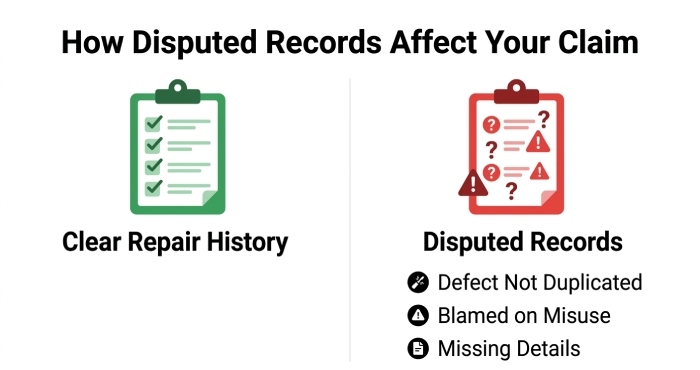
Conflicting records may affect how a California Lemon Law claim is evaluated because manufacturers may argue that a defect could not be duplicated, resulted from misuse, or was corrected within applicable mileage or time limits. Dealership repair records can therefore play an important role in determining what defect was reported, what repairs were attempted, and how the manufacturer responded to the repair history.
A lemon law attorney uses technical knowledge and legal guidance to determine whether the repair history supports repurchase, refund, compensation, settlement, or a replacement vehicle. If a dealership’s documentation is incomplete or inconsistent, the case evaluation must account for both what the records say and what they omit.
Collecting and Comparing Repair Orders, Invoices, and Service Notes
A California Lemon Law investigation begins with collecting every available repair order, invoice, diagnostic printout, inspection sheet, warranty claim record, rental receipt, and communication with the dealership or manufacturers. A lemon law lawyer will compare the customer complaint, technician findings, parts replaced, mileage, dates, and final disposition of each visit.
Consumers seeking a San Diego lemon law attorney should bring a complete repair history, purchase or lease agreement, warranty documents, and any emails or text messages exchanged with service advisors. These records can help an attorney compare the consumer’s account with dealership documentation and identify inconsistencies that may be relevant to the claim.
What a Lemon Law Attorney Looks For
A lemon law attorney may examine whether the same vehicle defect appears under different descriptions. For example, a transmission hesitation might be recorded as “rough shifting,” “delayed engagement,” “software update,” or “could not duplicate.” Although these descriptions differ, they may reveal a continuing defect.
Key Repair Record Details
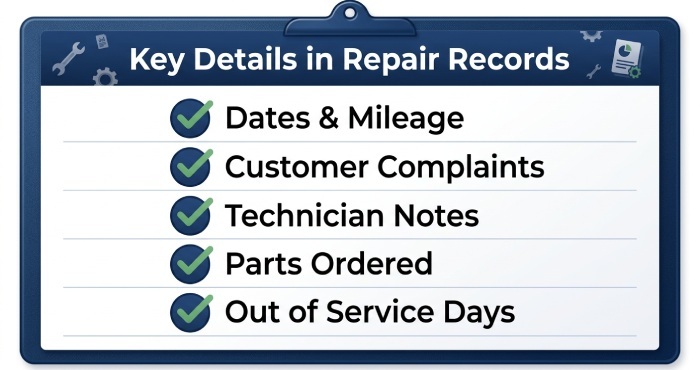
Important details include:
- Dates and mileage for each service visit
- Customer complaints as written by the service advisor
- Technician notes and diagnostic codes
- Parts ordered, replaced, or backordered
- Whether the vehicle was out of service
- Whether repairs occurred within warranty coverage
- Whether the dealer contacted the manufacturer for assistance
Why the Customer Complaint Line Matters
The customer complaint line is especially important because it often captures the earliest evidence of the vehicle defect. If later invoices soften or change the complaint, a lemon law lawyer may use earlier repair history to challenge the manufacturer’s version of events.
Identifying Gaps, Alterations, or Inconsistencies in Dealership Documentation
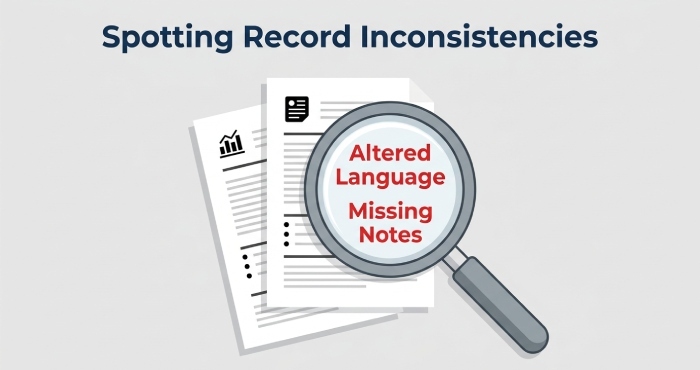
Conflicting repair records often arise from incomplete service notes, inconsistent mileage entries, missing pages, altered language, or vague “no problem found” statements. A California Lemon Law lawyer may investigate whether dealer practices caused the repair history to understate the seriousness or frequency of the defect.
For example, if one invoice states that the vehicle was test-driven and another internal note shows no road test occurred, that inconsistency may be significant. If a repair order says “customer declined repair” but the consumer denies being offered a repair, the attorney may request additional dealership records. This type of negligence investigation can expose whether repair opportunities were mishandled.
Red Flags in Dealership Records
A lemon law attorney may look for red flags such as:
- Repeated “could not duplicate” findings despite ongoing complaints
- Missing diagnostic trouble codes
- Repair orders closed and reopened to reduce days out of service
- Warranty coverage denials without explanation
- Internal notes that contradict customer-facing invoices
- Statements that shift blame to the consumer without evidence
Altered or Incomplete Entries
If the records appear altered, a lemon law lawyer may compare printed invoices with electronic repair data, manufacturer warranty submissions, and dealership management system notes. The goal is to determine whether the repair history accurately reflects the consumer’s experience and whether the manufacturers had a reasonable number of repairs.
A california lemon law lawyer can also evaluate whether the rebuttable presumption applies under the Song-Beverly Consumer Warranty Act, especially when a serious safety-related vehicle defect persists or the vehicle spends substantial time out of service.