
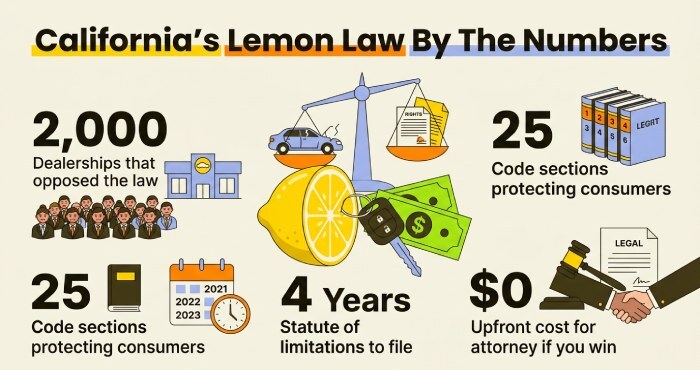
Here’s a statistic that should make every California car buyer sit up straight: 2,000 franchised new car dealerships actively organized to defeat the very law designed to protect you from getting stuck with a lemon. They lost — and that’s exactly why California’s Lemon Law remains one of the most powerful consumer protection tools in the country.
If you’ve ever found yourself trapped in an endless cycle of repair visits, loaner cars, and apologetic service advisors while your brand-new vehicle refuses to work properly, you’re living the nightmare this law was designed to end. But here’s the thing most consumers don’t realize: the protections are only as good as your knowledge of how to use them.
TL;DR: California Civil Code § 1793.2 lets you demand a full refund or replacement vehicle if your new car isn’t fixed after 4 repair attempts (or just 2 for safety defects), or 30+ days in the shop. Manufacturers must pay your attorney fees if you win — meaning legal help typically costs you nothing upfront. The law covers EVs too, and it’s among the strongest in the nation.
Key Takeaways
- Four strikes and they’re out: After 4 failed repair attempts for the same problem (or just 2 for safety issues), your vehicle is presumed to be a lemon
- 30 days is the magic number: If your car spends 30+ cumulative days in the shop, you’ve likely got a valid claim
- Free legal representation: Under California Lemon Law, you generally do not pay your attorney’s fees out of pocket because the manufacturer may be required to cover reasonable attorney fees if you prevail. A California Lemon Law lawyer can handle your claim on your behalf.
- Early reporting = bigger refund: Your buyback amount is reduced based on mileage when you first reported the defect, not when you file a claim
- EVs are fully covered: Battery degradation, charging failures, and software glitches all qualify as defects under the law
- All 50 states have lemon laws: But California’s is consistently ranked among the most consumer-friendly in the nation
The Industry Didn’t Want You to Have These Rights
Let’s start with the elephant in the showroom. When California’s Lemon Law was making its way through the legislature, it didn’t exactly receive a warm welcome from the automotive industry. According to academic research published on SSRN, two thousand franchised new car dealerships banded together through an industry group called California Advocates Inc. to actively oppose the law’s passage.
They lost. And that resistance tells you everything you need to know about why these protections matter. Industry doesn’t mobilize against toothless regulations. The organized opposition demonstrates that California’s Lemon Law creates meaningful accountability — the kind that actually costs manufacturers money when they sell defective products.
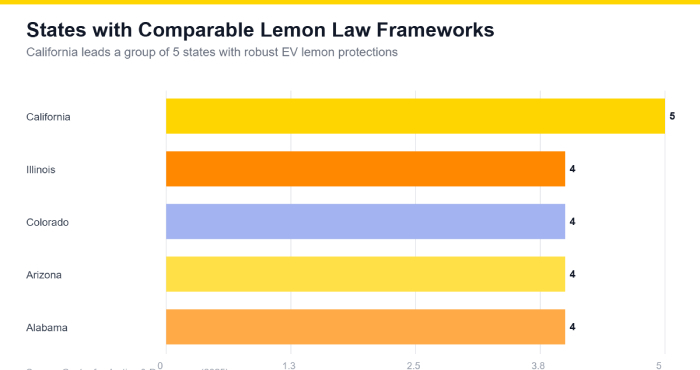
States with Comparable Lemon Law Frameworks — Source: Center for Justice & Democracy (2025)
This chart illustrates just how sweeping California’s framework is compared to states with narrower protections. California covers leased vehicles, certain used cars, and offers some of the lowest thresholds for presuming a vehicle is a lemon.
What Actually Makes a Car a “Lemon” Under California Law?
The word “lemon” gets thrown around casually, but in California, it carries a precise legal definition. Under California Civil Code Section 1795.4, a lemon is formally defined as a new car that has not been repaired after a “reasonable number of attempts.”
So what counts as “reasonable”? California has established clear thresholds that create a legal presumption your vehicle qualifies:
When Your Car Becomes a Lemon — Source: California Civil Code § 1793.2
Notice that safety-related defects — think brake failures, steering problems, or airbag malfunctions — require only 2 repair attempts before the presumption kicks in. That’s not a typo. If your car has a defect that could kill you, the law gives manufacturers exactly two chances to fix it.
The “Substantially Impairs” Standard
Not every annoyance qualifies. The defect must “substantially impair” your vehicle’s use, value, or safety. A squeaky interior panel or minor paint imperfection probably won’t cut it. But problems affecting drivability, safety systems, or core functionality absolutely do — and some issues that seem minor may have safety implications. That dashboard warning light that keeps illuminating? It could indicate underlying safety system problems that absolutely qualify.
The Legal Framework: California Civil Code § 1793.2 et seq.
California’s Lemon Law isn’t a single isolated statute — it’s a comprehensive framework spanning California Civil Code sections 1793.2 through 1793.26. That “et seq.” (Latin for “and the following”) means multiple interconnected sections work together to cover what constitutes a defect, how many repair attempts are reasonable, what remedies you’re entitled to, and how the entire process unfolds.
Why does this matter? Because unlike informal policies or voluntary manufacturer programs, this creates legally enforceable rights that manufacturers cannot simply ignore or negotiate away. When you purchase or lease a new motor vehicle in California that comes with a manufacturer’s written warranty, you’re automatically covered — no additional action required.
California’s Lemon Law By The Numbers — Source: SSRN Academic Paper (2007) & California Civil Code
What Manufacturers Are Legally Required to Do
Let’s be crystal clear about this: manufacturers are legally obligated to repair defects. According to the LemonLawCalifornia.org consumer brochure, this isn’t a courtesy or goodwill gesture — it’s a mandate backed by law. Here’s what they must do:
- Repair defects that substantially impair use, value, or safety within the warranty period
- Provide a refund or replacement when reasonable repair attempts don’t fix the problem
- Cover your attorney fees if you prevail in a lemon law claim
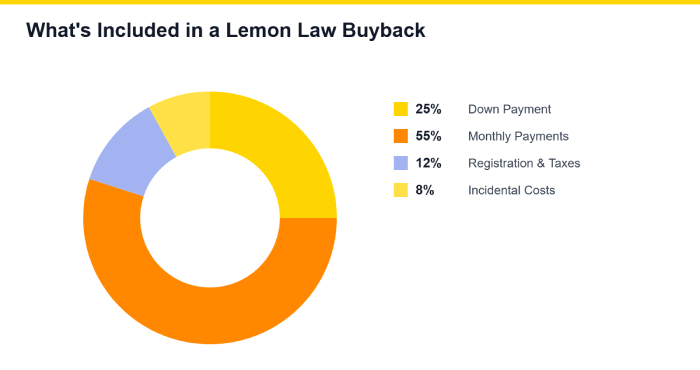
- Pay incidental costs including registration fees, taxes, rental car expenses, and towing
What’s Included in a Lemon Law Buyback — Source: LemonLawCalifornia.org (2020)
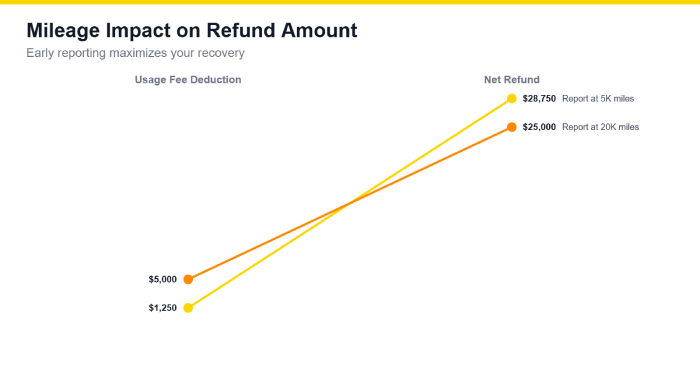
The buyback calculation works in your favor — you recover virtually everything you’ve paid into the vehicle. The only deduction is a “usage fee” based on mileage at the time you first reported the defect, calculated as: (miles at first repair ÷ 120,000) × purchase price.
Electric Vehicles: Yes, They’re Fully Covered
With EVs becoming increasingly common, a natural question arises: do lemon laws apply to electric vehicles? The answer is an emphatic yes. According to the Center for Justice & Democracy’s 2025 Electric Vehicle Safety Report, California’s consumer rights provisions apply to EVs just as they do to traditional internal combustion vehicles.
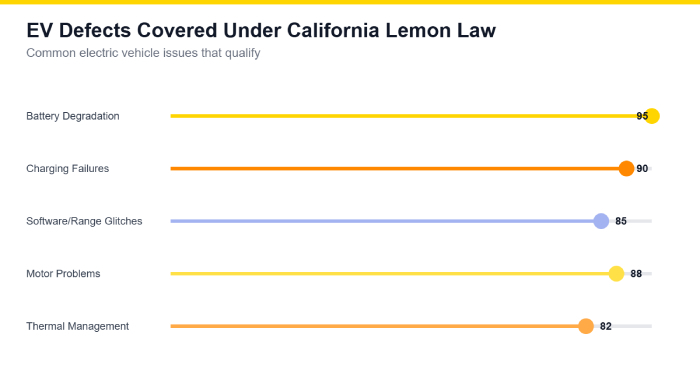
EVs present unique defect categories that traditional lemon laws didn’t anticipate but generally cover:
EV Defects Covered Under California Lemon Law — Source: Center for Justice & Democracy (2025)
Battery degradation, charging system failures, and software glitches affecting range calculations can all qualify as defects that substantially impair use, value, or safety. If your EV keeps leaving you stranded with phantom range readings or refuses to charge properly, you have rights.
How California Stacks Up Nationally
All 50 states have some form of lemon law, but they’re not created equal. California’s framework is consistently ranked among the most consumer-friendly in the nation. The Center for Justice & Democracy identifies at least four other states with comparable statutory frameworks: Alabama (Code § 8-20A-3), Arizona (Rev. Stat § 44-1265), Colorado (Rev. Stat. § 42-10-106), and Illinois (815 ILCS 380).
State Lemon Law Comparison — Source: Center for Justice & Democracy (2025)
California’s advantages include broader coverage (leased vehicles and certain used cars qualify), lower thresholds for the lemon presumption, and the crucial requirement that manufacturers pay prevailing consumers’ attorney fees.
The Claims Process: A Step-by-Step Breakdown
Understanding your rights is essential, but knowing how to exercise them is what gets results. Here’s exactly how the process works:
Step 1: Document Everything From Day One
Your case lives or dies on evidence. From the moment you notice a problem:
- Request and retain copies of all repair orders
- Note dates, mileage at each service visit, and specific symptoms reported
- Keep records of rental car expenses, towing costs, and other incidental expenses
- Save all correspondence with the dealer and manufacturer
- Consider keeping a written log of problems as they occur
Step 2: Give Them a Reasonable Chance to Fix It
You can’t declare your car a lemon after one failed repair (unless the defect is immediately life-threatening). Take the vehicle to an authorized dealership, clearly describe the problem each time, and allow them to attempt repairs. Count each visit carefully — this becomes your evidence.
Step 3: Escalate to the Manufacturer
If dealership repairs aren’t working, contact the manufacturer’s customer service directly. Send written notice describing the defect, the number and dates of repair attempts, and your belief that the vehicle may qualify as a lemon under California Civil Code § 1793.2. Request either a refund or replacement.
Step 4: Consult a Lemon Law Attorney
Here’s the game-changer most consumers don’t realize: if you win, the manufacturer pays your attorney fees. This means lemon law attorneys typically work on contingency with no upfront cost to you. Given this, there’s virtually no reason not to at least get a consultation.
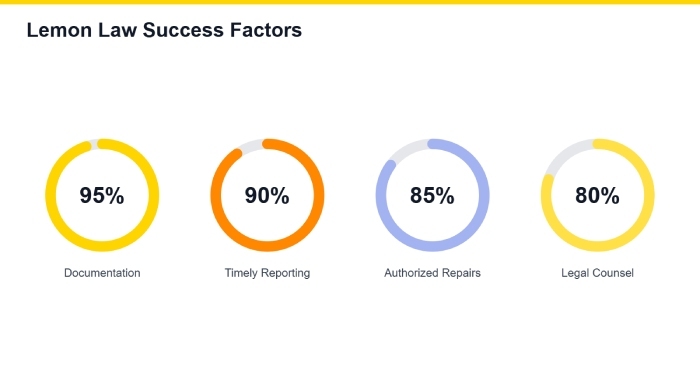
Lemon Law Success Factors — Source: California Lemon Attorneys (2023)
Notice how the process favors the informed consumer. Early documentation and timely escalation are your best weapons.
The Five Mistakes That Kill Otherwise Valid Claims
After reviewing countless cases, certain patterns emerge. These are the errors that undermine even strong claims:
The 5 Claim-Killing Mistakes — Source: California Lemon Attorneys (2023)
Mistake #1: Failing to Document Repair Attempts
The most common error is poor record-keeping. If you can’t prove how many times you brought the vehicle in for the same problem, your claim becomes nearly impossible to establish. Always — always — obtain and retain repair orders.
Mistake #2: Using Independent Mechanics
Warranty repairs must generally be performed by authorized dealers. If you take your vehicle to an independent shop, those repair attempts may not count toward your lemon law claim, and you could potentially void warranty coverage entirely.
Mistake #3: Waiting Too Long
California has a four-year statute of limitations, which seems generous until you realize: evidence gets lost, memories fade, and — critically — the mileage offset grows larger the more you drive. Every mile you put on after the first defect report reduces your potential refund.
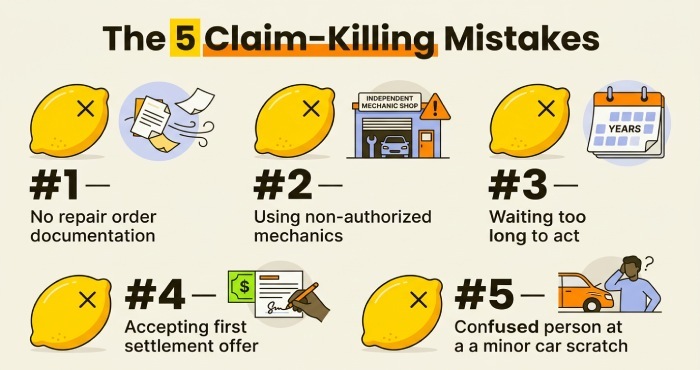
Mistake #4: Accepting Lowball Settlements
Manufacturers know most consumers don’t understand their full rights. Initial settlement offers are often significantly below what you’re entitled to. Since attorney representation typically costs you nothing out of pocket, there’s no good reason to accept any offer without legal review.
Mistake #5: Not Understanding What Qualifies
Some consumers pursue claims for truly minor issues; others walk away from legitimate claims because they assume their problem “isn’t serious enough.” An attorney can help you evaluate whether your specific issues meet the “substantially impairs” standard.
What This Means for You: Action Steps
If you’re currently dealing with a vehicle that’s spending more time in the repair shop than on the road, here’s your playbook:
- Start documenting immediately — even if you’re not sure you have a lemon, meticulous records protect your options
- Report defects early and in writing — the sooner you document, the lower your mileage at first report, maximizing your potential refund
- Count your repair attempts — review all service records for the same problem; each distinct issue counts separately
- Calculate your out-of-service days — add up every day at the dealership, including weekends and holidays
- Don’t sign anything without attorney review — settlement offers often lowball you significantly
- Consult a lemon law attorney — it typically costs nothing upfront, and you’ll know exactly where you stand
Mileage Impact on Refund Amount — Source: California Civil Code § 1793.2
The timeline matters. Acting within 18 months puts you firmly within warranty protection; waiting until year four risks evidence loss and a reduced recovery due to mileage.
The Bottom Line
California’s Lemon Law exists because consumers fought for it — against the organized opposition of 2,000 dealerships who understood exactly how much accountability it would create. That fight was worth it. Today, you have legally enforceable rights that manufacturers cannot simply ignore.
But here’s the catch: the law doesn’t automatically protect you. You have to know your rights, document your situation, and take affirmative steps to invoke those protections. The manufacturers certainly won’t volunteer to buy back your defective vehicle out of the goodness of their hearts.
Your vehicle is likely one of the largest purchases you’ll ever make. California law ensures you don’t have to accept a defective one. If you’re trapped in that cycle of breakdowns and repairs, know this: you have options, the law is on your side, and — thanks to fee-shifting — pursuing those options typically costs you nothing upfront.
Don’t let a lemon sour your investment. The protections are there. Use them.
References
- California Lemon Attorneys (2023). California Lemon Law and Auto Dealer Fraud FAQ. https://californialemonattorneys.com/wp-content/uploads/californialemonattorneys.com-California-Lemon-Law-and-Auto-Dealer-Fraud-FAQ.pdf
- California Department of Tax and Fee Administration (2024). Audit Manual Chapter 6: Vehicle, Vessel, and Aircraft Dealers. https://cdtfa.ca.gov/taxes-and-fees/manuals/am-06.pdf
- California Supreme Court (2021). Filing No. S266034 – Respondent Request for Judicial Notice. https://supreme.courts.ca.gov/sites/default/files/supremecourt/default/documents/12-360.8-s266034-resp-req-jud-notice-exhs-vol-7-of-9-rec%27d-060121.pdf
- California Supreme Court (2023). Filing S274625 – Respondent Request for Judicial Notice. https://supreme.courts.ca.gov/sites/default/files/supremecourt/default/documents/37-1160-s274625-resp-req-jud-notice-082323.pdf
- LemonLawCalifornia.org (2020). Lemon Aid for Consumers Brochure. http://lemonlawcalifornia.org/brochure.pdf
- SSRN (2007). The Legislature, ‘Lemons,’ and Legal Endogeneity – Academic Paper. https://papers.ssrn.com/sol3/Delivery.cfm/SSRN_ID997931_code238096.pdf?abstractid=997931&mirid=1&type=2
- Center for Justice & Democracy (2025). Highway to the Danger Zone: Electric Vehicle Safety Report. https://www.centerjd.org/system/files/ElectricVehiclesF4R2.pdf