
If you buy a defective car in California, you have some of the strongest legal protections in the country. But you do not have the strongest. That distinction may surprise you—and understanding why could save you thousands of dollars depending on where you live, where you buy, and what kind of vehicle you purchase.
California’s Song-Beverly Consumer Warranty Act, popularly known as the Lemon Law, has been the gold standard of automotive consumer protection for decades. It provides full-warranty-period coverage, up to triple damages for willful violations, and mandatory manufacturer-paid attorney fees. But a series of legislative changes in 2024 and 2025—combined with a landmark California Supreme Court ruling—have reshaped the landscape in ways that weaken some of those protections. Meanwhile, states like New Jersey, Hawaii, Massachusetts, and Washington have provisions that outperform California in specific, meaningful ways.
This article breaks down, category by category, how California’s lemon law actually compares to the other 49 states and Washington, D.C. Every statistic is drawn from primary-source documents: official state lemon law summaries published by BBB National Programs, legislative analyses from the California Assembly Judiciary Committee, FTC audit reports, and the National Consumer Law Center’s compendium of state warranty laws. These aren’t opinions or rankings from attorney websites. They are the actual documents that define the law.
California’s Biggest Advantage: Full Warranty Coverage
The single most important thing that sets California apart from most other states is the duration of its lemon law protection. According to the BBB National Programs California Lemon Law Summary—a standardized PDF document that every state’s lemon law provisions are catalogued in—Song-Beverly “does not specifically define a ‘lemon law rights period,’ but applies to the entire manufacturer’s written warranty.”
This is extraordinary. In most states, your lemon law protection expires after a fixed window regardless of your warranty. Connecticut covers you for 2 years or 24,000 miles (BBB CT Summary PDF). New Jersey’s coverage runs for 2 years or 24,000 miles (BBB NJ Summary PDF). Many states—Alabama, Colorado, Illinois, Michigan, Ohio—cap it at just one year.
In California, if your vehicle has a five-year, 60,000-mile powertrain warranty, your lemon law protection extends for that entire period. If your electric vehicle has an eight-year battery warranty, you’re covered for eight years on battery defects. No other major state matches this breadth of coverage.
What this means for you: If you are buying a vehicle with a long warranty—especially an EV with an 8–10 year battery warranty—California’s lemon law gives you protection that most other states simply do not. This is California’s single greatest structural advantage, and it applies to you for as long as your manufacturer warranty is active.
Where California Falls Short: Repair Attempts and Days Out of Service
California’s lemon law presumption—the point at which the law assumes your car is a lemon—is actually less consumer-friendly than several other states. The BBB California Summary PDF details the thresholds: within the first 18 months or 18,000 miles, the presumption triggers after 4 repair attempts for the same non-safety defect, 2 attempts for safety defects likely to cause death or serious injury, or 30 calendar days out of service.
Now compare those thresholds to what other states require:
New Jersey: 3 Attempts, 20 Days
New Jersey’s lemon presumption triggers after just 3 repair attempts or 20 calendar days out of service (BBB NJ Summary PDF). That is one fewer repair attempt and ten fewer days than California requires. For a consumer stuck with a chronically defective vehicle, that gap is the difference between months of additional frustration and a resolution.
Massachusetts: 15 Business Days
Massachusetts uses the shortest out-of-service threshold in the nation: 15 business days (BBB MA Lemon Law Chart PDF). That is roughly three calendar weeks, versus California’s 30 calendar days (about 4.5 weeks). If your car has been sitting at the dealership for over three weeks, Massachusetts says that’s enough. California makes you wait an extra week and a half.

Hawaii: 1 Attempt for Life-Threatening Defects
Hawaii has the strictest safety-defect threshold in the nation. The BBB Hawaii Summary PDF and the Hawaii DCCA’s SCAP Consumer Handbook confirm that a vehicle qualifies as a lemon after just one repair attempt for a defect “likely to cause death or serious bodily injury if the vehicle is driven.” California requires two attempts for the same category of defect.
The logic behind Hawaii’s rule is compelling: a consumer should not have to risk their life twice for a manufacturer to acknowledge a safety defect. California’s two-attempt threshold means a consumer with failing brakes or a fire-prone battery could be sent back onto the road after one failed repair attempt before the legal presumption kicks in.
What this means for you: If you are comparing lemon law protections across states—perhaps because you are buying a vehicle across state lines, you are military and relocating, or you are deciding where to register—the repair-attempt and days-out-of-service thresholds matter enormously. A lower threshold means a faster path to resolution. California’s thresholds are average, not best-in-class.
Where California Excels: Penalties, Attorney Fees, and Financial Remedies
If California’s thresholds are middle-of-the-pack, its financial provisions are among the strongest in the country. The BBB California Summary PDF details the remedy structure:
Civil penalty of up to 2x actual damages for willful manufacturer violations. If a manufacturer knowingly sold you a lemon and refused to buy it back, the court can award you up to three times your actual damages—the refund itself plus a penalty of twice that amount. This is not a theoretical provision. California courts routinely award civil penalties in cases where manufacturers delay or stonewall legitimate claims.
Mandatory manufacturer-paid attorney fees for prevailing consumers. The PDF states that a consumer who prevails “shall be allowed by the court to recover costs and expenses, including reasonable attorney’s fees based on actual time expended.” This one-way fee-shifting provision is what makes the entire lemon law system work. It means you can hire an attorney without paying out of pocket, because the manufacturer pays your legal costs if you win.
Now compare this with Colorado. The BBB Colorado Summary PDF reveals the harshest anti-consumer provision in any state lemon law: attorney fees go to the “prevailing side.” This means that if you file a lemon law claim in Colorado and lose, you can be ordered to pay the manufacturer’s legal costs. The chilling effect of this provision cannot be overstated. It means that a Colorado consumer with a borderline case faces the risk of owing thousands of dollars to a multinational corporation if a judge disagrees with their claim. In California, you risk nothing by filing. In Colorado, you risk your savings.
California also uses a more consumer-friendly mileage offset formula than several states. The buyback amount is reduced by: (Miles at First Repair / 120,000) x Purchase Price. New Jersey uses 100,000 as the divisor (BBB NJ PDF), which results in a larger deduction from the consumer’s refund. On a $40,000 vehicle with 10,000 miles at first repair, California’s formula deducts $3,333; New Jersey’s deducts $4,000—a $667 difference in the manufacturer’s favor.
What this means for you: California’s penalty structure is a genuine deterrent against manufacturer bad faith. The combination of 2x civil penalties and mandatory attorney fees creates a system where manufacturers have strong financial incentives to settle legitimate claims rather than fight them. If you are in California and have a valid lemon law claim, the financial architecture of the law is on your side in ways that most other states cannot match.
The Used Car Gap: Where California Has Fallen Behind
This is the area where California’s lemon law has deteriorated the most—and where several other states now offer significantly better protection.
A Connecticut General Assembly research report—a government PDF from the CT legislature—provides the definitive count: only 10 states have separate used car lemon laws: Arizona, Connecticut, Hawaii, Illinois, Massachusetts, Minnesota, New Jersey, New Mexico, New York, and Rhode Island. In five of those states (Hawaii, New Jersey, New York, Massachusetts, and Rhode Island), a dealer who cannot fix the car must give the consumer a full refund.
The NCLC’s 2026 Compendium of State Used Car Warranty Laws—a comprehensive PDF white paper from the National Consumer Law Center—provides the statutory text for every state’s used car protections. It reveals that New Jersey’s used car law is the most protective in the country: dealers must provide mandatory warranties on all used vehicles up to 7 model years old with under 100,000 miles, with tiered coverage ranging from 90 days (under 24,000 miles) to 30 days (60,000–100,000 miles). If the dealer cannot fix a defect after 3 attempts or 20 cumulative days, the consumer gets a full refund.
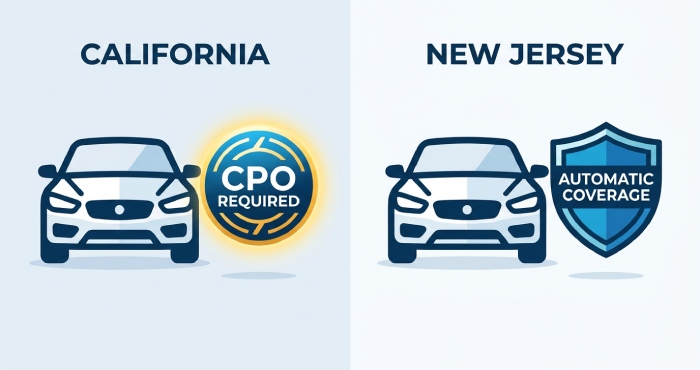
California, by contrast, no longer has effective used car lemon law protections for most buyers. Following the California Supreme Court’s October 2024 decision in Rodriguez v. FCA US, LLC, used vehicles with remaining manufacturer warranties do not qualify as “new motor vehicles” under the Song-Beverly Act unless a new Certified Pre-Owned (CPO) warranty was issued at the time of sale. This ruling stripped lemon law protections from the vast majority of used car buyers in the state.
The SB 26 Senate Judiciary analysis confirms that the 2025 reforms clarified this restriction: “used vehicle buyers must have an active manufacturer warranty or a certified pre-owned (CPO) warranty to qualify for lemon law protection.”
If you are buying a used car in 2026, a consumer in New Jersey has dramatically more legal protection than a consumer in California. That is a reversal from even five years ago.
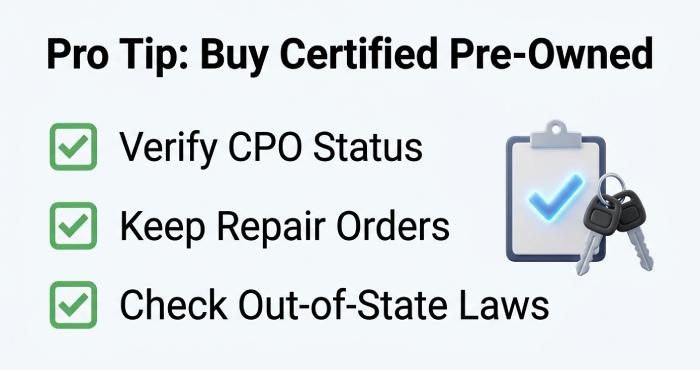
What to do: If you are purchasing a used vehicle in California, insist on CPO certification with a new manufacturer warranty issued at the point of sale. This is now the only reliable path to full Song-Beverly lemon law protection for used car buyers. Without CPO certification, your remedies are limited to breach-of-warranty claims under the federal Magnuson-Moss Act or implied warranty claims under the UCC—both of which provide weaker remedies, slower resolution, and no civil penalty provision.
The 2024–2025 Reforms: How AB 1755 and SB 26 Changed California’s Law
Two bills signed into law in the span of seven months fundamentally changed how California’s lemon law operates. Understanding these changes is essential for anyone filing—or considering filing—a lemon law claim in the state.
AB 1755: The Procedural Overhaul
The California Assembly Judiciary Committee’s analysis of AB 1755—a 20+ page government PDF—is the most important primary source for understanding this law. It reveals the crisis that prompted the bill: lemon law case filings nearly doubled from 14,892 in 2022 to 22,655 in 2023. The California Judges Association reported that nearly 10% of all civil filings in Los Angeles County were lemon law cases. Courts were projecting that upward of 30,000 cases would be filed by the end of 2024.
AB 1755’s key changes, as documented in the legislative analysis PDF:
- 6-year absolute statute of limitations from the date of vehicle delivery, replacing the prior 4-year-from-discovery standard. This is particularly significant for EV owners: if your car has an 8-year battery warranty, the 6-year cap could expire before your warranty does.
- 30-day pre-suit written notice requirement before filing a lawsuit seeking civil penalties. You must notify the manufacturer by certified mail or email with your name, VIN, description of each defect, and a clear demand for repurchase or replacement.
- Mandatory early discovery and mediation timelines designed to reduce discovery disputes that were clogging courts. The Judiciary Committee’s PDF notes this was supported by the California Judges Association.
- $50/day penalty imposed on manufacturers who fail to complete a buyback or replacement within 60 days of agreeing to a settlement—a new consumer-friendly enforcement mechanism.
Governor Newsom’s AB 1755 signing message—another government PDF—acknowledged that some manufacturers found the procedures “unworkable” and committed to a follow-up bill. That bill became SB 26.
SB 26: The Opt-In Compromise
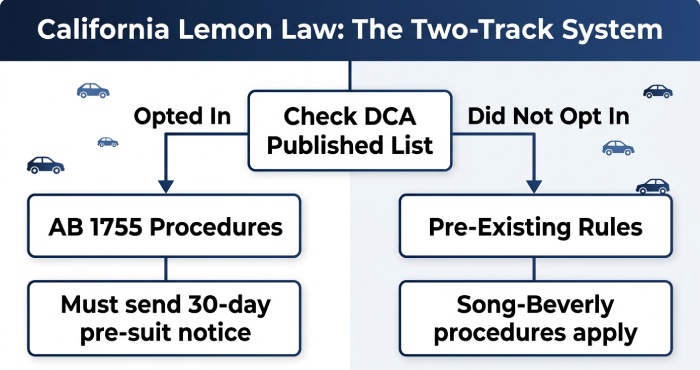
The SB 26 Senate Judiciary analysis explains the compromise: SB 26 makes AB 1755’s procedures optional. Manufacturers make an irrevocable 5-year election to operate under the new streamlined procedures or remain under the pre-existing lemon law rules. This creates a two-track system where the rules governing your claim depend on which manufacturer built your vehicle.
The SB 26 analysis PDF lists which manufacturers opted in: Tesla, Toyota, Volkswagen, Honda, Subaru, Rivian, Lucid, and Scout Motors all elected to operate under the AB 1755 framework. GM, Ford, and Stellantis’s positions are documented in the analysis but may vary. This means the procedures you follow, the deadlines you face, and the penalties available to you depend on who made your car.
What to do: Before taking any legal action on a lemon law claim in California, check the California DCA’s published list of manufacturer elections to determine which set of rules applies to your vehicle’s manufacturer. If your manufacturer opted into AB 1755, you must send a formal pre-suit notice at least 30 days before filing a lawsuit. If they did not opt in, the pre-existing Song-Beverly procedures apply. Getting this wrong could delay your claim by months.
The State-by-State Scorecard: Where Each State Stands
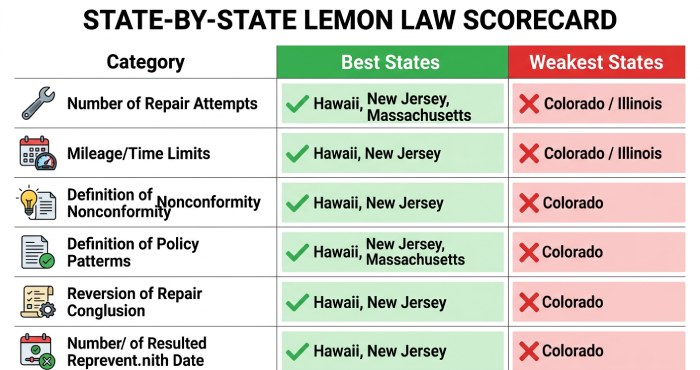
Based on the standardized PDF summaries published by BBB National Programs for each state, here is how California compares across the key dimensions that matter most to consumers:
Repair Attempts Before Presumption
- Best: Hawaii – 1 attempt for safety defects (PDF)
- Strong: New Jersey – 3 attempts (PDF)
- Average: California – 4 attempts / 2 for safety (PDF)
- Weak: Many states – 4 attempts, no safety exception
Days Out of Service
- Best: Massachusetts – 15 business days (PDF)
- Strong: New Jersey – 20 calendar days
- Average: California – 30 calendar days
- Weak: Colorado – 30 business days (≈42 calendar days)
Coverage Period
- Best: California – Entire manufacturer warranty period
- Strong: Connecticut, New Jersey, Washington – 2 years / 24,000 miles
- Weak: Alabama, Colorado, Illinois, Michigan, Ohio – 1 year only
Civil Penalties
- Best: California – Up to 2x actual damages for willful violations
- Average: Most states have some penalty provision
- None: Colorado, Illinois, and others – No penalty for manufacturer bad faith
Attorney Fee Risk
- Best: California – One-way fee-shifting (manufacturer pays if consumer wins)
- Worst: Colorado – Two-way fee-shifting (loser pays, including consumers) (PDF)
Used Car Protections
- Best: New Jersey – Mandatory dealer warranties up to 100K miles / 7 years old
- Strong: New York, Massachusetts, Rhode Island – Tiered used car protections
- Weak (post-2024): California – CPO vehicles only after Rodriguez v. FCA
- None: 40+ states have no standalone used car lemon law (CT Legislature PDF)
The Federal Backstop: What Magnuson-Moss Provides Everywhere
Regardless of which state you live in, the federal Magnuson-Moss Warranty Act (15 U.S.C. §§2301–2312) provides baseline warranty protection for any consumer product sold with a written warranty. The FTC’s 2023 Audit of BBB Auto Line—a detailed government PDF submitted to the Federal Trade Commission—documents how 16 major manufacturers participate in the BBB Auto Line arbitration program under Magnuson-Moss requirements.
Magnuson-Moss is particularly important for consumers in weak lemon law states like Colorado, Illinois, or North Dakota. It provides attorney fee-shifting (the manufacturer pays your legal costs if you win), it covers any vehicle with a written warranty regardless of state, and it provides a federal cause of action when state remedies are insufficient.
What to do:
If your state’s lemon law does not cover your situation—perhaps because you bought a used car in a state without used car protections, or because your vehicle’s defect appeared after the state’s coverage period expired but within the manufacturer’s warranty—ask a lemon law attorney California consumers trust about a Magnuson-Moss claim. It is available in all 50 states and provides a viable alternative when state law falls short.
Your State-by-State Action Plan
If You Live in California
- Your strongest advantage is full-warranty-period coverage and 2x civil penalties. Use them.
- Check which track your manufacturer is on (AB 1755 opt-in or pre-existing rules) at the CA DCA website.
- Send formal pre-suit notice by certified mail at least 30 days before filing any lawsuit.
- Document every repair visit: date, mileage, symptoms, diagnostic codes, work performed.
- For used vehicles: insist on CPO certification with a new manufacturer warranty at the point of sale.
If You Live in a Top-Ranked State (NJ, WA, MA, HI)
- Take advantage of lower thresholds: NJ requires only 3 attempts or 20 days; MA uses 15 business days.
- In NJ: you have a state-operated arbitration program and used car protections up to 100K miles.
- In HI: one safety-defect repair attempt triggers the presumption. Document that single failed repair carefully.
If You Live in a Weak State (CO, IL, ND, LA, MO)
- Your state lemon law may be inadequate. Consider a federal Magnuson-Moss claim instead.
- In Colorado specifically: be aware that if you file a lemon law claim and lose, you may owe the manufacturer’s attorney fees. Consult an attorney before filing.
- Document everything. Even in weak-law states, strong documentation can support a settlement without litigation.
If You Are Buying Across State Lines or Relocating
- The lemon law that applies is generally the law of the state where the vehicle was purchased or registered, not where you currently live.
- Military members stationed in California may use California’s lemon law even for vehicles purchased elsewhere (CA Civil Code §1795.8).
- Review the BBB National Programs PDF summary for your specific state at bbbprograms.org before purchasing.
The Bottom Line
California’s Song-Beverly Act remains one of the strongest lemon laws in the country. Its full-warranty-period coverage, 2x civil penalty provision, and one-way attorney fee-shifting are genuine structural advantages that most other states cannot match. But the 2024–2025 reforms—AB 1755’s procedural tightening, SB 26’s two-track system, and the Rodriguez ruling’s gutting of used car protections—have introduced complexity and uncertainty that weakens the consumer’s position in specific, measurable ways.
Meanwhile, New Jersey’s lower thresholds and robust used car protections, Hawaii’s single-attempt safety-defect rule, and Massachusetts’s 15-day out-of-service standard demonstrate that there is room for California to improve—and that consumers in those states have advantages that Californians do not. McMillian Law group highlights how these differences in state lemon laws can significantly impact a consumer’s ability to secure relief for a defective vehicle.
Sources and References
All sources are downloadable PDF documents from government agencies, nonprofit organizations, or institutional publishers. Every URL links directly to the source file.
Government Legislative PDFs
[1] California Assembly Judiciary Committee. AB 1755 Legislative Analysis, August 2024. https://ajud.assembly.ca.gov/system/files/2024-08/ab-1755-analysis.pdf
[2] Governor Gavin Newsom. AB 1755 Signing Message, September 2024. https://www.gov.ca.gov/wp-content/uploads/2024/09/AB-1755-SIGNING-Message.pdf
[3] California Senate Judiciary Committee. SB 26 Analysis, 2025. https://trackbill.com/s3/bills/CA/2025/SB/26/analyses/senate-judiciary.pdf
[4] Connecticut General Assembly. Used Car Lemon Laws: 50-State Research Report, 2015. https://www.cga.ct.gov/2015/rpt/pdf/2015-R-0285.pdf
Government Consumer Protection PDFs
[5] Federal Trade Commission. 2023 Audit of BBB Auto Line, March 2023. https://www.ftc.gov/system/files/ftc_gov/pdf/2023-audit-bbb-auto-line.pdf
[6] Hawaii DCCA. State Certified Arbitration Program – Lemon Law Consumer Handbook. https://files.hawaii.gov/dcca/rico/scap_llaw/lemon_law_handbook_consumers.pdf
[7] Washington State Attorney General. Lemon Law Brochure, April 2009. https://agportal-s3bucket.s3.amazonaws.com/uploadedfiles/Home/Safeguarding_Consumers/Lemon_Law/General_Lemon_Law/Lemon%20Law%20Brochure%204-09.pdf
[8] California DCA. New Lemon Law Procedures (AB 1755 / SB 26). https://www.dca.ca.gov/acp/new_lemon_law.shtml
BBB National Programs State Lemon Law Summaries (PDFs)
[9] BBB National Programs. California Lemon Law Summary, Updated March 2022. https://assets.bbbprograms.org/docs/default-source/auto-line/statelemonlaws/california-lemonlaw.pdf
[10] BBB National Programs. New Jersey Lemon Law Summary, Updated July 2022. https://assets.bbbprograms.org/docs/default-source/auto-line/statelemonlaws/nj-lemonlaw.pdf
[11] BBB National Programs. Hawaii Lemon Law Summary, 2022. https://assets.bbbprograms.org/docs/default-source/auto-line/statelemonlaws/hawaii-lemonlaw.pdf
[12] BBB National Programs. Colorado Lemon Law Summary, Updated April 2023. https://assets.bbbprograms.org/docs/default-source/auto-line/statelemonlaws/colorado-lemonlaw.pdf
[13] BBB National Programs. Connecticut Lemon Law Summary, Updated January 2022. https://assets.bbbprograms.org/docs/default-source/auto-line/statelemonlaws/connecticut-lemonlaw.pdf
[14] BBB National Programs. Massachusetts Lemon Law Chart. https://assets.bbbprograms.org/docs/default-source/auto-line/lemon-law-charts/ma-ll-chart.pdf
Nonprofit and Academic PDFs
[15] National Consumer Law Center (NCLC). Compendium of State Lemon and Warranty Laws for Used Cars, January 2026. https://www.nclc.org/wp-content/uploads/2026/01/202601_White-Paper_Compendium-of-Used-Car-Warranty-Laws.pdf
[16] Loyola Consumer Law Review. State Lemon Law Coverage Terms (Academic Article). https://lawecommons.luc.edu/cgi/viewcontent.cgi?article=1398&context=lclr
Legal and Industry Publication PDFs
[17] Advocate Magazine. When Life Gives You Lemon…Law Reform, February 2025. https://www.advocatemagazine.com/images/issues/2025/02-february/reprints/Fonseca-Kamana-Feb25-article-Advocate-magazine.pdf
[18] RVIA (RV Industry Association). AB 1755 Fact Sheet, 2024. https://www.rvia.org/system/files/media/file/California%20AB%201755%20Fact%20Sheet_Final_1.pdf