
The San Ysidro Port of Entry is the busiest land border crossing in the Western Hemisphere. Every day, tens of thousands of people cross between Tijuana and San Diego. Some of them are bringing cars.
The price differential is real. A vehicle that costs $35,000 at a San Diego dealership may be available for $28,000–30,000 in Mexico. For San Diego residents who live in border communities—San Ysidro, Otay Mesa, Chula Vista, National City—the temptation is understandable. But the savings come with a legal trap that almost nobody discusses until it is too late: the vehicle may not be covered by California’s lemon law.
California’s Song-Beverly Consumer Warranty Act covers vehicles “purchased or leased at retail in California” (BBB National Programs CA Lemon Law Summary). A vehicle purchased in Mexico was not purchased at retail in California. This single statutory requirement creates a coverage gap that affects thousands of San Diego residents, and no one is explaining it to them before they buy.
This article covers the entire chain: what happens when you import a vehicle from Mexico, what the federal government requires, what California’s DMV and CARB require, what warranty protections you have and do not have, and what to do if the vehicle turns out to be defective.
Step 1: What the Federal Government Requires When You Import a Vehicle
Before you can register a vehicle from Mexico in California, you must clear it through U.S. Customs and Border Protection and satisfy requirements from three federal agencies: CBP, NHTSA, and the EPA.
The NHTSA HS-7 Declaration
Every vehicle imported into the United States must be accompanied by NHTSA Form HS-7—the “Declaration of Importation of Motor Vehicles and Motor Vehicle Equipment Subject to Federal Motor Vehicle Safety, Bumper, and Theft Prevention Standards” (NHTSA HS-7 Form PDF). This form requires you to declare the legal basis for importing the vehicle.
The NHTSA Vehicle Importation Guidelines—a government PDF—explains the options:
- Box 1: The vehicle is 25 or more years old. Vehicles at least 25 years old are exempt from FMVSS compliance. This is the “25-year rule” that classic car importers use.
- Box 2A: The vehicle was originally manufactured to conform to all U.S. Federal Motor Vehicle Safety Standards and bears a certification label affixed by the original manufacturer. This is the easiest pathway—but only works if the vehicle was built for the U.S. market.
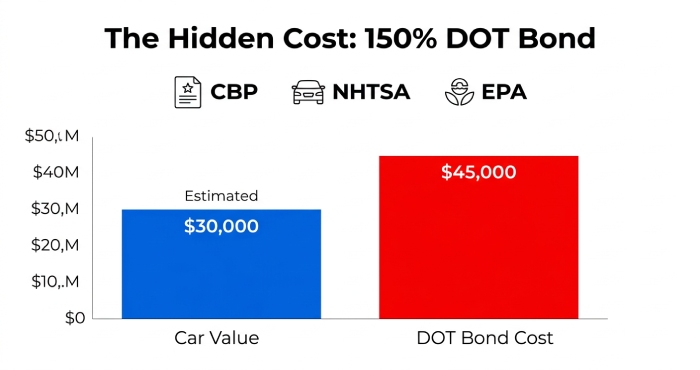
- Box 3: The vehicle does not conform to FMVSS, but NHTSA has determined the model is eligible for importation. The importer must contract with a Registered Importer (RI) to modify the vehicle and post a DOT Conformance Bond equal to 150% of the vehicle’s entered value (NHTSA Bond Form HS-474). The RI has 120 days to bring the vehicle into compliance.
For most vehicles purchased in Mexico, Box 3 is the relevant pathway—and it is expensive. On a $30,000 vehicle, the DOT Conformance Bond alone is $45,000 (150% of value). Add the Registered Importer’s fees for modifying the vehicle to meet U.S. safety standards, and the total cost of importation can easily exceed the price savings that motivated the cross-border purchase in the first place.
The AAMVA Imported Vehicles Working Group Guidance—a comprehensive PDF from the American Association of Motor Vehicle Administrators—provides additional detail on interpreting each HS-7 box and the titling implications for state DMVs.
The EPA Emissions Compliance
In addition to NHTSA’s safety requirements, the EPA requires a separate declaration (Form 3520-1) confirming that the vehicle meets U.S. emission standards. A vehicle manufactured for the Mexican market may not meet EPA standards, and modifying it to do so adds additional cost and complexity.
Step 2: What California’s DMV and CARB Require
Even after clearing federal requirements, a vehicle imported from Mexico must satisfy California’s own—and stricter—registration and emissions requirements.
The California DMV Fast Facts: Buying a Vehicle From Out of State (FFVR 29)—a government PDF—states clearly:
California has special requirements for vehicles imported from other countries (including Canada and Mexico). It may be very costly or impossible to modify these vehicles to meet California’s smog requirements. All vehicles must be certified to meet California smog laws to be registered in California.
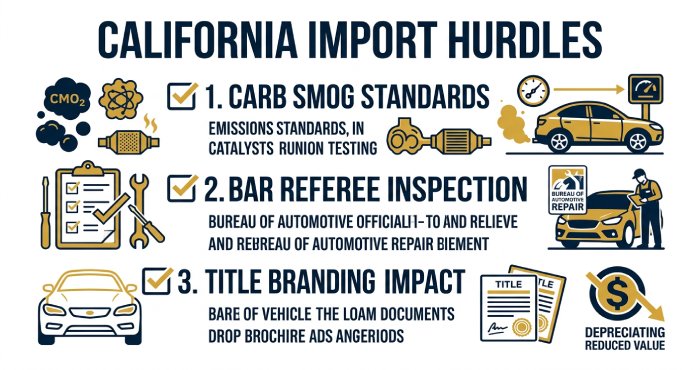
This is the critical point. California has stricter emission standards than the federal government. A vehicle that meets EPA standards may still fail California’s CARB requirements. The DMV PDF distinguishes between “California-certified (50-state)” vehicles and “49-state” vehicles. A vehicle manufactured for Mexico is neither—it is a foreign-market vehicle that may not meet even the less stringent 49-state federal standards.
California considers any vehicle with less than 7,500 miles on the odometer at the time of purchase or acquisition by a California resident to be a new vehicle, regardless of registration status. This means a low-mileage vehicle from Mexico may be classified as “new” by California standards but was never certified for sale in California.
The BAR Referee Inspection
Grey-market vehicles that clear federal importation must undergo a BAR (Bureau of Automotive Repair) Referee inspection before they can be registered in California. The BAR Referee label identifies the vehicle’s certification type and emission control requirements. Without this label, a smog check station cannot inspect the vehicle, and DMV cannot register it. Consumers with a grey-market vehicle that lacks a BAR Referee label must contact the BAR Referee at (800) 622-7733 to schedule an appointment.
Title Branding
The AAMVA Imported Vehicles Guidance notes that jurisdictions may brand the title of an imported vehicle to provide notice to future owners. Nevada brands titles of grey-market vehicles “Non-US Vehicle.” Idaho uses “Gray Market – Exempt from FMVSS Compliance” for vehicles 25+ years old. California’s DMV procedures similarly identify imported vehicles in the registration system.
This title branding has a direct impact on resale value. A vehicle with a grey-market or import notation on its title will be worth significantly less than an equivalent vehicle with a clean domestic title. The savings you captured on the initial purchase may be partially or fully offset by the reduced resale value.
The Warranty Gap: Why Song-Beverly Probably Does Not Cover Your Cross-Border Purchase
This is the core legal issue that no one discusses before a cross-border purchase, and it is the most consequential.
The BBB National Programs CA Lemon Law Summary defines the vehicles covered by Song-Beverly. The lemon law applies to a vehicle that:
- “is used or bought for use primarily for personal, family or household purposes, or”
- “has a gross vehicle weight under 10,000 pounds and can be bought or used primarily for business purposes by any person or business to which at least one but not more than five motor vehicles are registered in California.”
Critically, the covered vehicle must have been:
- Purchased or leased at retail in California, or
- Purchased or leased by a full-time active duty member of the Armed Forces stationed or residing in California.
A vehicle purchased in Tijuana was not purchased at retail in California. This is the statutory coverage gap. The Song-Beverly Act’s protections—the right to a buyback, the 2x civil penalty for willful violations, the mandatory manufacturer-paid attorney fees—are tied to the place of retail purchase. A cross-border purchase falls outside this definition.
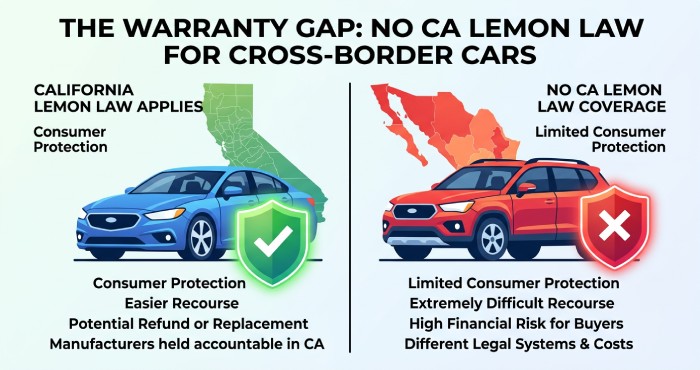
The CA DCA’s Lemon Law Q&A reinforces this by listing eligible vehicles as those covered under “the manufacturer’s new vehicle warranty.” A vehicle built for the Mexican market and sold by a Mexican dealer may carry a Mexico-only warranty that U.S. dealerships do not honor, even when the same model is sold by Ford, GM, or Toyota in the United States, so consulting an RV lemon law attorney may help clarify your options.
The manufacturer’s warranty is a contract between you and the manufacturer for the market where the vehicle was sold. A Ford warranty from a Mexican dealer is not automatically a Ford warranty at a San Diego dealer. The terms, coverage periods, and authorized service networks may differ entirely.
What Protections Do You Actually Have?
If Song-Beverly does not cover your cross-border purchase, you are not without legal remedies. But the available protections are weaker, slower, and more expensive to enforce.
Federal Magnuson-Moss Warranty Act
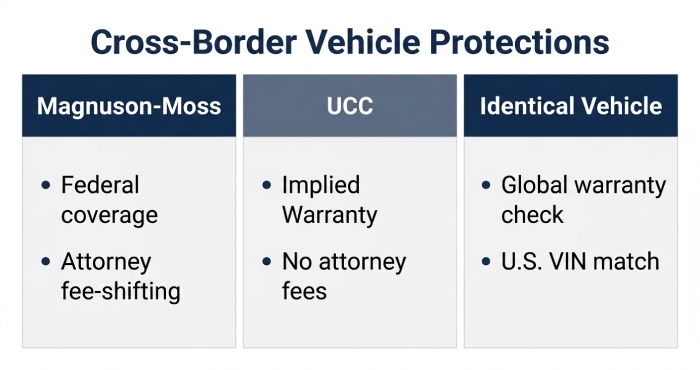
The Magnuson-Moss Warranty Act (15 U.S.C. §§2301–2312) covers any consumer product sold with a written warranty in the United States. If the manufacturer provides any written warranty that covers the vehicle in the U.S.—even a limited warranty, even one issued after importation—Magnuson-Moss may apply. It provides attorney fee-shifting (manufacturer pays if you prevail) and allows federal court claims. However, Magnuson-Moss does not provide Song-Beverly’s 2x civil penalty for willful violations, and the remedies are generally narrower.
Implied Warranty Under the UCC
California’s Uniform Commercial Code provides an implied warranty of merchantability on goods sold at retail. If you purchased a vehicle—even from a Mexican dealer—that is fundamentally defective, you may have a breach of implied warranty claim. However, UCC remedies are limited to the difference in value between the goods as warranted and the goods as delivered, which is typically far less than a Song-Beverly buyback. There is also no attorney fee-shifting under the UCC, meaning you bear your own legal costs.
The “Identical Vehicle” Question
If your cross-border vehicle is identical to a vehicle sold in the U.S.—same model, same specifications, same VIN prefix indicating U.S.-market manufacturing—and carries a manufacturer’s warranty that is honored in the U.S., you may have a stronger argument for Song-Beverly coverage. Some manufacturers (Toyota, Honda) issue “global” warranties that cover vehicles regardless of purchase country. Others (domestic brands, some luxury brands) issue market-specific warranties that do not transfer across borders. Check your specific warranty document before assuming coverage.
The Real Cost of a Cross-Border Purchase: A Worked Example
Here is what a San Diego resident might actually pay when purchasing a $30,000 vehicle from a Tijuana dealer and importing it, compared to buying the same vehicle domestically:
- Purchase price (Tijuana): $28,000
- U.S. Customs duties: 2.5% on passenger cars = $700
- DOT Conformance Bond (150% of value, if non-conforming): $42,000 (refundable after compliance certification)
- Registered Importer modification fees: $2,000–$8,000+ depending on required modifications
- CARB/BAR compliance and inspection: $500–$2,000
- California use tax (7.75%–8.5% depending on city): ~$2,200
- DMV registration and titling: ~$400
- Lost Song-Beverly protection: Priceless—a lemon law buyback on a $30,000 vehicle can be worth $25,000–40,000+ with penalties and attorney fees
Total out-of-pocket (excluding refundable bond): approximately $33,800–$41,300. The $2,000 “savings” on the purchase price is consumed many times over by importation costs. And if the vehicle turns out to be defective, you have lost access to the most powerful consumer protection tool available: Song-Beverly’s mandatory buyback, 2x civil penalty, and manufacturer-paid attorney fees.
What to Do Instead: Protecting Yourself in San Diego’s Border Market
If You Are Considering a Cross-Border Purchase
- Understand that importing a non-conforming vehicle from Mexico is almost never cost-effective for vehicles less than 25 years old. The importation costs, bond requirements, and modification expenses typically exceed any savings on purchase price.
- Check whether the specific vehicle model carries a warranty that is honored in the U.S. Contact the manufacturer’s U.S. customer service line—not the Mexican dealer—and ask specifically whether warranty coverage transfers across borders.
- If the vehicle was manufactured for the U.S. market (check the certification label on the driver-side door frame) and carries a U.S. warranty, your Song-Beverly argument is stronger. Have this verified before purchase.
- Be aware that the vehicle’s title will likely carry a grey-market or import notation, reducing resale value by 10–30%.
If You Already Own an Imported Vehicle with Defects
- Check your warranty document to determine if it is honored in the U.S. If yes, take the vehicle to a U.S. authorized dealer and request warranty repairs. Document every visit with a written repair order.
- If the manufacturer refuses warranty service, consult an attorney about a Magnuson-Moss claim. The federal act provides attorney fee-shifting and may apply even when Song-Beverly does not.
- File a complaint with NHTSA at NHTSA.gov/report-a-safety-problem regardless of where the vehicle was purchased. NHTSA’s complaint database is used to identify defect patterns and initiate recalls, which apply to all vehicles regardless of purchase location.
- Contact the BAR Referee at (800) 622-7733 if you have emissions compliance issues that are preventing registration.
The Safest Path for San Diego Buyers
- Buy from an authorized California dealer. This guarantees Song-Beverly coverage, ensures CARB compliance, and provides a domestic warranty.
- If price is the primary concern, compare the cross-border “savings” against the total importation cost—including the DOT bond, RI fees, CARB compliance, and the loss of lemon law protections. In almost every case, buying domestically costs less when all factors are included.
- If you must purchase from Mexico, limit your search to vehicles that carry a U.S. FMVSS certification label and a manufacturer warranty that is explicitly honored in the United States. These are typically vehicles built in Mexican factories for the U.S. market that ended up on Mexican dealer lots—not vehicles manufactured to Mexican specifications.

The Bottom Line
The San Ysidro border crossing makes cross-border vehicle purchases physically easy. The legal, financial, and consumer protection consequences make them extraordinarily complicated.
A vehicle purchased in Tijuana and imported to San Diego must clear three federal agencies (CBP, NHTSA, EPA), satisfy California’s stricter CARB emission standards, pass a BAR Referee inspection, and carry a title notation that reduces its resale value. The total importation cost for a non-conforming vehicle typically exceeds the purchase price savings. And the most consequential loss—the one that does not show up in any cost calculation until something goes wrong—is the loss of Song-Beverly’s lemon law protections.
California’s Lemon Law is among the nation’s strongest consumer protections, offering a full manufacturer-funded buyback, potential triple damages for willful violations, and attorney fees paid by the manufacturer. A California lemon law lawyer can help enforce these rights, but the law generally applies only to vehicles purchased or leased at retail in California—five words that make all the difference.
If you’re buying a vehicle in San Diego, keep your purchase local. A Lemon Law Attorney San Diego residents trust can help protect your rights, making that protection far more valuable than any perceived savings from buying elsewhere.
Sources and References
All sources are downloadable PDFs from government agencies or institutional organizations.
Federal Government PDFs
[1] NHTSA. Form HS-7: Declaration of Importation of Motor Vehicles (Revised 2020). https://www.nhtsa.gov/sites/nhtsa.gov/files/documents/hs7_111920_v3_secured.pdf
[2] NHTSA. Vehicle Importation Guidelines (Other Than Canada), May 2022. https://www.nhtsa.gov/sites/nhtsa.gov/files/2022-05/Vehicle-Importatoin-Guidelines-Other-Than-Canada.pdf
[3] NHTSA. Form HS-474: DOT Conformance Bond for Imported Vehicles. https://www.nhtsa.gov/sites/nhtsa.gov/files/documents/hs-474_bond_form_r.v.6.pdf
[4] NHTSA. 2024 Annual Report on Safety Recalls, Published April 2025. https://www.nhtsa.gov/sites/nhtsa.gov/files/2025-04/2024-annual-recalls-report.pdf
California Government PDFs
[5] CA DMV. Fast Facts: Buying a Vehicle From Out of State (FFVR 29). https://www.dmv.ca.gov/portal/uploads/2020/03/ffvr29-1.pdf
[6] CA DMV. How To: Register a Vehicle From Out of State (HTVR 9). https://www.dmv.ca.gov/portal/file/how-to-register-an-out-of-state-vehicle-htvr9/
[7] CA DCA. Lemon Law Q&A Brochure, Revised September 2024. https://www.dca.ca.gov/acp/pdf_files/lemonlaw_qa.pdf
Industry and Nonprofit PDFs
[8] AAMVA (American Association of Motor Vehicle Administrators). Imported Vehicles Working Group Guidance. https://www.aamva.org/getmedia/d5c53446-900a-4021-9d58-9f79d3a29f3f/Imported-Vehicles-Guidance_final-
[9] BBB National Programs. California Lemon Law Summary. https://assets.bbbprograms.org/docs/default-source/auto-line/statelemonlaws/california-lemonlaw.pdf
Disclaimer: This article is for informational purposes only and does not constitute legal advice. Vehicle importation involves complex federal, state, and international regulations. Cross-border vehicle purchases may have tax, customs, and warranty implications not fully addressed in this article. Consult a qualified attorney and a licensed customs broker for guidance specific to your situation.