
There is a single sentence in California’s Civil Code that created an entire legal industry. It is 28 words long, and it reads:
If the buyer prevails in an action under this section, the buyer shall be allowed by the court to recover as part of the judgment a sum equal to the aggregate amount of costs and expenses, including attorney’s fees based on actual time expended, determined by the court to have been reasonably incurred by the buyer in connection with the commencement and prosecution of such action.
That is Civil Code Section 1794, subdivision (d)—the one-way fee-shifting provision of California’s Song-Beverly Consumer Warranty Act. It is the reason you can hire a lemon law attorney without paying a dime out of pocket. It is the reason there are hundreds of law firms in California that practice exclusively lemon law. And it is the reason that lemon law filings in the state exploded from approximately 4,500 in 2015 to over 30,000 in 2024 (AB 1755 Assembly Judiciary Analysis).
Whether that explosion represents a triumph of consumer access to justice or an attorney-driven litigation machine depends almost entirely on which side of the courtroom you are sitting on. This article examines the economics of the fee-shifting provision from both sides, using primary-source documents—California Supreme Court filings, legislative analyses, published appellate decisions, and academic research—to explain how 28 words reshaped the business of cars and the business of law in California.
How the Fee-Shifting Provision Works
In most civil litigation in the United States, each party pays its own attorney fees regardless of who wins. This is called the “American Rule.” Song-Beverly creates a deliberate exception: if the consumer prevails, the manufacturer must pay the consumer’s attorney fees. If the manufacturer prevails, the consumer owes nothing to the manufacturer for legal costs.
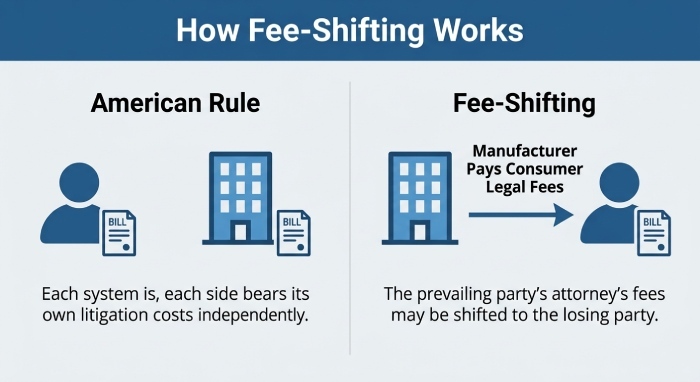
This one-way structure is not an accident. An amicus brief filed before the California Supreme Court in Ayers v. FCA US, LLC by Housing & Economic Rights Advocates and other consumer organizations (Supreme Court PDF) explains the legislative intent:
The Legislature has mandated fee awards to prevailing consumers as an incentive for private attorneys to file and prosecute consumer cases the Legislature considers socially valuable, but would otherwise be too small, too risky, and too time-consuming and expensive for private attorneys to take on.
The brief cites over 200 federal statutes and nearly 2,000 state statutes that provide for fee-shifting, describing the practice as “integral” to the American legal system rather than an exception to it. Fee-shifting provisions exist in civil rights law, environmental law, antitrust law, and consumer protection law for the same reason: without them, individuals cannot afford to enforce their rights against well-resourced corporations.
The BBB National Programs California Summary PDF confirms the mechanics: the manufacturer must pay “costs and expenses, including reasonable attorney’s fees based on actual time expended, determined by the court to have been reasonably incurred by the consumer.” The key word is “reasonable”—courts retain discretion to reduce fee requests they deem excessive.
What This Means in Practice
The fee-shifting provision is the engine that makes the entire lemon law system accessible to consumers. Without it, a consumer with a $40,000 vehicle would need to weigh the cost of hiring an attorney—potentially $15,000–50,000 in fees for a contested case—against the uncertain recovery. Most consumers would never file. The defect would go unaddressed, the manufacturer would face no accountability, and the consumer protection statute would exist on paper but not in practice.
With fee-shifting, the calculus changes completely. An attorney can evaluate a consumer’s case, take it on contingency, invest months of work, and recover fees from the manufacturer if the case succeeds. The consumer pays nothing regardless of outcome. The attorney bears the risk but has a viable economic model. The manufacturer faces genuine accountability.
The Loyola Consumer Law Review—an academic PDF analyzing Song-Beverly developments—confirms that “attorneys’ fees are mandatory” for prevailing consumers, distinguishing Song-Beverly from statutes where fee awards are discretionary.
The Scale: From 4,500 Cases to 30,000
The fee-shifting provision has been in Song-Beverly since the statute’s inception, but its economic impact accelerated dramatically in the past decade. The AB 1755 legislative analysis and the Advocate Magazine practitioner analysis provide the filing trajectory:
- 2015: Approximately 4,500 lemon law filings
- 2022: 14,892 filings
- 2023: 22,655 filings (52% increase YoY)
- 2024: Estimated 30,000+ filings
That is a roughly 7x increase in nine years. In Los Angeles County alone, nearly 10% of all civil filings are now lemon law cases. The AB 1755 analysis notes that the “influx of lemon law litigation, and the accompanying increases in discovery disputes, dispositive motions, and protracted settlement negotiations, is resulting in growing case backlogs across the entire civil justice system.”
If the average lemon law case generates $10,000–30,000 in attorney fees (a range consistent with the complexity and duration of contested cases), then 30,000 filings represent a legal services market of $300 million to $900 million annually—in attorney fees alone, in a single state, in a single practice area. Add the vehicle buyback amounts, civil penalties, and incidental damages, and the total economic activity driven by Song-Beverly’s fee-shifting provision easily exceeds $1 billion per year.
The Manufacturer’s Argument: Fee-Shifting Drives Excessive Litigation
Automakers have made their position clear in the legislative record. The AB 1755 Assembly Judiciary analysis documents the coalition opposing the bill’s fee provisions. A letter from Toyota, Honda, Volkswagen, and other foreign automakers stated:
This legislation mandates that plaintiffs’ attorneys receive fees even when a manufacturer fully complies with the Song Beverly Act by offering a timely pre-lawsuit repurchase.
The legislative analysis acknowledges this concern but contextualizes it: “While true, this statement generally reflects existing practice. In fact, just because an attorney is not forced to file suit does not mean they did not do billable work for a client.” The analysis further notes that the manufacturer coalition “did not have tangible alternative suggestions for remedying the impact of lemon law litigation on the courts.”
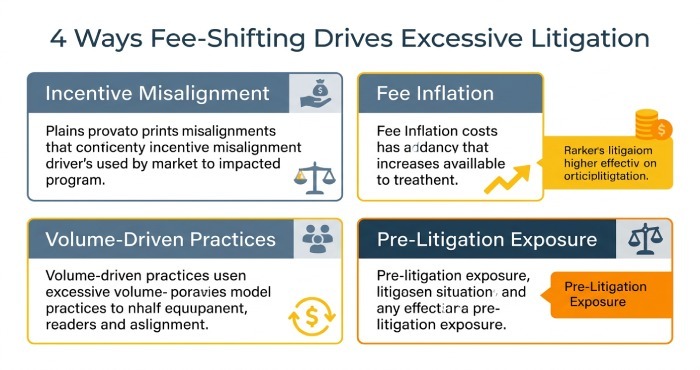
The manufacturer argument has several dimensions documented across the legislative PDFs:
- Incentive misalignment: Fee-shifting creates economic incentives for attorneys to file cases regardless of their strength, because even a marginal case may settle for enough to cover the attorney’s fees. The manufacturer pays fees whether the case goes to trial or settles after initial discovery.
- Fee inflation: Because fees are calculated on “actual time expended,” attorneys have incentives to invest more time than a case warrants, knowing the manufacturer will pay the bill if the consumer prevails.
- Volume-driven practices: The fee model supports high-volume lemon law practices that file hundreds or thousands of cases per year, using standardized templates and leveraging economies of scale. The legislative analysis cites “the unscrupulous behavior of some lemon law litigators, including filing needless discovery motions and seeking to delay document production” (SB 26 Assembly Floor Analysis).
- Pre-litigation fee exposure: Under AB 1755, manufacturers now face fee exposure even during the 30-day pre-suit notice period. The legislative analysis acknowledges this is “somewhat unique in statute.”
The Consumer Advocate’s Response: Fee-Shifting Is the Only Reason the Law Works
The Supreme Court amicus brief filed by Housing & Economic Rights Advocates and other consumer organizations makes the case for fee-shifting with a clarity that the legislative record does not match:
Our Legislature has provided injured consumers strong encouragement to seek legal redress in a situation in which a lawsuit might not otherwise have been economically feasible.
The brief argues that without fee-shifting, manufacturers would have no financial incentive to comply with the buyback obligation at all. The cost of fighting a consumer in court would be cheaper than repurchasing the vehicle. Fee-shifting changes the math: if the manufacturer loses, it pays not only the buyback but also the consumer’s legal costs. This makes stonewalling more expensive than compliance.
Consumer advocates point to the CALPIRG Auto Lemon Index finding that GM was sued 26 times more often than Toyota as evidence that the volume of lawsuits correlates with vehicle quality, not with attorney behavior. If attorneys were filing indiscriminately, the lawsuit rates would be distributed more evenly across manufacturers. The fact that four companies—GM, Ford, Stellantis, and Nissan—account for over 70% of all California lemon law cases suggests that the litigation is driven by defects, not by fee-seeking.

The CARS Foundation’s opposition letter in the SB 26 Senate Judiciary analysis adds another dimension: manufacturers citing “frivolous” claims as justification for reform are the same manufacturers with the worst defect records. The CARS Foundation cites Figueroa v. FCA US, LLC (2022), in which the Court of Appeal found that FCA was “forcing consumers to trade in or sell defective vehicles rather than timely repurchasing them”—and then citing the resulting litigation as evidence that the system is broken.
The Section 998 Weapon: How Manufacturers Fight Back on Fees
California’s Code of Civil Procedure Section 998 allows either party to make a formal settlement offer before trial. If the opposing party rejects the offer and does not achieve a better result at trial, the rejecting party forfeits its right to recover post-offer costs, including expert witness fees. The question that reached the California Supreme Court in Ayers v. FCA US, LLC (published appellate opinion PDF) was whether Section 998 can be used to cut off a consumer’s recovery of post-offer attorney fees in a Song-Beverly case.
This is a nuclear question for the lemon law industry. If manufacturers can make early Section 998 offers and effectively cap the consumer’s attorney fee recovery, it fundamentally changes the economics of every case. The Supreme Court amicus brief argues that applying Section 998 to Song-Beverly attorney fees would:
- Become a leveraging tool: “Section 998 would become firmly established as an effective strategy for leveraging car buyers and their counsel into low settlements, significantly diluting” the protections of Song-Beverly.
- Create asymmetric risk: A manufacturer could make a low early offer, force the consumer to choose between accepting an inadequate settlement or risking the loss of attorney fees if the trial result does not exceed the offer. The consumer’s attorney, who bears the economic risk, would pressure the client to settle.
- Undermine the statute’s purpose: If fee-shifting can be neutralized by Section 998 offers, the Legislature’s intent to make lemon law cases economically viable for consumers would be defeated.
The appellate court in Ayers held that Section 998 does apply to post-offer costs in Song-Beverly cases, reversing a portion of the consumer’s cost judgment. The case has been accepted for review by the California Supreme Court. Its resolution will determine whether manufacturers gain a powerful new tool for limiting attorney fee exposure—or whether the one-way fee-shifting provision remains fully intact.
What this means: If the Supreme Court upholds the appellate decision, manufacturers will begin making Section 998 offers in every lemon law case as standard practice. Consumers who reject those offers and fail to beat them at trial will lose their post-offer attorney fees. Attorneys will become more selective about which cases they take and more inclined to settle early. The practical effect could be a significant reduction in both the volume and the recoveries of lemon law cases—a structural shift in the economics of the practice.
AB 1755’s Fee Provisions: The Compromise That Satisfied No One
AB 1755 addressed attorney fees in two significant ways, both documented in the Assembly Judiciary analysis:
Pre-Litigation Fee Recovery
For the first time, AB 1755 explicitly provides that consumer attorneys can recover fees for work performed during the 30-day pre-suit notice period. The legislative analysis characterizes this as “somewhat unique in statute” but notes it “mirrors existing civil litigation practice.” The Advocate Magazine analysis confirms that the new standardized release template includes specific provisions for attorney fee calculation, whether “by agreement or by motion.”
The opposing manufacturer coalition objected: “This legislation mandates that plaintiffs’ attorneys receive fees even when a manufacturer fully complies with the Song Beverly Act by offering a timely pre-lawsuit repurchase.” The committee responded that attorneys who perform legitimate pre-litigation work—evaluating the claim, gathering documents, drafting the demand notice—deserve compensation regardless of whether the case proceeds to court.
The Fee Controversy’s Role in Creating the Two-Track System
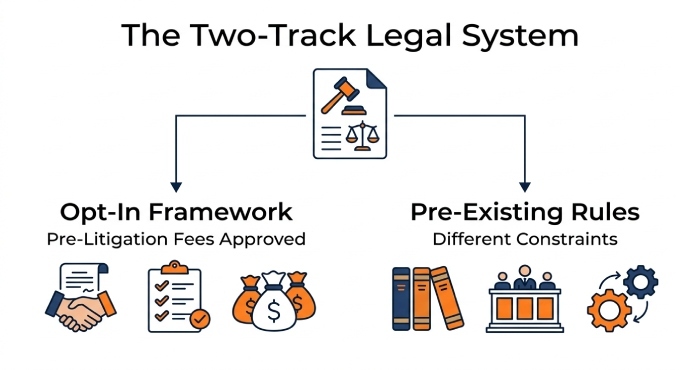
Attorney fees were one of the central disputes that drove the need for SB 26. The SB 26 Senate Judiciary analysis reveals that some manufacturers found the fee provisions “unworkable” and that the Governor’s signing message committed to making the entire AB 1755 framework opt-in. The result is a two-track system where manufacturers that opt into AB 1755 accept the pre-litigation fee provisions, while those that remain under pre-existing rules do not.
This creates an odd asymmetry: the same attorney performing the same work on two identical cases may or may not be entitled to pre-litigation fees depending on which manufacturer built the car. The consumer’s rights—and the attorney’s economics—vary by manufacturer, not by the merits of the case.
The Honest Assessment: Both Sides Have a Point
This is the rare policy debate where both sides are substantially correct about the facts, even though they disagree about the implications.
The consumer advocates are right that:
- Without fee-shifting, consumers cannot afford to enforce their rights against billion-dollar manufacturers. The fee provision is the enforcement mechanism that makes the statute functional.
- The concentration of lawsuits among a few manufacturers (GM, Ford, Stellantis, Nissan = 70%+ of cases) strongly suggests that defect rates, not attorney behavior, drive case volume.
- Manufacturers who delay or stonewall legitimate buyback requests bear significant responsibility for the litigation volume. Courts have specifically admonished manufacturers for “forcing consumers to trade in or sell defective vehicles rather than timely repurchasing them.”
- Fee-shifting exists in hundreds of federal and thousands of state statutes. It is not an anomaly unique to lemon law; it is a standard tool for enforcing consumer protection.
The manufacturers are right that:
- The volume of filings has grown at a rate that strains the court system and creates significant costs for manufacturers regardless of case merit.
- Some high-volume lemon law practices file cases using standardized templates with minimal individualized evaluation, creating a factory-like litigation model that the statute’s authors did not envision.
- The economic incentives do favor filing: an attorney who files 500 cases per year can earn substantial revenue even if a significant percentage settle for modest amounts, because fees are paid per case regardless of recovery size.
- Pre-litigation fees for the 30-day notice period are genuinely novel. Requiring manufacturers to pay attorney fees for work performed before a lawsuit is filed is a departure from traditional litigation economics.
The fundamental disagreement is not about these facts. It is about whether the solution is to strengthen the fee provision (making it harder for manufacturers to circumvent with Section 998 offers), weaken it (allowing two-way fee-shifting as Colorado does), or restructure it (capping fees, requiring proportionality between fees and recovery, or creating fee schedules). AB 1755 attempted a middle path and satisfied neither side.

What to Watch: The Supreme Court Decision That Could Change Everything
The California Supreme Court’s pending decision in the Ayers v. FCA line of cases will be the most consequential development in lemon law economics in years. If the Court holds that Section 998 applies to Song-Beverly attorney fees, manufacturers will immediately begin making early settlement offers in every case, fundamentally changing the negotiation dynamics of the practice.
For consumers, the practical impact would be pressure to settle cases earlier and for less money. For attorneys, it would mean greater risk in every case and more selective case intake. For manufacturers, it would be a powerful cost-containment tool that reduces their exposure to open-ended fee awards. For the courts, it could reduce filing volume—which was AB 1755’s stated goal.
Beyond Ayers, watch for:
- 2025–2026 filing data: Will the combination of AB 1755’s procedural hurdles and the potential Section 998 threat reduce case volume?
- Fee petition outcomes under AB 1755: Courts will begin ruling on pre-litigation fee requests. How they calculate “reasonable” fees for the 30-day notice period will set important precedent.
- Consumer attorney market consolidation: If fee economics tighten, smaller lemon law practices may be squeezed out, concentrating the market among larger firms with the capital to absorb risk.
- Legislative response: If the Supreme Court applies Section 998, consumer advocates will push for a legislative amendment explicitly exempting Song-Beverly fee awards from Section 998’s cost-shifting provisions.
The Bottom Line
Twenty-eight words in California’s Civil Code created a legal ecosystem that generates hundreds of millions of dollars annually in attorney fees, drives over 30,000 lawsuits per year, and serves as the primary enforcement mechanism for one of the strongest consumer protection statutes in the country.
That ecosystem produces genuine value: It enables consumers who could never afford legal representation to pursue justice against manufacturers that sold them defective vehicles. By working with an experienced lemon law lawyer in San Diego, consumers can more effectively enforce their rights, hold manufacturers financially accountable for quality failures, prevent companies from stonewalling legitimate claims, and ensure the Song-Beverly Act serves as a meaningful legal protection rather than merely words on paper.
It also produces genuine problems: it incentivizes volume over selectivity, it supports litigation practices that file cases at industrial scale, and it creates fee exposure that manufacturers cite as a significant drag on their costs—costs that are ultimately passed through to consumers in the form of higher vehicle prices.
The tension between these two realities is not resolvable by pretending one side is right and the other is wrong. Both sides are describing real phenomena. The question is how to calibrate the fee-shifting provision so that it continues to make the statute enforceable while reducing the incentives for marginal or formulaic litigation. AB 1755 was one attempt at that calibration. Ayers v. FCA may be another. Neither is the last word.
What is certain is that the 28 words of Section 1794(d) will continue to shape the economics of car buying, car manufacturing, and car litigating in California for decades to come. Understanding how those words function—and how courts continue to interpret and challenge them—is essential for every consumer, manufacturer, and California Lemon Law attorney in San Diego operating within this evolving legal landscape.
Sources and References
All sources are downloadable PDFs from courts, government agencies, academic journals, or legal publications.
Court Documents
[1] Housing & Economic Rights Advocates et al.. Amicus Curiae Brief, Ayers v. FCA US, LLC, California Supreme Court Case No. S280598, July 2024. https://supreme.courts.ca.gov/sites/default/files/supremecourt/default/documents/18-930-s280598-ac-housing-econ-rights-advocates-et-al-073024.pdf
[2] Court of Appeal, Second District. Ayers v. FCA US, LLC (2024) 99 Cal.App.5th 1280 (Published Opinion). https://cdn.spinxweb.net/horvitz/uploads/2025/08/Ayers-v.-FCA-1.pdf
[3] Orange County Superior Court. Song-Beverly Case Management Order. https://www.occourts.org/system/files/civil/songbeverlycasemanagementorder.pdf
California Legislative PDFs
[4] CA Assembly Judiciary Committee. AB 1755 Legislative Analysis, August 2024. https://ajud.assembly.ca.gov/system/files/2024-08/ab-1755-analysis.pdf
[5] AB 1755 Bill Text. As Amended, Kalra and Umberg, August 2024. https://sjud.senate.ca.gov/system/files/2024-08/ab-1755-kalra-aug-26-bill-text.pdf
[6] CA Senate Judiciary Committee. SB 26 Analysis, February 2025. https://trackbill.com/s3/bills/CA/2025/SB/26/analyses/senate-judiciary.pdf
[7] CA Assembly Floor. SB 26 Third Reading Analysis. https://trackbill.com/s3/bills/CA/2025/SB/26/analyses/assembly-floor-analysis.pdf
[8] Governor Gavin Newsom. AB 1755 Signing Message, September 2024. https://www.gov.ca.gov/wp-content/uploads/2024/09/AB-1755-SIGNING-Message.pdf
Academic and Legal Publications
[9] Loyola Consumer Law Review. Developments Under Song-Beverly Consumer Warranty Act. https://lawecommons.luc.edu/cgi/viewcontent.cgi?article=1808&context=lclr
[10] CA Law Revision Commission. Staff Memorandum, Study J-901: Attorney Fee Awards, July 2000. https://clrc.ca.gov/pub/2000/MM00-54.pdf
[11] Song-Beverly Consumer Warranty Act. Full Civil Code Text (PDF). https://www.thelemonlawattorneys.com/wp-content/uploads/2019/01/CALIFORNIA-CIVIL-CODE.pdf
[12] Advocate Magazine (Michelle Fonseca-Kamana). When Life Gives You Lemon…Law Reform, February 2025. https://www.advocatemagazine.com/images/issues/2025/02-february/reprints/Fonseca-Kamana-Feb25-article-Advocate-magazine.pdf
Nonprofit Research and Industry Data
[13] BBB National Programs. California Lemon Law Summary (PDF). https://assets.bbbprograms.org/docs/default-source/auto-line/statelemonlaws/california-lemonlaw.pdf
[14] CALPIRG Education Fund / CARS Foundation / Frontier Group. The Auto Lemon Index, May 2022. https://publicinterestnetwork.org/wp-content/uploads/2022/05/Auto-Lemon-Index-CAP-CARS-FG-May22-1.pdf
Disclaimer: This article is for informational purposes only and does not constitute legal advice. The economics of lemon law practice involve complex legal, ethical, and regulatory considerations. Nothing in this article should be construed as endorsing or criticizing the practice of any individual attorney or firm. Consult a qualified attorney for guidance specific to your situation.