
Purchasing a vehicle is meant to symbolize liberation, not disappointment. However, for certain motorists, each mile serves as a painful reminder of errors made. “Mileage Mayhem: When Every Mile Feels Like a Mistake” investigates the frustrating truth of owning a faulty car that often resides in the repair shop rather than on the road. With ongoing mechanical issues and unresolved safety problems, the initial joy of ownership can easily shift to stress and worry.
Lemon Law Basics: Why mileage matters and how states tie remedies to miles
Under California’s lemon law—rooted in the Song-Beverly Consumer Warranty Act and the Tanner Consumer Protection Act—mileage is a key factor in determining both eligibility and compensation, as it affects when a defect is first identified within the warranty period and how a refund or replacement is calculated based on repair history and usage; because these details can significantly impact your claim, consulting experienced lemon law lawyers can help ensure you understand your rights and maximize the remedy available to you.
If a defect continues despite multiple repair attempts or if the vehicle has significant downtime, you might be eligible for compensation. However, any refund you receive will be adjusted downwards based on how much the vehicle was used before the initial repair attempt. Thus, keeping accurate mileage records from the beginning is essential for maximizing your potential recovery.
Mileage as a gatekeeper to remedies
- Mileage signals when your warranty period troubles began and whether you acted promptly.
- A clean paper trail of repair orders, pre-repair mileage, and repair attempts helps prove eligibility for a vehicle refund under California lemon law.
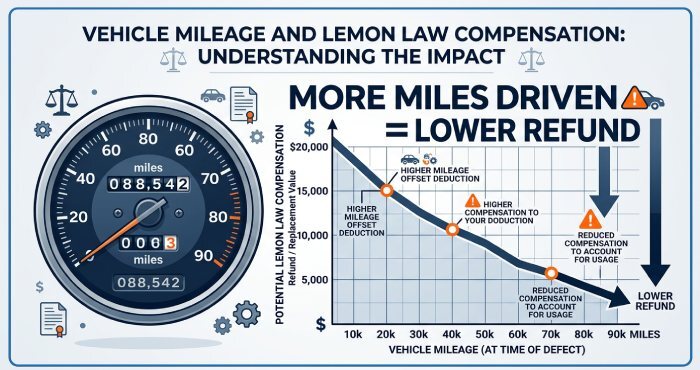
- High-mileage vehicles can still qualify, but the mileage offset will be larger, reducing compensation.
 buyback” width=”700″ height=”370″ />
Mileage offset versus mileage deduction
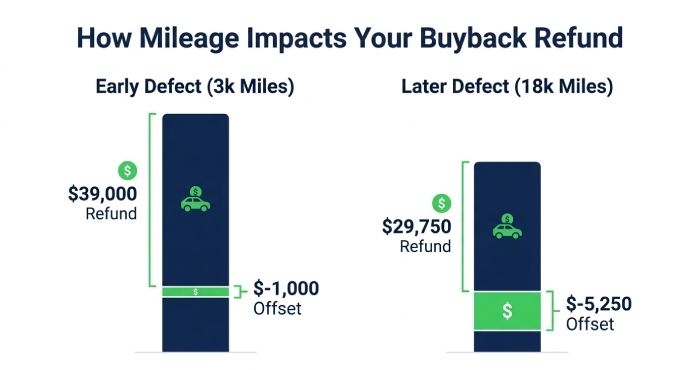
California lemon law uses the terms mileage offset and mileage deduction interchangeably. Both refer to the statutory reduction applied to the vehicle refund to reflect the miles driven before the first repair attempt for the defect that led to buyback.
Eligibility Windows: Time, mileage thresholds, and repair-attempt presumptions
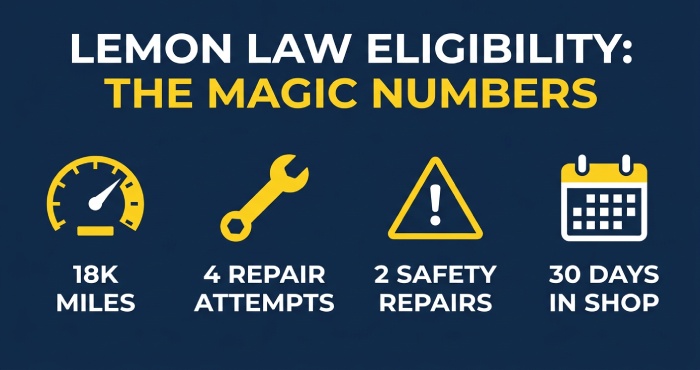
According to California’s Tanner Consumer Protection Act, a car is considered a lemon if a significant defect persists during the warranty period or within 18 months or 18,000 miles, despite several repair attempts — usually four for the same problem, two for serious safety concerns, or a total of 30 days out of service. However, even if these standards aren’t met, one can still establish a claim based on the vehicle’s overall repair record.
Additionally, the frequently referenced 120,000 miles is relevant only for determining the mileage deduction for refunds and does not affect eligibility.
Presumption mechanics and the “reasonable” standard
- The reasonable number of repair attempts depends on defect severity, safety implications, and repeated failure despite dealer involvement.
- Documentation of each repair order and odometer reading at drop-off/pick-up can make or break the presumption.
- Delayed warranty coverage issues and hidden defects can complicate whether the first repair attempt fell inside the warranty period, but warranty terms control.
Edge triggers and variations
- Used car lemon law protections are limited but may apply when a manufacturer’s warranty transfers.
- Leased vehicles generally receive similar protections; mileage still affects any vehicle refund or replacement vehicle outcome.
The Buyback Math: Mileage offset formulas, deductions, and sample scenarios
Core calculation formula in California
- Mileage offset (mileage deduction) = (Miles at first repair attempt ÷ 120,000) × purchase price.
- Vehicle refund (statutory restitution) = purchase price − mileage offset, plus incidental damages and certain fees (e.g., towing, rental cars) and less trade-in credits already realized.
California lemon law also provides additional remedies, including civil penalties for willful violations when a manufacturer unreasonably fails to honor its warranty, which a skilled lemon law attorney can help pursue. Because of the 120,000-mile formula, higher mileage before the first repair attempt results in a larger deduction from the refund.
Sample scenarios
1) Early defect, low miles:
- Purchase price: $40,000
- Pre-repair mileage (first repair attempt): 3,000
- Mileage offset: (3,000 ÷ 120,000) × $40,000 = $1,000
- Vehicle refund baseline: $40,000 − $1,000 = $39,000 (plus incidental damages and fees)
2) Later defect, higher miles:
- Purchase price: $35,000
- Pre-repair mileage: 18,000
- Mileage offset: (18,000 ÷ 120,000) × $35,000 = $5,250
- Vehicle refund baseline: $35,000 − $5,250 = $29,750
3) Trade-in and fees:
- Courts consider how negative equity, finance charges, and trade-in credits factor into statutory restitution. Cases such as Niedermeier v. FCA US LLC discuss offsets and whether particular items are includable. Always align entries with the repair order history and the California Civil Code framework.
Replacement vehicle as an alternative
Instead of a vehicle refund, some consumers opt for a replacement vehicle. The same mileage offset principles inform the exchange value under the manufacturer’s warranty, and incidental damages may still be recoverable. The choice between a replacement vehicle and a vehicle refund often turns on vehicle value fluctuations, financing, and personal preference.
Proving the Miles: Odometer integrity, service records, telematics, and test-drive usage
Evidence to gather
Collect solid proof by recording odometer readings during each drop-off and pick-up (backed by telematics), maintaining comprehensive service and repair logs that include mileage and any downtime, and leveraging external data sources such as emissions tests or inspections to confirm the mileage history and validate the 120,000-mile guideline calculation.
Disputes, hidden defects, and test drives
- Record each visit to check for any concealed or sporadic issues, even if nothing is detected. Monitor and contest any additional miles that dealers may add during test drives, and ensure you can demonstrate that the defect arose during the warranty period by providing prompt documentation if your claim is questioned.
When each mile you drive brings back memories of a regrettable buy, it’s crucial to keep in mind that mileage isn’t the only factor influencing your situation — timeliness, proper documentation, and proactive steps matter as well. By meticulously tracking details, responding quickly to any issues, and grasping how mileage affects your claim, you can transform irritation into an advantage. Should matters become more complicated, seeking guidance from a Lemon Law attorney in San Diego can provide you with clear direction and assurance, enabling you to turn a challenging driving experience into a just and financially beneficial outcome.