
Lemon law regulations may be hidden in the details, yet they offer significant safeguards for buyers dealing with faulty cars. These laws make sure that manufacturers are responsible if their repairs do not resolve major problems. An in-depth examination shows how this seemingly minor legal text can effectively advocate for you.
What Lemon Laws Actually Cover: definitions, eligible vehicles and buyers (new, used, leased), and warranty windows
Definitions and Scope
A Lemon Law mandates that manufacturers must uphold a vehicle’s warranty if a significant defect — one that affects its usability, value, or safety — cannot be fixed after a reasonable number of attempts during the warranty period. In California, through laws like the Song-Beverly Consumer Warranty Act and the Tanner Consumer Protection Act, consumers usually have the right to receive either a refund or a replacement if the vehicle fails to meet warranty standards.
Eligible Vehicles and Claimants
Most Lemon Laws pertain to new vehicles purchased or leased for personal, family, or household purposes and might include certain used vehicles that are still under the original manufacturer’s warranty. Generally, both purchasers and lessees can submit claims, although coverage for vehicles such as motorhomes, motorcycles, or those used for commercial purposes can differ by location.
Warranty Periods and Key References
In California, a vehicle is typically presumed to be a lemon if defects occur within 18 months or 18,000 miles, provided the manufacturer has been given a fair opportunity to rectify the issues, according to California Civil Code Section 1793.22. Additionally, federal regulations under the Magnuson-Moss Warranty Act can bolster claims, particularly when state lemon law protections are limited or have lapsed.
When a Vehicle Qualifies as a Lemon: repair-attempt thresholds, days out of service, safety defects, and who has the burden of proof
Thresholds that trigger the presumption
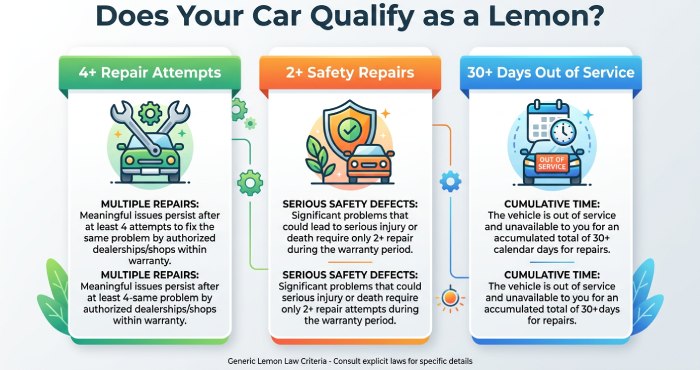
Under California Civil Code 1793.22, a vehicle is presumed to be a lemon if, during the coverage period:
- The same defect has been subject to four or more repair attempts; or
- A safety defect likely to cause death or serious bodily injury has had two or more repair attempts; or
- The vehicle has been out of service for repair for a cumulative total of more than 30 days.
Other states use similar—but not identical—thresholds for repair attempts and days out of service. Regardless, the essence is repeated, unsuccessful repairs of a covered defect within the warranty window.
Evidence and burden of proof
The purchaser or tenant is required to demonstrate initially that a valid defect occurred within the warranty period and that they made reasonable efforts to repair it, highlighting the importance of maintaining a comprehensive repair history. After satisfying legal criteria, certain assumptions can reduce this requirement. Moreover, having a thorough documentation trail — including disclosures, correspondence, and records — can bolster a legal claim and affect the decisions regarding incidental and consequential damages in arbitration or court proceedings.
The Claim Playbook: documentation to keep, giving proper notice, dealer vs. manufacturer roles, arbitration vs. court, and key deadlines
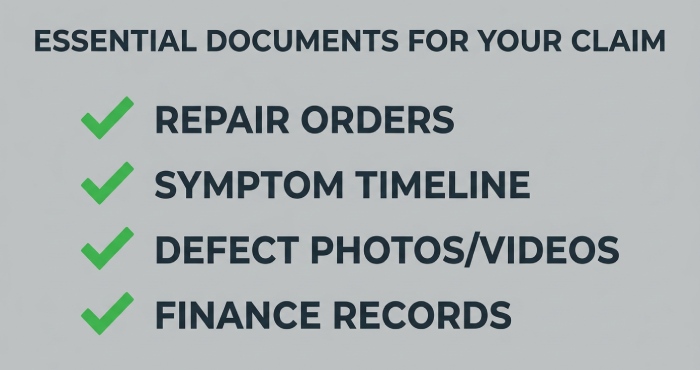
Start with disciplined documentation. Keep:
- Every repair order and warranty invoice
- Timeline of symptoms, mileage, and days out of service
- Photos/videos of the defect
- All recall or Technical Service Bulletin references
- Finance records and Truth in Lending Act disclosures if the vehicle is financed
Send a written notice to both the dealer and the manufacturer that references the warranty and requests repairs. While the dealer carries out the necessary work, the manufacturer will determine whether a refund or replacement is appropriate. Several manufacturers mandate third-party dispute resolution, typically certified by the Department of Consumer Affairs, in which arbitrators evaluate claims based on the federal Magnuson-Moss Warranty Act guidelines overseen by the Federal Trade Commission.
Arbitration vs. civil action
Arbitration can be faster and less formal, but outcomes vary by program and arbitrators. You retain the right to a civil action under the statute if arbitration fails or is non-binding. A seasoned lemon law attorney can evaluate whether to arbitrate or proceed to court, frame the burden of proof, and preserve leverage for civil penalties. If you’re in California, a San Diego Lemon Law attorney can handle the manufacturer’s channels and the court filing.
Timing traps and notices
- Presumption window: typically the first 18 months/18,000 miles in California.
- Statute of limitations: often four years for breach of warranty claims in California; other states vary.
- Notice: provide prompt written notice to the manufacturer and allow reasonable repair attempts.
- Lienholder: coordinate with your lienholder early if a buyback is on the table to avoid payoff delays.
Remedies With Teeth: buyback vs. replacement, mileage offsets, incidental/consequential damages, civil penalties, and attorney-fee shifting
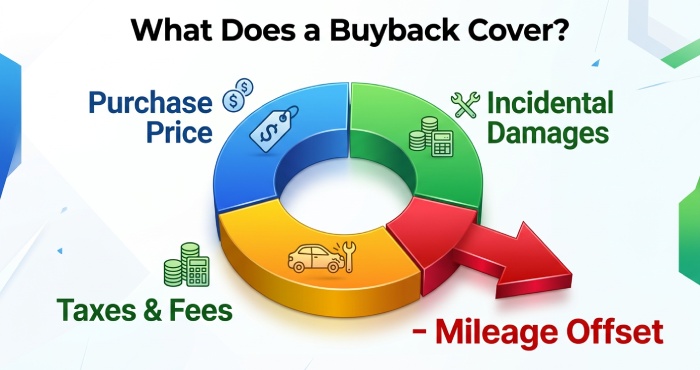
When a vehicle qualifies as a lemon vehicle under the California Lemon Law or another Lemon Law Statute, you may elect refund or replacement. A refund (Lemon Law Buyback) typically includes:
- Return of purchase price or paid lease amounts
- Sales tax reimbursement, registration, and official fees
- Payoff to the lienholder
- Deduction of a mileage offset for use before the first qualifying defect
A replacement means a comparable new motor vehicle with a fresh warranty, again subject to a mileage offset calculation in some states. These remedies are designed to be complete; they may include incidental damages (towing, rental cars, diagnostic fees) and consequential damages (lost income, out-of-pocket travel tied to repairs) where authorized. Some claims also seek compensation for diminished value.
Under California Civil Code §§ 1793.23–1793.26, reacquired vehicles must be branded as “Lemon Law Buyback” with the DMV and include written disclosure of the defect, and failing to do so can trigger civil penalties for manufacturers. The law also allows successful consumers to recover attorney fees and costs, so experienced lemon law lawyers can often pursue refunds or replacements without upfront fees.