
California’s lemon law was written in 1970. The Song-Beverly Consumer Warranty Act imagined a world in which a consumer buys a car, the car breaks down, the consumer drives it to a dealership, a technician opens the hood, and a physical repair is attempted. If the repair fails after a reasonable number of attempts, the manufacturer buys the car back.
For 54 years, that framework has worked reasonably well for cars powered by internal combustion engines. But electric vehicles have broken it in ways that no one anticipated, and the law has not caught up.
When your Tesla receives an over-the-air software update at 2 a.m. that fixes a braking calibration issue, does that count as a “repair attempt”? There is no repair order. There was no dealership visit. Your car never left the driveway. The BBB National Programs California Lemon Law Summary states that “written notice of nonconformity to the manufacturer or its service and repair facility constitutes return of the goods.” The law contemplates a physical return. An OTA update involves no return, no facility, and no written notice from the consumer.
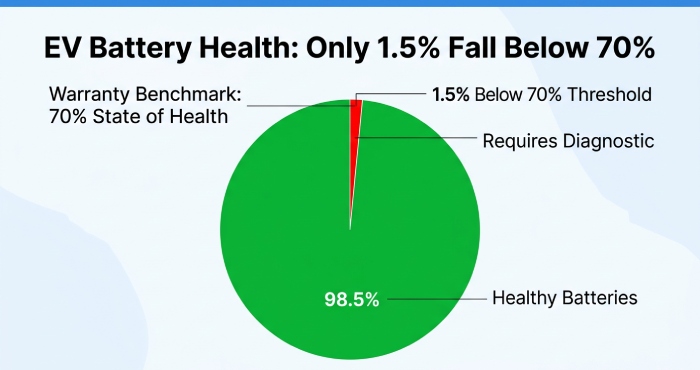
When your EV’s battery degrades from 300 miles of range to 210 miles over five years, is that a “substantial defect” or normal wear? The battery still works. The car still drives. But you have lost 30% of the capability you paid for. California’s Air Resources Board says a battery below 70% state of health is a warranty defect (CARB Final Regulation Order, Section 1962.8). But lemon law statutes do not reference battery state of health at all.
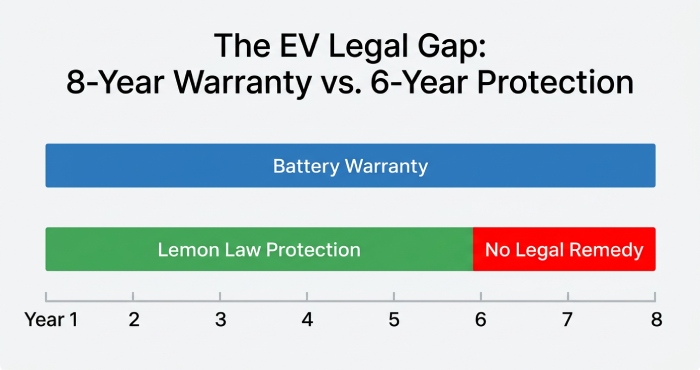
When your EV’s battery warranty covers you for eight years but California’s new lemon law statute of limitations expires after six, what happens in years seven and eight? According to a plaintiff-side law firm quoted in the AB 1755 legislative analysis—a government PDF—the answer is: you have a warranty but no lemon law remedy to enforce it.
These are not hypothetical edge cases. They are the everyday reality for millions of EV owners in California and across the country. This article examines the four fundamental ways that EV technology has outpaced lemon law, what it means for you if you own an electric vehicle, and what needs to change.
The OTA Problem: When a “Repair” Happens While You Sleep
In 2024, Tesla led all automakers in total recalled vehicles with 5.1 million units (NHTSA 2024 Annual Report on Safety Recalls). That number sounds alarming until you understand that a significant share of those recalls were resolved through over-the-air software updates pushed remotely to vehicles. No dealership visit. No parts. No labor. No repair order. The NHTSA report shows Tesla leading all manufacturers in OTA-remedied recalls.
From an engineering perspective, this is a triumph. Tesla can identify a software defect affecting millions of vehicles and deploy a fix to every one of them overnight, at minimal cost. The traditional recall model—mailing letters, scheduling appointments, ordering parts, paying technicians—is slow, expensive, and achieves only about a 69% completion rate (NHTSA January 2025 Recall Completion Report). OTA achieves near-100%.
But from a legal perspective, OTA updates create a problem that no lemon law was designed to address: they leave no paper trail that fits the statutory framework.
California’s lemon presumption triggers after four repair attempts for the same defect, two attempts for safety defects, or 30 cumulative days out of service (BBB CA Lemon Law Summary PDF). Every one of those metrics assumes a physical interaction: you bring the car in, a technician works on it, you pick it up. Each visit generates a repair order that documents the symptoms, the diagnostic codes, and the work performed.
An OTA update generates none of this. The vehicle’s software logs may record that an update was applied, but there is no repair order signed by a technician, no “days out of service” (the car never left your garage), and no clear documentation that the consumer reported the defect and the manufacturer attempted a fix. If the OTA update fails to resolve the issue and the consumer later files a lemon law claim, can those invisible updates be counted toward the four-attempt threshold? The statute does not say.
What This Means for EV Owners
If your EV receives an OTA update that is supposed to fix a defect but doesn’t, you are in a legal gray zone. The manufacturer may argue that no “repair attempt” occurred because you never brought the car in. You may argue that the manufacturer’s own software push was an attempt to repair a known defect and it failed. Neither side has clear statutory support.
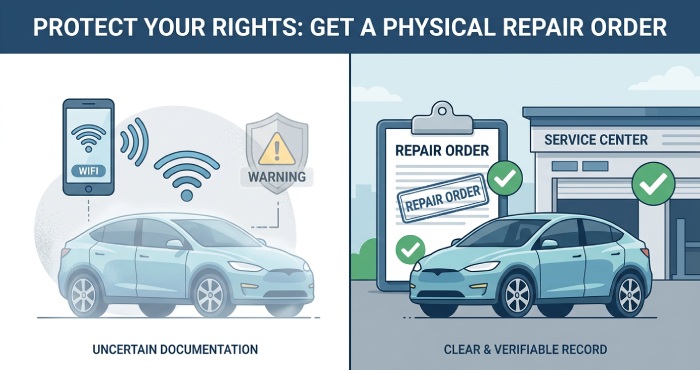
What to do: Document everything. If you receive an OTA update that your manufacturer’s release notes describe as addressing a specific defect, save a screenshot of those release notes, note the date and time, and record whether the defect persists afterward. If the problem continues, also take the vehicle to a service center and request a physical repair order. This creates the traditional paper trail that the statute recognizes. The physical visit counts unambiguously as a “repair attempt,” and the days the car is at the service center count toward the 30-day out-of-service threshold. Do not rely on OTA updates alone to build your lemon law case.
The Battery Degradation Question: Is Losing 30% of Your Range a “Defect”?
Every lithium-ion battery degrades over time. This is not a defect—it is chemistry. A brand-new EV with 300 miles of range will have less range in five years, less in ten, and less in fifteen. The question is: at what point does normal degradation cross the line into a warranty defect that triggers lemon law protections?
The California Air Resources Board has provided the clearest answer of any regulatory body. CARB’s Advanced Clean Cars II Final Regulation Order (Section 1962.8, Title 13 of the California Code of Regulations) mandates that EV batteries must be “free from defects in materials and workmanship which cause the battery state of health to deteriorate to less than 70% for a warranty period of eight years or 100,000 miles” for 2026–2030 model years, and to less than 75% for 2031 and subsequent model years.
In practical terms: if your 2027 EV’s battery drops below 70% of its original capacity within eight years or 100,000 miles, CARB considers that a defect—not normal wear. The manufacturer must replace or repair it under warranty. For 2031+ models, the threshold rises to 75%, meaning manufacturers will need to build batteries that retain more capacity over the same period.
CARB’s Final Statement of Reasons draws a clear distinction: “Battery warranty is there to protect vehicle owners that got a defective battery. Vehicle durability requirements ensure the vehicle model was adequately designed to protect for degradation of any propulsion-related component in the first 10 years.”
This distinction between a defective battery (warranty claim) and inadequate design (durability regulation) is critical (CARB Final Statement of Reasons PDF). A battery that degrades to 65% in year six due to a manufacturing flaw in the cell chemistry is a warranty defect. A battery that degrades to 72% in year six because the vehicle’s thermal management system was poorly designed is a durability failure. Both harm the consumer, but they trigger different legal remedies.
The Real-World Data
How common is it for batteries to actually breach the 70% threshold? The P3 Group’s 2024 battery aging study—a whitepaper analyzing data from over 7,000 real-world EVs—found that “in practice, the state of health rarely falls below 70% within the warranty period.” The Washington State Department of Ecology’s EV Battery Management Report estimates an EV battery failure rate of approximately 1.5%. And the CPUC Energy Storage Procurement Study confirms that the 70% threshold is the industry-standard benchmark.
This means that for the vast majority of EV owners, battery degradation will not reach the level of a warranty defect. But for the 1–2% whose batteries do fail prematurely, the legal question becomes: does a battery at 68% state of health “substantially impair the use, value, or safety” of the vehicle—the standard that Song-Beverly uses to define a lemon? A car with 68% battery health still drives. It still charges. But it has lost nearly a third of its range, which may mean the owner can no longer make their daily commute without a mid-day charge, can no longer take the road trips they bought the car for, or has watched its resale value plummet.
What to do: If your EV’s range has declined significantly, request a battery state of health diagnostic at a manufacturer service center. Get the percentage in writing on a repair order. If the SoH is below 70% and the vehicle is within the 8-year/100,000-mile warranty, you have a warranty claim under CARB’s regulation. Whether that warranty claim also supports a lemon law buyback depends on whether the manufacturer can repair or replace the battery after a reasonable number of attempts. If they replace the battery and the new one also degrades prematurely, that pattern of failed repairs is classic lemon law territory.
Tesla’s Arbitration Clause: The 30-Day Window Most Owners Miss
Every Tesla sold in the United States comes with a mandatory arbitration clause embedded in the Motor Vehicle Order Agreement—the PDF document that constitutes your purchase contract. The clause states that any dispute “will not be decided by a judge or jury but instead by a single arbitrator in an arbitration administered by the American Arbitration Association (AAA).” It includes a class action waiver: “The arbitrator cannot hear class or representative claims.”
This clause fundamentally changes the legal landscape for Tesla EV owners compared to buyers of Ford, GM, Toyota, or any other manufacturer that sells through independent dealerships. Traditional automakers do not typically include binding arbitration clauses in their purchase agreements because the purchase contract is between the consumer and the dealer, not the manufacturer. Tesla’s direct-to-consumer model eliminates the dealer middleman, putting Tesla’s own arbitration clause directly in front of every buyer.
However, the order agreement includes a critical escape hatch:
You may opt out of arbitration within 30 days after signing this Agreement by sending a letter to: Tesla, Inc.; P.O. Box 15430; Fremont, CA 94539-7970, stating your name, Vehicle Identification Number, and intent to opt out of the arbitration provision.
That opt-out window is real, and the National Consumer Law Center recommends exercising it. Their guidance states: “Even if you don’t currently have a dispute with the company, it is a good idea to opt out of the forced arbitration clause to preserve your options.”
How Tesla’s Dispute Resolution Actually Works
Tesla’s New Vehicle Limited Warranty establishes a two-tier dispute resolution process. First, Tesla offers optional arbitration through the National Center for Dispute Settlement (NCDS). NCDS decisions are binding on Tesla but not on the consumer—you can reject an unfavorable NCDS ruling. Second, all unresolved disputes go to binding AAA arbitration under the terms of the purchase agreement.
Tesla’s Owners Rights Notification—a multi-state PDF containing lemon law notices for every state—confirms this process and adds state-specific details. In California, the notification states that Tesla will comply with an NCDS decision “within 30 days after receiving notice of the consumer’s acceptance.” Remedies include “repairs; reimbursement for repairs and incidental expenses; and repurchase or replacement.”
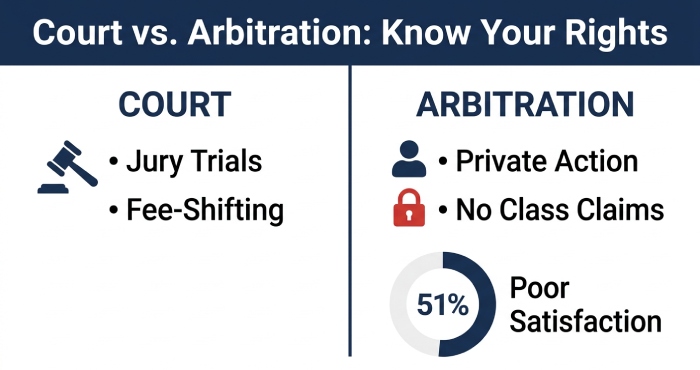
The practical impact of arbitration versus court is significant. In court, lemon law cases are decided by judges or juries who may be sympathetic to consumer claims, and California’s one-way attorney fee-shifting means the manufacturer pays your lawyer if you win. In arbitration, a single arbitrator decides, class claims are prohibited, and the proceedings are private. The CA DCA’s 2024 ACP survey shows that among consumers who went through lemon law arbitration in California, 51% rated their satisfaction as “poor” or “very poor,” and only 58% rated the arbitrator’s fairness favorably.
What to do: If you have recently purchased or are about to purchase a Tesla, send the arbitration opt-out letter within 30 days via certified mail with return receipt requested. Keep a copy of the letter and the delivery confirmation. This costs nothing and preserves your right to pursue a lemon law claim in court if needed. If your 30-day window has already closed and you have a dispute, you can still pursue NCDS arbitration (which is non-binding on you) before entering binding AAA arbitration. Consult a lemon law lawyer in San Diego before making any election—many will evaluate your case for free.
The Six-Year Gap: How AB 1755 Effectively Nullifies EV Battery Warranties
This is the most consequential issue in this article, and it received almost no public attention when it was enacted.
AB 1755, signed by Governor Newsom in September 2024, imposed a six-year absolute statute of limitations on California lemon law claims, measured from the date of vehicle delivery. The AB 1755 legislative analysis—a government PDF from the California Assembly Judiciary Committee—documents the concern raised during hearings:
Strategic Legal Practices, APC, is concerned that “AB 1755 effectively nullifies 10-year emission warranties and 8 to 10-year electric vehicle battery warranties after just 6 years, because claims would not be able to be brought more than 6 years after delivery of the vehicle.”
The legislative analysis acknowledges this concern but notes that “only truly extended warranties would be implicated,” since most automobile warranties range between 36 and 60 months. The committee treated the EV battery scenario as an edge case.
But it is not an edge case. It is the standard case for every EV sold in California.
Federal regulation mandates that EV battery warranties cover at least 8 years or 100,000 miles. CARB’s ACC II regulation extends this with the 70% state-of-health threshold. Ford’s 2024 BEV Warranty Guide confirms 8-year/100,000-mile coverage for battery and electric drive motor. Tesla’s warranty covers Model 3 and Model Y batteries for 8 years/120,000 miles, and Model S and Model X for 8 years/unlimited miles. Hyundai, Kia, and GM provide similar 8–10 year battery warranties.
Under AB 1755, a consumer who buys an EV in January 2025 and experiences a battery defect in February 2031—six years and one month after delivery, but still well within the eight-year battery warranty—cannot file a lemon law claim. The warranty says the battery is covered. The statute of limitations says the claim is time-barred.
The SB 26 Senate Judiciary analysis confirms that Tesla opted into the AB 1755 framework. This means Tesla EV owners in California face a specific two-year gap: their battery warranty runs for eight years, but their lemon law remedy expires after six.
What You Still Have After Year Six
The six-year cap does not eliminate all remedies. You still have:
- Warranty repair claims: The manufacturer’s warranty is a separate contractual obligation. If your battery fails below 70% SoH in year seven, the manufacturer must still repair or replace it under the warranty terms. What you lose is the lemon law’s additional remedies: the right to demand a full buyback, the 2x civil penalty for willful violations, and the manufacturer-paid attorney fees.
- Federal Magnuson-Moss claims: The federal warranty act has its own statute of limitations (generally four years from the warranty breach, not from vehicle delivery), and it provides attorney fee-shifting. This may become the primary legal vehicle for EV battery claims in years seven and eight.
- Breach of contract/warranty claims: Under the California Uniform Commercial Code, you can sue for breach of warranty, though the remedies are narrower than Song-Beverly’s.
What to do: Be aware of the calendar. If your EV develops a battery defect in years five or six, do not wait. File your lemon law claim before the six-year window closes. If the defect appears after year six, consult an attorney about Magnuson-Moss and UCC warranty claims. And if you are buying an EV in 2026 or later, check whether your manufacturer opted into AB 1755 under SB 26 by visiting the CA DCA’s published list. Manufacturers that did not opt in are not subject to the six-year cap.

Case Study: The Bolt Battery Recall and What It Reveals
The Chevrolet Bolt EV/EUV battery recall is the most expensive and instructive EV warranty event in automotive history. GM’s Q1 2024 SEC filing disclosed a remaining accrual of $0.5 billion for the recall as of March 2024. The total cost to GM exceeded $2 billion. The defect was traced to two concurrent manufacturing flaws in LG Energy Solution’s battery cells: a torn anode tab and a folded separator, either of which could cause an internal short circuit leading to thermal runaway and fire.
The Bolt recall reveals every weakness in the current legal framework simultaneously:
- The defect was invisible. Owners could not detect the manufacturing flaw through normal use. The battery worked normally until it didn’t—at which point it could catch fire. This is fundamentally different from a combustion engine defect, where the consumer typically notices symptoms (noise, vibration, warning lights) that prompt a repair visit.
- The remedy was a full battery module replacement. There was no “repair” in the traditional sense. GM had to replace the battery packs in approximately 142,000 vehicles—a logistics and supply chain challenge that took nearly two years to complete.
- The fix required the manufacturer to stop selling the car entirely. GM halted Bolt production in 2021 and asked owners to stop parking their vehicles in garages or charging them above 90%. The vehicle was effectively unusable in the way it was intended to be used.
- The cost dwarfed anything in the ICE world. A traditional powertrain defect affecting 142,000 vehicles might cost a few hundred dollars per vehicle to repair. The Bolt recall cost roughly $14,000 per vehicle—because the battery pack is the most expensive single component.
For Bolt owners who pursued lemon law claims during the recall, the question was clear-cut: the vehicle had a safety defect (fire risk) that the manufacturer could not repair in a timely manner. But for future EV battery defects that are less dramatic—gradual degradation, intermittent charging failures, range loss in cold weather—the legal path is far murkier.
What Needs to Change: Five Reforms for the EV Era
1. Define OTA Updates in the Statute
State lemon laws need to explicitly address whether OTA software updates count as repair attempts. A workable framework would count an OTA update as a repair attempt if: (a) the update was deployed in response to a reported defect or recall, (b) the manufacturer’s release notes identify the defect being addressed, and (c) the defect persists after the update. The consumer should not be required to visit a physical service center for an attempt to “count” if the manufacturer chose to attempt the repair remotely.
2. Align the Statute of Limitations with the Warranty Period
AB 1755’s six-year cap should be amended to provide that the statute of limitations cannot expire before the end of the applicable manufacturer warranty—or at minimum, the federally mandated EV battery warranty period of eight years. A simple fix: “the later of six years from delivery or one year after the expiration of the applicable express warranty.” This would close the two-year gap for EV battery claims without affecting the timeline for standard warranty claims.
3. Establish a Battery State of Health Standard for Lemon Law
CARB has already defined 70% SoH as the threshold for a battery warranty defect. Lemon law statutes should incorporate this standard by providing that a battery below the CARB-mandated SoH threshold constitutes a “substantial impairment of use, value, or safety” per se. This would eliminate the case-by-case litigation over whether a specific degree of range loss is “substantial enough” to qualify.
4. Require OTA Update Documentation
Manufacturers that deploy OTA updates should be required to provide consumers with a written record equivalent to a repair order: the date and time of the update, the specific defect or issue addressed, the software version before and after, and whether the update fully resolved the reported concern. This documentation should be accessible through the vehicle’s owner portal and admissible in arbitration or court proceedings.
5. Regulate Arbitration Clauses in Direct-Sale Vehicle Purchases
As more manufacturers move toward direct-to-consumer sales (following Tesla’s model), mandatory arbitration clauses in vehicle purchase agreements will become more common. Legislators should consider requiring that arbitration opt-out windows be prominently disclosed at the time of purchase—not buried in multi-page terms of service—and that the opt-out period be extended from 30 days to at least 90 days to give consumers time to understand their rights.
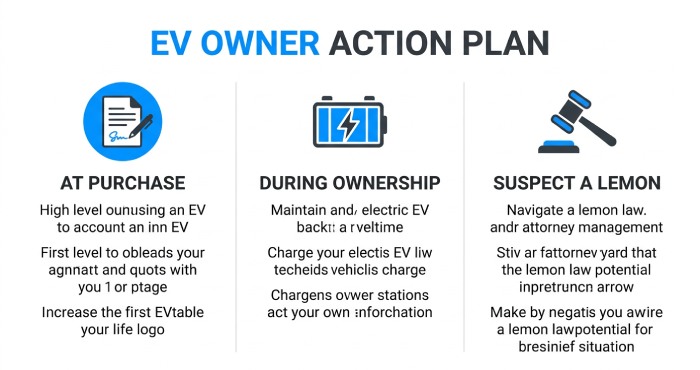
Your EV Owner Action Plan
At Purchase
- If buying a Tesla: send the arbitration opt-out letter within 30 days via certified mail to Tesla, Inc.; P.O. Box 15430; Fremont, CA 94539-7970. Include your name, VIN, and intent to opt out. Keep proof of delivery.
- For any EV: photograph or save the full warranty document, especially the battery capacity retention warranty terms. Note the exact SoH percentage threshold and coverage period.
- Check whether your manufacturer opted into AB 1755 at the CA DCA website. This determines your statute of limitations and procedural requirements.
During Ownership
- Screenshot OTA update release notes when they reference defect fixes. Note dates and whether the issue resolved.
- If a defect persists after an OTA update, take the vehicle to a service center and request a physical repair order. This creates the documentation the statute recognizes.
- Request a battery state of health diagnostic annually after year three. Get the SoH percentage on a written repair order.
- Keep a personal log of range loss, charging issues, and any defect symptoms with dates and mileage.
If You Suspect a Lemon
- Do not wait until year seven or eight of a battery warranty. If a defect appears in years five or six, file your lemon law claim before the six-year AB 1755 window closes.
- Count your repair attempts carefully. If OTA updates failed to fix the issue, document them but also ensure you have physical repair visits on the record.
- Consult a San Diego lemon law attorney. Under Song-Beverly, the manufacturer pays your attorney fees if you prevail. Most San Diego lemon law attorneys work on contingency, meaning there is typically no out-of-pocket cost to you while pursuing your claim.
The Bottom Line
The legal framework for protecting car buyers was built for a world of carburetors, transmissions, and catalytic converters. Electric vehicles have introduced technologies—over-the-air software updates, lithium-ion battery chemistry, direct-to-consumer sales with mandatory arbitration—that this framework was never designed to handle.
The result is a growing gap between the protections consumers think they have and the protections they actually have. An EV owner with an eight-year battery warranty may assume that warranty gives them full recourse if the battery fails in year seven. It does not—not under California’s lemon law as currently written. A Tesla owner may assume their purchase contract is similar to every other car purchase. It is not—it includes a binding arbitration clause that most other manufacturers do not impose.
The good news is that these gaps are fixable. CARB has already defined battery health standards. NHTSA is tracking EV-specific recalls. The legislative tools exist. What is missing is the political will to update laws written before any of today’s EVs were on the road.
Until that happens, the responsibility falls on EV owners to understand the limits of their legal protections and take specific steps—opting out of arbitration, documenting Over-the-air (OTA) updates, requesting SoH diagnostics, watching the statute of limitations calendar—to protect themselves. The law will eventually catch up. The question is how many consumers will fall into the gap before it does.
Sources and References
All sources are downloadable PDFs from government agencies, Tesla corporate documents, SEC filings, nonprofit organizations, or research institutions. Every URL links directly to the source document.
Government PDFs
[1] NHTSA. 2024 Annual Report on Safety Recalls, Published April 2025. https://www.nhtsa.gov/sites/nhtsa.gov/files/2025-04/2024-annual-recalls-report.pdf
[2] NHTSA. January 2025 Report on Vehicle Safety Recall Completion Rates. https://www.nhtsa.gov/sites/nhtsa.gov/files/2025-01/recall-completion-rates-report-update-01172025.pdf
[3] California Air Resources Board. Advanced Clean Cars II Final Regulation Order, Section 1962.8, Title 13 CCR. https://ww2.arb.ca.gov/sites/default/files/barcu/regact/2022/accii/acciifro1962.8.pdf
[4] California Air Resources Board. Advanced Clean Cars II Final Statement of Reasons. https://ww2.arb.ca.gov/sites/default/files/barcu/regact/2022/accii/fsorappd.pdf
[5] California Assembly Judiciary Committee. AB 1755 Legislative Analysis, August 2024. https://ajud.assembly.ca.gov/system/files/2024-08/ab-1755-analysis.pdf
[6] California Senate Judiciary Committee. SB 26 Analysis, February 2025. https://trackbill.com/s3/bills/CA/2025/SB/26/analyses/senate-judiciary.pdf
[7] California DCA. 2024 ACP Consumer Satisfaction Survey Results. https://www.dca.ca.gov/acp/pdf_files/survey2024.pdf
[8] CPUC. Energy Storage Procurement Study: End of Life Options, June 2023. https://www.cpuc.ca.gov/-/media/cpuc-website/divisions/energy-division/documents/energy-storage/2023-05-31_lumen_energy-storage-procurement-study-report-attg.pdf
[9] Washington State Dept. of Ecology. EV Battery Management Final Report to Legislature, 2024. https://apps.ecology.wa.gov/publications/documents/2407014.pdf
Tesla Corporate Documents
[10] Tesla, Inc.. Motor Vehicle Order Agreement (Purchase Contract with Arbitration Clause). https://www.tesla.com/order/download-order-agreement
[11] Tesla, Inc.. Model 3 New Vehicle Limited Warranty (North America). https://www.tesla.com/sites/default/files/downloads/Model_3_New_Vehicle_Limited_Warranty_NA_en.pdf
[12] Tesla, Inc.. Owners Rights Notification (Multi-State Lemon Law Notices). https://www.tesla.com/sites/default/files/blog_attachments/ownersrightsnotification.pdf
Other Manufacturer Documents
[13] Ford Motor Company. 2024 Battery Electric Vehicle Warranty Guide. https://www.fordservicecontent.com/Ford_Content/Catalog/owner_information/2024_US_Ford_BEV_Warranty_Guide-9.5.23.pdf
SEC Filings
[14] General Motors Company. Form 10-Q, Q1 2024 (Bolt Battery Recall Accrual). https://investor.gm.com/static-files/41c480cf-888b-4c0a-8d66-d83353444de8
Nonprofit and Industry Research
[15] BBB National Programs. California Lemon Law Summary. https://assets.bbbprograms.org/docs/default-source/auto-line/statelemonlaws/california-lemonlaw.pdf
[16] National Consumer Law Center (NCLC). How to Opt Out of a Forced Arbitration Clause. https://www.nclc.org/wp-content/uploads/2022/10/Opt-out-of-arbitration-form.pdf
[17] P3 Group. Battery Aging in Practice: Analysis of Over 7,000 EVs, November 2024. https://www.p3-group.com/wp-content/uploads/2024/11/241125_Whitepaper_SOH_EN.pdf
[18] Warranty Week. 2024 U.S. Auto Warranty Annual Report (Tesla Claims Data), February 2025. https://www.warrantyweek.com/archive/ww20250227.html
Disclaimer: This article is provided for informational purposes only and does not constitute legal advice. EV lemon law is a rapidly evolving area with significant unresolved legal questions. If you believe your electric vehicle qualifies under any state or federal lemon law, consult a qualified attorney for guidance specific to your situation and jurisdiction.