
You fought for months. You documented every repair visit, every loaner car, every morning you walked out to a vehicle that would not start. You hired an attorney, navigated arbitration or litigation, and finally got the answer you deserved: your car is a lemon, and the manufacturer must buy it back.
Congratulations. Now what?
This is the question that almost no one answers. Search for “California lemon law” and you will find thousands of articles explaining how to qualify for a claim, how many repair attempts are needed, and whether your vehicle is covered. But search for what happens after you win, and you will find almost nothing. The entire internet is focused on getting you to the finish line. Nobody tells you what happens when you cross it.
That silence is expensive. The post-victory buyback process is where consumers routinely lose thousands of dollars—accepting incorrect mileage offset calculations, missing sales tax refunds they are legally owed, signing releases that waive additional rights, or waiting weeks for restitution checks that manufacturers are supposed to have ready at the time of vehicle return. A 2025 analysis in Advocate Magazine noted that “many manufacturers refuse to provide checks at the time of vehicle return, forcing plaintiffs to wait to have the settlement funds they need to purchase another vehicle.”
This article walks you through every step of the buyback process—from the day you win to the day the money hits your account—using only primary-source documents: government PDFs from the California DMV, the California DCA, the California Legislature, and the BBB National Programs’ standardized state summaries. This is the guide that should have existed years ago.
Step 1: Understanding Exactly What You Are Owed
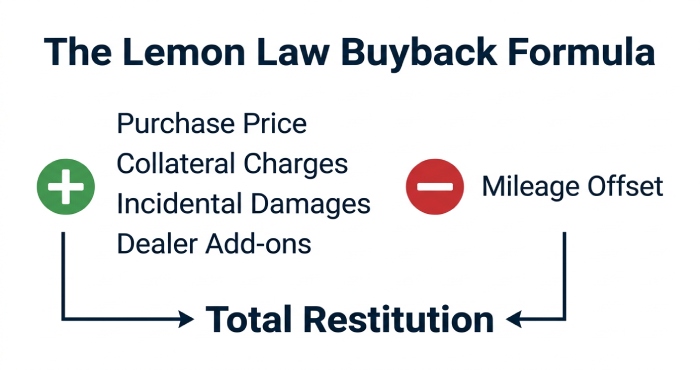
The first thing to understand is that a lemon law buyback is not simply a refund of the sticker price. It is a comprehensive restitution formula designed to put you back in the financial position you were in before you bought the defective vehicle. According to the BBB National Programs California Lemon Law Summary—a standardized PDF document that catalogs the provisions of every state’s lemon law—the California buyback includes:
- The actual purchase price, including the vehicle’s base price, transportation charges, and all manufacturer-installed options.
- Collateral charges: sales tax, license fees, registration fees, and any government charges paid at the time of purchase.
- Incidental damages: towing charges, rental car costs, prepayment penalties on your auto loan, and finance charges incurred because of the defect.
- Minus ONE deduction only: a mileage offset representing the value of your use of the vehicle before the first repair attempt for the defect (detailed below).
That third category—incidental damages—is where many consumers leave money on the table. If you paid for Uber rides while your car was in the shop, rented a vehicle for a family trip because your lemon was being repaired, or paid a prepayment penalty on an auto loan you had to refinance, those costs are recoverable. But you need receipts. The manufacturer will not voluntarily calculate these amounts for you.
What to do right now: Before your case concludes, create a comprehensive spreadsheet of every out-of-pocket cost you incurred because of the defect. Include rental cars, ride-share receipts, towing invoices, hotel stays if you were stranded, and any loan fees. Attach a receipt or bank statement to each line item. This spreadsheet becomes an exhibit in your settlement negotiation, and every dollar you can document is a dollar the manufacturer must reimburse.
What About Dealer Add-Ons?
The AB 1755 legislative analysis clarifies a question that has caused disputes for years: which dealer-installed options count toward the purchase price? The answer, now codified in statute, is that optional features that “constitute dealer additions” are included in the buyback price, while consumer-installed aftermarket accessories are not.
In practical terms: if the dealership installed a roof rack, upgraded wheels, or added a tow package and built the cost into the purchase price, those amounts are part of your refund. If you later added a custom stereo system or aftermarket bumper, those are not. The line is drawn at who installed the addition and whether it was included in the original purchase price.
Step 2: The Mileage Offset — The Only Deduction They Can Take
The mileage offset is the manufacturer’s only permitted deduction from your buyback refund. It represents compensation for the use you got out of the vehicle before the defect first appeared. The formula, documented in the BBB California Summary PDF, is:
(Miles driven before first repair attempt for the defect ÷ 120,000) × Purchase Price = Mileage Offset
Let’s run a real example. You bought a $45,000 SUV. The defect—a recurring transmission shudder—first appeared at 8,000 miles, and that’s when you brought it to the dealer for the first repair attempt. Your mileage offset is:
(8,000 ÷ 120,000) × $45,000 = $3,000
You would receive $45,000 minus $3,000 = $42,000, plus all collateral charges and incidental damages. The 120,000-mile divisor is favorable to consumers because it produces a relatively small deduction. If you first reported the defect at 5,000 miles, your offset would be just $1,875. If you waited until 20,000 miles, it would be $7,500.
This is why early reporting matters enormously. Every mile you drive before that first repair attempt increases the deduction from your refund. The moment you notice a recurring defect, take the vehicle to the dealer and get it documented in writing. That repair order establishes the mileage at first repair, which locks in your offset for the life of the claim.
How Other States Compare
Not all states use the same formula, and the differences can cost you thousands. According to the BBB New Jersey Summary PDF, New Jersey uses a 100,000-mile divisor instead of California’s 120,000. On our same $45,000 SUV with 8,000 miles at first repair, the NJ offset would be $3,600 versus California’s $3,000—a $600 difference in the manufacturer’s favor.
Hawaii has the most consumer-friendly approach. The BBB Hawaii Summary PDF shows that Hawaii calculates the offset at 1% of purchase price per 1,000 miles—but critically, it caps the mileage count at the date of the third repair attempt (or first safety repair, or 30th out-of-service day). This means that all miles driven after the presumption triggers—during the months or years the claim is being processed—do not increase the offset. California does not have this protection.
Mileage Offset Comparison Table:
| State | Formula | Offset on $45K / 8K mi | Source |
| California | Miles ÷ 120,000 × Price | $3,000 | BBB CA PDF |
| New Jersey | Miles ÷ 100,000 × Price | $3,600 | BBB NJ PDF |
| Hawaii | 1% per 1,000 mi (capped) | $3,600 (capped at trigger) | BBB HI PDF |
| New York | Varies; no offset for replacement | $0 if replacement chosen | NY AG PDF |
Sources: BBB National Programs state summaries and NY Attorney General Lemon Law Guide. All linked in references.
What to do: When your attorney presents the settlement offer, verify the mileage offset calculation yourself. Confirm the denominator is 120,000 (not 100,000), confirm the mileage used is from your first repair attempt for the specific defect (not total current mileage), and confirm the purchase price used matches your contract. Errors in any of these three numbers can cost you hundreds or thousands of dollars.
Step 3: Getting Your Sales Tax Back
This is the money that consumers most often miss. California sales tax on a $45,000 vehicle ranges from roughly $3,400 to $4,800 depending on your county. That is a substantial sum, and the manufacturer is required to refund it as part of the buyback.
The BBB California Summary PDF explains the mechanism: “The manufacturer refunds sales tax to the consumer. The State Board of Equalization reimburses the manufacturer for sales tax paid to or for the consumer.” In other words, you get your sales tax back from the manufacturer, and the manufacturer gets reimbursed by the state. You do not need to file a separate claim with the tax board—the manufacturer handles that.
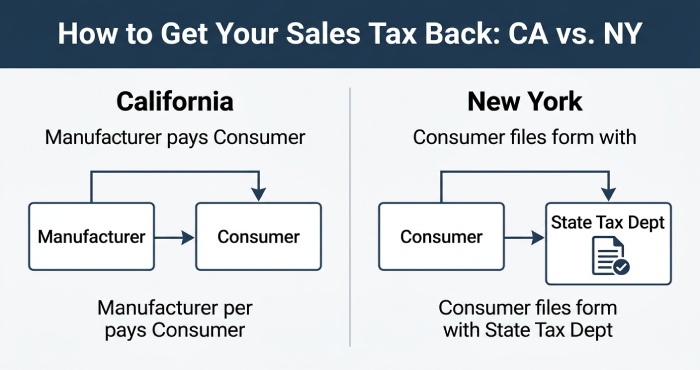
This is different from how other states work. In New York, the NY Attorney General’s Lemon Law Guide states that sales tax is refunded separately by the New York Commissioner of Taxation and Finance—not by the manufacturer. The consumer must file a separate form to recover it. Missing this step means leaving thousands on the table.
What to do: When reviewing your settlement documentation, verify that sales tax is explicitly listed as a line item in the refund calculation. If you are in California, the manufacturer should include it in the buyback check. If you are in New York or another state where tax is refunded separately, ask your attorney for the specific form and filing deadline. Do not assume this will happen automatically.
Step 4: The Release — What You Sign Matters More Than You Think
Before you get your money, you must sign a release—a legal document that formally settles the claim and transfers the vehicle back to the manufacturer. For years, this was a major pain point. Manufacturers used custom release templates packed with broad waiver language, non-disparagement clauses, and provisions that went far beyond the scope of the lemon law claim. Consumers were pressured to sign or risk delaying their refund.
AB 1755 changed this. The bill text creates a mandatory standardized SBA release template (Code of Civil Procedure §871.25). The law is explicit: “No remedy may be contingent on the execution of any release other than this template.” This means manufacturers cannot require you to sign any additional waivers, non-disclosure agreements, or non-disparagement clauses as a condition of receiving your buyback.
The Advocate Magazine analysis details what the standardized release must include:
- Specific dollar amounts for loan or lease payoff
- Specific dollar amounts for consumer recovery (the check you receive)
- Reimbursement for any payments made between the settlement date and the payoff date
- The civil penalty amount, if applicable
- Attorney fee provisions—whether agreed upon or subject to court motion
- Signatures from both parties
Two provisions of the new release are particularly important and virtually unknown to consumers:
First, the release takes effect when you return the vehicle—not when you sign it. Under the old system, many releases took effect the moment you signed, which meant that if the defective vehicle injured you between signing and return, the release could bar your personal injury claim. The new template eliminates this risk (Advocate Magazine PDF).
Second, the manufacturer must have your restitution check ready at the time you return the vehicle. The Advocate Magazine analysis notes that “many manufacturers refuse to provide checks at the time of the vehicle return, forcing plaintiffs to wait to have the settlement funds they need to purchase another vehicle.” The new law requires the manufacturer to process loan payoff funds, attorney fees, and civil penalty payments within one business day of vehicle return.
What to do: If your manufacturer presents a release document that is not the standardized AB 1755 template, or if it contains additional clauses beyond the template’s scope, do not sign it. Show your attorney the statutory template language and insist on the standardized form. If the manufacturer is one that opted into AB 1755 under SB 26, these provisions are mandatory. Check the CA DCA’s manufacturer opt-in list to confirm.
Step 5: The $50/Day Penalty for Delayed Settlements
Before AB 1755, there was no financial penalty for manufacturers who dragged their feet after agreeing to a buyback. A manufacturer could agree to repurchase your vehicle and then take months to process the paperwork. The AB 1755 legislative analysis notes that this was one of the most common consumer complaints: the delay between reaching a settlement and actually receiving the money.
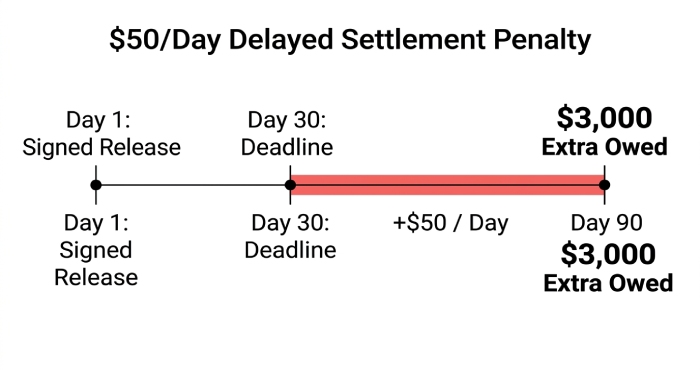
The new law imposes a mandatory $50/day penalty on manufacturers who fail to complete a buyback within 30 days of receiving the signed release (AB 1755 Bill Text, Section 871.27). The legislative analysis acknowledged that $50/day may prove insufficient as a deterrent for large manufacturers and may need to be adjusted, but it represents the first financial penalty in the history of California’s lemon law for settlement delays.
Here’s what $50/day looks like in practice: if a manufacturer takes 90 days to complete your buyback instead of 30, the penalty is $50 x 60 excess days = $3,000 in additional damages owed to you. That is not a trivial amount, and it gives your attorney significant leverage in demanding prompt completion.
What to do: Record the date you submit your signed release. Mark your calendar for Day 31. If you have not received your restitution check and loan payoff confirmation by that date, notify your attorney immediately. The $50/day penalty accrues automatically, and documenting the timeline is straightforward—it’s just math.
Step 6: Returning the Vehicle and the DMV Process
The physical return of the vehicle triggers a series of DMV requirements that most consumers know nothing about—but that matter if you ever encounter a “lemon law buyback” vehicle on a dealer lot in the future.
The California DMV’s Fast Facts: Lemon Law Buyback Vehicles—a downloadable government PDF—details the manufacturer’s legal obligations once they take possession of a buyback vehicle:
- Retitle the vehicle in the manufacturer’s name.
- Request DMV inscribe the certificate of title and registration certificate with the notation “LEMON LAW BUYBACK.”
- Affix a physical decal reading “Lemon Law Buyback” to the vehicle. The DMV PDF specifies the decal must be placed on the left door frame, the threshold to the driver’s side front seat, or on the left side of a doorless vehicle like a motorcycle.
These requirements exist because lemon law buyback vehicles are not destroyed. Manufacturers almost always repair them and resell them. The BBB California Summary PDF details the resale requirements: before any resale, lease, or transfer, the manufacturer must provide written disclosure of every nonconformity reported by the original buyer, any repairs made, and whether the title has been branded. The manufacturer must also warrant to the next buyer, for a full year, that the vehicle is free of the originally reported problems.
What this means for you as the original owner: Your obligation is simply to return the vehicle in its current condition. Do not make any repairs, remove any parts, or attempt to “clean up” the defect before return. The vehicle should be returned in the same condition it was in during your last repair attempt. Remove your personal belongings, clean out the glove box, and hand over the keys. That is it.
What this means if you are ever shopping for a used car: Always check the title for a “Lemon Law Buyback” notation. Run the VIN through the NHTSA recall lookup and request a vehicle history report. A branded title does not mean the car is inherently unsafe—many buyback vehicles are successfully repaired—but it does mean the vehicle had a defect serious enough that the manufacturer could not fix it and was legally compelled to buy it back. That history deserves scrutiny.
Step 7: If You Leased — The Two-Party Split
Leased vehicle buybacks are more complicated than purchases because the money goes to two different parties. The BBB California Summary PDF breaks it down:
The leasing company (lessor) receives: the remaining balance of the lease payoff amount, minus the security deposit (which goes to you) and any refunds due for unexpired service contracts.
You (the lessee) receive: all collateral charges (sales tax, registration, fees), all incidental damages (towing, rentals), all base monthly payments you have made, any trade-in value or down payment you put down, and your security deposit—minus the mileage offset.
The critical detail most consumers miss is that the payments you made between the settlement date and the payoff date are also recoverable. Under the new AB 1755 standardized release, the settlement must include reimbursement for payments made during this gap period (Advocate Magazine PDF). If the manufacturer takes 45 days to process the buyback and you make a lease payment during that window, that payment is added to your recovery.
What to do: Keep making your lease payments until the buyback is complete. Do not stop payments expecting the manufacturer to handle it—missed payments will damage your credit and could trigger lease default provisions. Document every payment you make after the settlement date, and ensure those amounts are included in the final recovery calculation.
Step 8: What If You Go Through Arbitration Instead of Court?
Many consumers resolve their lemon law claims through arbitration rather than litigation. California offers a state-certified arbitration program through the Department of Consumer Affairs’ Arbitration Certification Program (ACP). It is free and typically resolves within 40 days.
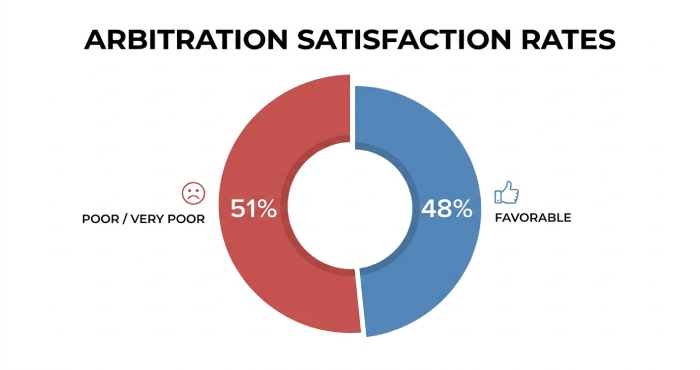
But the data on consumer satisfaction is decidedly mixed. The 2024 ACP Consumer Satisfaction Survey—a government PDF published by the DCA—contacted 944 consumers who participated in the program. Of those who responded:
- 51% rated their overall satisfaction as “poor” or “very poor”
- 48% rated it “excellent,” “good,” or “satisfactory”
- Only 58% rated the arbitrator’s fairness and neutrality favorably
The 2023 ACP Survey provides additional context: of 1,368 consumers contacted, 1,002 (73%) used the BBB AUTO LINE program, 359 (26%) used the California Dispute Settlement Program (CDSP), and 7 used CAP-Motors. BBB AUTO LINE handles the vast majority of California lemon law arbitrations.
The FTC’s 2023 Audit of BBB Auto Line found 16 manufacturers substantially compliant with federal Rule 703 arbitration standards. The audit covers disclosure requirements, consumer notification obligations, and manufacturer follow-through on arbitration decisions.
There is a critical nuance about arbitration that most consumers do not understand: an arbitration decision is binding on the manufacturer but NOT on you. If the arbitrator rules in the manufacturer’s favor, you still have the right to file a lawsuit. If the arbitrator rules in your favor but the award amount is inadequate, you can reject it and go to court. However, the arbitration decision will be admissible as evidence in any subsequent court proceeding—which means a favorable arbitration ruling strengthens your litigation case, while an unfavorable one can be used against you (BBB CA Summary PDF).
What to do: If you are considering arbitration, approach it with the same seriousness as a court proceeding. Bring organized repair records, a written timeline of defects, photographs or video evidence, and a clear written summary of your position. The fact that it is free and informal does not mean preparation is optional. If an arbitrator decides against your claim, speak with a California lemon law lawyer before accepting the outcome, as you still have the right to file a lawsuit, and under the Song-Beverly Act, the manufacturer may be required to cover your attorney’s fees if you win.
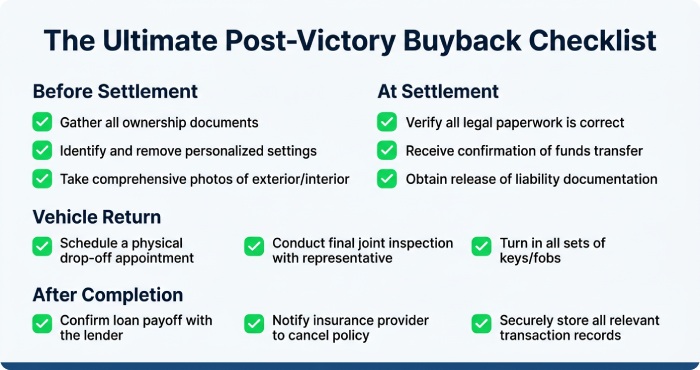
Your Complete Post-Victory Checklist
Here is every step, consolidated, from the moment you win to the moment the process is complete:
Before Settlement
- Compile a complete spreadsheet of incidental damages: rental cars, towing, ride-shares, hotel stays, loan fees. Attach receipts to every line item.
- Verify that the purchase price in the settlement includes dealer-installed additions that were part of the original sale price.
- Confirm the mileage at first repair attempt for the specific defect. This number determines your offset.
At Settlement
- Verify the mileage offset calculation uses the 120,000-mile divisor and the correct mileage at first repair.
- Confirm sales tax is explicitly listed as a refundable line item.
- Confirm the settlement release is the AB 1755 standardized template (if manufacturer opted in). Reject any release with additional waivers, non-disparagement clauses, or non-disclosure provisions.
- If leased: verify the settlement splits correctly between you and the leasing company, and that gap-period payments are included.
After Signing the Release
- Record the date you submit the signed release. Mark Day 31 on your calendar.
- Continue making loan or lease payments until you receive written confirmation that the loan has been paid off. Do not stop payments early.
- If the manufacturer has not completed the buyback by Day 31, notify your attorney about the $50/day penalty.
At Vehicle Return
- Expect the restitution check to be ready at the time of vehicle return. If it is not, document the date and report to your attorney.
- Remove all personal belongings. Return the vehicle in its current condition with all keys and accessories.
- Do not sign any additional documents beyond the standardized release.
After Completion
- Verify that your auto loan or lease has been fully paid off. Check with your lender directly—do not rely on the manufacturer’s confirmation alone.
- Confirm you received reimbursement for any payments made between the settlement date and the loan payoff date.
- Keep all settlement documents, repair records, and correspondence for at least 6 years (the new AB 1755 statute of limitations period).
- If you received a civil penalty award, verify it was paid. If attorney fees were to be determined by court motion, follow up with your attorney on the fee petition timeline.
The Bottom Line
The buyback process is where the lemon law’s promise becomes real—or where it quietly falls short. The difference between a consumer who recovers every dollar they are owed and one who leaves thousands on the table comes down to preparation, documentation, and knowing exactly what the law requires. An RV lemon law attorney can help ensure the buyback, replacement, or settlement process is completed properly after a successful lemon law claim.
The good news is that AB 1755, for all its controversy, introduced genuine consumer protections in the settlement phase that never existed before: the standardized release template, the $50/day penalty, the requirement for restitution checks at vehicle return, and the one-business-day payment deadline. These provisions give consumers and their attorneys real leverage against manufacturer delay tactics.
The challenge is that almost no one knows these provisions exist. The AB 1755 bill text is a government PDF buried on a legislative committee website. The Advocate Magazine analysis that explains the practical implications is behind a legal publication’s archive. The DMV’s Fast Facts brochure on buyback vehicles is a PDF that most consumers will never find. A skilled lemon law attorney San Diego can help maximize compensation and enforce important buyback deadlines.
Now you have all of it. The process is documented, the calculations are explained, and the checklist is ready. Use it.
Sources and References
All sources are downloadable PDF documents from government agencies, nonprofit organizations, or legal publications. Every URL links directly to the source file.
California Government PDFs
[1] California Assembly Judiciary Committee. AB 1755 Legislative Analysis, August 2024. https://ajud.assembly.ca.gov/system/files/2024-08/ab-1755-analysis.pdf
[2] California Senate Judiciary Committee. AB 1755 Bill Text (Kalra and Umberg), August 2024. https://sjud.senate.ca.gov/system/files/2024-08/ab-1755-kalra-aug-26-bill-text.pdf
[3] Governor Gavin Newsom. AB 1755 Signing Message, September 2024. https://www.gov.ca.gov/wp-content/uploads/2024/09/AB-1755-SIGNING-Message.pdf
[4] California Senate Judiciary Committee. SB 26 Analysis, February 2025. https://trackbill.com/s3/bills/CA/2025/SB/26/analyses/senate-judiciary.pdf
[5] California DCA. Lemon Law Q&A Brochure, Revised September 2024. https://www.dca.ca.gov/acp/pdf_files/lemonlaw_qa.pdf
[6] California DCA. 2024 ACP Consumer Satisfaction Survey Results. https://www.dca.ca.gov/acp/pdf_files/survey2024.pdf
[7] California DCA. 2023 ACP Consumer Satisfaction Survey Results. https://www.dca.ca.gov/acp/pdf_files/survey2023.pdf
[8] California DMV. Fast Facts: Lemon Law Buyback Vehicles (FFVR 17). https://www.dmv.ca.gov/portal/file/ffvr17-pdf/
Federal Government PDFs
[9] Federal Trade Commission. 2023 Audit of BBB Auto Line, March 2023. https://www.ftc.gov/system/files/ftc_gov/pdf/2023-audit-bbb-auto-line.pdf
Other State Government PDFs
[10] New York Attorney General. New Car Lemon Law: A Guide for Consumers. https://ag.ny.gov/sites/default/files/new_car_lemon_law_guide.pdf
[11] Hawaii DCCA. SCAP Lemon Law Consumer Handbook. https://files.hawaii.gov/dcca/rico/scap_llaw/lemon_law_handbook_consumers.pdf
BBB National Programs State Summaries (PDFs)
[12] BBB National Programs. California Lemon Law Summary. https://assets.bbbprograms.org/docs/default-source/auto-line/statelemonlaws/california-lemonlaw.pdf
[13] BBB National Programs. New Jersey Lemon Law Summary. https://assets.bbbprograms.org/docs/default-source/auto-line/statelemonlaws/nj-lemonlaw.pdf
[14] BBB National Programs. Hawaii Lemon Law Summary. https://assets.bbbprograms.org/docs/default-source/auto-line/statelemonlaws/hawaii-lemonlaw.pdf
Legal Publication PDFs
[15] Advocate Magazine (Michelle Fonseca-Kamana). When Life Gives You Lemon…Law Reform, February 2025. https://www.advocatemagazine.com/images/issues/2025/02-february/reprints/Fonseca-Kamana-Feb25-article-Advocate-magazine.pdf
[16] RVIA (RV Industry Association). AB 1755 Fact Sheet, 2024. https://www.rvia.org/system/files/media/file/California%20AB%201755%20Fact%20Sheet_Final_1.pdf
Disclaimer: This article is provided for informational purposes only and does not constitute legal advice. The lemon law buyback process involves complex legal and financial calculations. If you have won or are pursuing a lemon law claim, consult a qualified attorney for guidance specific to your situation.