
Ongoing battery depletion may seem like a trivial issue for your vehicle at first, but it can swiftly escalate into a source of frustration, high costs, and even safety hazards. Regardless of whether you own a conventional gasoline car or a contemporary electric vehicle (EV), a battery that continually discharges can disrupt your daily routine and cast doubt on the reliability of your vehicle.
This situation prompts many drivers to wonder: Does ongoing battery drain meet the criteria for a lemon law claim?
The answer is affirmative — but only under certain legal stipulations. This article will clarify how lemon law relates to battery drainage problems, define what constitutes a defect, and outline steps to create a compelling claim.
What Lemon Law Is Designed to Do
Lemon laws are designed to safeguard buyers and leases of vehicles that have significant, unresolved issues. Although the specifics vary by region, the fundamental aim is consistent: to prevent consumers from being burdened with a faulty vehicle that the manufacturer fails to rectify.
For a vehicle to be eligible for lemon law protection, three main criteria typically need to be met:
- A significant defect impacting the vehicle’s function
- Multiple failed repair attempts
- The problem arises during the warranty period
A “significant defect” generally refers to a problem that affects the car’s usage, value, or safety. This can include ongoing issues like rapid battery depletion.
What Counts as Persistent Battery Drain?
Battery drainage becomes problematic when it exceeds typical levels. While all car batteries naturally lose charge over time, ongoing power loss indicates an unusual and repeated issue.
Some common indicators are:
- The vehicle fails to start after sitting unused overnight
- Frequent jump-starts are required
- The battery discharges quickly, even if it’s a new one
- Electrical systems malfunction due to insufficient power
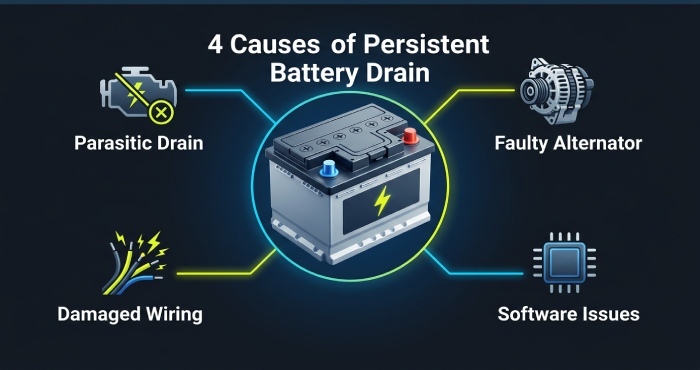
Several potential factors may contribute to this problem, including:
- Damaged wiring or electrical parts
- Parasitic drains (components that consume power while the vehicle is off)
- A faulty alternator or charging system
- Software issues in newer models
In contemporary vehicles, particularly electric ones, battery systems are increasingly intricate, complicating both diagnosis and repair.
Does Battery Drain Meet Lemon Law Standards?
1. The Defect Needs to Be Significant
Not every problem with a battery qualifies for a lemon law claim. To meet the criteria, the issue must be considerable enough to impact the vehicle’s usability.
A consistent battery drain can satisfy this condition if:
- The car becomes unreliable as a means of daily transportation
- You frequently find yourself stranded with a dead battery
- The issue disrupts your daily life or causes ongoing inconveniences
For instance, if your car refuses to start several times a week, that’s not just a minor hiccup — it’s a failure in reliability.
2. The Manufacturer Must Be Given a Chance to Resolve It
The lemon law does not apply merely because a problem exists. You are required to allow the manufacturer or dealer a reasonable opportunity to address it.
Most regions consider a vehicle to be a lemon if:
- The same issue has been unsuccessfully repaired three to four times, or
- The vehicle has been out of commission for 30 cumulative days or more, or
- Fewer repair attempts are needed if the defect poses a safety risk
Battery drain problems often fit this criterion because they can be tough to pinpoint. You may visit the service center multiple times only to be told, “No issue detected,” while the problem persists.
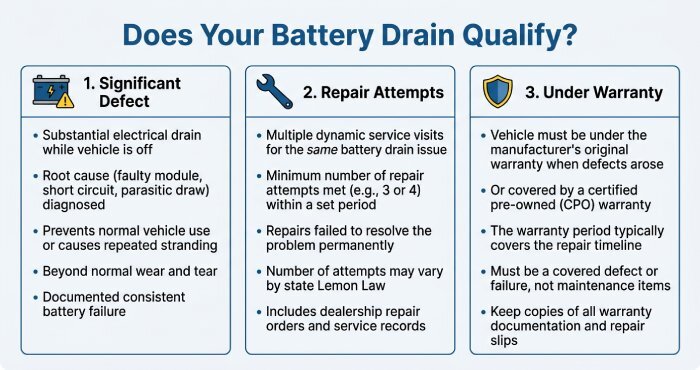
3. The Issue Must Occur Within Warranty Period
Timing is essential. Lemon law protections typically apply only if the defect arises:
- Within the manufacturer’s warranty duration, or
- Within a specified timeframe (commonly within the first 1 to 2 years)
If you experience battery issues after the warranty has lapsed, you may still have some rights — but these would not fall under standard lemon law regulations.
Why Battery Drain Claims Can Be Challenging
Disputes frequently arise over battery-related issues, as manufacturers may contend that there is no defect present. They might assert that:
- The battery is simply undergoing natural deterioration
- External environmental factors are influencing its performance
- The driver’s actions are to blame
For example, leaving headlights on or utilizing non-original electronic devices can deplete a battery’s charge. Nevertheless, ongoing problems in a new or properly maintained vehicle are significantly more challenging to categorize as standard wear and tear.
Special Considerations for Electric Vehicles
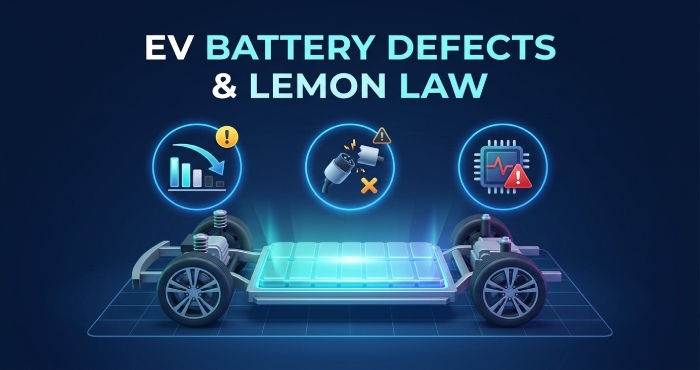
Electric vehicles introduce additional challenges when it comes to claims related to batteries. Unlike conventional vehicles, EVs utilize sophisticated battery technologies and software for power management. Common battery-related concerns in electric vehicles may include:
- Sudden and mysterious reductions in driving range
- Issues with charging, such as inconsistencies or failures
- Software glitches impacting battery management systems
Manufacturers might opt to resolve these issues by deploying software updates instead of making physical repairs. Depending on the specifics, these updates can still be recognized as repair attempts under lemon law. Given that EV batteries play a crucial role in the vehicle’s functionality, any defects in these systems are typically deemed significant.
When Battery Drain Becomes a Safety Issue
Initially, the issue of battery drain may appear to be a trivial problem; however, it can rapidly become a significant safety issue. Some scenarios include:
- Getting stuck in unsafe or isolated locations
- Losing essential features such as headlights or door locks
- Experiencing a power outage in an electric vehicle while on the road
If a defect poses a risk to safety, it may require fewer repair attempts to be eligible for a lemon law claim, as laws typically regard safety-related defects with heightened seriousness.
Situations That Usually Don’t Qualify
Not all battery problems qualify under lemon law regulations. The chances of a claim being successful diminish in the following scenarios:
- The issue was fixed after a single repair.
- The battery was replaced solely because it was old.
- The issue resulted from user mistakes.
- Modifications made after purchase caused the problem.
Lemon law is designed to address ongoing, unresolved issues rather than singular occurrences.
How to Build a Strong Lemon Law Claim
If you think your car may be eligible, acting promptly can be crucial.
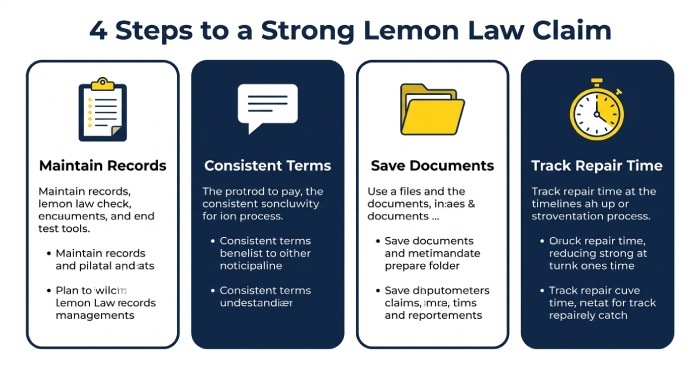
- Maintain Comprehensive Records: Keep track of every service appointment, noting the dates, mileage, and specifics of the problems encountered.
- Use Uniform Terminology: Clearly and consistently articulate the issue, for example, “the battery discharges overnight.”
- Preserve All Correspondence: Retain emails, service documents, and any written interactions with the dealership or manufacturer.
- Monitor Repair Time: Record the duration your vehicle spends in the repair shop. Longer repair times can bolster your case.
What Compensation Can You Receive?
Should your car be classified as a lemon, you could be eligible for one of the following options:
- A new vehicle, or
- A complete or partial reimbursement (buyback).
Refunds usually cover:
- The original purchase amount
- Taxes and fees
- Extra expenses such as towing or rental cars
Keep in mind that a minor deduction might be assessed depending on how extensively you used the vehicle prior to the discovery of the defect.
Common Manufacturer Pushback
Manufacturers frequently push back against lemon law claims, particularly regarding battery problems. Their counterarguments might involve:
- Asserting that the problem can’t be reproduced
- Suggesting that the battery drainage is typical
- Attributing the issue to external influences or user behavior
Consequently, it’s crucial to maintain thorough records and document multiple repair attempts. The more proof you gather, the more challenging it becomes for them to dismiss your claim.
When to Seek Legal Help
If you find yourself in the following situations, it may be wise to reach out to a Lemon Law lawyer:
- Your car has needed several repairs.
- The problem persists despite those efforts.
- You’ve experienced considerable downtime or inconvenience without your vehicle.
- The manufacturer refuses to take accountability for the issue.
Additionally, many Lemon Law attorneys work on a contingency fee basis, meaning they only get paid if you successfully win or settle your case.
Final Thoughts: Does Battery Drain Qualify?
Ongoing battery depletion can certainly be grounds for a lemon law claim, provided it meets certain legal criteria. In summary, your chances of a successful claim improve if:
- The problem greatly impairs your vehicle’s functionality
- There have been several unsuccessful repair attempts
- The defect surfaced during the warranty coverage
As cars evolve technologically, issues related to electrical systems and batteries are becoming increasingly prevalent and legally relevant. If your vehicle repeatedly struggles to maintain a charge and there’s no effective remedy, you may face more than a technical issue — you could have a legitimate legal case.
Conclusion
A failing battery can be just as frustrating as any major defect. What starts as a small inconvenience can quickly escalate into a serious disruption—especially when repeated repairs don’t solve the issue.
This is where lemon laws step in to protect consumers. If your vehicle continues to experience unresolved battery problems that affect its reliability, it may qualify as a lemon. In such cases, consulting a Lemon Law attorney San Diego can help you understand your rights and legal options.
The key is persistence—both in addressing the defect and in keeping detailed records of every repair attempt. With solid documentation and the right legal approach, you can hold the manufacturer accountable and move forward from a vehicle that simply doesn’t perform as it should.