
According to the California Lemon Law, your service records are essential and serve as more than just documents. An experienced attorney can leverage multiple repair attempts to demonstrate that a defect affects your vehicle’s usability, worth, or safety. With the right paperwork, you could be eligible for a buyback or a new vehicle.
Way 1: Use your repair timeline to trigger California’s Song-Beverly presumption
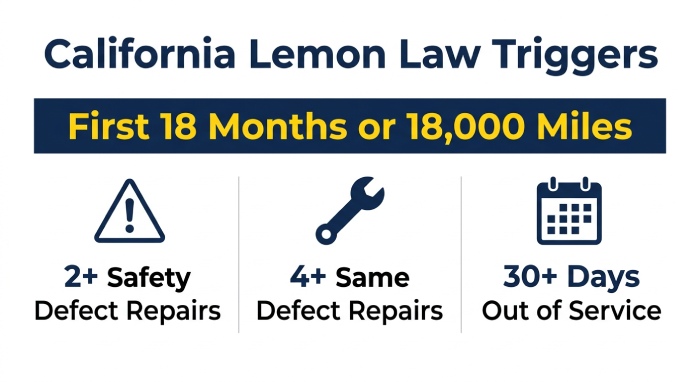
The Song-Beverly Consumer Warranty Act—often called the California Lemon Law—creates a presumption that your vehicle is a lemon if, during the first 18 months or 18,000 miles, you have:
- Two or more repair attempts for serious safety defects that present a significant danger of serious bodily injury
- Four or more repair attempts for the same vehicle defect
- 30 or more total days out of service for warranty repairs
A lemon law attorney will align every dealer repair visit by date, mileage, and symptom to show the pattern. When the presumption applies, the manufacturer’s obligations become clearer, and your path to buyback or a replacement vehicle accelerates.
Organizing Your Records:
Gather all repair orders, invoices, and warranty papers in one place, including any notes indicating “no problem found.” Document essential information such as concern-cause-correction (CCC) details, repair duration, odometer readings, and receipts for rentals or towing services.
Criteria for Presumption:
Significant safety issues, such as brake malfunctions or engine stalling, may fulfill the legal requirements for a claim. Persistent problems or lengthy repair durations, including the total time the vehicle is out of service, contribute to building a strong case.
Special Vehicles: RV and Motorhome Lemon Laws:
Claims related to RVs and motorhomes often require distinguishing between defects associated with the chassis and those pertaining to the coach, as they may be covered by different warranties. Consulting a lawyer can help streamline these elements and seek solutions like replacement or buyback if legal standards are satisfied.
Way 2: Establish a reasonable number of attempts without the presumption
Even if you are outside the 18 months/18,000 miles window, a California Lemon Law claim can succeed by showing a reasonable number of repair attempts. Courts look at the defect’s seriousness, how often it recurs, and the manufacturer’s opportunity to fix it.
A seasoned lemon law attorney aggregates:
- Attempts at multiple dealers to demonstrate system-wide failure, not a single shop’s shortcoming
- “No problem found” or “could not duplicate” visits, which still count as repair attempts
- Repeat symptoms across different parts replacements, highlighting failed fixes and a persistent vehicle defect
“No problem found” visits still count
If you repeatedly report a serious defect—say, intermittent loss of power in a GM SUV or phantom braking in a Tesla—and the dealer repair log reads “could not reproduce,” those entries still show notice and opportunity. A Lemon Law Lawyer will connect these visits to subsequent failures to prove that the manufacturer had fair chances but could not repair the defect.
Way 3: Convert repair records into proof of substantial impairment
To prevail under California’s Lemon Law, you must show that the defect substantially impairs the vehicle’s use, value, or safety. A lemon law attorney in South Bay, San Diego will rely on CCC notes from each service visit to strengthen the claim and establish a clear pattern of unresolved issues.
- Use: Link problems like stalling, entering limp mode, or transmission delays to disrupted journeys or the need for towing.
- Value: Illustrate how ongoing defects and a history of lemon issues have diminished the resale or trade-in price.
- Safety: Relate warning indicators, failures in braking or steering, battery or charging malfunctions, or airbag errors to potential dangers.
Supporting Evidence:
- Ongoing complaints recorded at various mileage points
- Consistent findings from technicians, such as metal shavings or module issues
- Decreased valuations from dealers reluctant to accept a vehicle with known defects.
Way 4: Prove manufacturer notice, knowledge, and willful violation
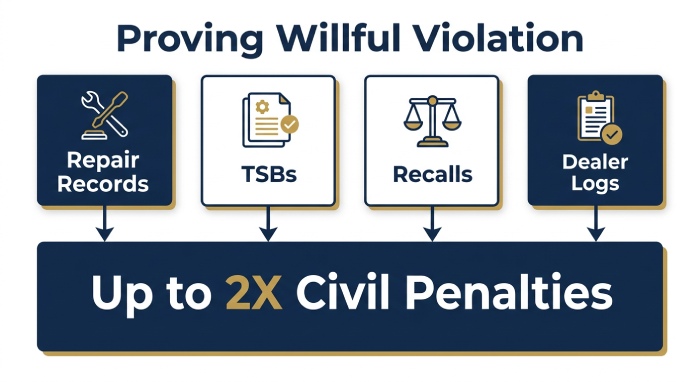
Repair records, TSBs, recalls, and tech support communications can show the manufacturer knew about a defect but failed to fix it under warranty. If a vehicle qualifies for a buyback or replacement yet is still denied after reasonable repair attempts, a lemon law attorney may argue this is a willful violation, potentially leading to civil penalties of up to twice the actual damages.
A strong approach includes matching repair visits with TSB dates, citing relevant recalls, and documenting dealer interactions that prove ongoing issues. While tools like buyback calculators can help, working with a California lemon law attorney—especially in San Diego—can provide clearer guidance and next steps.
Way 5: Quantify days out of service and every dollar tied to repairs
Beyond meeting the 30-day threshold, a California Lemon Law claim should capture all direct and incidental damages. A meticulous Lemon Law attorney will total:
- Days out of service (from drop-off time to pick-up time)
- Rental car periods, towing, diagnostic fees, ride-hailing to and from the dealer, and storage
- Costs associated with repairs you paid when the dealer mischaracterized a warranty concern as customer pay
Document courtesy car agreements, repair orders, and credit card receipts. This record supports restitution, strengthens leverage for a lemon law settlement, and shows how the defect impaired use and value. When a manufacturer refuses to provide a buyback or a replacement vehicle despite clear evidence, your lawyer can file a lemon law claim or a full lemon lawsuit to enforce your lemon law rights and broader consumer protection remedies.
Way 6: Neutralize defenses and minimize the mileage offset
Manufacturers often argue misuse, modifications, or poor maintenance. A lemon law lawyer anticipates and defeats these defenses.
- Maintenance: Keeping clean and prompt service records, along with the vehicle’s original condition, helps diminish allegations of improper use or alterations.
- Root cause: A specialist can associate different symptoms with a common defect, like a malfunctioning control module or damaged wiring.
- Initial nonconformity mileage: Identifying the first problem limits the mileage impact and enhances the potential for refunds or replacements.
If a dealer fails to fix a defect after a reasonable number of attempts, California Lemon Law may qualify you for a buyback or replacement. A San Diego Lemon Law lawyer can help you decide whether to settle, go to trial, or seek civil penalties for willful violations. Success depends on solid documentation, expert evaluation, and a consistent legal approach.