
While dealership loaner vehicles may appear to be a handy benefit, they can subtly impact the validity of your lemon law claim. Although they allow you to continue driving while your car is being fixed, their usage may influence the way that downtime, hassle, and persistent problems are recorded. Grasping the legal implications of loaner cars can aid in preserving the strength of your case. In this article, we will examine the scenarios in which a loaner car supports your argument and situations where it may hinder your claim.
Lemon Law Basics When a Loaner Is Provided
Eligibility thresholds under state lemon laws and federal lemon law
A dealership loaner can be a lifeline while your defective vehicle is in the shop, but it also plays a role in your lemon law case. At a high level, state lemon laws set eligibility thresholds based on repair attempts, days out of service, and mileage/time windows after purchase or lease. Most states require either a specific number of unsuccessful repair attempts for the same product defect, or a cumulative number of days the vehicle is unavailable for use due to warranty repairs. Some statutes, such as the Michigan Lemon Law, codify a 30-day benchmark, while others vary or use a “reasonable number” standard.
If your situation doesn’t squarely fit a state statute, the federal lemon law—the Magnuson-Moss Warranty Act—may provide parallel consumer protection. Magnuson-Moss, read together with the Uniform Commercial Code, empowers consumers to seek legal remedies for breach of warranty when chronic problems persist. Understanding which law applies to your lemon law claim is foundational to asserting your rights under lemon law and calculating the impact of any loaner use on the claim timeline.
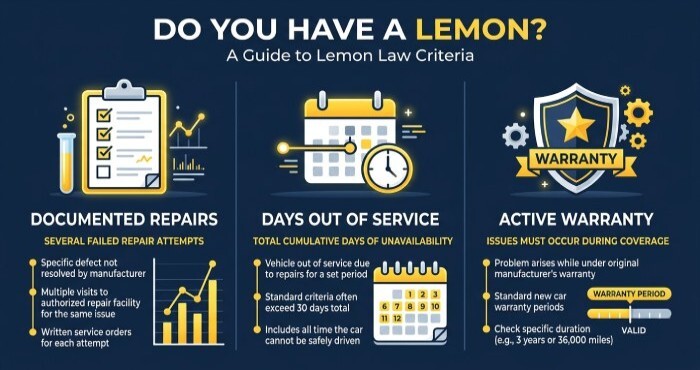
Repair attempts, days out of service, and the lemon law process
Documented repair attempts at a Dealer or Authorized Repair Facility are central to the lemon law process. Each visit should tie to a specific symptom or defect, especially if it creates an unsafe vehicle condition or recurring drivability issue. Days out of service typically run from the date you deliver the vehicle for diagnosis through the date the dealer notifies you it is ready for pickup. Whether you drive a lemon car, lemon SUV, or lemon truck, the same rules generally apply to used vehicles and leased vehicles if they are still under warranty and satisfy lemon law requirements. If state lemon laws are not met, the Magnuson-Moss Warranty Act often remains available to file a claim or pursue a lawsuit for breach of written or implied warranty.
Do Loaners Stop the Clock? How They Affect Timelines
State variations and special rules for days-out-of-service
The short answer: in many states, a loaner does not stop the clock for days out of service; the calculation continues while the defective vehicle is at the repair facility. However, there are notable state-by-state nuances. For example, the Michigan Lemon Law counts days the vehicle is unavailable for use due to warranty repair regardless of whether the dealer supplies a loaner. Other states weigh “reasonable time” for diagnosis and parts availability, and a small minority consider whether a comparable loaner mitigates “loss of use.” Always check reliable lemon law resources or consult a lemon law attorney to interpret your jurisdiction’s rules.
- Eligibility thresholds: If your statute requires 3–4 repair attempts or 30+ cumulative days out of service, the presence of a loaner rarely negates those thresholds; it simply alleviates your mobility concerns.
- Mileage offsets: Loaner use does not usually change the mileage offset formula for a buyback or refund calculation; offsets are tied to the original vehicle’s mileage at first repair, not the miles put on a loaner.
- Federal overlay: Under the federal lemon law (Magnuson-Moss Warranty Act), a loaner similarly does not excuse a Manufacturer from honoring the warranty within a reasonable time.
As a practical example, owners of certain Ford vehicles equipped with the PowerShift Transmission often accumulated extensive service days while parts were on backorder. A loaner softened the inconvenience but did not reset the lemon law claim. Consumers should retain all service reports and repair records to preserve eligibility.
Documentation, Dollars, and Defensive Strategies
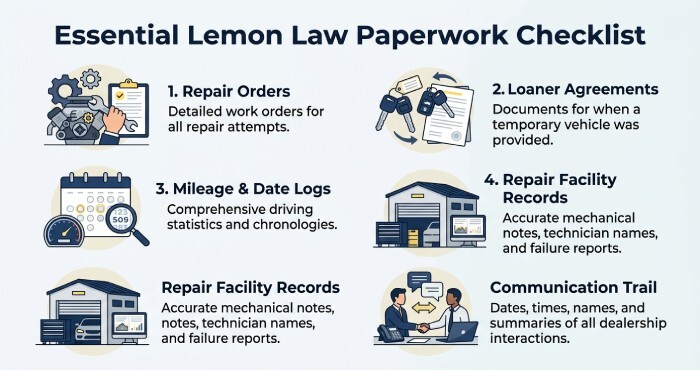
Documentation you must collect with a loaner
Paperwork is your proof. When a dealer provides a loaner, keep meticulous records to protect your lemon law case.
Essential papers to gather and retain
- Repair orders and service reports:Insist every visit generates a repair order describing the symptoms, diagnosis, warranty coverage, and all repair attempts. These service reports form the backbone of your lemon law claim.
- Loaner agreements: Obtain a copy of the loaner contract, including dates, mileage, fuel/insurance terms, and any fees. Confirm it is a temporary courtesy vehicle, not a waiver of rights under lemon law.
- Dates and mileage: Log the drop-off/pickup dates and mileage for both the defective vehicle and the loaner. Photograph the odometers. This supports days-out-of-service and mileage offset calculations.
- Repair records from an Authorized Repair Facility: If the dealer sends the vehicle to an Authorized Repair Facility or specialist, obtain those records as well. They count toward repair attempts and days out of service.
- Communications trail: Save emails, texts, and portal messages with the Dealer or Manufacturer about parts delays, vehicle recall notices, or escalation. These entries can corroborate chronic problems and a pattern of product defect.
If you speak with an Attorney for a case evaluation or free case review, preserve communications under attorney-client privilege and share organized copies of all repair records.
Financial implications: rental credits, mileage offsets, and buyback math
Loaners affect the economics, but not always in the way you might expect.
Mileage offsets and loss-of-use vs. rental credit
- Mileage offsets: Most state lemon laws and the Uniform Commercial Code allow the Manufacturer a usage deduction calculated from the mileage at the first qualifying nonconformity. Miles driven in a loaner don’t increase this offset. Track the first-repair mileage carefully.
- Loss-of-use: Some states allow you to claim loss-of-use damages; others consider a free loaner or rental credit to mitigate those amounts. Under the Federal Warranty Law and Magnuson-Moss Warranty Act, incidental and consequential damages may be recoverable, depending on the warranty and state law.
- Buyback/replacement vehicle: In a repurchase, you typically receive a refund of payments, taxes, and certain fees minus the statutory mileage offset. For a replacement vehicle, ensure the vehicle coverage and options are comparable and that ancillary warranties and add-ons transfer or are reimbursed.
- Insurance and fees: Clarify who pays insurance, tolls, or per-day charges on the loaner. Improperly imposed fees may be recoverable as legal remedies under consumer protection statutes.
Owners of specialized vehicles—ATV, Motorcycle, Car, Motorhome, or Boat—should confirm whether the applicable state lemon laws or Magnuson-Moss remedies apply to their class of vehicle and the warranty.
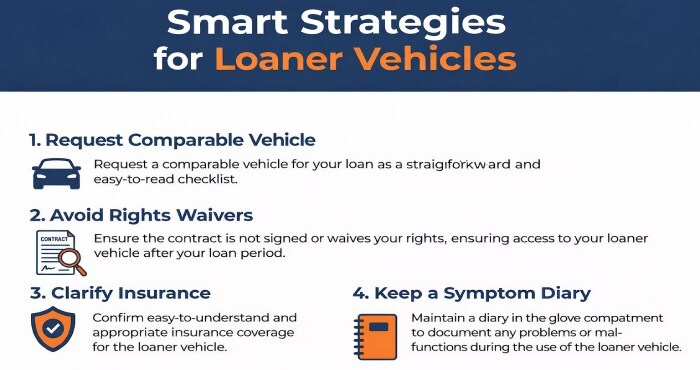
Practical strategies and pitfalls with loaners
- Request a comparable loaner: If you drive a lemon SUV or need towing capacity comparable to a lemon truck, ask for a functionally similar loaner. Note any shortfalls, as they may be relevant to loss-of-use.
- Avoid rights waivers: Read the loaner agreement. Do not sign language that purports to limit your legal rights, your ability to file a claim, or your rights under lemon law. If in doubt, have a lemon law attorney review it.
- Insurance clarity: Confirm coverage and deductibles for the loaner. Ask whether your policy or the dealer’s policy applies.
- Escalation: If repairs stall, escalate with the Manufacturer’s regional representative and document the delay. Politely reference your rights under the Magnuson-Moss Warranty Act and state lemon laws.
- Evidence of chronic problems: Keep a symptom diary; recurring stalling, shuddering, or transmission hesitation—like the issues associated with some Ford PowerShift Transmission complaints—can establish chronic problems and an unsafe vehicle condition.
- Resources and outreach: Reputable lemon law resources such as National Lemon Law Information, Your Legal Justice, and Consumer Protection Lawyers often publish guides and a Blog with practical checklists. Many also post updates on Facebook, Twitter, YouTube, and LinkedIn.
If you believe you’re facing consumer fraud, a vehicle recall that wasn’t disclosed, or repeated warranty denials, seek legal remedies promptly. An experienced Attorney can explain lemon law requirements, coordinate a case evaluation, and help you file a claim or, if necessary, pursue a lawsuit. Firms such as Stern Law, PLLC, led by Ken Stern, have long focused on consumer protection litigation and can advise on complex fact patterns involving multiple repair attempts or cross-state service histories. For localized guidance, a lemon law attorney can interpret how your jurisdiction treats loaners in calculating days out of service.
When you’re ready to explore options—refund or replacement vehicle—ask counsel to model both outcomes under your state statute and the federal lemon law. Many firms provide a free case review, and you can also consult a lemon law lawyer for help navigating both the Magnuson-Moss Warranty Act and the Uniform Commercial Code. If you’re in Southern California, you can start with a Lemon Law attorney San Diego CA who understands local dealers and Authorized Repair Facility practices.
Finally, remember: a loaner is a convenience, not a cure. It does not erase a defective vehicle, it does not absolve the Manufacturer from honoring the warranty, and it does not prevent you from asserting your rights under lemon law. Keep your paperwork tight, know your legal rights, and use loaners strategically to strengthen—rather than complicate—your lemon law claim.