
When discussing “lemon” vehicles, cars that have ongoing issues affecting their safety, value, or functionality timing plays a crucial role. Consumers often only discover they own a lemon after experiencing frequent malfunctions or expensive repairs. However, many car manufacturers utilize advanced systems to detect problematic vehicles before any formal claims are made.
Through the use of data analytics, warranty assessments, customer service feedback, and repair records, automakers continuously search for trends that may indicate a defective vehicle. Gaining insight into how these companies monitor such cars not only reveals their quality control methods but also shows their proactive efforts to resolve problems, sometimes even before the owners recognize any issues.
Why car manufacturers track potential lemons early
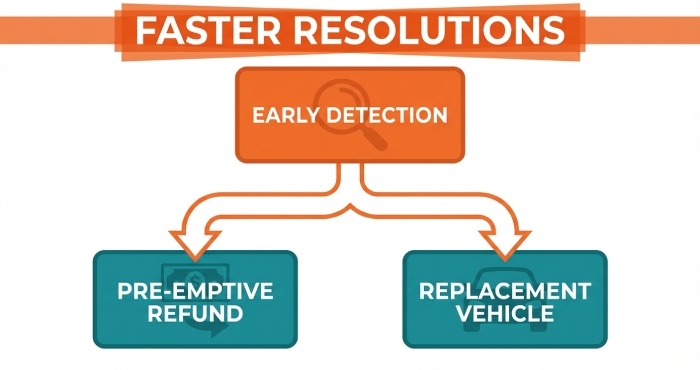
In the modern automotive industry, car manufacturers aggressively monitor field data to identify defective vehicles long before consumers initiate lemon law claims. Early detection helps them contain warranty costs, uphold warranty standards, and protect customer satisfaction. It also reduces legal risk by enabling faster repair attempts, goodwill fixes, or even a pre-emptive refund or replacement under the manufacturer’s warranty.
This proactive stance aligns with consumer protection goals and the lemon law process that governs substantial defects, vehicle safety, and vehicle reliability. Whether under federal lemon law frameworks like the Magnuson-Moss Warranty Act or varying state lemon laws such as the Texas Lemon Law, California rules, and programs in New York and Arizona, manufacturers know that recurring problems can trigger refund or replacement obligations. Detecting patterns early helps them meet warranty standards, improve customer service outcomes, and, when necessary, make an informed decision to offer a replacement vehicle, cash compensation, or a refund.
Mapping the data sources manufacturers monitor
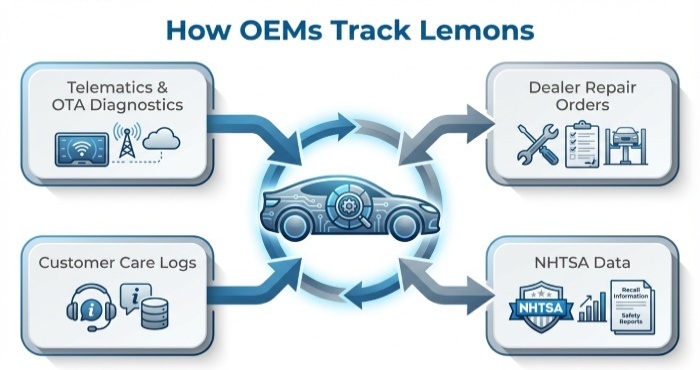
Car manufacturers fold multiple inputs into an integrated quality and compliance view to spot vehicle defects and potential lemon status criteria at the VIN level.
Connected-vehicle telemetry and OTA diagnostics
- Telematics and over-the-air diagnostics: Real-time health monitoring captures Diagnostic Trouble Codes (DTCs), battery and module health, misfire counts, software fault logs, and vehicle mileage. These data streams highlight recurring problems that might indicate defective vehicles. OEMs also watch for anomalies suggesting odometer tampering or usage beyond warranty standards.
- Parts returns: Failed component tear-downs and supplier return analyses help link systemic defects to specific model and year ranges, revealing nascent issues that could drive lemon law claims.
Dealership repair orders and warranty submissions
- Dealer repairs and warranty submissions: Authorized dealer service lanes generate repair records with labor ops, parts lists, DTC snapshots, and repair attempts counts. When a vehicle cycles through multiple visits for the same concern, the back-end systems flag it against lemon status criteria set by state lemon laws and the manufacturer’s warranty.
Customer care logs and NHTSA complaints
- Customer care logs: OEM customer service centers track call transcripts, case IDs, goodwill coverage, and escalations. Natural language processing highlights frustration signals, vehicle safety concerns, or requests for a refund or replacement.
- NHTSA complaints: The National Highway Traffic Safety Administration database and Early Warning Reporting summaries reveal broader safety patterns, complementing internal quality feedback loops.
The analytics pipeline that flags potential lemons
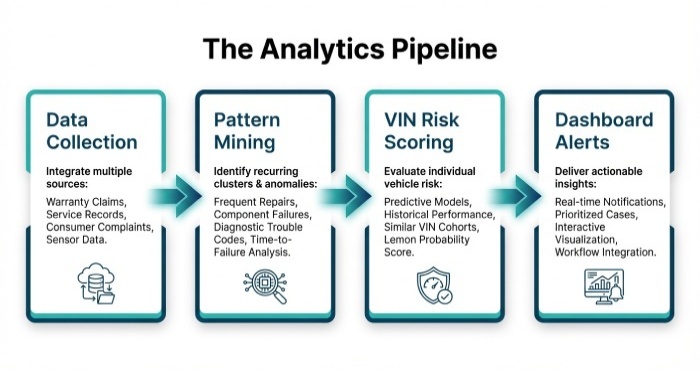
Modern quality analytics turn raw data into risk insights:
- Repeat-repair thresholds: Systems count repair attempts for the same symptom, module, or system. Thresholds are tuned to state lemon laws and internal warranty standards to surface vehicles most likely to trigger lemon law claims.
- DTC pattern mining: Algorithms cluster DTCs and symptom codes to reveal hidden defect modes across populations, sometimes linked to a specific model and year or software version.
- VIN-level risk scoring: Each vehicle receives a dynamic score based on severity, frequency, days out of service, vehicle mileage, repair records completeness, and past outcomes like arbitration or buybacks.
- NLP on service notes: Text mining of dealer stories identifies recurring problems, intermittent failures, and references to “no trouble found,” which often precede difficult vehicle defects.
- Early-warning dashboards: Quality, legal, and field teams watch dashboards that blend warranty submissions, parts returns, and NHTSA signals to guide interventions before a lemon law complaint process begins.
Closing the loop with dealers and field teams
Once a vehicle trends toward lemon law exposure, manufacturers deploy operational countermeasures:
- TAC escalations: Technical Assistance Centers review complex cases, prescribe deeper diagnostics, and document repair attempts to ensure compliance with the manufacturer’s warranty.
- Field service engineers: On-site experts support authorized dealer technicians with advanced troubleshooting and confirm whether a defect is systemic.
- TSBs and software fixes: Technical Service Bulletins, calibrations, and over-the-air updates address known issues at scale, potentially restoring vehicle reliability without replacing hardware.
- Goodwill repairs and pre-claim buybacks: To balance consumer protection and cost, OEMs may authorize goodwill coverage, extended warranties, or, in high-risk cases, a pre-claim buyback resulting in a refund or replacement. These decisions factor in customer satisfaction, safety, and legal exposure under the lemon law.
Law, compliance, and privacy boundaries
Manufacturers operate under strict legal and privacy frameworks:
- Lemon-law criteria by state: State lemon laws define substantial defects, number of repair attempts, and days out of service. For example, Texas Lemon Law sets specific thresholds that differ from California, New York, or Arizona. OEMs align internal triggers with these variations to manage lemon law claims consistently.
- Federal norms: The Magnuson-Moss Warranty Act (and the magnuson-moss warranty act as commonly referenced in consumer materials) underpins federal lemon law remedies for warranty breaches, including refund, replacement vehicle, or cash compensation.
- NHTSA Early Warning Reporting: OEMs submit death, injury, and property damage data, plus warranty and field reports, to satisfy safety reporting obligations.
- Data retention and consent: Privacy programs govern how long telematics, repair records, and customer care logs are stored. Consumers can exercise consent choices, including telematics opt-outs, though declining data may hinder remote diagnostics.
- Managing legal exposure: Legal teams monitor class-action lawsuits, arbitration outcomes, and regulatory actions. They craft policies, documentation templates, and customer service scripts to ensure the lemon law process and lemon law complaint process are followed uniformly, supporting consumer rights while controlling risk.
Manufacturers operate under strict legal and privacy frameworks, ensuring compliance with regulations while protecting consumer data, with guidance from a lemon law lawyer to navigate disputes.
What this means for owners
If your vehicle is on an OEM watchlist, you’ll often see telltale signs:
- Red flags: Multiple dealer repairs for the same issue, rapid TSB updates, repeated software flashes, parts on national backorder, or direct outreach from corporate customer service proposing goodwill.
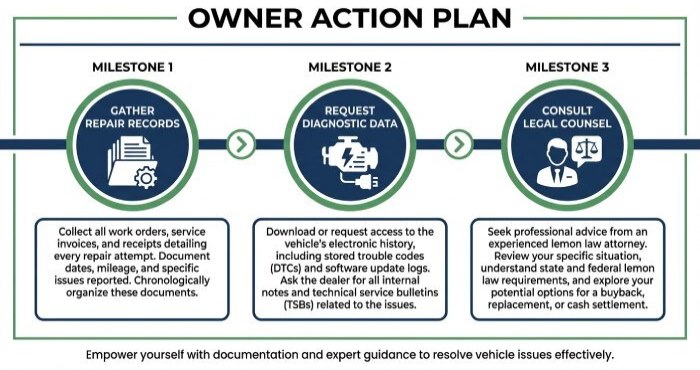
- Gather your records: Maintain car owner documentation, including all repair records, work orders, dates in service, vehicle mileage, and communications. This substantiates repair attempts and ties issues to your vehicle purchase timeline.
- Leverage data: Ask for printouts of DTCs, test results, and TAC case numbers. NHTSA complaint references and TSB numbers can strengthen negotiations for a refund or replacement under the manufacturer’s warranty.
- Steps before filing: Escalate through corporate channels, request a final repair attempt, and review state lemon laws to confirm lemon status criteria. Consider whether used cars’ lemon law coverage applies in your jurisdiction.
- Professional help: A seasoned lemon law attorney can advise on arbitration options or court filings and when to seek a replacement vehicle or refund.
Real-world patterns and examples across the automotive industry
Across the automotive industry, early-warning programs have surfaced notable issues:
- OEM examples: General Motors, Ford, Chrysler, Toyota, and Honda all operate sophisticated quality analytics tied to dealer networks and NHTSA reporting. Field campaigns often precede lemon law claims when a pattern emerges.
- Model patterns: Safety and drivability complaints involving vehicles like the Jeep Grand Cherokee, Chrysler Pacifica, and Dodge Durango have, at times, concentrated around certain model and year combinations, prompting TSBs, recalls, or software updates coordinated with the National Highway Traffic Safety Administration.
- Legal landscape: Advocacy groups and firms such as Allen Stewart PC frequently discuss trends in state lemon laws and federal lemon law remedies. While every case is fact-specific, consistent documentation and clear evidence of substantial defects and repeated repair attempts are common denominators.
- State nuances: California tends to be favorable to consumers; Texas Lemon Law has distinct timelines and procedures; New York and Arizona add their own notice and repair thresholds. Understanding your jurisdiction’s nuances can influence whether an OEM offers a pre-claim refund or replacement.
- Owner takeaways: If recurring problems persist despite compliant repair attempts, the combination of telematics data, dealer documentation, and NHTSA complaints can help you assert consumer protection rights and pursue appropriate remedies under lemon law.
Producers are progressively utilizing sophisticated tracking technologies to detect problematic vehicles, often referred to as “lemons,” well before owners submit any claims. They rely on a variety of tools, including diagnostic telematics and warranty data evaluation. For car owners in California, grasping how these systems work is essential when dealing with ongoing issues.
Engaging with a knowledgeable California Lemon Law attorney in San Diego can help safeguard your rights and provide expert support in filing a claim if your car meets the criteria for being classified as a lemon. Staying well-informed and taking initiative is the best approach to protect your investment and minimize the stress associated with a faulty vehicle.