
California Lemon Law protects consumers who purchase or lease vehicles that fail to conform to the manufacturer’s written warranty. In qualifying cases, a consumer may seek a vehicle replacement, a refund, and potentially a civil penalty. Recent changes under Assembly Bill 1755 (AB 1755) and Senate Bill 26 (SB 26) have introduced additional pre-suit procedures for certain Lemon Law claims.
One important requirement is the 30-day pre-suit notice. When the applicable procedure applies, a consumer seeking civil penalties must provide written notice to the vehicle manufacturer at least 30 days before filing a lawsuit. The notice must contain specific information and must be sent using an approved delivery method.
What Is the 30-Day Pre-Suit Notice?
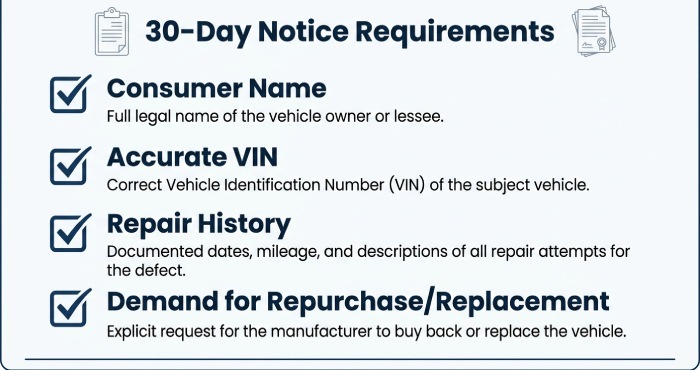
California Code of Civil Procedure Section 871.24 establishes a written pre-suit notice requirement for certain California Lemon Law actions seeking civil penalties under Civil Code Section 1794(c). At least 30 days before filing such an action, the consumer must notify the manufacturer of their name, the vehicle’s accurate Vehicle Identification Number (VIN), a brief summary of the vehicle’s repair history and problems, and a demand for repurchase or replacement.
The 30-day notice is not required for every California Lemon Law claim. Under Section 871.24(h), a consumer may bring an action seeking restitution or replacement without first providing the notice, provided the consumer has possession of the vehicle when filing and does not seek civil penalties in that action. Whether the notice procedure applies should be confirmed based on the claim and the applicable statutory requirements.
Therefore, consumers should first determine whether the manufacturer and claim are subject to the statutory pre-suit notice procedure before relying on the 30-day requirement.
What Information Must the Notice Include?
A proper notice should be clear, accurate, and complete. Section 871.24 requires the consumer to provide specific information, including:
- Consumer’s name: Identify the person bringing the Lemon Law claim.
- Vehicle identification number: Provide the accurate VIN of the vehicle.
- Repair history: Include a brief summary of the vehicle’s repair history.
- Vehicle problems: Identify the warranty-related problems or nonconformities affecting the vehicle.
- Demand for relief: Clearly demand that the manufacturer repurchase or replace the vehicle.
The statute specifically identifies the consumer’s name, accurate Vehicle Identification Number (VIN), brief repair history and vehicle problems, together with a demand for repurchase or replacement.
Although the statutory notice can be relatively concise, supporting documentation can help establish the accuracy of the information provided. Consumers should gather repair orders, warranty records, purchase or lease documents, communications with the manufacturer or dealership, and other records relating to the vehicle.
Where Should the Notice Be Sent?
The delivery method matters. Under Section 871.24, the written notice must generally be sent using one of the methods specified by the manufacturer and statute.
The law permits delivery by:
The notice may be sent to the email address prominently displayed on the manufacturer’s website for this purpose.
Consumers should use the manufacturer’s designated Lemon Law or written-notice email address rather than sending the notice to a general customer-service address. A lemon law attorney San Diego can help consumers identify the correct contact details and ensure their written notices meet applicable requirements. Some manufacturers have established dedicated email addresses specifically for California written notices. For example, Hyundai currently publishes a designated email address for notices under Section 871.24.
Certified or Registered Mail
The notice may also be sent by certified or registered mail, return receipt requested, to the address provided by the manufacturer in its owner’s manual or warranty booklet.
Using the manufacturer’s published address is important. Sending a notice to a dealership or an unrelated corporate address may create uncertainty about whether the statutory notice was properly delivered.
How to Preserve Proof of Service
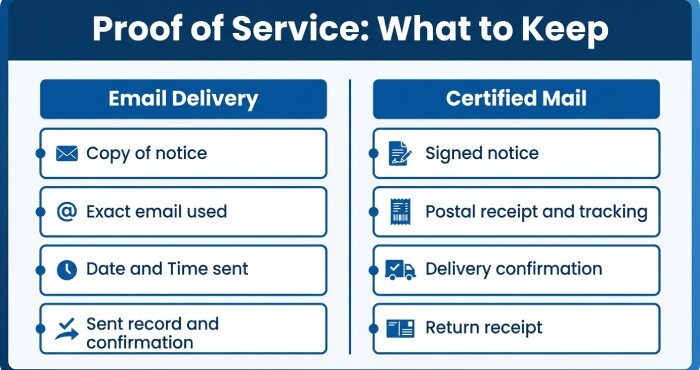
Proof of service is critical because the consumer may later need to demonstrate when the manufacturer received the notice and what information was provided.
For email delivery, retain:
- A complete copy of the notice.
- The exact email address used.
- The date and time the email was sent.
- The sent-email record.
- Any automated delivery confirmation.
- Any response or acknowledgment from the manufacturer.
For certified or registered mail, retain:
- A copy of the signed notice.
- The postal receipt.
- The tracking number.
- The delivery confirmation.
- The return receipt showing delivery, when available.
- Any correspondence received from the manufacturer.
It is also sensible to keep the notice and all delivery records together in a dedicated claim file. This creates a chronological record that can be reviewed if the manufacturer disputes receiving the notice.
Keep Possession of the Vehicle
Another important requirement under Section 871.24 is vehicle possession. At the time the required notice is sent, the consumer must have possession of the motor vehicle.
This makes timing especially important. Consumers should not assume that sending a notice is merely an administrative step. The statutory requirements should be reviewed together with the vehicle’s current status, repair history, warranty coverage, and planned litigation timeline.
What Happens After the Notice Is Sent?
For manufacturers subject to California’s applicable AB 1755/SB 26 procedures, the notice triggers a defined pre-litigation process. The manufacturer must acknowledge receipt of the consumer’s request. Under California Code of Civil Procedure Section 871.24(e), if the manufacturer offers restitution or replacement within 30 days after receiving the notice and completes the repurchase or replacement within 60 days of receiving the original notice, the consumer generally cannot maintain a claim for civil penalties under the statute, provided the other statutory conditions are met.
If the manufacturer does not make a qualifying offer within 30 days, or fails to complete the restitution or replacement within the required 60-day period, the consumer may be able to pursue further legal remedies, including civil penalties, subject to the applicable statutory requirements. Consumers should also understand that the law includes specific vehicle-possession requirements during this process.
Why Legal Guidance Can Be Important
California Lemon Law procedures can vary depending on the manufacturer, vehicle, warranty, type of claim, and applicable statutory procedure. The newer AB 1755/SB 26 framework also means that not every California Lemon Law claim should automatically be handled under the same 30-day pre-suit notice process.
An experienced California Lemon Law attorney or RV lemon law attorney can review the repair history, determine whether the statutory pre-suit notice requirement applies, identify the correct manufacturer notice address or email, prepare the demand, and preserve evidence showing when and how the notice was delivered.
Final Thoughts
Serving a California Lemon Law pre-suit notice requires timely written notice, accurate consumer and vehicle details, a summary of the vehicle’s problems and repair history, and a clear demand for repurchase or replacement. A California lemon law lawyer can help ensure the notice meets applicable legal requirements. Consumers should also follow the appropriate delivery method and keep proof of service. Since AB 1755 and SB 26 introduced specific procedures, it is important to confirm the rules that apply before sending notice or filing a lawsuit.