
Why Airbag Parts Delays Matter for Vehicle Safety and Usability
An airbag parts delay is not a minor inconvenience when the affected component relates to the Supplemental Restraint System, or SRS. If your SRS warning light is illuminated, the vehicle may be signaling an airbag malfunction, sensor fault, wiring issue, passenger-classification sensor problem, or a stored crash-system code. Any of these conditions can create serious safety implications, including deployment failure in a collision or false deployment while driving.
A dashboard airbag alert should never be treated like a routine maintenance reminder. The SRS warning light may indicate that the restraint system is partially disabled, has detected an electrical fault, or cannot confirm that all crash sensors and deployment components are communicating properly. Even if the vehicle still starts and drives, the issue can affect whether the airbags, seatbelt pretensioners, or related safety features perform as designed during a collision.
Airbags Are Safety-Critical, Not Cosmetic
Airbag defects can raise significant safety concerns and may support a California Lemon Law claim when they substantially impair a vehicle’s use, value, or safety and the manufacturer fails to repair the problem within a reasonable number of opportunities. Parts shortages and extended repair delays may also be relevant when evaluating a claim. The Takata airbag recall demonstrated how widespread safety defects can affect vehicles across multiple manufacturers and require extensive recall-repair efforts.If an unresolved airbag issue prevents safe vehicle use, owners may have legal rights under warranty laws, lemon law, or federal consumer protection statutes.
Common Airbag-Related Warning Signs
Owners should take the following documented symptoms seriously:
- SRS warning light stays on or flashes
- “Airbag system service required” message appears
- Passenger-classification sensor fails to detect an occupant
- Prior repair order states “no problem found” despite recurring warnings
- Airbag recall remains open after checking the NHTSA recall lookup
- Vehicle remains out of service because parts are unavailable
Why “No Problem Found” Still Matters
A “no problem found” report does not necessarily establish that an airbag malfunction has been resolved. If the warning returns, owners should document each visit, describe the recurring symptoms, and retain all repair orders. These records may help establish the repair history, although a documented visit alone does not prove that a qualifying defect exists.
When a Delayed Airbag Repair May Qualify Under Lemon Law
Under California’s Song-Beverly Consumer Warranty Act, a vehicle may qualify for Lemon Law remedies when a warranty-covered nonconformity substantially impairs its use, value, or safety and the manufacturer or its authorized representatives have had a reasonable number of opportunities to repair it. California’s Lemon Law presumption generally applies when specified repair-attempt or out-of-service conditions occur within 18 months of delivery or 18,000 miles, whichever comes first. The presumption is rebuttable and is not the only way to establish a claim.
Lemon Law Standards for Airbag Delays
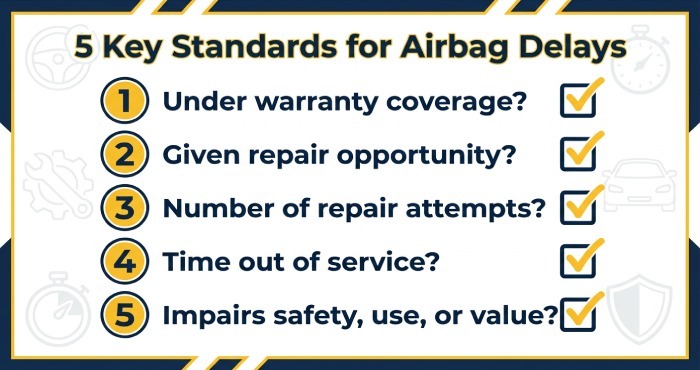
Under many state lemon laws, the key questions include:
1. Did the airbag malfunction occur during warranty coverage?
2. Did the dealer or authorized service agent receive a reasonable opportunity to repair?
3. How many repair attempts were made?
4. How long was the vehicle out of service?
5. Does the defect substantially impair safety, use, or value?
A California consumer may consult a California lemon law lawyer to assess how state lemon laws apply to an airbag parts delay. A San Diego owner may also seek local guidance from a lemon law attorney in San Diego.
New, Used, CPO, and Extended Warranty Vehicles
New, used, and Certified Pre-Owned (CPO) vehicles may qualify for lemon law or Magnuson-Moss Warranty Act protection if an airbag defect occurs under a valid written warranty. Buyers should preserve CPO documents, inspection reports, advertisements, and repair records to establish warranty coverage and any unresolved safety issues.
What a Takata Recall Can Teach Owners About Delays
The Takata recall demonstrated how widespread airbag defects can cause major parts shortages and lengthy repair delays. Even when supply issues are beyond the manufacturer’s control, owners may still have lemon law or warranty rights if their vehicles remain unsafe, unusable, or out of service for an extended period.
Why Recall Remedies Can Take Time
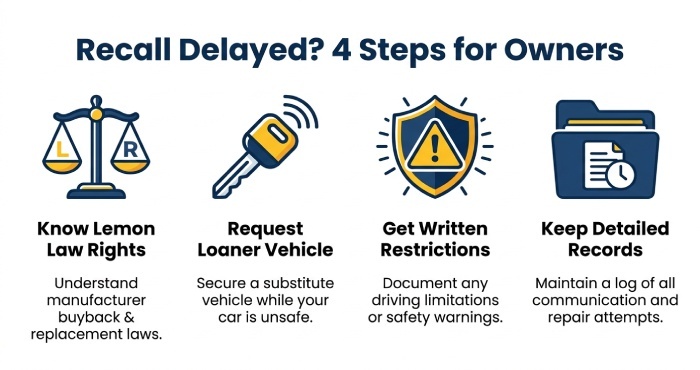
Airbag recall repairs may be delayed while manufacturers develop fixes, distribute replacement parts, or issue service instructions. Owners should ask about loaner vehicles, rental reimbursement, transportation assistance, and written driving restrictions, while keeping records of all communications to document safety concerns and repair delays.
Manufacturer, Dealer, and Parts Supply Chain Responsibilities
Manufacturers cannot always avoid responsibility by citing airbag parts shortages. Lemon law may apply if they fail to repair the defective vehicle within a reasonable time.
Who Is Responsible for What?
The dealer documents the concern, opens the repair order, diagnoses the SRS warning light, and performs the warranty repair if parts are available. The manufacturer is responsible for fulfilling applicable warranty obligations, including making replacement parts available to authorized repair facilities. It may also be required to provide a replacement vehicle or restitution when the requirements of California Lemon Law are satisfied. The National Highway Traffic Safety Administration, or NHTSA, oversees safety recalls and maintains recall data, but NHTSA does not usually obtain individual lemon law compensation for a consumer.
Parts Shortage Is Not Always a Defense
An airbag parts delay caused by backordered inflators, modules, or sensors may still count against the manufacturer. California Lemon Law considers the circumstances surrounding warranty repairs, including the nature of the defect, repair opportunities, and time the vehicle remains out of service. Parts shortages do not automatically excuse every repair delay, but California law recognizes a limited extension when repairs cannot be performed because of conditions beyond the manufacturer’s or its authorized representative’s control.
Federal Warranty Rights: Magnuson-Moss and MMWA
The Magnuson-Moss Warranty Act is a federal consumer warranty law that provides remedies for certain breaches of written and implied warranties. Although it is sometimes called the federal lemon law, it is not identical to state Lemon Law statutes. Whether it applies depends on the warranty, the alleged breach, and the applicable statutory requirements. The MMWA can apply to airbag malfunction claims involving new vehicles, used vehicles with warranty coverage, CPO vehicles, and sometimes RVs or motor homes. If an RV has unresolved airbag or restraint-system issues, an owner may consult an RV lemon law attorney.
The Magnuson-Moss Warranty Act and MMWA are especially important where state lemon laws are limited by time, mileage, or vehicle category. The Magnuson-Moss Warranty Act allows a court to award reasonable costs and attorney’s fees to a consumer who finally prevails in an eligible warranty action. Such an award is subject to the statute and the court’s discretion; it is not automatic.