
How One of California’s Busiest Counties Handles 2,000+ Warranty Cases Per Year — and What That Means for Your Timeline
Read time: approximately 22 minutes. Every statistic in this article is hyperlinked to a primary-source PDF or government document — Judicial Council of California reports, the San Diego Superior Court’s own Local Rules, the Assembly Judiciary Committee’s analysis of AB 1755, and the Department of Consumer Affairs’ lemon-law portal. Full URLs are printed inline so citations survive any export, copy-paste, or PDF conversion.
Why San Diego is the lemon-law case to watch
California’s lemon-law docket has tripled in five years. Statewide filings rose from roughly 4,500 cases in 2015 to 14,892 in 2022, to 22,655 in 2023, and to over 25,000 in 2024. In Los Angeles County, lemon-law cases now account for nearly 10% of all civil filings — the statistic that drove the legislature to pass AB 1755 in 2024 and SB 26 in 2025. San Diego rarely gets named in that conversation, but it should: by every available measure, the San Diego Superior Court is the second-largest trial court system in California, and the lemon-law pressure that overwhelmed Los Angeles is hitting San Diego with the same trajectory and a smaller bench.
If you are searching for “lemon law San Diego court” or “how long does a lemon law case take in San Diego,” you are landing on a question that does not have a clean public answer — because no one has put the pieces together. This article does. It pulls together San Diego Superior Court’s own Local Rules, the Judicial Council of California’s annual statistics, the trial court budget filings, and the Assembly Judiciary Committee’s own analysis of AB 1755, and turns those documents into a practical map of how a lemon-law case actually moves through Department-level civil calendars in San Diego, what the new procedural deadlines mean, and what to do before you file.
Between 2022 and 2023, the number of lemon law case filings in California courts nearly doubled from 14,892 filings in 2022 to 22,655 filings in 2023. In Los Angeles County, post-pandemic lemon law filings represented nearly 10% of all new civil filings in the superior court.
— California Senate Judiciary Committee, SB 26 Analysis (2025)
How to read this article
- The data — the primary-source statistic with an inline clickable hyperlink and full URL.
- What this means — translation into practical impact for a San Diego case.
- What to do next — a specific, free or low-cost action a San Diego resident can take this week.
The article ends with a 7-step pre-filing checklist, a one-page case-timeline map, and a complete reference list.
1. San Diego is the second-largest trial court system in California
The data
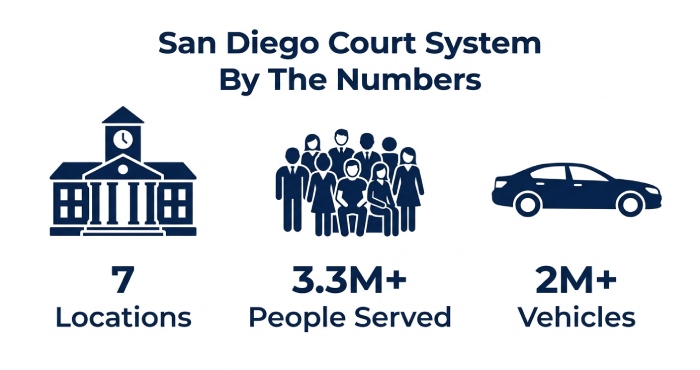
The Judicial Council of California publishes a Court Statistics Report annually summarizing caseloads, dispositions, and processing times for every superior court in the state. The 2024 edition (covering FY 2022-23) documents that over 4.5 million cases were filed statewide in the superior courts, with 255,914 unlimited civil cases (matters seeking more than $25,000) and 402,019 limited civil cases (matters seeking $25,000 or less) (California 2024 Court Statistics Report — https://courts.ca.gov/sites/default/files/courts/default/2024-12/2024-court-statistics-report.pdf). The San Diego Superior Court operates 7 courthouse locations across the county — the Central Courthouse, Hall of Justice, Juvenile Court, North County Courthouse in Vista, South County Courthouse in Chula Vista, East County Courthouse in El Cajon, and the Kearny Mesa Traffic Facility — staffed by 135 authorized judicial positions and 19 commissioners (San Diego Superior Court FY 2022-23 Schedule 1 — https://courts.ca.gov/sites/default/files/courts/default/2024-10/san-diego-sch1-2223.pdf).
What this actually means
Three structural facts about the San Diego court system shape every lemon-law case filed there:
- San Diego is the second-largest trial court system in California by population served. It serves a county of more than 3.3 million people and handles civil disputes generated by approximately 2 million registered vehicles. Only Los Angeles processes more.
- Civil cases are heard primarily at three locations: the Central Courthouse and Hall of Justice in downtown San Diego, the North County Courthouse in Vista, and the South County Courthouse in Chula Vista. Where your case is filed and assigned can affect the calendar pace by several months — judges and clerks in busier downtown departments carry larger inventories than their counterparts in regional courthouses.
- The court has been operating under a backlog notice since 2025. As of the most recent posting on the San Diego Superior Court’s Civil Division page, the court is publicly acknowledging a “significant backlog in all filing types” due to a case management system data conversion — meaning new filings, fee processing, and clerk-level review are taking longer than normal even before a case reaches a judge.
Applying the 10% rule
If lemon-law cases now represent nearly 10% of all new civil filings in Los Angeles County (per the AB 1755 Assembly Judiciary Analysis and the SB 26 Senate Judiciary Analysis), and if San Diego’s civil-filing volume tracks proportionally with population — San Diego represents roughly 8% of California’s population vs. Los Angeles County’s 25% — then San Diego is processing somewhere between 1,500 and 2,500 lemon-law cases per year. The state has not yet published a county-by-county lemon-law breakdown, but the statewide filing totals (14,892 in 2022 → 25,000+ in 2024) and Los Angeles’s documented share make the San Diego estimate unavoidable.
|
What to do next Identify which courthouse your case will be filed in before you file. San Diego’s Civil Division assigns cases by the venue rules in its Division II Local Rules — central San Diego, North County (Vista), South County (Chula Vista), and East County (El Cajon) all have their own civil calendars and judge assignments. Filing at the wrong location triggers an automatic transfer that adds weeks. The current San Diego Local Rules are available as a PDF at the link above; check Division II Chapter 2 for venue and case-assignment rules before submitting your complaint. |
Identify which courthouse your case will be filed in before you file. San Diego’s Civil Division assigns cases by the venue rules in its Division II Local Rules — central San Diego, North County (Vista), South County (Chula Vista), and East County (El Cajon) all have their own civil calendars and judge assignments. Filing at the wrong location triggers an automatic transfer that adds weeks. The current San Diego Local Rules are available as a PDF at the link above; check Division II Chapter 2 for venue and case-assignment rules before submitting your complaint.
2. The 10% statistic that drove AB 1755 — and what it implies for San Diego
The data
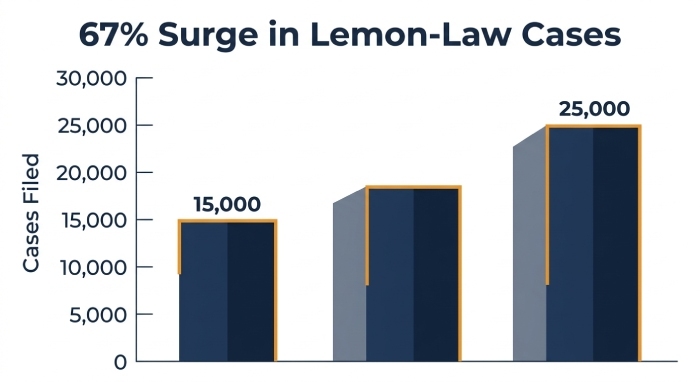
The California Assembly Committee on Judiciary’s analysis of AB 1755 — the bill that rewrote the procedural side of Song-Beverly Consumer Warranty Act litigation effective January 1, 2025 — documents that lemon-law cases filed under Song-Beverly surged from approximately 15,000 in 2022 to over 22,000 in 2023 and more than 25,000 in 2024, a 67% increase in two years (AB 1755 Assembly Judiciary Analysis — https://ajud.assembly.ca.gov/system/files/2024-08/ab-1755-analysis.pdf). The SB 26 Senate Judiciary Analysis, which followed in early 2025, restated the trajectory with sharper precision: from 14,892 filings in 2022 to 22,655 filings in 2023, and added that “in Los Angeles County, post-pandemic lemon law filings represented nearly 10% of all new civil filings in the superior court” (SB 26 Senate Judiciary Analysis — https://trackbill.com/s3/bills/CA/2025/SB/26/analyses/senate-judiciary.pdf).
The same SB 26 analysis points to the mechanism driving the surge: “At their core, lemon law disputes are largely paperwork driven cases. Prior to the adoption of the AB 1755 procedures, parties squabbled over what maintenance records must be disclosed, what warranty documents must be provided to opposing parties, and how depositions could be conducted. Every time one of these disputes arose, the court was forced to calendar a motion hearing and delay a potential trial. The calendaring backlog caused by these discovery disputes is what bogged down the civil courts prior to AB 1755’s enactment.”
What this means for a San Diego filer
Three implications drop directly out of this data for anyone filing a lemon-law case in San Diego:
- Your case is competing for calendar time with thousands of other lemon-law cases. Each motion hearing in your case is one calendar slot the court has to find. The legislature explicitly identified this calendaring pressure as the reason for AB 1755.
- The court is now operating under accelerated procedural rules — for opted-in manufacturers only. AB 1755 mandated that specified documents be disclosed within 60 days of an answer, that scope-limited depositions of the plaintiff and the defendant’s most-qualified representative be completed within 120 days, and that mediation occur within 150 days. SB 26 then made those rules opt-in.
- Which set of rules applies to your case depends on the manufacturer. The California Department of Consumer Affairs‘ Arbitration Certification Program publishes the official opt-in list on December 15 every year. You need to know your manufacturer’s status before you file.
The lemon-law plaintiff demographics
Public legislative testimony and academic analysis of California lemon-law filings 2018-2021 (cited in the Senate analysis and reported by University of California, Irvine in a March 2025 review of the AB 1755 record) breaks the case mix down by manufacturer share. General Motors accounted for 29% of lemon-law cases filed in California; Stellantis (formerly Fiat Chrysler) for 17%; Ford for 13.5%; Volkswagen for 3.2%; Toyota for 2.2%; and Tesla for 0.6% — despite Tesla and Toyota together accounting for a large share of California’s vehicle sales (SB 26 Assembly Floor Analysis — https://trackbill.com/s3/bills/CA/2025/SB/26/analyses/assembly-floor-analysis.pdf). The disproportion is what makes manufacturer identity so important to case strategy: a defect on a GM vehicle is litigated against a defendant that has handled tens of thousands of similar cases; a Tesla defect is litigated against a defendant that has handled almost none, and that has a contractual arbitration clause in its order agreement.
|
What to do next Before you contact a lemon-law attorney, check whether your manufacturer has opted in to the AB 1755 procedural rules. The Department of Consumer Affairs maintains the official, updated list of opt-in manufacturers at https://www.dca.ca.gov/acp/new_lemon_law.shtml. If your manufacturer has opted in, the 6-year-from-delivery filing cap, mandatory 30-day pre-suit notice, and 150-day mediation timeline apply. If they have not, the older Song- Beverly procedural rules govern your case. The two paths have meaningfully different leverage and strategy implications — know which one applies before you call an attorney. |
3. How long does a lemon-law case actually take in San Diego?
The data
The Judicial Council of California’s Standards of Judicial Administration set explicit time goals for every superior court in the state. Standard 2.2 directs that each trial court should manage unlimited civil cases (cases seeking more than $25,000, which includes essentially every Song-Beverly action) so that 75% are disposed of within 12 months, 85% within 18 months, and 100% within 24 months (Cal. Standards of Judicial Administration 2.2 — https://courts.ca.gov/cms/rules/index/standards/standard2_2). For limited civil cases, the goals are even tighter — 90% within 12 months and 100% within 24 months. These are statewide goals, not San Diego-specific, but every San Diego judge is measured against them, and the San Diego Local Rules incorporate them into the court’s own case-management framework (San Diego Division II Civil Local Rules — https://www.sdcourt.ca.gov/sites/default/files/sdcourt/generalinformation/localrulesofcourt/division_ii_-_civil_2026.pdf).
The reality in California civil courts is more nuanced. The California Construction Law Blog’s published litigation benchmarks note: “While California state judges try to meet these goals, they are just goals, and the reality is that many unlimited civil cases can take up to five years to go to trial.” Practical observation by California civil practitioners places typical contested Song-Beverly cases under the pre-AB 1755 regime at 18–30 months from filing to resolution; under the new AB 1755 expedited procedures for opted-in manufacturers, the timeline target is 6–9 months from answer to mediation completion.
What this means in practice
Set out the two parallel tracks side by side. For an opted-in manufacturer under AB 1755:
| Stage | AB 1755 deadline (opted-in) | What happens |
| Pre-suit | 30-day written notice | Consumer mails certified notice to manufacturer demanding repurchase or replacement; clock starts. |
| Manufacturer response | Within 30 days of notice | Manufacturer must respond. If it agrees to repurchase/replace, it has 60 days from the original notice to complete. |
| Filing | After 30-day window expires | If no agreement, consumer files complaint in San Diego Superior Court. |
| Answer | 30 days from service | Defendant manufacturer files answer or responsive pleading. |
| Initial disclosures | 60 days from answer | Both sides exchange specified documents (purchase contract, repair invoices, warranty paperwork, communications) without formal request. |
| Limited depositions | 120 days from answer | Plaintiff deposition and defendant’s most-qualified person deposition, scope-limited. |
| Mediation | Within 150 days of answer | Mandatory mediation — discovery is otherwise stayed. |
| Trial (if no settlement) | 12-24 months from filing | Standard San Diego unlimited civil time goals apply. |
For a manufacturer that has not opted in, the older Song-Beverly procedural rules apply — meaning no mandatory pre-suit notice, no 60-day initial disclosure rule, no 150-day mediation requirement. Discovery proceeds on the standard California Code of Civil Procedure timeline, motions calendar as the court can schedule them, and the typical contested case can take 18 to 30 months from filing to resolution. The leverage trade-off: the older regime allows full discovery and full civil-penalty exposure (up to 2× damages for willful violations), but moves more slowly through a congested calendar.
Where the realistic numbers land
Walking through three actual San Diego scenarios:
- Uncontested buyback. Manufacturer accepts the pre-suit demand within 30 days, completes the repurchase within 60 days.
- Total time: 60–90 days from initial notice.
- Settled at AB 1755 mediation. Manufacturer denies the pre-suit demand, case is filed, parties exchange initial disclosures, attend mandatory mediation 150 days after answer, settle there.
- Total time: roughly 8 to 12 months from filing.
- Trial under the old rules (non-opted-in manufacturer). Full discovery, depositions, motion practice, trial readiness conference, trial setting.
- Total time: typically 18 to 30 months from filing, occasionally longer if the case is reassigned between judges or extended by motion practice.
|
What to do next Pull San Diego Superior Court’s Department Assignments page and identify the civil departments hearing lemon-law cases at your filing courthouse. The court publishes an up-to-date list at https://www.sandiego.courts.ca.gov/portal/about/depts_ccn.html. Each independent-calendar civil judge manages their own inventory, and pace varies meaningfully between departments. An experienced San Diego lemon-law firm will know which judges tend to push opted-in cases to the 150-day mediation deadline strictly and which tend to grant continuances — that knowledge alone can shift your settlement timing by 60 days. |
4. The AB 1755 procedural timeline, in plain English
The data
AB 1755 added Chapter 12 (commencing with Section 871.20) to Title 10 of Part 2 of the California Code of Civil Procedure, applicable to actions seeking restitution or replacement of a new motor vehicle under the Song-Beverly Consumer Warranty Act or the Tanner Consumer Protection Act (AB 1755 Bill Text (Aug. 26, 2024) — https://sjud.senate.ca.gov/system/files/2024-08/ab-1755-kalra-aug-26-bill-text.pdf). The SB 26 follow-up bill made the entire AB 1755 procedural framework opt-in: only manufacturers who file written election with the Department of Consumer Affairs are bound by the new rules (SB 26 Senate Judiciary Analysis — https://trackbill.com/s3/bills/CA/2025/SB/26/analyses/senate-judiciary.pdf). The DCA’s Arbitration Certification Program publishes the current opt-in list and updates it annually on December 15 (California DCA Arbitration Certification Program — Lemon Law Opt-In Page — https://www.dca.ca.gov/acp/new_lemon_law.shtml).
The full timeline, end to end
Phase 1: Pre-suit notice (the new mandatory step)
Effective July 1, 2025, before any consumer can file a lawsuit seeking civil penalties against an opted-in manufacturer, the consumer must send a written notice that includes:
- The consumer’s full name and contact information
- The vehicle identification number (VIN)
- A summary of the repair history and ongoing issues
- A formal request for repurchase or replacement
The manufacturer has 30 days to respond. If it agrees to repurchase or replace, it has 60 days from the original notice to complete the transaction. If it delays beyond that, statutory daily penalties of $50/day apply. If the manufacturer denies the request or fails to respond, the consumer can proceed to file the lawsuit.
Phase 2: Filing the complaint
San Diego Superior Court charges a $435 first-paper filing fee for unlimited civil cases — those seeking more than $35,000, which includes essentially every Song-Beverly action involving a modern vehicle (San Diego Court Fee Schedule (ADM-001) — Limited civil cases (between $12,500 and $35,000 at issue) carry lower fees. Fee waivers are available for low-income filers via Judicial Council Form FW-001 (Judicial Council Fee Waiver Application (FW-001) — http://www.sdcourt.ca.gov/pls/portal/url/ITEM/A9749EE8D37B2A97E0440003BAFC2575). Filing is mandatory by electronic submission for attorney-represented parties — paper filings are accepted only for self-represented litigants and special case types.
Phase 3: Service and answer
Under San Diego Local Rule 2.1.6 and California Rule of Court 3.110, the plaintiff must serve all defendants within 60 days of filing the complaint and file proof of service. The defendant must generally appear (answer or demurrer) within 30 days of service (San Diego Superior Court 2026 Local Rules — https://wwwprod.sdcourt.ca.gov/sites/default/files/sdcourt/generalinformation/localrulesofcourt/
san_diego_county_superior_court_rules__2026.pdf). An extension of up to 15 days is permitted by stipulation. Failure to comply with the 60-day service deadline can result in sanctions, including dismissal, at the initial Case Management Conference.
Phase 4: Initial disclosures (the 60-day clock)
Within 60 days of the defendant’s answer, both parties must exchange — without any formal discovery request — a specified set of documents:
- Vehicle purchase or lease agreement
- Repair invoices and service records
- Correspondence between consumer and manufacturer/dealership
- Warranty documentation and manufacturer responses
This is a significant procedural shift. Under the old Song-Beverly framework, getting these documents required formal discovery requests and frequent motions to compel. The AB 1755 expedited disclosure rule made them automatic — and made failure to disclose sanctionable.
Phase 5: Mandatory mediation (the 150-day cliff)
For opted-in manufacturers, mediation is mandatory and must be conducted within 150 days of the defendant’s answer, with scheduling within 90 days. Most discovery beyond the initial disclosures is stayed pending mediation — meaning the parties have a fixed window to settle on the basis of paperwork rather than full depositions and expert reports.
Phase 6: Discovery and trial (if no settlement)
If mediation does not resolve the case, the parties proceed into full discovery and trial preparation under the standard San Diego Local Rules and the California Code of Civil Procedure. The San Diego Superior Court’s Division II Civil Local Rules govern case management conferences, expert witness disclosure, trial readiness conferences, mandatory settlement conferences, and trial setting (San Diego Division II Civil Local Rules — https://www.sdcourt.ca.gov/sites/default/files/sdcourt/generalinformation/localrulesofcourt/division_ii_-_civil_2026.pdf). The Judicial Council’s 75%/85%/100% disposition goals continue to apply — meaning judges will push toward trial well before the 24-month cliff.
|
What to do next Identify which courthouse your case will be filed in before you file. San Diego’s Civil Division assigns cases by the venue rules in its Division II Local Rules — central San Diego, North County (Vista), South County (Chula Vista), and East County (El Cajon) all have their own civil calendars and judge assignments. Filing at the wrong location triggers an automatic transfer that adds weeks. The current San Diego Local Rules are available as a PDF at the link above; check Division II Chapter 2 for venue and case-assignment rules before submitting your complaint. |
5. Which San Diego courthouse handles your case
The data
San Diego Superior Court’s 2026 Local Rules govern venue and case assignment under Division I Chapter 2 and Division II Chapter 1. The court operates seven physical locations, but civil cases — including lemon-law actions — are concentrated at four:
- Central Courthouse, 1100 Union Street, San Diego, CA 92101 — handles the majority of civil filings for central San Diego, including downtown, Mission Valley, Hillcrest, La Jolla, Pacific Beach, and the surrounding neighborhoods.
- Hall of Justice, 330 West Broadway, San Diego, CA 92101 — a secondary downtown civil and criminal location used for specific case types and trial overflow.
- North County Courthouse, 325 South Melrose Drive, Vista, CA 92081 — civil cases originating in Oceanside, Carlsbad, Encinitas, San Marcos, Escondido, Vista, and the rest of North County.
- South County Courthouse, 500 3rd Avenue, Chula Vista, CA 91910 — civil cases for Chula Vista, National City, Imperial Beach, and the South Bay.
- East County Courthouse, 250 East Main Street, El Cajon, CA 92020 — historically focused on criminal and family law but handles select civil matters for East County residents.
What this means for your filing strategy
San Diego Local Rule 2.1.3 (Case Assignment) governs which courthouse and department a case is assigned to. Generally, civil cases are assigned to the courthouse whose region encompasses the residence of the plaintiff or the defendant — but the court reserves discretion to reassign cases for caseload management. Two practical consequences:
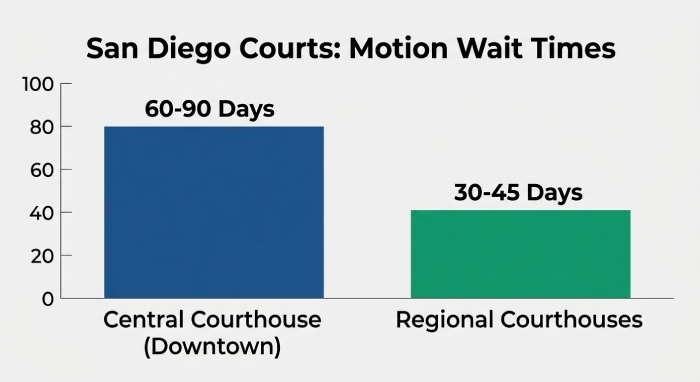
- The downtown civil calendar is busier than the regional calendars. A case filed at the Central Courthouse generally faces a more crowded motion calendar than the same case filed at the North County or South County courthouses. For routine motions like a motion to compel, downtown wait times can run 60–90 days; regional courthouses often calendar similar motions in 30–45 days.
- Trial dates are easier to obtain at regional courthouses. If your case actually proceeds to trial — most lemon-law cases settle, but some do not — regional courthouses typically have shorter trial-setting waits than downtown.
Where lemon-law cases actually sit
Lemon-law cases in San Diego are not handled by a single specialized department like construction-defect cases. They are assigned to the court’s general civil independent calendar departments, with judges who hear the full range of unlimited civil matters. As of the most recent department assignment publication, civil independent calendar departments at the Central Courthouse generally include departments in the C-60 through C-75 range, with parallel civil calendars in North County (Vista) and South County (Chula Vista). The court publishes current judge-to-department assignments at https://www.sandiego.courts.ca.gov/portal/about/depts_ccn.html and updates the page regularly.
|
What to do next Before you file, pull the current San Diego Superior Court Department Assignments page and identify which judges currently sit on the independent calendar civil departments at your likely filing courthouse. Then, search the Register of Actions in San Diego’s online case lookup for lemon-law cases assigned to that judge in the past 12 months — the case-management history is a public record. If the judge has a track record of pushing mandatory mediation and tight initial disclosure deadlines, your case is likely to move faster. If the same judge has a track record of granting continuances, plan accordingly. |
6. Mandatory ADR: why mediation isn’t optional anymore
The data
San Diego Superior Court’s policy on Alternative Dispute Resolution is explicit in the Local Rules: “It is the policy of the San Diego Superior Court to strongly support the use of Alternative Dispute Resolution in all general civil cases. The court has long recognized the value of early case management intervention and the use of ADR options for amenable and eligible cases. The use of ADR will be discussed at all Case Management Conferences. It is the court’s expectation that litigants will utilize some form of ADR — i.e., the court’s mediation, voluntary settlement, and arbitration programs or other available private ADR options as a mechanism for case settlement before trial” (San Diego Division II Civil Local Rules — https://www.sdcourt.ca.gov/sites/default/files/sdcourt/generalinformation/localrulesofcourt/division_ii_-_civil_2026.pdf). For opted-in manufacturers under AB 1755, that expectation becomes a mandate: mediation must occur within 150 days of the answer, and most discovery is stayed pending mediation (SB 26 Senate Judiciary Analysis — https://trackbill.com/s3/bills/CA/2025/SB/26/analyses/senate-judiciary.pdf).
Why mediation actually matters for your timeline
Three points worth understanding before your mediation date:
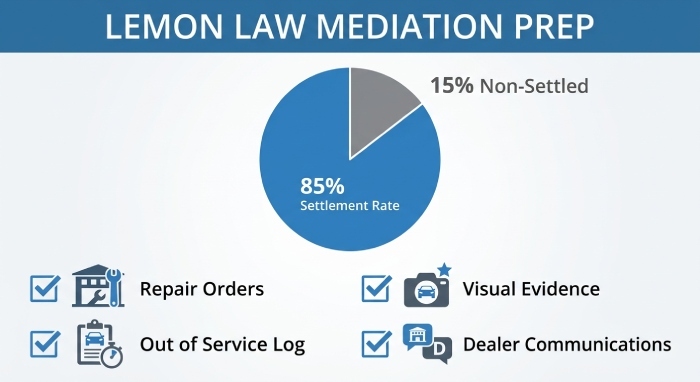
- Most lemon-law cases settle. Industry-wide observation places the settlement rate for California lemon-law cases at 85%+ — the overwhelming majority resolve before trial. AB 1755’s mediation rule converts that into a procedural fact: the 150-day window is when most cases now resolve.
- Discovery is paused during mediation. Under AB 1755, you arrive at mediation with the documents from the initial 60-day disclosure but without the benefit of full depositions or expert reports. Your leverage at mediation depends almost entirely on the quality of the records you already have — repair orders, dealer communications, dated SoH diagnostic results.
- San Diego mediators are not provided free by the court. The San Diego Civil Mediation Program offers a panel of approved mediators, and parties typically split the mediator’s fee. The court’s ADR Administrator and Mediation Program Coordinator can be reached at (619) 450-7300; the panel and fees are documented in the San Diego Local Rules.
What to bring to mediation
A successful San Diego lemon-law mediation typically requires:
- Complete repair order history, including any “no issue found” visits — these count toward the four-attempt presumption under Song-Beverly.
- A written log of days the vehicle was out of service (30+ cumulative days within the first 18 months/18,000 miles triggers Song-Beverly’s statutory presumption).
- Photographs, video, or app screenshots of the defect when it occurred.
- Communications with the dealer and manufacturer — emails, texts, in-app service messages.
- Any NHTSA recall printouts for the VIN (free at https://www.nhtsa.gov/recalls).
- A pre-mediation brief prepared by a skilled lemon law attorney San Diego consumers trust can outline the defect timeline, explain the legal basis of the claim, and detail the requested remedy.
|
What to do next Organize your documents into a single “Mediation Binder” — physical or PDF — at least 30 days before the mediation date. Most San Diego mediators ask for a pre-mediation submission 7-10 days in advance. The mediator reads your submission before the session, which means a well-organized binder is doing settlement work before you even walk in the door. An identical submission given to the opposing side reduces the chance of a procedural surprise and signals you are serious about resolution. |
7. The opt-in question: why your manufacturer’s status changes everything
The data
Senate Bill 26, signed April 2, 2025, made the AB 1755 procedural framework optional for manufacturers (SB 26 Senate Judiciary Analysis — https://trackbill.com/s3/bills/CA/2025/SB/26/analyses/senate-judiciary.pdf). The California Department of Consumer Affairs’ Arbitration Certification Program publishes the official, updated list of manufacturers who have opted in (California DCA Arbitration Certification Program — Lemon Law Opt-In Page — https://www.dca.ca.gov/acp/new_lemon_law.shtml). Manufacturers who opt in commit irrevocably for five calendar years; the DCA must publish the updated opt-in list every December 15.
The two-track system in practice
California now has two parallel sets of procedural rules for the same Song-Beverly Consumer Warranty Act:
| Issue | Opted-in manufacturer (AB 1755) | Non-opted-in manufacturer (old rules) |
| Statute of limitations | 1 year after warranty expires, max 6 years from delivery | 4 years from when claim arose (old standard) |
| Pre-suit notice | Mandatory written notice, 30-day response window | Not required |
| Initial disclosures | Automatic within 60 days of answer | Formal discovery required |
| Mediation | Mandatory within 150 days of answer | Discretionary |
| Civil-penalty exposure | Up to 2× damages for willful violations | Up to 2× damages for willful violations |
| Attorney’s fees | Recoverable under § 1794(d) | Recoverable under § 1794(d) |
| Typical resolution time | 8–12 months from filing (most cases) | 18–30 months from filing (most cases) |
Read across the table and the trade-off becomes visible. Opted-in cases move faster but with restricted discovery. Non-opted-in cases move slower but allow full discovery, more leverage at deposition, and broader settlement negotiation. The substantive remedies — replace or refund, civil penalties, attorney’s fees — are identical.
How to check your manufacturer’s status
The Department of Consumer Affairs publishes the official opt-in list at https://www.dca.ca.gov/acp/new_lemon_law.shtml. Bookmark the page. Updates occur annually on December 15, but new election filings can be processed throughout the year. As of the most recent public listing (May 2025), several major domestic manufacturers had elected in; foreign manufacturers and Tesla were generally outside the opt-in framework. Manufacturer status can change year to year, so verify on the day you are preparing to file.
|
What to do next Print the current Department of Consumer Affairs opt-in list, dated as of the day you print it, and save it to your case folder. If your manufacturer’s status changes between your pre-suit notice and your filing date, you need contemporaneous evidence of what the rules were when you sent your notice. The list is also the cleanest possible exhibit if a procedural dispute arises about which framework governs. |
8. What it costs to file in San Diego
The data
San Diego Superior Court’s Fee Schedule (Form ADM-001) sets the current first-paper filing fee for unlimited civil cases at $435 under Government Code §§ 70611, 70602.5, and 70602.6 (San Diego Court Fee Schedule (ADM-001) — https://www.sdcourt.ca.gov/sites/default/files/sdcourt/generalinformation/forms/adminforms/adm001.pdf). Limited civil cases (between $12,500 and $35,000 at issue) carry a fee of $370; cases between $10,000 and $12,500 cost $225. To preserve the right to a jury trial, one party from each side must pay an advance jury fee of $150 on or before the initial Case Management Conference. Fee waivers are available for low-income filers using Judicial Council Form FW-001 (Judicial Council Fee Waiver Application (FW-001) — http://www.sdcourt.ca.gov/pls/portal/url/ITEM/A9749EE8D37B2A97E0440003BAFC2575).
What this actually costs a San Diego owner
Most California lemon-law plaintiffs do not pay these fees out of pocket. Under California’s Song-Beverly Civil Code § 1794(d), prevailing consumers may recover attorney’s fees and legal costs from the manufacturer. As a result, many firms handle cases on a contingency basis, meaning clients typically pay nothing upfront. An experienced lemon law lawyer California consumers trust can often pursue compensation directly from the manufacturer if the claim succeeds. . The practical financial picture for a typical plaintiff:
- Filing fee: $435 — paid by the law firm and reimbursed at settlement or judgment.
- Jury fee: $150 — same treatment.
- Service of process: $75–$200 — paid by the law firm and reimbursed.
- Expert witnesses (if needed): $3,000–$15,000 — paid by the law firm, recovered as costs at settlement or judgment if the consumer prevails.
- Mediator fees (under AB 1755): typically $1,500–$4,000 per side — split between parties or paid as part of settlement.
- Out-of-pocket cost to the consumer: typically zero. Pre-suit notice postage (~$10 in certified mail) is the most common direct expense.
|
What to do next Confirm in writing that any San Diego lemon-law firm you retain is working on a true contingency basis with manufacturer-paid fees under Civil Code § 1794(d). Most reputable firms operate this way, but the engagement letter is what controls. The engagement should expressly state that the consumer is not responsible for any costs unless and until the case is successfully resolved. If the engagement requires you to pay costs out of pocket up front, that is unusual for a Song-Beverly case and warrants a second opinion. |
9. The 12 most common procedural mistakes in San Diego lemon-law cases
Compiled from the AB 1755 and SB 26 legislative analyses, the San Diego Local Rules, and the California Department of Consumer Affairs’ lemon-law guidance, here are the mistakes that most often cost San Diego plaintiffs leverage, time, or recovery:
- Sending the pre-suit notice by regular mail instead of certified. Without proof of receipt, the 30-day clock never reliably starts.
- Selling or trading the vehicle before the case is resolved. AB 1755 now requires consumer notice to subsequent buyers if the vehicle is sold during pending litigation.
- Failing to keep “no issue found” repair receipts. Those visits still count toward Song-Beverly’s four-attempt presumption.
- Missing the 60-day initial disclosure deadline. Under AB 1755 for opted-in cases, sanctions follow automatically.
- Filing in the wrong courthouse. Triggers transfer, adds weeks, sometimes months.
- Filing pro se in an unlimited civil case. Most Song-Beverly cases involve technical defect arguments, expert testimony, and procedural deadlines that disadvantage self-represented litigants.
- Assuming all manufacturers are subject to AB 1755. The opt-in framework means procedural rules differ by defendant.
- Calculating the statute of limitations from warranty expiration alone. AB 1755’s 6-year-from-delivery cap can be much shorter.
- Not running an NHTSA VIN recall check. Unremedied recalls strengthen the defect-pattern argument.
- Failing to attempt manufacturer-level dispute resolution first. Some warranties require it; even when not required, documented attempts strengthen the case.
- Going to mediation without organized documents. AB 1755 stays full discovery during mediation; your binder is your evidence base.
- Signing a Tesla Order Agreement without opting out of arbitration. The 30-day window closes fast and removes the jury-trial path.
|
What to do next Do a 15-minute self-audit against this list before you file. Most of the mistakes above are preventable with documentation, calendaring, and one extra phone call to the dealer or manufacturer before sending any letters. The cost of avoiding the mistakes is approximately zero; the cost of making them is measured in months of delay and tens of thousands of dollars in recoverable damages. |
10. Pre-filing checklist for San Diego residents
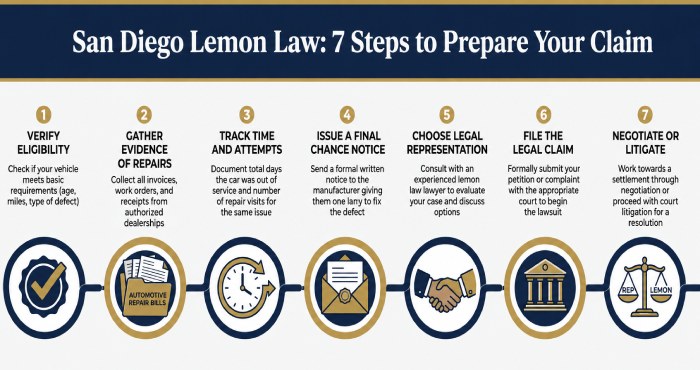
If you are considering a lemon-law claim in San Diego County, here is the seven-step pre-filing sequence — gathered from the San Diego Local Rules, the Judicial Council standards, the Department of Consumer Affairs’ lemon-law portal, and the AB 1755 legislative record.
- Verify your manufacturer’s opt-in status. Check the official Department of Consumer Affairs list at https://www.dca.ca.gov/acp/new_lemon_law.shtml. Print or save the page with today’s date. This determines which procedural framework governs your case.
- Calculate your statute of limitations. Write down (a) the original delivery date of your vehicle and (b) the date your express warranty expires. If the manufacturer is opted in, the earlier of “6 years from delivery” or “1 year after warranty expiration” controls. If not opted in, the older 4-years-from-claim-accrual rule applies.
- Gather every repair order. Including “no issue found” visits. Photograph each one (the phone timestamp is admissible) and save to a single folder. Song-Beverly’s 4-attempt and 30-day-out-of-service presumptions are documentary tests.
- Run a NHTSA recall lookup on your VIN. Free at https://www.nhtsa.gov/recalls. Save the result as a dated PDF. Unremedied recalls strengthen the defect argument and create independent breach-of-warranty exposure for the manufacturer.
- Send the pre-suit notice by certified mail with return receipt. Required for opted-in manufacturers, recommended for all. Include the consumer’s name, vehicle VIN, summary of the repair history, and a formal demand for repurchase or replacement. Keep the postal receipt and tracking number.
- Identify your filing courthouse before contacting an attorney. Central San Diego, North County (Vista), South County (Chula Vista), or East County (El Cajon). Each courthouse has its own civil calendar pace and judge inventory. Filing at the wrong location triggers transfer and delay.
- Interview at least two San Diego lemon-law firms. Most offer free case evaluations. Ask each: (a) what percentage of their docket is Song-Beverly cases, (b) whether they have tried lemon-law cases in your filing courthouse, (c) their typical resolution timeline for cases like yours, and (d) the engagement-letter terms. Most reputable firms work on contingency with manufacturer-paid fees under § 1794(d) — confirm in writing.
Total cost of executing this checklist: approximately $20 in certified-mail postage and PDF printing. Total time: 3 to 5 hours over one or two weekends. Total potential value preserved: tens of thousands of dollars in Song-Beverly remedies if a real defect is later confirmed.
Editorial note
This article is research and analysis. It is not legal advice. California lemon law and the procedural rules under AB 1755 and SB 26 contain technical complexities that depend on the specific vehicle, manufacturer, defect, and timeline involved. A San Diego resident who believes they may have a Song-Beverly claim should consult a licensed California attorney before sending any pre-suit notice or filing a complaint. The statistics, fee schedules, and procedural rules cited in this article are accurate as of the publication dates of the underlying source documents, all of which are linked above and below for independent verification. San Diego Superior Court Local Rules are revised annually; verify the current 2026 version before relying on any specific rule citation.
References — primary sources with clickable links and full URLs
Every source cited in this article, with its full title, year, file type, and complete URL. URLs are reproduced as plain text so they remain accessible if hyperlink formatting is stripped by any export or conversion.
San Diego Superior Court — Local Rules and procedural documents
- Superior Court of California, County of San Diego — 2026 Local Rules of Court (2026, PDF). https://wwwprod.sdcourt.ca.gov/sites/default/files/sdcourt/generalinformation/localrulesofcourt/san_diego_county_superior_court_rules__2026.pdf
- San Diego Superior Court — Division II Civil Local Rules (2026) (2026, PDF). https://www.sdcourt.ca.gov/sites/default/files/sdcourt/generalinformation/localrulesofcourt/division_ii_-_civil_2026.pdf
- Superior Court of California, County of San Diego — Fee Schedule (Form ADM-001) (2025, PDF). https://www.sdcourt.ca.gov/sites/default/files/sdcourt/generalinformation/forms/adminforms/adm001.pdf
- San Diego Superior Court — FY 2025-2026 Proposed Baseline Budget, Schedule 1 (2025, PDF). https://sdcourt.ca.gov/sites/default/files/2025-10/10-10-2025_public_notice_re_fy_2025-2026_sdsc_proposed_baseline_budget_-_schedule_1.pdf
- San Diego Superior Court — FY 2022-2023 Schedule 1 (Trial Court Budget Reports) (2023, PDF). https://courts.ca.gov/sites/default/files/courts/default/2024-10/san-diego-sch1-2223.pdf
- California Judicial Council — Request to Waive Court Fees (Form FW-001) (Mandatory 2025 form, PDF). http://www.sdcourt.ca.gov/pls/portal/url/ITEM/A9749EE8D37B2A97E0440003BAFC2575
Judicial Council of California — statistics and standards
- Judicial Council of California — 2024 Court Statistics Report (Statewide Caseload Trends 2013-14 through 2022-23) (2024, PDF). https://courts.ca.gov/sites/default/files/courts/default/2024-12/2024-court-statistics-report.pdf
- Judicial Council of California — 2023 Court Statistics Report (2023, PDF). https://www.courts.ca.gov/documents/2023-Court-Statistics-Report.pdf
- Judicial Council of California — Standards of Judicial Administration, Standard 2.2 (Trial Court Case Disposition Time Goals) (Current, Judicial Council standard). https://courts.ca.gov/cms/rules/index/standards/standard2_2
California lemon-law legislation — AB 1755 and SB 26
- California Assembly Committee on Judiciary — Analysis of AB 1755 (2024, PDF). https://ajud.assembly.ca.gov/system/files/2024-08/ab-1755-analysis.pdf
- California Legislature — AB 1755 Bill Text (As Amended August 26, 2024) (2024, PDF). https://sjud.senate.ca.gov/system/files/2024-08/ab-1755-kalra-aug-26-bill-text.pdf
- Assemblymember Kalra — AB 1755 Fact Sheet (August 2024) (2024, PDF). https://kalra.asmdc.org/sites/a25.asmdc.org/files/2024-08/AB%201755%20(Kalra%20and%20Umberg)_Lemon%20Law_%20Fact%20Sheet_8-20-24.pdf
- California Senate Judiciary Committee — SB 26 Analysis (2025, PDF). https://trackbill.com/s3/bills/CA/2025/SB/26/analyses/senate-judiciary.pdf
- California Assembly Floor — SB 26 (Umberg) As Amended March 24, 2025 — Floor Analysis (2025, PDF). https://trackbill.com/s3/bills/CA/2025/SB/26/analyses/assembly-floor-analysis.pdf
California Department of Consumer Affairs — opt-in tracking and lemon-law guidance
- California Department of Consumer Affairs — Lemon Law Questions and Answers (Current, PDF). https://www.dca.ca.gov/acp/pdf_files/lemonlaw_qa.pdf
- California Department of Consumer Affairs, Arbitration Certification Program — New Lemon Law Procedures (Opt-In Manufacturer List) (2025, Government webpage (no PDF equivalent maintained by agency)). https://www.dca.ca.gov/acp/new_lemon_law.shtml
- Better Business Bureau — California Lemon Law Summary (BBB AUTO LINE) (Current, PDF). https://assets.bbbprograms.org/docs/default-source/auto-line/statelemonlaws/california-lemonlaw.pdf