
Executive takeaway
California lemon-law filings reportedly fell about 31% in early 2026 compared with the same period in 2025. That figure measures lawsuits, not vehicle quality or consumer outcomes. Procedural reforms offer a plausible explanation, but the supplied evidence does not establish causation. Manufacturer opt-in status, warranty dates, notice requirements, and early mediation now require careful assessment when pursuing a lemon law claim. The central question remains unanswered: do fewer filings reflect satisfactory early resolutions, more abandoned claims, or both? The supplied outcome evidence cannot distinguish these possibilities.
What the reported 31% decline actually measures
California lemon-law lawsuits reportedly fell roughly 31% in early 2026 compared with the same period in 2025. The figure comes from Ginsburg Law Group’s summary of Daily Journal reporting, as described in the supplied evidence. The underlying filing dataset was not provided.
That attribution limits the claim’s precision. The evidence does not establish the underlying counts or exact comparison dates. The percentage should remain a reported finding, not an independently verified statewide calculation or full-year result.
Filed lawsuits are not a measure of vehicle defects or all consumer disputes. Ginsburg’s account distinguishes filings from repurchases, settlements, and abandoned claims that never reach court. An owner who obtains satisfactory pre-suit relief and an owner who abandons an unresolved dispute both produce no filing. Their experiences differ sharply despite their identical absence from the docket.
National litigation reporting supplies context, not confirmation. Law.com’s coverage of Lex Machina’s 2026 Product Liability Litigation Report describes federal product-liability growth in 2025, before the reported California decline in early 2026. Its population includes cases outside multidistrict litigation, which coordinates related federal cases for pretrial proceedings. That broader national category cannot be treated as a matching California lemon-law series.
Legal Newsline’s September 2026 coverage suggests vehicle-warranty filings may have peaked in 2025. This is consistent with a subsequent slowdown, but it does not independently verify the reported California percentage. Nor does an earlier litigation peak establish what happened to vehicle reliability in 2026.
Historical California totals in the supplied research also conflict, preventing a reliable reconstruction of the trend preceding 2026. Their scope and counting methods need verification before inclusion in a year-by-year chart. Combining them would create an appearance of precision unsupported by the evidence.
The defensible conclusion is therefore narrow: fewer lawsuits reportedly reached court during the early-2026 comparison period. Whether disputes resolved earlier, expired, shifted between reporting periods, or went unpursued remains unknown.
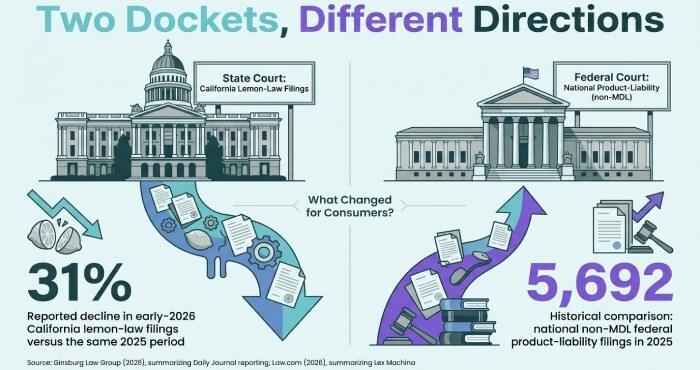
Source: Ginsburg Law Group (2026), summarizing Daily Journal reporting; Law.com (2026), summarizing Lex Machina
Fewer lawsuits leave the biggest question unanswered
Fewer lawsuits do not establish that consumers are better off—or worse off. The central question is whether disputes resolve earlier or fewer viable claims reach court. Both possibilities fit the reported decline, but they imply different consumer outcomes.
Procedural reform offers a plausible explanation, not a demonstrated cause. McMillan Law Group’s June 2026 retrospective describes changes to deadlines, notice, document exchange, and mediation. These changes could affect whether consumers sue, when they file, and how quickly filed cases resolve.
Several mechanisms deserve separate testing:
- Successful pre-suit resolution: Manufacturers may provide satisfactory repurchases, replacements, or settlements before owners sue.
- Missed deadlines: Otherwise viable claims may expire before owners obtain advice or act.
- Abandoned claims: Documentation burdens or difficulty securing representation may discourage owners from pursuing relief.
- Changed filing timing: Claims may shift between reporting periods rather than disappear permanently.
These mechanisms can operate simultaneously. Their relative contributions cannot be inferred from a single aggregate filing percentage. Early mediation also occurs after filing, so faster mediated settlements do not directly explain fewer initial lawsuits.
Complaint histories cannot resolve the question without comparable observation periods and appropriate denominators. McMillan’s June 2026 vehicle-brand analysis discusses complaints accumulated across earlier years, not a matched comparison of defect incidence in 2025 and 2026. Complaint totals also need sales or vehicle-population denominators before supporting comparisons across manufacturers.
The absence of a verified decline in defects does not establish that reliability remained unchanged. Likewise, national litigation growth before 2026 cannot rule out improvements in particular vehicles. Filing behavior and engineering performance require different evidence.
A stronger assessment would follow disputes from initial complaint through final outcome, including matters never filed. It would record completed remedies, time to relief, missed deadlines, withdrawals, and reasons attorneys decline representation. Comparisons should account for manufacturer opt-in status, warranty coverage, vehicle age, and sales volume. These are proposed research measures, not findings from an existing dataset.
Start with the manufacturer, not a universal deadline
Start with the manufacturer’s procedural track, not a deadline assumed to apply statewide. California’s Song-Beverly Consumer Warranty Act provides the underlying warranty framework. A July 2026 statutory overview describes obligations and potential remedies, including replacement or restitution.
Substantive entitlement and procedural compliance answer different questions: whether relief is owed, and how consumers must pursue it. A persistent defect does not establish which deadline applies. Following the correct procedure likewise does not prove entitlement to a remedy.
The May 2026 AB 1755 and SB 26 explainer describes new timing and early case-management requirements under AB 1755. It explains that SB 26 subsequently created a manufacturer election structure. A universal description of California’s “new lemon-law deadline” therefore risks misleading consumers.
According to LemonLawPro’s June 2026 guide, manufacturers can elect the new procedures. Manufacturers outside that election remain under the traditional framework. Election status is therefore an essential starting point, though claim scope and transition rules still require review.
The following comparison summarizes the supplied 2026 commentary. It is not a verified determination of the law governing an individual claim.
| Issue | Described elected procedures | Traditional framework |
| Applicability | Depends on manufacturer election, statutory scope, and transition rules. | Applies where the elected procedures do not govern, subject to verification. |
| Filing timing | One year after applicable express-warranty expiration, subject to a six-year original-delivery cap. | Requires separate analysis of limitation and accrual rules—when the filing clock starts. |
| Civil-penalty notice | Advance notice for affected claims seeking civil penalties. | Do not automatically import elected-track notice requirements. |
| Early case management | Early record exchange and mediation. | Do not assume the elected timetable applies. |
The traditional track does not guarantee a longer filing window. Its deadline requires claim-specific analysis rather than a calculation based solely on warranty expiration. Before using this comparison for advice, counsel should check enacted provisions, amendments, official election records, and effective dates.
Repair-attempt presumptions also require careful explanation. The 2026 statute overview describes benchmarks involving repair attempts and time out of service within 18 months or 18,000 miles. Those benchmarks concern a presumption—a rule that can help establish a fact—not a complete definition of every valid claim.
Screening should therefore assess the underlying warranty claim separately from timing and any applicable presumption. Missing a familiar numerical benchmark should not, by itself, trigger rejection.
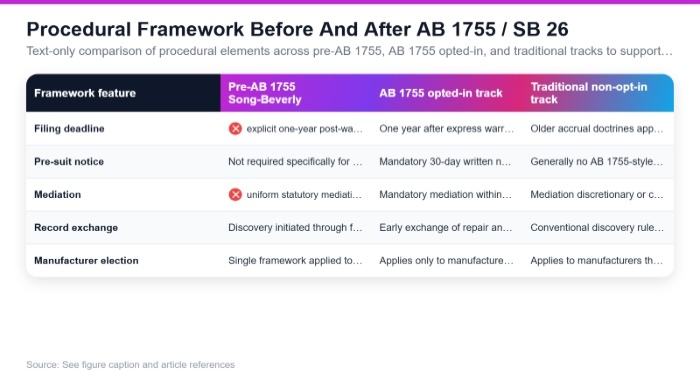
This comparison table contrasts key features of California’s traditional Song-Beverly lemon-law framework with the new AB 1755 procedures for opted-in manufacturers and the dual-track system created by SB 26, highlighting how filing deadlines, notice requirements, and mediation have changed.[1][9][17][19] Method: The table synthesizes doctrinal descriptions from LemonLawPro, McMillan Law Group, LawyersForConsumers, Plaintiff Magazine, and National Law Review, focusing on three regimes: pre-AB 1755 Song-Beverly, AB 1755’s opted-in track, and the traditional track for non-opt-in manufacturers.[1][9][11][17][19] Each row distills a major procedural element, such as statutes of limitation or pre-suit notice, into concise textual comparisons without numeric values, to aid quick strategic reference for practitioners.
Build the timeline before assessing litigation strategy
Build a documented timeline before deciding whether, when, or how to sue. For opted-in manufacturers, the supplied commentary describes two linked limits. Neither should be calculated from the current owner’s purchase date alone.
The May 2026 procedural explainer describes one year after the applicable express warranty expires. It also describes a six-year outer limit from original delivery to the first owner. Under that summary, the earlier date controls, subject to verification of the governing provisions and their application.
These descriptions support urgent screening, not definitive conclusions from incomplete records. Intake should assemble five sets of information:
- Original delivery: Obtain records showing delivery to the first owner. Keep that date separate from any later purchase.
- Warranty documents: Collect relevant express-warranty terms and documents describing different coverage periods.
- Expiration facts: Record dates and mileage supporting the proposed expiration date. Mark estimates as provisional.
- Repair chronology: List complaints, repair visits, mileage, and periods when the vehicle remained unavailable. Preserve supporting orders and communications.
- Manufacturer status: Record the election status, supporting information, and verification date. LemonLawPro’s 2026 guide recommends checking the Department of Consumer Affairs’ opt-in roster.
Warranty identification requires legal review, not merely calendar arithmetic. Counsel must determine which coverage applies to the alleged defect before calculating its expiration. A later purchaser’s contract also cannot, by itself, establish delivery to the first owner.
A statutory deadline and an internal planning deadline serve different purposes. The former governs timely legal action; the latter reserves time for records, review, and required steps. Missing an office’s preferred intake cutoff does not establish that the legal deadline has passed.
Notice needs a separate calendar entry and coordinated legal analysis. McMillan’s June 2026 retrospective describes advance notice associated with civil-penalty claims. Counsel should verify its interaction with filing time before advising an owner to wait or proceed.
The supplied research makes categorical assertions about retroactivity, tolling, and ongoing negotiations. Those assertions require statutory verification before becoming consumer guidance. Tolling means a legally recognized pause or extension of the filing clock. Consumers should neither assume that repairs preserve their claims nor rely on an unverified statement that notice never affects timing.
Deadline uncertainty calls for prompt assessment, not automatic rejection. Intake should flag the earliest plausible deadline, missing facts, and unresolved legal questions for immediate attorney review.
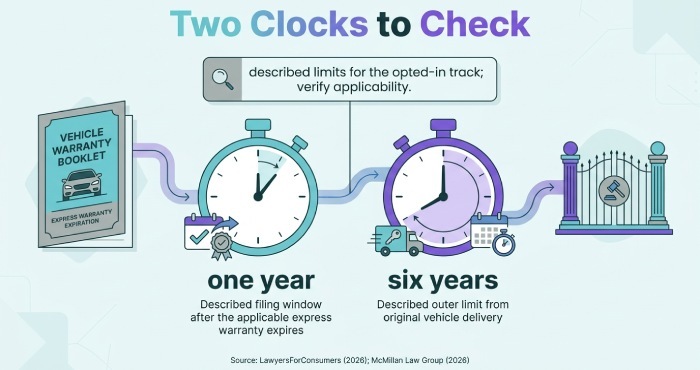
Source: LawyersForConsumers (2026); McMillan Law Group (2026)
Notice protects a different part of the case
Eligibility for restitution or replacement is separate from preserving a civil-penalty claim. Filing deadlines govern timely legal action. Notice requirements may affect an additional remedy, making their coordination essential.
For affected civil-penalty claims, McMillan Law Group’s June 2026 retrospective describes written notice at least 30 days before filing. This should not become a universal instruction for every owner. Manufacturer election status and the governing provisions must first be established.
Civil penalties are additional monetary relief, not another name for restitution. A September 2026 Consumer Protection Law Group briefing warns that defective notice can jeopardize penalties even when underlying relief remains available. Its described penalty of up to twice actual damages is conditional, not an automatic award or guaranteed settlement.
The supplied account of Ginsburg’s September 2026 guidance emphasizes accurate vehicle identification, a coherent repair history, and an explicit demand. A preparation checklist should include:
- The owner’s name.
- An accurate vehicle identification number, checked against records.
- A concise description of problems and repair attempts.
- A clear request for repurchase or replacement.
Delivery deserves the same scrutiny as content. Ginsburg’s account describes certified mail or specified email addresses, depending on manufacturer instructions. A lemon law attorney should confirm the legally authorized channel and designated recipient. An ordinary customer-service message should not be assumed to satisfy formal notice requirements.
Retain the exact notice, attachments, and evidence of sending and delivery. These records help establish what the manufacturer received and when. They also provide a reliable basis for later review of compliance.
A prompt offer should not automatically be treated as eliminating penalties. The supplied commentary links penalty exposure to post-notice conduct but does not establish every governing condition. Response, offer, and performance requirements need confirmation against primary law.
An acknowledgment, a proposed repurchase, and a completed resolution are different events. Their legal consequences require separate assessment. Notice can create an opportunity for pre-suit resolution, but neither compliance nor a timely response guarantees satisfactory relief.
Early mediation moves preparation to the front
Early mediation shifts preparation toward the beginning of a lawsuit rather than eliminating it. Its value depends on whether earlier negotiations support informed decisions, not simply faster settlements.
McMillan’s June 2026 retrospective describes early exchanges of repair orders, warranty documents, and pre-suit communications under AB 1755. According to that account, parties exchange these materials soon after filing without awaiting formal document requests.
The May 2026 procedural explainer describes mediation within approximately 150 days of the manufacturer’s responsive pleading. That means the manufacturer’s formal court response, not the consumer’s complaint or an earlier settlement letter.
The supplied summaries also describe a discovery stay—a pause in formal evidence-gathering during the early mediation process. Counsel should verify the timetable, scope, exceptions, and applicability against primary law before relying on these descriptions.
Preparation should produce organized evidence, not merely an accelerated settlement demand. A useful mediation file would include:
- Repair orders: Arrange visits by date, mileage, symptoms, work performed, and recorded results. Flag missing records and inconsistencies.
- Warranty documents: Include relevant terms and purchase or delivery records. Identify unresolved coverage questions.
- Communications: Preserve complaints, responses, and settlement exchanges with dates and attachments.
- Defect chronology: Explain when problems appeared, how repairs addressed them, and whether symptoms returned. Distinguish records from recollection.
This organization can clarify persistent problems and expose evidential gaps before negotiations. It also helps counsel explain which conclusions the record supports and which remain uncertain.
Ginsburg’s September 2026 commentary describes opportunities for repurchases or replacements without prolonged litigation. Where exchanged records adequately establish the dispute, earlier agreement could reduce delay and litigation burdens. Incomplete records create the opposite risk: negotiating before the claim can be assessed reliably.
Post-filing mediation does not remove cases from the filing count. It may shorten case duration or reduce the active docket, but neither effect reverses the filing event. Expectations about mediation could influence pre-suit decisions; the supplied evidence does not establish that effect. Mediation therefore requires evaluation through resolution quality and timing, not attribution of the filing decline itself.
Why settlement stories cannot answer the statewide question
Settlement stories cannot establish statewide consumer outcomes. The supplied sources provide no comprehensive outcome dataset or reliable California settlement average. The September 2026 Lemon Law Calculators discussion describes limits in public settlement reporting. It does not justify assuming that every agreement is confidential or that agencies collect no relevant information.
Practitioner estimates cannot close this gap without transparent methods and a defined sample. A September 2026 Consumer Protection Law Group press release offers settlement ranges while cautioning that results vary. Such estimates cannot establish typical recovery when the case mix and selection process remain unclear.
In a June 2026 press release, The Lemon Reps reported over $3.2 million recovered and more than 1,500 resolved cases during its first year. It also reported an average settlement time of approximately 90 days. These are self-reported firm results, not independently established statewide measures or a calendar-year 2026 sample.
Selection bias limits their interpretation. Accepted clients may differ from rejected applicants, unrepresented owners, and people who never seek help. The supplied account also does not establish a California-only sample suitable for evaluating the state’s reforms.
Missing definitions further restrict comparison. The evidence does not establish whether recovery totals and resolved-case counts cover identical groups or when settlement timing begins. Dividing the aggregate figures would not produce a defensible typical payout. Speed alone also says nothing about the adequacy of relief.
Outcome categories require care because remedies and resolution processes overlap:
- Refunds or repurchases describe monetary relief associated with returning a vehicle; reporting definitions may overlap.
- Replacements provide another vehicle rather than a monetary refund.
- Negotiated settlements may provide money, repurchase, replacement, or other terms.
- Arbitration outcomes describe a decision process that may award remedies resembling those above.
These categories should not become separate slices of a statewide total without rules preventing double counting. A negotiated repurchase could otherwise appear as both a settlement and a refund.
California’s arbitration certification system does not resolve the evidence gap. The 2026 certification-program discussion describes certification of manufacturer dispute-resolution programs, not a state board deciding disputes. The supplied material provides no comprehensive participation or success figures and does not establish that arbitration is universally required.
Selected recoveries show what particular firms report achieving. They do not count everyone who received relief, accepted less, withdrew, or remained without a remedy. Statewide evaluation requires comparable records covering those less visible outcomes.
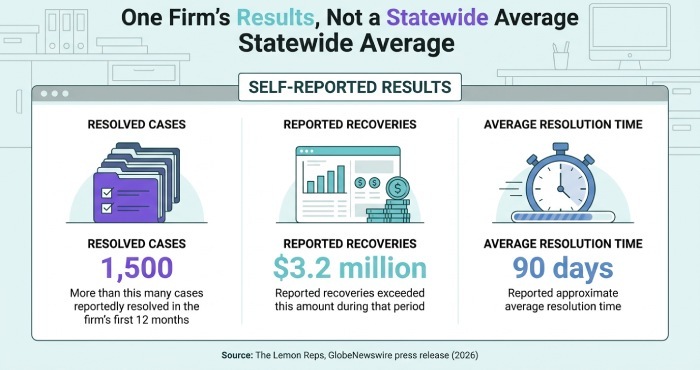
Source: The Lemon Reps, GlobeNewswire press release (2026)
A practical intake checklist for 2026 claims
For McMillan Law Group and similar practices, intake should separate procedural urgency from substantive claim strength. This checklist is a screening aid, not a definitive eligibility determination. An attorney should resolve uncertain coverage, election status, and deadlines before staff communicate legal conclusions.
- Verify the procedural track. Establish manufacturer election status and its applicable period before applying elected-track requirements. LemonLawPro’s June 2026 guide directs readers to the Department of Consumer Affairs’ roster. Record the supporting information and verification date.
- Assess coverage. Collect the purchase or lease agreement, warranty documents, vehicle-use information, and defect description. The July 2026 statutory overview provides context, but repair-count shortcuts should not replace claim-specific review.
- Establish delivery and warranty dates. Identify original delivery to the first owner, relevant coverage, and supported expiration facts. The May 2026 procedural overview connects the described elected-track limits to these dates.
- Escalate deadline assessment. Have counsel evaluate the described one-year post-warranty limit and six-year original-delivery cap where applicable. Verify transition rules and possible exceptions. Do not assume continuing repairs preserve time or automatically apply elected procedures to other manufacturers.
- Review civil-penalty notice separately. Check timing, recipient, delivery method, identifying information, repair history, and requested remedy. McMillan’s June 2026 retrospective describes at least 30 days’ advance notice for affected penalty claims. Counsel must coordinate notice with filing requirements.
- Build a usable record. Organize repair orders, mileage, diagnostics, days out of service, and manufacturer communications chronologically. Keep payment records and claimed expenses separately. Missing uploads should prompt follow-up, not establish that no claim exists.
- Evaluate remedies and client priorities. Consider restitution or replacement, supported expenses, and any available civil penalties. Explain that penalties are conditional. Assess proposed terms against the record and client’s circumstances, not an advertised settlement average.
The checklist should produce an attorney-reviewed calendar with factual support, unresolved assumptions, responsible staff, and reminders. A deadline-risk flag should trigger review even when other records remain incomplete.
Digital uploads can help organize documents and reveal omissions.
- These are proposed workflow benefits, not evidence of better settlements.
- Practices should also offer telephone assistance and help assembling paper records.
- Internet access, language barriers, work schedules, and missing service documents are plausible preparation obstacles; their effects are not measured here.
Fee discussions should distinguish statutory recovery from contractual obligations.
- The 2026 statute overview describes fee recovery for prevailing buyers, subject to statutory requirements and reasonable-fee assessment.
- That protection does not establish a firm’s fee agreement, upfront-payment policy, or client cost obligations.
Finally, record early resolutions separately from withdrawals, declined matters, and deadline-related losses.
- Document remedies, timing, unresolved problems, and reasons for closure.
- Such records would help practices investigate whether fewer filings reflect resolved disputes or owners leaving the process without relief.
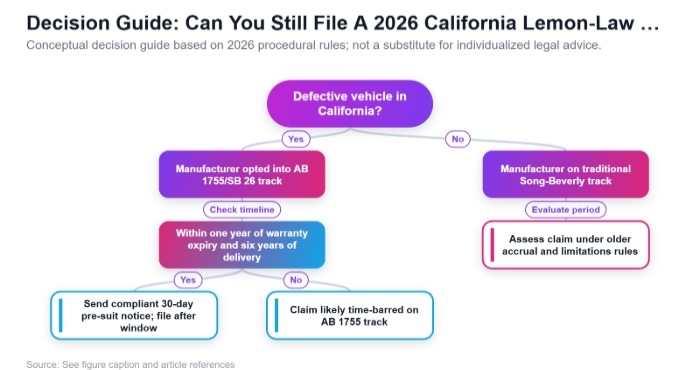
This decision tree offers a conceptual roadmap for consumers and practitioners assessing whether a California lemon-law case can still be filed in 2026, based on manufacturer opt-in status, warranty timelines, and compliance with pre-suit notice requirements.[1][2][17][19] Method: The tree structure is derived from statutory descriptions and practitioner analyses of AB 1755 and SB 26, particularly the dual-track system and one-year post-warranty filing window for opted-in manufacturers.[1][17][19] Nodes represent key yes/no or threshold decisions—such as whether the manufacturer has opted in and whether the claim falls within the one-year and six-year limits—rather than rendering a full legal opinion, and are intended as a practical checklist for initial case-intake screening.
Measure resolved problems, not just quieter courts
The reported 31% decline in early-2026 filings compared with the same period in 2025 does not establish improved consumer welfare. Ginsburg’s September 2026 account distinguishes lawsuit counts from outcomes. Successful early settlements and abandoned unresolved claims can both reduce filings; their relative contributions remain unknown.
Lower filing volume also does not establish that court congestion improved. That assessment requires workload and case-duration evidence, not merely counts of newly opened cases.
The immediate practical response is careful procedural screening. The May 2026 AB 1755 and SB 26 overview explains why manufacturer election status matters. Practices should establish the applicable track, verify deadlines, and organize supporting records early. Filing requirements and civil-penalty notice need separate assessment and coordinated planning; their interaction should not be reduced to unverified categorical advice.
Anonymized outcome tracking should be the next accountability measure. This is an editorial recommendation, not an existing statewide reporting system. Participating firms, manufacturers, and independent researchers could adopt consistent definitions for:
- Notices sent and their dates.
- Pre-suit remedies and completed resolutions.
- Filed cases and subsequent outcomes.
- Missed deadlines and documented reasons claims stopped.
- Time from initial complaint to resolution.
- Remedies requested, offered, and received.
Tracking must include unresolved and withdrawn matters, not only successful cases. Otherwise, it would reproduce the selection problem identified throughout this paper. A California Lemon Law lawyer can help evaluate these outcomes and identify potential procedural challenges.
Faster resolutions with appropriate relief would support an efficiency argument. Documented deadline losses and unresolved withdrawals would strengthen concerns about procedural attrition. Neither pattern alone would establish causation, but both would reveal more than filing totals.
The policy question remains: are owners obtaining appropriate relief more efficiently, or disappearing from the available statistics?
Limitations
- The supplied evidence consists of research summaries and source metadata. Underlying court datasets, statutory text, and official manufacturer election records were not available for verification.
- The reported 31% decline lacks underlying counts and exact comparison dates in the supplied evidence. It describes early 2026, not the completed calendar year.
- Historical California filing totals conflict. National federal product-liability data also cover a different population and cannot independently verify the California decline.
- Most procedural commentary comes from consumer-side firms. Promotional recovery announcements and statistical compilations cannot establish representative statewide outcomes.
- The evidence does not establish reform-driven causation, changing defect rates, or the balance between successful early resolution and procedural attrition.
References
- What Is SB 26 Lemon Law in California? How Does It Affect …
- California Lemon Law Lawsuits Dropped 31%. That Doesn’t Mean …
- California Lemon Law fueling surge in Los Angeles car warranty lawsuits
- Average Lemon Law Settlement in California (2026)
- California’s Lemon Law Crisis: Which Car Brands Are Selling You …
- Report: Vehicle Warranty Cases Drive Surge in Products …
- AB 1755 One Year Later: Did the Controversial Lemon Law Reform …
- Consumer Protection Law Group Advocates for Vehicle …
- The Lemon Reps Recover Over $3.2 Million for Lemon Law Victims in Their First 12 Months
- California Lemon Law After AB 1755 and SB 26
- California Lemon Law Statute | CA Consumer Protection Laws