
Executive takeaway
California’s reported lemon-law filings fell 31.3% in the first half of 2026. Los Angeles remained a major litigation hub, but the available data cannot establish whether most counties experienced similar declines. Statewide warranty counts, county product-liability totals, and federal vehicle cases measure different categories and periods. Procedural reforms and changes at high-volume firms could explain part of the slowdown, but their effects remain unproven.
Counsel should strengthen documentation, verify applicable procedures and deadlines, and track comparable local data. Fewer lawsuits alone do not demonstrate fewer defects, better settlements, or diminished consumer protection.
Filings fell. The geographic verdict is still open.
California’s reported lemon-law filings fell 31.3% in the first half of 2026, with 13,295 cases filed through June. The supplied evidence attributes these figures to a Bowman & Brooke review covered by the Los Angeles Times. The comparison covers the same six-month period in 2025. It establishes a substantial aggregate slowdown, but leaves its geographic reach unresolved.
The central question is whether filings declined across many counties or primarily within a few large venues. Los Angeles could account for much of the statewide change without other counties following the same trajectory. A statewide decline is not proof of a geographically widespread decline.
Los Angeles warrants attention because its substantial litigation volume could materially affect California’s total. Related reporting also describes cooling in its product-liability docket. That broader category provides context, but cannot substitute for county-level lemon-law counts.
Explaining the slowdown requires a separate inquiry. Procedural reforms and changes in law-firm practices offer plausible, potentially overlapping explanations. Aggregate filings cannot establish their relative importance or show whether consumers receive faster, better resolutions.
This analysis therefore separates three questions: how much filing volume changed, where it changed, and what happened to consumers. It uses reported counts, identifies calculations explicitly, and treats causal explanations as hypotheses. Because the supplied material summarizes sources rather than reproduces their underlying evidence, its findings remain qualified.
For practitioners and California lemon law lawyers, preparation is more defensible than geographic speculation. The reported slowdown provides no basis for treating another county as an escape route. Documentation, verified deadlines, and case-specific legal analysis remain the practical priorities.
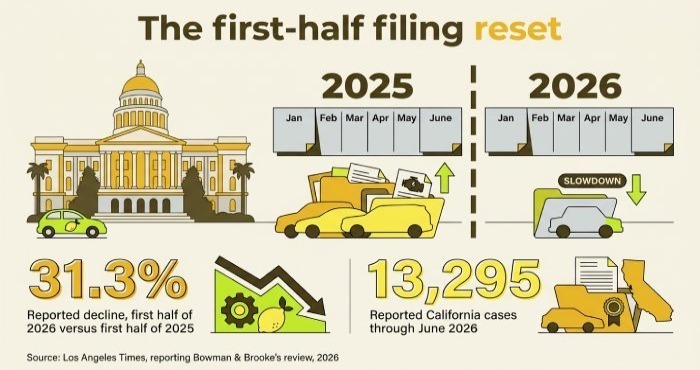
Source: Los Angeles Times, reporting Bowman & Brooke’s review, 2026
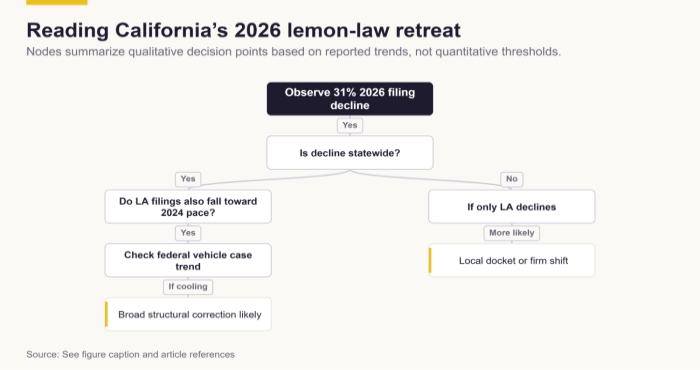
A decision guide for interpreting whether the 2026 decline in filings reflects a localized Los Angeles adjustment or a broader statewide structural shift. Method: Tree structure is based on logical branches drawn from statewide filing trends, Los Angeles County data, and federal vehicle case counts reported by Bowman & Brooke and Lex Machina.
Read the timeline before reading the trend
The reported decline compares six months with six months—not one full year with another. Annual totals establish the baseline; the first-half count measures a more recent change.
The supplied summary of the Los Angeles Times report gives 30,142 statewide filings in 2024 and 32,480 in 2025. Those full-year counts imply an increase of 2,338 cases, or approximately 7.8%, calculated from the reported figures. Thus, the latest completed-year comparison shows growth.
The reversal appears in Bowman & Brooke’s review through June 30, 2026. It reportedly counted 13,295 filings, 31.3% fewer than during the first half of 2025. That percentage does not compare the partial-year count with all 32,480 filings recorded in 2025.
Annualizing the first-half count answers a different question. Doubling 13,295 produces 26,590 projected filings for 2026, consistent with the reported projection of just over 26,500. Against the 2025 total, this implies an 18.1% annual decline, calculated from the supplied counts. It is a projection, not an observed annual result.
The two decline rates are not contradictory; they use different comparison periods. Annualization assumes the second half matches the first half’s filing volume. The evidence supplies neither a seasonal adjustment nor grounds for treating that assumption as a forecast.
Historical comparisons describe the earlier expansion, not a complete annual series. The supplied evidence attributes roughly 4,500 filings in 2015, 14,892 in 2022, and 22,655 in 2023 to the Advocate historical review. These selected observations provide context for the 2024–2026 figures. Missing years leave intervening fluctuations unknown.
The timeline figure should distinguish the evidence types rather than imply continuous measurement:
- Reported annual counts: Available historical observations and the 2024–2025 totals.
- Actual partial-year count: 13,295 filings through June 2026.
- Projected annual count: 26,590, explicitly labeled as twice the first-half count.
- Missing observations: Visible gaps, including 2020, rather than zeros or interpolated estimates.
The defensible conclusion is specific: reported filings rose in 2025, then fell sharply during the first half of 2026. Whether that slowdown persists throughout the year remains unresolved.
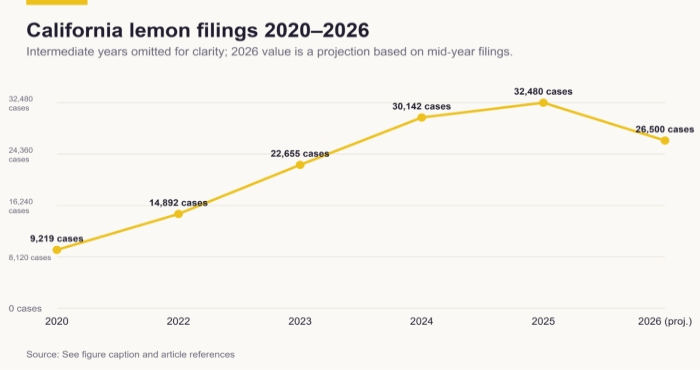
A time series of statewide lemon‑law filings from 2020 through projected 2026, illustrating the surge and subsequent retreat. Method: 2020, 2024, 2025, and projected 2026 counts come from Bowman & Brooke’s statewide analysis; 2022 and 2023 counts draw on Advocate Magazine and AB 1755 legislative data.
Why Los Angeles became the pressure point
Los Angeles’s large docket makes it consequential to California’s filing story, but potentially unrepresentative of other venues. Its prominence must be assessed without confusing different measures of litigation activity.
As a historical comparison, reported product-liability filings rose from 479 in 2021 to 11,822 in 2025. The supplied summary of Legal Newsline’s account of Lex Machina data attributes much of that growth to vehicle-warranty claims. These figures establish a large expansion in a broader case category—not a clean lemon-law series.
A separate historical estimate conveys warranty disputes’ prominence within the local civil docket. The supplied evidence attributes an estimate of nearly 10% of Los Angeles civil filings to the February 2025 Advocate practitioner review. This approximate estimate is not a current measurement or an independently verified court census.
The measures answer different questions. One describes growth in product-liability filings; the other estimates warranty disputes’ share of civil litigation. Neither establishes Los Angeles’s precise share of California lemon-law cases.
The disputes’ substance also matters. The supplied reporting describes vehicle-warranty claims as overwhelmingly involving economic loss rather than bodily injury. A vehicle can fail to meet its warranty without causing an accident or physical harm. That distinction separates many warranty disputes from injury-centered product-liability cases.
Repurchase and replacement address qualifying warranty failures. Broadly, these remedies involve buying back the vehicle or providing another vehicle under applicable legal requirements. The supplied evidence associates the Consumer Attorneys of California overview with these protections after a reasonable number of unsuccessful repair attempts. Eligibility still depends on the governing law and individual facts.
Economic-loss claims are not necessarily administratively simple. Courts may need to resolve contested repair histories, warranty obligations, and remedies. Repeated legal issues can coexist with meaningful differences between consumers’ cases.
High volume creates potential congestion alongside opportunities for specialization. The supplied summary of CalMatters’ legislative reporting describes negotiations involving judges, consumer attorneys, and automakers to accelerate resolutions and ease court pressure. That history supports concern about capacity, but does not measure how much filing volume contributed to delays.
Repeated exposure could help lawyers and judges handle recurring warranty issues more efficiently. This is a plausible benefit of specialization, not evidence that Los Angeles cases resolve faster or better. The county’s workload makes it influential; neither workload nor expertise makes it representative.
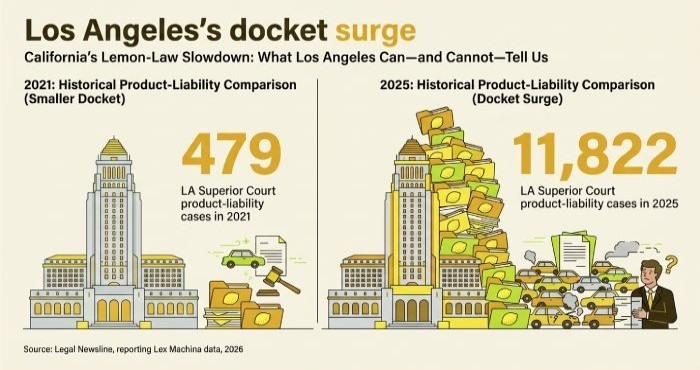
Source: Legal Newsline, reporting Lex Machina data, 2026
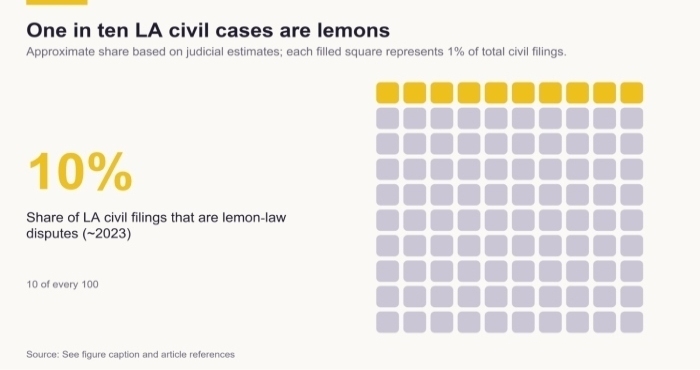
A 10×10 grid representing the approximate share of Los Angeles Superior Court civil filings that are lemon‑law disputes. Method: The California Judges Association’s estimate, cited in Advocate Magazine and practitioner commentary, is translated into a percentage and shown as filled squares in a waffle diagram.
A statewide total cannot answer a county-level question
The geographic question requires matched county counts, not another statewide headline. California’s aggregate decline is compatible with both a concentrated Los Angeles reduction and decreases across many counties.
The statewide finding comes from Bowman & Brooke’s reported comparison of first-half warranty filings. Describing that finding as statewide—including in the California Courts Newsroom listing—identifies the population counted. It does not establish how many counties declined. A publisher’s institutional standing cannot supply a missing geographic breakdown.
The Los Angeles evidence is less precise and uses a different classification. The supplied reporting describes its product-liability docket as returning toward 2024 levels in early 2026. It supplies neither matched first-half counts nor a county decline rate.
The comparison figure should preserve these distinctions:
- California warranty filings, January–June 2026: 13,295 cases; reported decline of 31.3% against January–June 2025.
- California warranty filings, full-year 2025: 32,480 cases, compared with 30,142 in full-year 2024.
- Los Angeles Superior Court product-liability filings, full-year 2025: 11,822 cases.
- Los Angeles Superior Court product-liability filings, early 2026: Qualitatively described as closer to 2024 levels; no comparable first-half count supplied.
The reported overlap between warranty litigation and Los Angeles product-liability filings makes concentration plausible. Legal Newsline’s summarized account attributes much of the county’s earlier growth to warranty claims. But overlap does not make the categories interchangeable.
Dividing the county’s product-liability count by California’s warranty total would produce a misleading geographic share. Comparing its full-year count with statewide first-half filings would add a period mismatch. Neither calculation measures Los Angeles’s contribution to the decline.
A defensible geographic test requires four elements:
- Comparable periods: January–June warranty counts for both 2025 and 2026, separately identifying each county.
- Consistent definitions: Common rules for identifying warranty claims, without substituting broader product-liability totals.
- Documented coverage: Included courts and case types, coverage changes, and duplicate-handling rules.
- County contributions: Absolute changes alongside percentage changes, showing each county’s contribution to the statewide decrease.
With those data, analysts could compare statewide totals excluding Los Angeles. Even a decline in that remainder would not prove that most counties declined; another large venue could dominate it. The analysis must distinguish the size of the aggregate reduction from its geographic distribution.
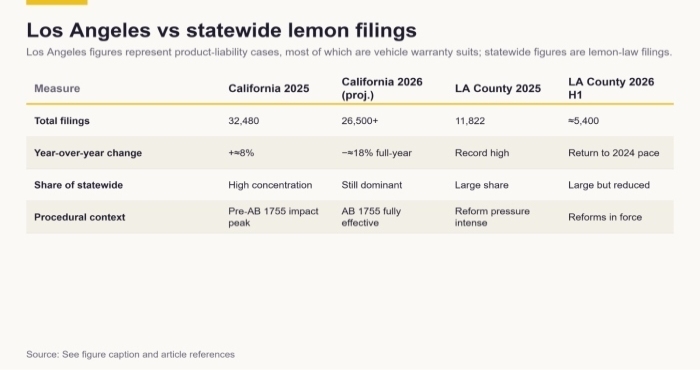
A side‑by‑side view of statewide and Los Angeles County filings at the 2025 peak and in early 2026, highlighting relative changes. Method: Statewide counts use Bowman & Brooke data; Los Angeles product‑liability figures rely on Lex Machina’s county breakdown, as reported by the Los Angeles Times and Legal Newsline.
Federal courts add context, not independent proof
Federal filings broaden the context, but national cooling does not independently prove widespread geographic decline. California’s substantial historical share means its own changes could materially influence national totals.
Multidistrict litigation, or MDL, coordinates federal cases sharing factual questions for pretrial proceedings. Non-MDL counts separate cases outside those centralized proceedings. They do not isolate lemon-law claims or eliminate geographic concentration.
The supplied summary of Legal Newsline’s Lex Machina coverage reports 5,692 federal non-MDL product-liability filings in 2025. Vehicle cases accounted for 3,281, more than half of the total. These are national, full-year figures—not California counts or a direct census of warranty disputes.
The Central District of California stands out within this landscape. The same supplied account reports 3,004 non-MDL product-liability cases across 2023–2025, more than three times any other federal district’s volume. This is a three-year cumulative count, not a 2025 annual figure or a vehicle-only total.
The district also differs geographically and institutionally from Los Angeles County Superior Court. Their respective prominence does not establish that their filings moved together in 2026. Neither reporting unit can substitute for the other.
The supplied summary of the Los Angeles Times coverage gives approximately 1,100 non-MDL vehicle-related product-liability filings in the first half of 2026. This national observation suggests a slower pace than 2025, but is not a completed annual result. A stronger comparison would use equivalent half-year periods and consistent reporting cutoffs.
California’s historical weight limits the geographic inference. For the historical period 2016–2025, the supplied Legal Newsline summary reports more vehicle-warranty cases in California’s federal districts than all other districts combined. A California slowdown could therefore reduce national totals without comparable decreases elsewhere.
The missing evidence is a matched district breakdown, particularly for the Central District and courts outside California. Without it, the national figures establish neither a measured Central District decline nor cooling beyond California. They provide context, not a basis for selecting another venue or declaring a geographically broad correction.
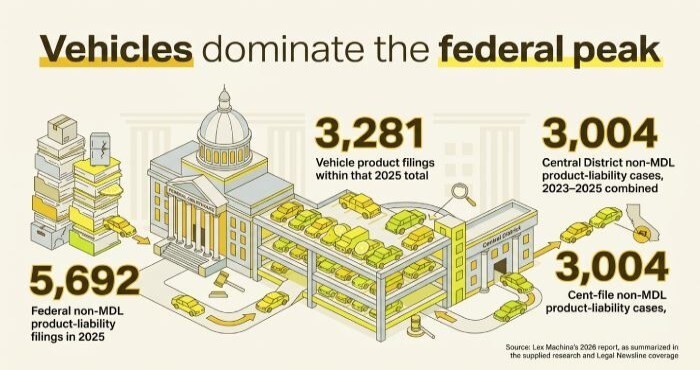
Source: Lex Machina’s 2026 report, as summarized in the supplied research and Legal Newsline coverage
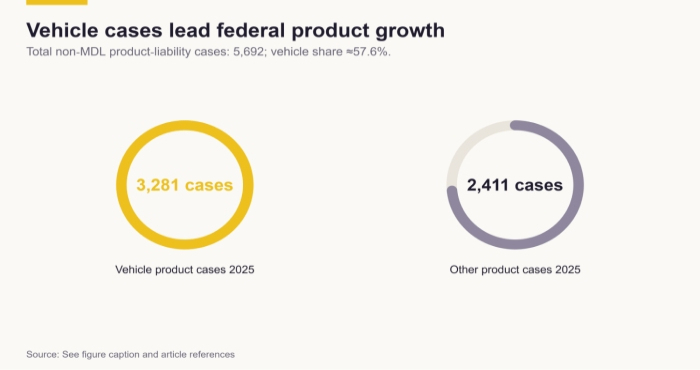
Shares of non‑MDL federal product‑liability filings in 2025, showing vehicle product cases versus all other product categories. Method: Total and vehicle case counts for 2025 are taken from Lex Machina’s 2026 Product Liability Litigation Report; percentages are calculated by dividing vehicle cases by total non‑MDL product‑liability filings.
What procedural reform might explain
Procedural reform is a plausible explanation for fewer filings, not a demonstrated cause. The supplied summary of CalMatters’ legislative reporting links AB 1755 to negotiations over court congestion and the handling of vehicle-warranty disputes. Those objectives concern dispute processing, not necessarily defect prevalence or consumer recovery.
The evidence describes four areas of procedural change associated with AB 1755 and subsequent legislation. Their possible effects should remain separate from claims about their precise legal reach:
- Notice: Formal notification could allow manufacturers to address claims before litigation. Whether it reduces disputes depends on the response, not merely the notice requirement.
- Records exchange: Earlier information sharing could clarify repair histories and warranty obligations. It does not itself establish entitlement to relief.
- Mediation: A neutral facilitator can help parties negotiate. Mediation neither guarantees settlement nor necessarily occurs before filing.
- Filing windows: Changed deadlines can affect when consumers and counsel must evaluate claims. Applicability depends on governing provisions, relevant dates, and exceptions.
The supplied material does not resolve manufacturer participation or statutory scope. Some passages describe subsequent legislation, identified as SB 26, as allowing manufacturers to opt out of certain procedures. Others describe mandatory mediation within opted-in programs. These formulations do not support reliable case-specific guidance.
The evidence also inconsistently treats filing limits as universal while describing other procedures as participation-dependent. McMillan Law Group’s reform commentary appears among the cited materials, but its underlying text is unavailable here. The claimed one-year post-warranty limit and six-year delivery cap therefore should not be presented as universal deadlines. Their scope, exceptions, and interaction with participation require authoritative legal verification.
Even with those uncertainties, the proposed mechanisms can be tested. Earlier information exchange might support settlement before substantial litigation costs arise. Additional procedural requirements might instead delay viable claims without resolving them.
Three timing explanations deserve separate investigation:
- Accelerated filings before changes: Counsel might file anticipated cases earlier. Testing this requires monthly counts around verified transition dates.
- Delayed filings afterward: Records collection, notice, or applicability review might lengthen preparation. Testing this requires tracking claims from intake through filing.
- More pre-suit resolutions: Disputes might settle without litigation. Testing this requires settlement or repurchase data and elapsed time to relief.
The filing totals distinguish none of these possibilities. Nor do they separate reform effects from changing law-firm practices. A statewide legal framework could also have uneven effects because participation, case composition, and firm responses may vary. Reform remains a hypothesis about the path into litigation, not a proven explanation for the slowdown.
A few firms can change the filing picture
Concentrated filing activity means a few firms can materially affect statewide totals. Those totals reflect both underlying disputes and decisions about which disputes reach court—and when.
The clearest reported example concerns one high-volume firm. The supplied evidence attributes 6,433 statewide warranty filings in 2025, compared with 108 in the first half of 2026, to Headtopics’ summary of Bowman & Brooke’s review. The contrast warrants attention, but its unequal reporting periods limit interpretation.
Twelve months versus six months is not a matched-period comparison. Measuring this firm’s contribution to the statewide first-half decline requires its first-half 2025 count. The evidence does not supply that baseline. Subtracting 108 from 6,433 would therefore answer the wrong question, while doubling 108 would yield only a projection.
Nevertheless, the example identifies a plausible aggregate mechanism. A substantial filer could sharply reduce new lawsuits while many other firms remain steady. Consumer demand for legal help need not decline proportionately.
Several explanations are possible, but none is a verified motive for this firm:
- Reduced participation: Accepting fewer matters or reducing its lemon-law practice.
- Strategic change: Altering case selection, preparation, or filing timing.
- Pre-suit resolution: Settling more disputes before filing complaints.
These explanations carry different implications for consumers. Earlier settlements could deliver relief without litigation; reduced representation could leave some disputes unfiled. Filing counts cannot distinguish those outcomes.
Firm strategy and procedural reform are also potentially connected explanations. A firm might change practices in response to new procedures, independently of them, or for several reasons. Establishing that relationship requires evidence about decisions and outcomes, not timing alone.
The geographic inference is equally limited. The evidence does not quantify this firm’s county distribution or Los Angeles share. Its reported statewide reduction therefore cannot establish where the slowdown occurred. Matched-period firm data would help explain aggregate movements, but county-level data would still be necessary.
What California counsel should do with this evidence
The practical response is earlier preparation, not a prediction about which venue will slow next. A lemon law attorney can help evaluate the available documentation, identify missing records, and determine which procedural requirements apply to an individual claim.
Build the factual record at intake. Collect essential documents, identify gaps, and assign responsibility for obtaining missing records:
- Repair records: Work orders, invoices, recorded complaints, mileage readings, and service-entry and exit dates.
- Warranty documents: Applicable terms, amendments, and descriptions of coverage.
- Delivery records: Purchase or lease documents and evidence of when the consumer received the vehicle.
- Communications: Emails, messages, letters, and notes of dealer or manufacturer conversations.
- A dated chronology: Reported problems, repair visits, responses, and unresolved issues.
Distinguish documented events from client recollections. Investigate inconsistencies rather than silently reconcile them, especially when dates could affect advice.
Verify governing rules before recommending action. The supplied summary of CalMatters’ reporting describes a contested legislative framework. That context supports checking authoritative law rather than relying on commentary alone.
For each matter, confirm the applicable regime, relevant manufacturer participation, notice requirements, and filing deadlines. Identify triggering dates and other procedural obligations. Calendar verified requirements separately, and do not assume negotiations suspend a deadline.
Evaluate early negotiation without assuming better recovery. A well-supported claim presentation may clarify disputed facts before litigation. But the evidence does not establish improved settlement rates, faster relief, or higher recoveries. Assess negotiation alongside deadlines, unresolved questions, and the client’s objectives; do not substitute it for preserving the claim.
Keep venue analysis separate from aggregate headlines. Evaluate legally available venues through the claim’s facts, applicable rules, and verified local information. Moving away from Los Angeles solely because statewide filings fell would replace case-specific analysis with an unsupported inference.
Track the firm’s pipeline in separate stages. Lawsuits alone cannot distinguish reduced demand from delayed filing, changed screening, or pre-suit resolution. An internal dashboard should record:
- Intake: New inquiries, accepted matters, and reasons for declining representation.
- Filed claims: Filing dates, venues, and corresponding intake periods.
- Pre-suit resolutions: Resolved matters, separately from withdrawals and declined cases.
- Elapsed time: Intake to records completion, notice, filing, or resolution, as applicable.
Compare matters entering during equivalent periods and keep unresolved cases visible. Recent matters have had less time to progress; ignoring that difference can distort apparent filing and resolution rates.
For consumers, the practical recommendation is to seek prompt advice and preserve documentation. A falling caseload is neither a reason to delay nor a promise of an easier claim. Eligibility, remedies, and likely outcomes require individual assessment.
The next test is outcomes, not just fewer cases
California’s reported aggregate retreat is substantial, but its geographic reach and causes remain unresolved. The first-half figures measure fewer filings—not the number of counties declining or the quality of consumer outcomes.
The next assessment should connect court activity with relief. Five complementary measures would help distinguish greater efficiency from delayed or discouraged claims:
- Matched county counts: Compare identical filing categories and periods in 2025 and 2026. Report each county’s percentage change and contribution to the decline, including totals excluding Los Angeles.
- Consistent federal categories: Track comparable vehicle-warranty cases across districts and periods. Separate broader product-liability categories and distinguish original federal filings from removals from state court.
- Pre-suit outcomes: Count notices, manufacturer responses, settlements, and disputes ending without suit. Separate resolved complaints from abandoned or pending claims where possible.
- Time to relief: Measure from the consumer’s initial complaint, not merely the filing date. Otherwise, longer pre-suit delays could make court proceedings appear faster without improving the consumer’s experience.
- Consumer recoveries: Track repurchases, replacements, and monetary payments, including amounts retained after applicable deductions and costs. Report typical outcomes and their distribution rather than exceptional awards.
Falling filings alongside faster relief and comparable recoveries would support an efficiency interpretation. Falling filings alongside longer waits or more unresolved complaints would raise access concerns. Neither pattern alone would establish causation; differences in case characteristics and reporting coverage would still require examination.
Los Angeles is influential, but its representativeness remains unproven. Its substantial docket makes local changes consequential to the statewide picture. Understanding that picture requires comparable county data; judging reform requires consumer outcomes. A quieter docket alone answers neither question.
Limitations
- The supplied evidence summarizes reporting and commentary; underlying datasets, source articles, and statutory text were not available for independent inspection. Several raw citations mismatch their described sources.
- Statewide lemon-law counts, Los Angeles product-liability totals, and federal vehicle cases are not interchangeable. Multiple reports also draw on the same underlying datasets rather than provide independent confirmation.
- First-half figures cannot establish full-year outcomes. Missing matched county counts prevent a reliable Los Angeles-versus-rest-of-state comparison.
- The evidence provides no direct measurements of defect prevalence, pre-suit settlements, or reforms’ causal effects. Conflicting descriptions of procedural applicability also preclude case-specific legal guidance.
References
- California ‘Lemon Law’ Filings Fall Sharply After Record Year
- California Lemon Law Filings Plunge in 2026 as Reforms Spur Early Dispute Resolution
- California lemon law filings fall sharply after record year
- CA Lemon Law fueling surge in L.A. car warranty lawsuits
- AB 1755 One Year Later: Did the Controversial Lemon Law Reform …
- When life gives you lemon…law reform – Advocate Magazine
- California lawmakers scramble to fix ‘lemon’ vehicle law
- Lemon Law