
Executive takeaway
California’s lemon-law changes make timing and warranty history central to evaluating a claim. Used-car buyers cannot assume remaining manufacturer coverage includes statutory refund-or-replace rights. Counsel must identify the governing procedures before calculating deadlines or advising on notice. Reported filings declined in early 2026, but that does not establish fewer defects or better consumer outcomes. The practical priority is early document review: establish warranty issuance, delivery dates, repair history, and available remedies. The supplied secondary summaries require primary-source confirmation before anyone relies on their legal details.
Why California Changed the Rules
Who can obtain a refund or replacement when serious vehicle defects persist despite repeated repairs? California’s changing lemon-law landscape makes the answer depend on more than repair history.
Two developments shape that answer: procedural reform and a court ruling narrowing used-vehicle eligibility. The first changes how covered claims proceed. The second determines whether certain buyers qualify for statutory refund-or-replace relief at all.
The supplied account of the Los Angeles Times legal overview describes tighter deadlines and structured dispute-resolution procedures. These measures seek earlier resolution and reduced court pressure, with applicability depending partly on manufacturer participation.
The used-vehicle ruling addresses a separate boundary: remaining manufacturer coverage does not automatically establish statutory buyback eligibility. A right to warranty repairs is not necessarily a right to repurchase or replacement. Eligibility and procedure therefore require separate analysis.
Rising litigation provides context for the reform effort. As a historical comparison preceding the reported 2026 decline, filings reached 14,892 in 2022 and 22,655 in 2023. The supplied research attributes these figures to Advocate’s reform analysis.
The reported total reached 30,190 in 2024, extending that increase. The National Law Review press release is among the supplied sources reporting this growth. A press release, however, is not an independent evaluation of its causes.
These counts indicate an expanding litigation workload, not an increase in vehicle defect rates. Filing decisions can also reflect settlement practices, legal strategies, and consumers’ ability to pursue claims.
The reform’s objectives need equally careful separation: quicker resolution, manageable dockets, and meaningful consumer remedies. Earlier settlements could advance all three if eligible buyers receive appropriate relief without prolonged litigation. Smaller dockets alone cannot establish that outcome.
This paper therefore examines two questions: how eligibility and procedures affect access, and what filing trends reveal about results. Its legal account relies on supplied secondary summaries, not direct inspection of statutes or the court opinion. Those limits matter most when translating general descriptions into advice about an individual claim.
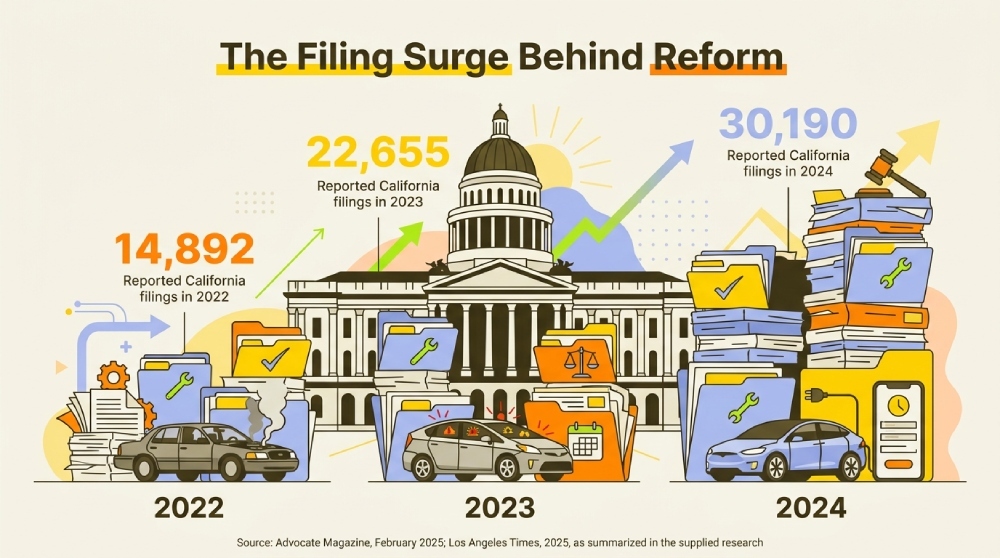
Source: Advocate Magazine, February 2025; Los Angeles Times, 2025, as summarized in the supplied research
What Lemon Relief Actually Requires
A repair warranty and a statutory buyback right are different protections. California’s Song-Beverly framework requires more than an unreliable vehicle or repeated repair visits. Eligibility also depends on the vehicle’s statutory category, warranty arrangements, and governing procedures.
The consumer-law overview summarized in the evidence identifies substantial impairment of the vehicle’s use, safety, or value as a central requirement. The problem must materially affect those interests, not merely disappoint the owner. The manufacturer must also receive a reasonable opportunity to repair the covered defect.
Repair history helps establish that opportunity, but visit counts alone do not establish entitlement. The inquiry concerns the covered problem, its seriousness, and the efforts made to resolve it.
Repair presumptions should not become automatic qualification rules. The supplied summaries mention repeated attempts and 30 cumulative repair days, but omit the full statutory conditions. Those references cannot support a universal checklist. Neither downtime nor a repair count substitutes for examining warranty coverage, substantial impairment, and statutory eligibility.
The eligibility figure should therefore present distinct legal questions rather than calculate entitlement from repair visits:
- Warranty and vehicle category: Was a qualifying manufacturer’s new-car warranty issued with the transaction, or did existing coverage merely carry over?
- Applicable procedures: Which deadlines, notice requirements, and transition provisions govern the claim?
- Defect and repair opportunity: Does the covered problem substantially impair use, safety, or value? What opportunity did the manufacturer receive to repair it?
- Available remedy: Does the evidence support statutory repurchase or replacement, repair rights, or another potential claim?
Fee shifting can improve access to counsel, but it does not guarantee free representation in every dispute. The supplied research describes reasonable attorney-fee recovery for prevailing consumers. Entitlement and the representation agreement still require review; consumers should clarify responsibility for fees and costs before proceeding.
Historical shorthand also needs caution. The evidence does not justify saying every used vehicle with remaining coverage previously qualified. Nor does it establish a universal former deadline of four years after warranty expiration. That comparison requires analysis of when a claim legally accrued, not simply when coverage ended.
These distinctions provide the foundation for the procedural inquiry: first identify the remedy being pursued, then determine the rules governing it.
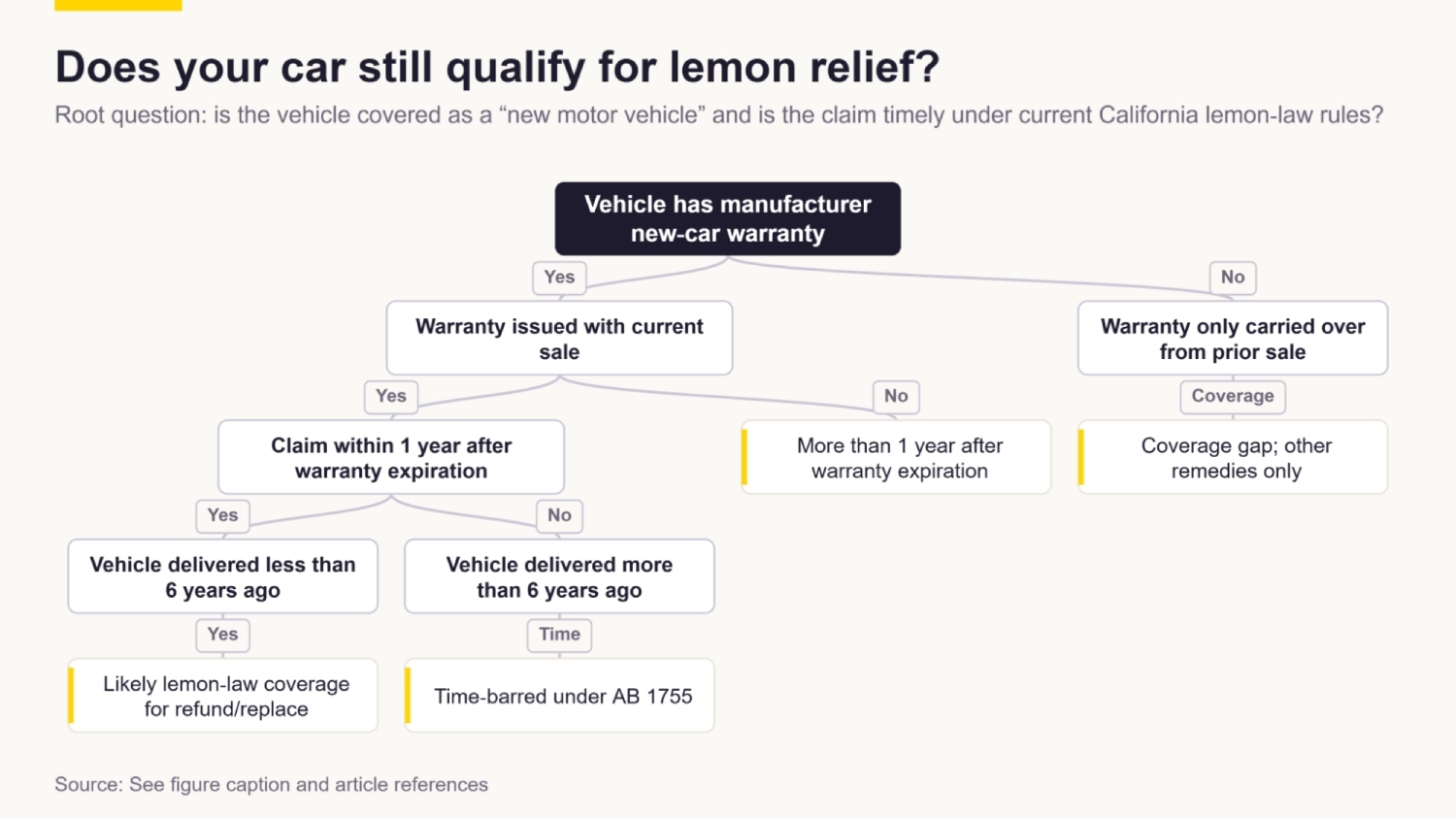
Decision guide for California consumers assessing whether their vehicle likely falls within lemon‑law coverage after Rodriguez and AB 1755. Method: Tree nodes represent key eligibility questions derived from statutory summaries and the Rodriguez ruling: whether the vehicle is new or used, whether a manufacturer warranty was issued with the sale, and whether the claim is within the one‑year post‑warranty and six‑year from delivery limits.[10][12][18][20] This is an interpretive tool, not legal advice.
Check the Applicable Rules Before Starting the Clock
Identify the applicable rules before calculating a deadline. The supplied summaries describe AB 1755 and SB 26 as creating procedures whose application depends partly on manufacturer election. Warranty documents, delivery records, and relevant dates therefore belong at the start of intake.
- Confirm manufacturer participation and claim coverage. The Los Angeles Times legal overview, as summarized in the evidence, discusses AB 1755’s changes and SB 26’s election framework. Consumers should not assume every automaker or every claim follows identical procedures.
Counsel should verify the manufacturer’s election, effective dates, and transition provisions for the particular dispute. Review the purchase or lease agreement, warranty, original delivery record, and repair history together. A brand name or current participation status cannot resolve every applicability question.
- Calculate filing limits only after checking scope and exceptions. The research describes one year after the applicable express warranty expires, alongside a six-year limit from original delivery. Consumer-side practitioner commentary characterizes these changes as significant restrictions on relief.
These descriptions are starting points for statutory analysis, not universal deadline formulas. The supplied materials do not establish every exception, controlling warranty, or circumstance that might pause a deadline. They also do not establish how every claim or remedy falls within the revised framework.
For a resold vehicle, distinguish the buyer’s purchase date from original delivery. Record both reported limits provisionally, then obtain a claim-specific calculation. Do not assume the later date controls or that continuing warranty coverage preserves the opportunity to sue.
- Separate notice from filing deadlines. The research reports written notice requesting repurchase or replacement at least 30 days before suit. However, its citations for some procedural details are mismatched. The evidence does not reliably establish whether each requirement conditions filing, civil penalties, or another remedy.
Keep the reported milestones distinct pending statutory confirmation:
- Notice: Written notice at least 30 days before suit.
- Response: A reported 30-day period for the manufacturer to offer restitution or replacement.
- Completion: A reported 60-day period to complete the remedy.
- Litigation: Separate filing limits and subsequent case-management requirements.
Do not combine these intervals into a presumed 90-day waiting period. The supplied summaries do not establish every triggering event, whether periods overlap, or all consequences of noncompliance. Missing notice should not be described as eliminating the entire claim—or merely reducing penalties—without checking the governing provision.
- Identify the litigation timetable separately. The supplied account of Advocate’s reform analysis describes early record exchange, limited initial depositions, and mandatory mediation. Mediation helps parties negotiate rather than adjudicating the dispute. These measures seek resolution before extensive discovery, the formal process of obtaining evidence.
Their existence does not establish that settlement will occur or that any agreement will provide adequate relief. The practical intake product should be a claim-specific calendar identifying confirmed deadlines, notice obligations, response milestones, and litigation steps.
A Used-Car Warranty Is Not a Guaranteed Buyback Right
A valid used-car warranty does not automatically create a statutory buyback right. The central distinction concerns the warranty’s repair promise and the remedies available under California law.
The supplied summaries describe the California Supreme Court’s 2024 decision in Rodriguez v. FCA US, LLC as addressing residual manufacturer coverage. According to the account of Pasadena Now’s explainer, that coverage alone does not satisfy the relevant statutory definition of a new motor vehicle. The consequence concerns the core refund-or-replace remedy, not the automatic cancellation of repair coverage.
The reported dividing line is whether a qualifying manufacturer’s new-car warranty was issued with the sale, rather than carried over. That makes the transaction documents central to determining available remedies. An active warranty alone does not resolve the issue, so consulting an experienced rv lemon law attorney can help clarify the applicable protections and potential legal options.
This account rests on secondary reporting and practitioner commentary, not direct analysis of the opinion. Lemon Law Experts’ discussion characterizes the decision as a substantial restriction on used-car claims. Broad statements that used cars have lost all protection, however, exceed the narrower distinction supported by the supplied research.
Transaction categories illustrate the questions requiring review:
- New purchases and leases: Manufacturer-warranted new vehicles remain the clearest category described in the summaries. Other eligibility requirements still apply.
- Demonstrator vehicles: The research identifies these as potentially covered despite prior use. Their treatment requires review of statutory status, not ordinary sales labels.
- Certified pre-owned purchases: Certification prompts closer examination, not an automatic eligibility finding. Determine what qualifying manufacturer warranty, if any, accompanied the sale.
- Residual-warranty resales: Under the secondary accounts of Rodriguez, an unused portion of an earlier warranty alone is insufficient for the core remedy.
The evidence does not establish that every certified pre-owned or extended-warranty arrangement qualifies. Nor does purchase from a franchise dealer settle the issue. Identify who made the warranty promise, what it covers, and whether it meets the relevant statutory definition.
A separate service contract also should not be treated as a manufacturer’s new-car warranty without legal analysis. Contractual repair benefits and statutory repurchase obligations address different questions.
The purchase agreement, warranty booklet, certification paperwork, and delivery history establish what accompanied the sale. Repair records then address what failed and how the responsible parties responded. Strong evidence of repeated breakdowns cannot, by itself, resolve an exclusion based on vehicle status.
A buyer outside the refund-or-replace category may still have repair rights or other potential remedies. Warranty, contract, or fraud claims require separate assessment of the documents, conduct, and governing law. The correct inquiry is therefore not simply whether protection exists, but which protection supports which remedy.
Fewer Lawsuits Do Not Explain What Happened to Drivers
California’s reported lemon-law filings fell sharply in early 2026, but that decline does not explain drivers’ outcomes. The supplied account of the Los Angeles Times filing report gives roughly 32,480 cases in 2025 and 13,295 through June 2026. These figures measure lawsuits entering court, not satisfactory consumer resolutions.
The reported 31.3 percent decline compares the first half of 2026 with the first half of 2025. Comparing six months with the full 2025 total would exaggerate the contraction. Any filing-trend figures should clearly distinguish the relevant reporting periods rather than treating them as equivalent annual observations, and consulting a lemon law attorney in San Diego can help vehicle owners understand how these trends may affect their legal rights.
An earlier projection also requires separate treatment. The August 2025 coverage reportedly cited a forecast exceeding 38,000 filings for 2025. The later figure of roughly 32,480 describes the completed year. The forecast was not an observed total.
Several explanations could account for the decline, with different implications for consumers. Ginsburg Law Group’s commentary discusses earlier settlements and changing strategies among high-volume plaintiffs’ firms. It also raises concerns about missed deadlines and abandoned disputes.
These are possible mechanisms, not measured shares of the decline:
- Earlier settlements could reduce filings while delivering adequate relief promptly.
- Changed firm strategies could alter case totals without changing underlying disputes.
- Missed deadlines could prevent litigation while vehicle problems remain unresolved.
- Abandoned disputes could remove claims from view without satisfactory resolution.
Practitioner commentary identifies these possibilities but cannot establish their frequency. The supplied evidence does not track a representative group from initial complaint through final outcome. It therefore cannot distinguish successful early resolutions from disputes consumers stopped pursuing.
The research also reports that settlement terms are often confidential, limiting assessment of compensation. Confidentiality does not prove inadequacy. It constrains evaluation in both directions: an agreement may deliver meaningful relief or involve substantial compromise.
Finally, the timing of the decline does not establish that reforms caused it. These counts cannot show whether vehicle quality improved, deteriorated, or remained unchanged.
Fewer lawsuits demonstrate a change in court activity, not necessarily a change in consumer protection.
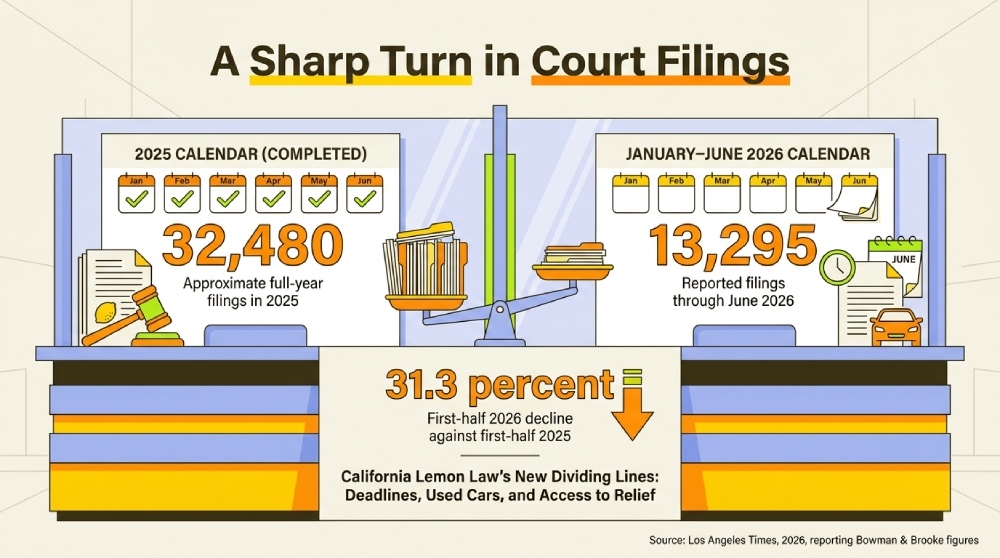
Source: Los Angeles Times, 2026, reporting Bowman & Brooke figures
Who Faces the Greatest Risk of Losing Relief?
Drivers face three distinct barriers: timing, statutory eligibility, and access to advice. Each requires a different response. Acting promptly cannot create an excluded remedy, while a potentially eligible claim can still face procedural obstacles.
Timing risks concern owners still pursuing repairs near a deadline. Repeated visits may keep attention on fixing the vehicle rather than checking legal requirements. Consumer-side commentary identifies delayed action as a concern, but the supplied evidence does not quantify resulting claim losses.
Where revised limits apply, continuing repair coverage may not preserve the same opportunity to sue. Owners need an assessment of governing procedures and dates, not simply another count of failed repairs. The risk is assuming that ongoing service or negotiations protect every legal option.
Eligibility risks concern buyers relying on residual manufacturer coverage. They may act promptly yet lack the statutory refund-or-replacement remedy. The supplied account of Pasadena Now’s explainer distinguishes remaining original coverage from a qualifying warranty issued with the sale.
For these buyers, the circumstances and documents of the transaction matter more than a general assurance that the car remains under warranty. Other remedies may exist, but they require separate evaluation rather than an assumption of equivalent buyback rights.
Access risks concern drivers unable to obtain a reliable assessment. ProbativeGrowth’s market analysis, as summarized in the evidence, identifies counties with sparse or absent law offices. This measures office locations, not specialist availability, capacity to accept cases, or remote representation.
Low office density therefore cannot establish that residents lack effective legal assistance. Language and limited digital access are also plausible barriers, but their frequency and effects are unmeasured here. The evidence supports identifying these concerns, not ranking affected groups by demonstrated claim losses.
These distinctions prevent access problems from being collapsed into a single story of consumer delay. Better information may help someone preserve an available claim. It cannot resolve a statutory exclusion, and it does not establish that suitable representation is accessible.
The Numbers We Need Beyond Court Filings
Court filings measure litigation volume, not the share of drivers receiving adequate relief. Evaluation must account for disputes resolved before filing and those ending without compensation.
As a 2018–2021 historical comparison, the supplied account of the Auto Lemon Index reports nearly 7.6 million new passenger-vehicle registrations and 34,397 state-court lemon-law cases. Prepared by CALPIRG Education Fund and the CARS Foundation, the index reports a lawsuit-to-registration ratio below 0.5 percent.
That aggregate ratio does not follow the same vehicles from registration through litigation. Cases filed during those years need not concern vehicles registered during those years. A figure presenting the ratio must therefore describe a comparison of totals, not the percentage of newly registered vehicles that produced lawsuits.
The ratio also cannot measure uncompensated defects. Registrations do not identify qualifying problems, while filings omit disputes resolved without litigation. A small ratio could coexist with effective informal relief, substantial unmet need, or both.
The 2025 annual total and first-half 2026 decline address a different question: recent filing activity. These figures are not directly comparable outcome measures to the earlier four-year registration ratio, a distinction worth understanding when consulting a California lemon law lawyer about vehicle defect claims and consumer protection rights. Combining them cannot establish whether access improved or worsened.
Safety complaints cannot fill this gap through subtraction. ProbativeGrowth’s California overview reportedly counts 27,208 NHTSA vehicle-safety complaints covering model years 2018–2027. Comparing that model-year-based total with annual lawsuits mixes populations, timeframes, and reporting systems.
A complaint does not establish statutory eligibility or reveal whether an owner received compensation. Without matched records and outcomes, the difference between complaints and lawsuits cannot estimate unmet claims.
The following are evaluation recommendations, not existing findings. A stronger assessment would track four measures inside and outside court:
- Resolution time: Measure time from the first documented relief request to payment, replacement, or closure. Report unresolved disputes separately so completed cases do not conceal prolonged delays.
- Settlement adequacy: Compare compensation with the remedy available under the applicable law and documented facts. Distinguish full relief from negotiated compromises.
- Eligibility denials: Record screening reasons, separating vehicle status, warranty arrangements, deadlines, and procedural requirements from disputes over defect evidence.
- Abandoned claims: Track consumers who stop pursuing relief and, where possible, why. Distinguish satisfactory repairs from cost, delay, confusion, or inability to secure representation.
These measures would evaluate consumer access separately from court efficiency. Their value lies in identifying what smaller dockets alone leave unknown.
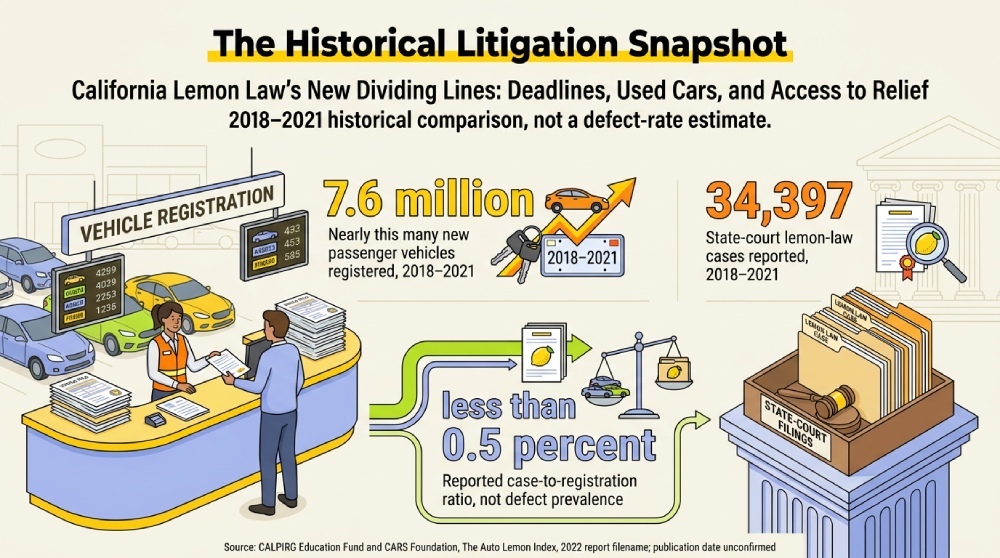
Source: CALPIRG Education Fund and CARS Foundation, The Auto Lemon Index, 2022 report filename; publication date unconfirmed
Build the File Early—and Check Other Remedies
Build the file before waiting for another repair. Early review should establish coverage, original delivery, and applicable procedures alongside the defect history. The following checklist is a practical recommendation, not a substitute for claim-specific legal advice.
- Purchase or lease documents: Keep signed agreements, financing papers, disclosures, advertisements, and certified pre-owned representations. Identify the seller, transaction date, vehicle identification number, and stated vehicle status.
- Warranty and service-contract terms: Retain complete booklets, certificates, amendments, and coverage confirmations. Identify who promised coverage and when that promise began.
- Original delivery information: Obtain records establishing original delivery, which may precede a used buyer’s purchase. Flag missing or conflicting dates rather than assuming the resale date controls.
- Repair orders and mileage: Collect intake repair orders and final invoices, including visits where technicians found no problem. Record the complaint, mileage, work performed, and whether symptoms returned.
- Downtime and expenses: List when the vehicle entered and left the shop. Preserve rental, towing, and other receipts without assuming every expense is recoverable.
- Communications and notices: Save messages, letters, portal submissions, case numbers, and dated telephone notes. Preserve each notice, its destination, attachments, and evidence of submission or delivery.
Prepare a short chronology distinguishing observations from diagnoses and promises. Explain effects on driving, safety, or ordinary use without overstating what the records establish.
Keep the procedural calendar separate from the repair history. The Los Angeles Times legal overview, as summarized in the evidence, describes revised timing and manufacturer-dependent procedures. Counsel should confirm their applicability before advising further delay.
Do not assume ongoing repairs, negotiations, or an open customer-service case suspend a deadline. Ask counsel to identify controlling dates, supported exceptions, and required notices. Likewise, do not assume a dealer conversation satisfies a manufacturer-directed notice requirement.
For used purchases, ask three questions: What warranty was issued, who issued it, and with which transaction? Labels such as certified, extended warranty, or protected are starting points for inquiry. The paperwork must establish whether coverage comes from a manufacturer warranty, dealer promise, or separate service contract.
If statutory buyback relief is unavailable, ask counsel to assess other possible claims. The supplied used-vehicle coverage discussion supports distinguishing repair rights from repurchase eligibility. It does not establish that another remedy necessarily succeeds.
Contract analysis requires the actual promises and evidence of performance or breach. Possible fraud claims require examination of representations, omissions, and supporting facts. Preserve advertisements, inspection claims, vehicle-history disclosures, and messages about known defects for that review.
Finally, distinguish fee arbitration from manufacturer-sponsored defect arbitration. The research describes arbitration for certain attorney-fee and cost disputes, but contains citation problems concerning its precise requirements. Confirm the governing provision rather than treating that description as verified procedural advice.
A process addressing legal fees is different from one deciding the underlying defect dispute. Before entering either, ask what issues it covers, whether its decision binds you, and how deadlines are affected. Documentation supports these decisions; it cannot create a remedy excluded by law.
Judge Reform by Outcomes, Not Just Smaller Dockets
California’s lemon-law changes require separating eligibility, timeliness, and actual outcomes. A serious defect does not alone establish repurchase rights. Remaining warranty coverage does not necessarily supply those rights either, particularly for used vehicles described in the secondary accounts of Rodriguez.
For individual claims, the starting point is the transaction: warranty issuance, original delivery, governing procedures, and repair history. These questions determine whether a remedy exists and whether it remains available. Careful documentation strengthens the assessment without resolving statutory exclusions.
For policy evaluation, the central question is different: does the process deliver appropriate relief with less delay and expense? Earlier settlements could benefit consumers and courts. Smaller dockets could also conceal unresolved disputes or claims that never receive meaningful review.
Filing commentary from Ginsburg Law Group identifies competing explanations, but does not measure their prevalence. The reported decline therefore proves neither improved consumer protection nor widespread exclusion. Both interpretations require evidence beyond case counts.
The priorities follow from that distinction:
- Consumers: Preserve transaction and repair records, and seek timely review while problems remain unresolved. Do not assume another repair attempt preserves every legal option.
- Counsel: Verify governing law, warranty issuance, delivery dates, and procedural applicability before calculating deadlines or recommending strategy.
- Policymakers: Measure time to relief, compensation, unresolved disputes, screening decisions, and reasons consumers abandon claims.
The appropriate test of reform is not simply whether fewer cases reach court. It is whether eligible consumers obtain meaningful relief efficiently—and whether available remedies remain practically accessible.
Limitations
- The evidence contains research summaries, not the statutory text, Rodriguez opinion, or complete underlying articles. Deadline scope, exceptions, notice consequences, and warranty eligibility remain subject to primary-source confirmation.
- Some underlying citations are mismatched: practitioner material is described as government guidance, and 2023 sources are cited for later reforms. Those attributions cannot substantiate the procedural details.
- Filing totals come from secondary reporting with limited methodological detail. Forecasts, annual totals, and half-year comparisons measure different periods and must remain separate.
- Law-firm commentary and press releases provide interested perspectives. Neither filing counts nor unmatched complaint and registration data establish defect prevalence, settlement adequacy, or reform effects.
- Geographic and other access barriers remain plausible risks, not measured causes of lost claims. Office density does not establish access to specialist or remote representation.
References
- The Auto Lemon Index
- Lemon law and auto fraud market data: California
- California ‘Lemon Law’ Filings Fall Sharply After Record Year
- California Lemon Law Lawsuits Dropped 31%. That Doesn’ …
- California’s Lemon Law Filings Surge as New Data Shows Significan
- California’s Lemon Law Is Changing and Car Buyers Have Fewer …
- When life gives you lemon…law reform – Advocate magazine
- California’s “Lemon Law” Changes and Consumer Rights
- Lemon Law Statistics
- The California Lemon Law Got Squeezed this Year… a Sour Deal for Consumers – The Lemon Law Experts