
Yes. A vehicle can be declared a lemon even if it never breaks down completely. Under many lemon law statutes, the key question is not whether the vehicle is totally inoperable, but whether it has a substantial defect that impairs its use, value, safety, or functionality and whether the manufacturer or dealer had a reasonable opportunity to fix it during the warranty period. In other words, a car qualifies when the facts meet the applicable legal criteria—not only when it leaves you stranded on the side of the road.
A lemon law claim may involve a brand new vehicle, a leased vehicle, or in some situations a car sold in used condition if it still has lemon law coverage or an active warranty. The vehicle may start, drive, and pass basic inspection, yet still have persistent issues that make it unreliable, unsafe, or significantly diminished in value. Repeated repair attempts, repair records, and documentation often matter more than a single dramatic incident.
What “Lemon” Means Under State Lemon Laws
Lemon law lawyers assist buyers in obtaining refunds, replacements, or compensation for vehicles that have ongoing defects covered by warranty, which impact their safety, value, or functionality.
Definition of a Lemon Vehicle
A “lemon” is generally a vehicle with manufacturing defects or a defect covered by the warranty that the manufacturer cannot repair within a reasonable number of repair attempts. Lemon law rules are state-specific, so the exact standard in California may differ from Oregon law, and neither should be confused with European law, NY criminal law, or general traffic law. However, most automobile lemon law statutes focus on whether the substantial defect affects safety, value, or functionality.
Common Defects That May Qualify
For example, a Chevy or Ford that repeatedly needs service for steering vibration, brake failure warnings, electrical problems, or a faulty gas gauge may be eligible for lemon law remedies even if it still starts every morning. A vehicle does not have to experience a catastrophic breakdown before the owner can ask whether the car qualifies. If the same persistent issues continue during the warranty period, the car qualification analysis may depend on repair history, time out of service, and documented attempts to fix the problem.

How Lemon Law Relates to Consumer Protection
Lemon law is a form of consumer protection closely related to warranty law and consumer protection law. It is different from bankruptcy law, business law, corporate law, personal injury law, estate law, elder law, family law, franchise law, social security matters, or the work of a fraud examiner, though attorneys in those fields may understand how documentation and legal remedies operate.
When Other Legal Areas Become Relevant
If a defect creates a risk of an accident, a traffic lawyer or personal injury attorney may also become relevant. However, the core lemon law issue remains focused on the defective vehicle, warranty coverage, and the manufacturer’s obligation to repair the problem within a reasonable timeframe.
Why Repeated Defects Can Qualify Even If the Car Still Runs
A vehicle that “runs” is not automatically a good vehicle. Lemon law recognizes that a car can be legally defective even if it never breaks down completely. A substantial defect may involve steering, brakes, transmission hesitation, electrical systems, air conditioning, engine misfires, or dashboard warnings. The problem may be intermittent, but repeated repair attempts can show that persistent issues were not resolved.
For instance, a vehicle may not break down on every trip, but it may pull hard to one side and need repeated realignment because of an axle problem. It may have a defective wheel bearing that causes grinding, an emergency brake that fails to hold, or wires missing from a sensor circuit. Each individual incident may seem manageable, but when the same mechanical problems return during the warranty period, the car qualifies if the defect substantially affects use, value, or safety.
Some owners mistakenly assume lemon law applies only after the vehicle breaks down and cannot move. That is not accurate. If a vehicle breaks down completely, the case may be obvious, but many strong lemon law cases involve persistent issues that never create total immobility. A substantial defect may be enough when the manufacturer has had reasonable repair attempts and the vehicle remains defective.
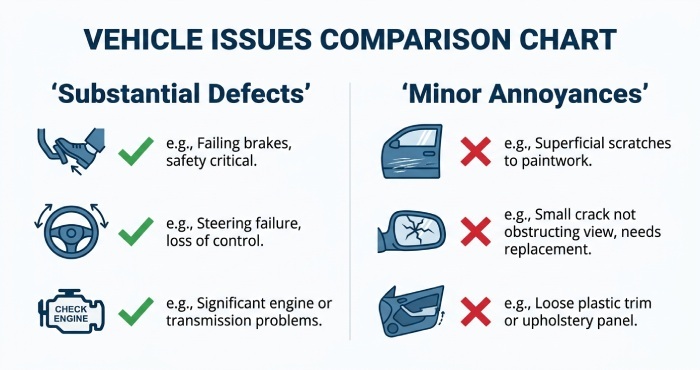
Substantial Defect Versus Minor Annoyance
-
- The distinction between a substantial defect and a minor inconvenience is important under lemon law.
- Cosmetic issues like a scratched hubcap or cracked mirror usually do not qualify unless they significantly reduce the vehicle’s value.
- Problems such as paint debris, trim gaps, or a loose interior panel are generally considered minor inconveniences.
- Lemon law typically focuses on defects that impair the vehicle’s safety, use, or value.
- Serious defects may include faulty brakes, recurring air conditioning failure in extreme heat, or an inaccurate gas gauge.
- Steering problems that require repeated realignment may also qualify as substantial defects.
- A vehicle may qualify as a lemon when the defect is serious and repair attempts fail to fix the issue within the required period.
- Used vehicles can sometimes qualify if they are covered by an express warranty and the applicable state lemon law allows used-car claims.
Common Non-Breakdown Problems That May Make a Vehicle a Lemon
A vehicle may be a lemon even if it never breaks down completely. Common non-breakdown issues include electrical failures, recurring check-engine lights, transmission hesitation, water leaks, brake defects, steering instability, defective airbags, persistent warning lights, infotainment failures that affect controls, and safety system malfunctions. These may be manufacturing defects rather than ordinary wear.
Other examples include repeated wheel bearing replacement, a loose axle assembly, wires missing from a factory harness, an unreliable emergency brake, a gas gauge that misreports fuel level, or air conditioning that fails after multiple repair attempts. Some problems may appear after purchase, while others may exist from the beginning. The important question is whether the vehicle has a substantial defect, whether the issue occurred during the warranty period, and whether the manufacturer or dealer had a reasonable chance to repair it.
A car sold in used condition can be more complicated. Lemon law coverage for a vehicle in used condition depends on the jurisdiction, the warranty, mileage, age, and whether the defect arose within the warranty period. In California, for example, used vehicles may sometimes be covered if they were sold with a qualifying warranty. Because state-specific criteria vary, a legal expert can help determine whether the car qualifies and whether refund eligibility, replacement, or other remedies are available.
The Role of Repair Attempts, Time in the Shop, and Documentation
Repair attempts are a key requirement in lemon law cases
- The vehicle owner must generally prove that the manufacturer or authorized dealer had a reasonable opportunity to fix the defect.
- The required number of repair attempts varies by state and depends on the severity of the issue.
- Safety-related defects often require fewer repair attempts compared to non-safety issues.

Time spent in the repair shop is an important factor
- Many lemon law rules consider how many total days the vehicle is out of service during the warranty period.
- A claim may be valid even if different issues occur, as long as the vehicle is repeatedly unavailable or unreliable.
- Total downtime can be just as important as the number of repair visits when evaluating eligibility.
Proper documentation strengthens a lemon law claim
- Keep all repair orders, invoices, diagnostic reports, and service records.
- Save communication such as emails, text messages, and written notes from the dealer or manufacturer.
- Each repair record should clearly show:
- Date and mileage
- Reported problem
- Work performed and parts replaced
- Whether the issue was confirmed or reproduced
- If a dealer notes “no problem found” but the issue continues, document it personally and return for additional service while still under warranty.
Building a Strong Repair History
A strong repair history shows patterns. For example, if the vehicle returns to the dealer four times for the same brake warning, three times for steering realignment, or repeatedly for a faulty air conditioning system, those repair attempts may support lemon status. The repair history should connect the persistent issues to the warranty period and demonstrate that the substantial defect was not fixed.

Owners should also record how the problem affects daily use. Does the vehicle hesitate in traffic? Did the emergency brake fail on a slope? Did the gas gauge create a risk of stalling? Did a wheel bearing noise worsen after repair? Did debris in a sensor area cause warning lights? These facts can matter because lemon law focuses on real-world safety, value, and functionality.
What to Do If You Suspect Your Vehicle Is a Lemon
If you believe your vehicle may qualify:
- Review your warranty coverage
- Collect all repair and service records
- Document ongoing issues (photos, videos, notes)
- Continue using authorized repair facilities
- Track time the vehicle is out of service
Should the problem continue, seek the guidance of an experienced lemon law attorney who specializes in lemon law cases..
Firms such as McMillan Law Group assist consumers in evaluating whether their vehicle qualifies under California lemon law and related warranty protections.
For example, consumers often seek guidance from experienced San Diego lemon law attorneys when determining whether a vehicle qualifies even without a full breakdown.