
When a vehicle undergoes repairs involving advanced driver assistance systems (ADAS), proper calibration is essential to help ensure that safety features function as intended. If a dealership returns a vehicle with unresolved calibration issues, the driver may face ongoing safety concerns and potential warranty disputes. Repeated unsuccessful repairs involving safety-related technology may also raise questions about the vehicle owner’s rights under California Lemon Law, depending on the circumstances.
Why Successful ADAS Calibration Is Required After Repairs
Repairs That Commonly Trigger Calibration
OEM calibration procedures often require ADAS calibration after collision repair, suspension repair, wheel alignment, structural repair, front bumper removal, airbag deployment, or vehicle restoration. A windshield replacement calibration is also commonly required when the windshield-mounted camera or forward-facing camera is removed, replaced, or disturbed near the rearview mirror.
OEMs specify when static calibration, dynamic calibration, or both are required. Static calibration may use a calibration mat, aiming targets, calibration targets, a Target Holding Device, a calibration rack, and measuring devices in a controlled environment. Dynamic calibration typically requires driving the vehicle under specific conditions so the forward-facing camera and other vehicle sensors can identify road markings, lanes, vehicles, and signs.
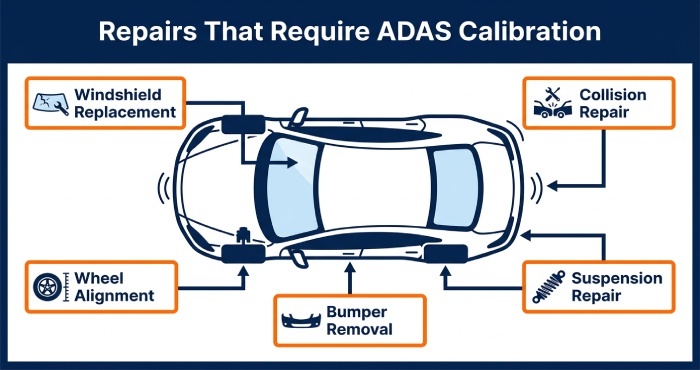
Why Sensor Alignment Cannot Be Assumed
Proper sensor alignment is essential for ADAS safety features to function as intended. Even when a vehicle’s bumper or windshield appears correctly installed, underlying sensors or mounting components may still be misaligned. These issues can affect features such as automatic emergency braking, lane keeping assist, and collision warnings. If calibration problems persist after dealership repairs, vehicle owners may face ongoing safety concerns and potential warranty disputes.
Static and Dynamic Requirements May Both Apply
Some advanced driver assistance systems require both static calibration and dynamic calibration. Static calibration establishes a baseline using calibration equipment and aiming targets. Dynamic calibration confirms that the system can interpret real-world road markings, traffic, and operating conditions. Skipping either step when required by OEM calibration procedures leaves the calibration process incomplete.
What Counts as a Failed, Incomplete, or Unverified Calibration
Failed Calibration
A failed calibration occurs when the ADAS scan tool, diagnostic tool, Scan and Calibration Tool, Electronic Calibration Module, or ADAS Calibration Tool reports that calibration did not complete. This may happen during static calibration, dynamic calibration, radar sensor calibration, or windshield replacement calibration. Causes can include damaged brackets, incorrect ride height, unresolved diagnostic trouble codes, poor lighting, unsuitable road markings, improper placement of aiming targets, or calibration equipment that is not approved for the vehicle.
Incomplete Calibration
An incomplete ADAS calibration occurs when the technician starts but does not finish the required calibration process. For example, static calibration may be completed, but dynamic calibration may not be performed due to weather, traffic, missing lane markings, or unavailable calibration equipment. Likewise, radar sensor calibration may be attempted, but the system recalibration may stop because the ADAS radar sensor is not in the factory position.
Unverified Calibration
An unverified calibration is one where there is no proof that the procedure succeeded. If the dealer cannot produce scan tool reports, before-and-after diagnostic results, measurements from the Vehicle Alignment System, calibration targets setup records, or confirmation that OEM calibration procedures were followed, the ADAS calibration should be treated as unverified.
Warning Lights Are Not the Only Test
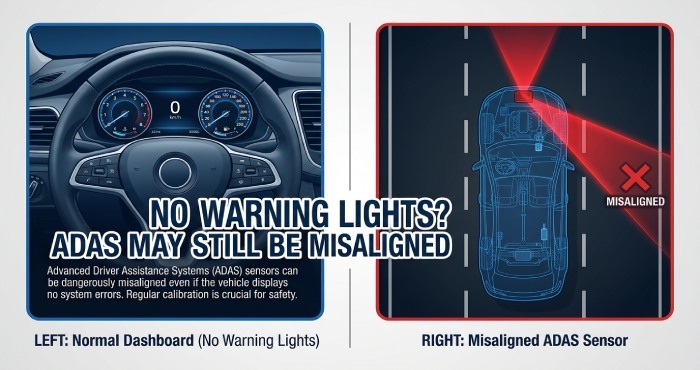
The absence of dashboard warning lights does not prove successful ADAS calibration. A lane departure warning icon may be off, but LDW may still perform poorly. A forward collision warning or automatic emergency braking function may not trigger a fault until the vehicle is in a critical situation. AAA and IIHS have both emphasized that advanced driver assistance systems can be highly sensitive to misalignment and may not always alert the driver when performance is degraded.
Legal, Safety, and Liability Risks of Closing the Repair Order
Misrepresentation and Consumer Risk
If a customer is told the vehicle is repaired when required OEM calibration procedures were not completed, that may create a misrepresentation issue. The risk is higher when the repair involves collision repair, windshield replacement calibration, post-collision calibration, radar sensor calibration, or front-end work affecting a forward-facing camera or ADAS radar sensor.
Consumers experiencing repeated unresolved ADAS problems may seek legal guidance. In Southern California, for example, a consumer may consult a lemon law attorney san diego if a vehicle repeatedly returns with unresolved safety technology concerns. A broader statewide claim may involve a California lemon law lawyer, and motorhome owners facing persistent electronic safety defects may contact an rv lemon law attorney.
Safety Systems May Intervene Incorrectly
Improper sensor recalibration can cause advanced driver assistance systems to misread distance, lane position, or traffic movement. Adaptive cruise control may follow too closely, automatic emergency braking may activate late, lane keeping assist may drift toward a lane edge, and blind spot detection may miss a vehicle. A faulty radar sensor calibration or inaccurate forward-facing camera calibration can compromise the collision warning system and connected braking systems.
Documentation Dealers Need Before Releasing the Vehicle
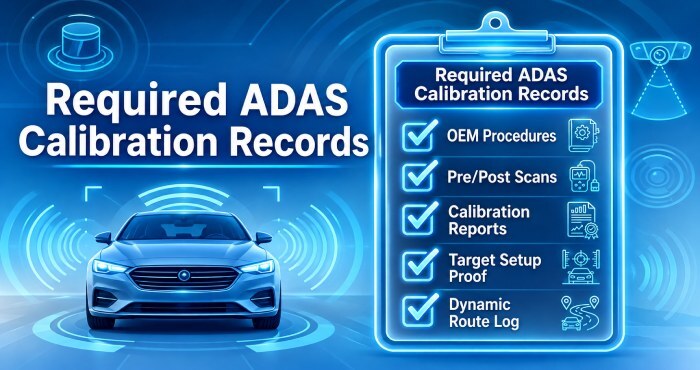
Required Calibration Records
A complete file should include the repair order, OEM calibration procedures used, scan tool pre-scan and post-scan, ADAS calibration report, technician notes, alignment rack or wheel alignment records, and proof that the vehicle was placed in the proper static environment. If static calibration was performed, the file should show how the calibration mat, aiming targets, measuring devices, laser measuring equipment, calibration rack, and Target Holding Device were set up.
If dynamic calibration was required, the dealer should document the route, conditions, speed range, road markings, and successful completion status. For windshield replacement calibration, the file should identify the windshield-mounted camera, forward-facing camera, glass replacement details, and any module adjustment performed. For radar sensor calibration, the file should document the ADAS radar sensor position, corner reflector or Doppler box setup, and final pass result.
Proof of OEM Compliance
The most important record is proof that OEM calibration procedures were followed from start to finish. “No codes present” is not the same as successful ADAS calibration. The documentation should confirm that the calibration equipment was appropriate, the sensor alignment was verified, and the advanced driver assistance systems were operating as designed.