
What an NHTSA complaint is and when California drivers should file one
An NHTSA complaint is a safety report submitted to the National Highway Traffic Safety Administration when a vehicle may have a safety defect, recurring malfunction, or dangerous condition. For California drivers, filing complaints with NHTSA can create an important public record—especially when warranty defects affect braking, steering, acceleration, battery systems, airbags, seat belts, fuel systems, or electrical components.
Under the California lemon law, formally known as the Song-Beverly Consumer Warranty Act, car buyers have consumer protections when defective vehicles cannot be repaired after a reasonable number of repair attempts. The law applies to many new vehicles, used vehicles, and pre-owned vehicles sold with an active manufacturer’s warranty. If your warranty claim involves a persistent defect that affects safety, value, or use, an NHTSA complaint can help document the seriousness of the problem.
When a safety issue should be reported
California drivers should consider filing an NHTSA complaint when:
- A significant defect creates a crash risk or injury risk
- The same issue continues after multiple repair attempts
- A car dealership says the problem is “normal” despite obvious symptoms
- The defect appears in other vehicles made by the same auto manufacturers
- A warranty claim is denied, delayed, or minimized
- A recall has not been issued, but the problem appears widespread
Vehicles manufactured by companies such as Ford, General Motors, Stellantis, Nissan, Tesla, Volkswagen, and Toyota may be subject to safety complaints when owners experience recurring defects.
Why NHTSA complaints matter beyond recalls
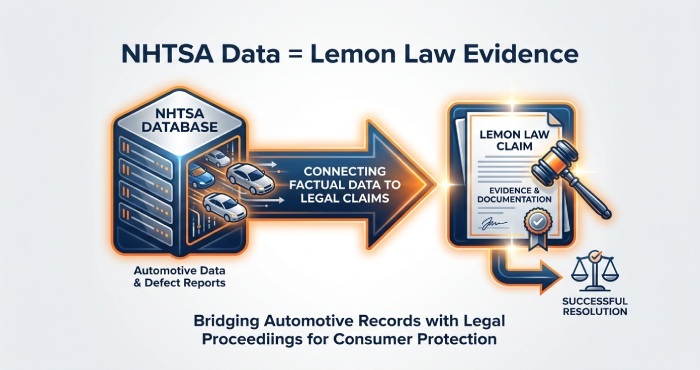
NHTSA uses complaints to identify defect trends, investigate defective vehicles, and pressure auto manufacturers to address widespread safety issues. While NHTSA does not handle your California lemon law claim directly, its database can become useful evidence in a lemon law case, arbitration, settlement process, or lemon law lawsuit.
If your vehicle is an RV or motor home, consulting an RV lemon law attorney may be especially important because warranty defects can involve both chassis and living-area systems.
Step-by-step guide to submitting a vehicle safety complaint with NHTSA
Filing an NHTSA complaint is free and can usually be completed online in minutes. The key is to be specific, accurate, and consistent with your repair records.
Step 1: Gather your vehicle information
Before starting, collect:
- VIN
- Year, make, and model
- Mileage when the issue occurred
- Date of incident
- Whether a crash, fire, injury, or stall occurred
- Whether the vehicle was towed
- Repair order numbers
- Manufacturer’s warranty documents
This information helps distinguish normal maintenance issues from warranty defects covered by the manufacturer’s warranty and the Song-Beverly Consumer Warranty Act.
Step 2: Visit the NHTSA complaint portal
Go to NHTSA’s vehicle safety complaint page and select the applicable category. You will typically describe the component involved, such as brakes, electrical system, engine, powertrain, steering, airbags, suspension, or forward-collision technology.
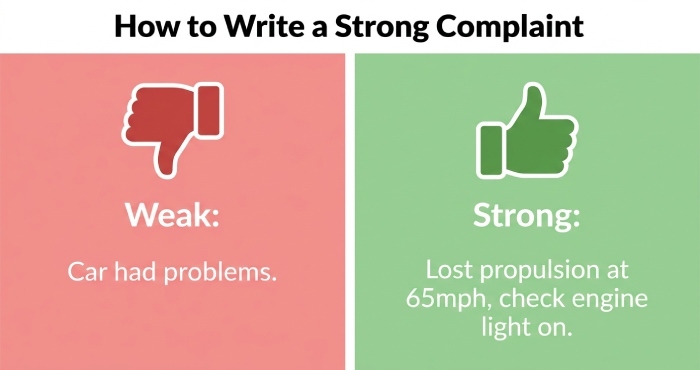
Use plain language. For example: “The vehicle lost propulsion while merging onto the freeway,” is stronger than “car had problems.” If the issue happened during normal driving, explain the speed, road conditions, warning lights, and whether prior repair attempts were made.
Step 3: Describe the defect clearly
Include recurrence and repair history
A strong NHTSA complaint notes whether the defect happened once or repeatedly. In a California lemon law case, repeated repair attempts are often critical. If the dealer performed several repairs under the manufacturer’s warranty and the warranty claim still failed to resolve the defect, say so.
Avoid speculation
Do not exaggerate or guess. Stick to facts: dates, mileage, symptoms, repair attempts, warning lights, and dealer responses. Accurate complaints are more credible in a lemon law lawsuit, court case, or dispute resolution setting.
Key documents and details to include for a stronger complaint record
Essential records to preserve
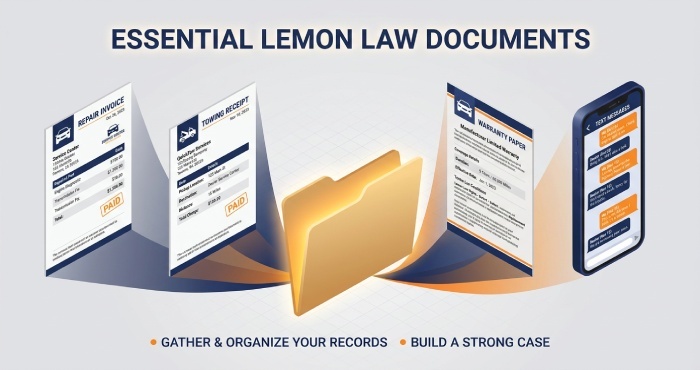
Keep copies of:
- Repair orders and invoices
- Warranty claim paperwork
- Texts or emails with the car dealership
- Photos or videos of warning lights
- Towing receipts
- Rental car or rideshare receipts
- Recall notices or technical service bulletins
- Manufacturer correspondence
- Your NHTSA complaint confirmation numbe
These records help show that warranty defects were reported during the manufacturer’s warranty period and that the dealership had a reasonable number of chances to repair the issue.
Details that help prove a lemon law case
A lemon law case often depends on whether significant warranty defects remain unresolved after repeated repair attempts and affect the vehicle’s use, value, or safety. Issues such as recurring battery shutdowns, steering malfunctions, brake failures, or engine stalling may support a claim. Keep all repair orders, warranty records, and related documentation for review by a lemon law attorney in San Diego, who can assess whether a vehicle replacement, buyback, or other legal remedy may be appropriate.
How an NHTSA complaint can support your California lemon law case
An NHTSA complaint is not a substitute for reporting a defect to the vehicle manufacturer or an authorized dealership under the applicable warranty. Vehicle owners should continue requesting repairs, obtaining written repair orders, and documenting every unsuccessful repair attempt. The NHTSA complaint provides an additional record of the reported safety concern, while repair documentation helps establish the facts relevant to a California Lemon Law claim.
It helps establish a documented timeline
Timing is important because delays may affect the statute of limitations for a lemon law lawsuit. An NHTSA complaint filed after repeated unsuccessful repairs may help document an ongoing defect. Under the Song-Beverly Consumer Warranty Act, manufacturers must provide applicable remedies when covered defects cannot be fixed within a reasonable number of repair attempts.
It may show a broader defect pattern
Repeated complaints about similar vehicle defects may help establish a pattern of recurring problems and support a lemon law claim during arbitration, settlement discussions, or litigation. Such reports can also highlight broader concerns about vehicle safety, manufacturing practices, and manufacturer accountability.
It can influence settlement posture
Auto manufacturers and car companies often evaluate risk before trial outcome. A well-documented complaint record can support the consumer’s position during dispute resolution or a court case. It may encourage a faster buyback, vehicle replacement, or refund purchase price settlement.
Arbitration and opt-out considerations
Some vehicle manufacturers offer arbitration programs to resolve warranty disputes. These programs may differ in their procedures, participation requirements, and whether their decisions are binding. Before agreeing to arbitration, California vehicle owners should understand how participation may affect their other legal options. A qualified California Lemon Law lawyer can explain the available options and help determine the appropriate course of action.