
Executive takeaway
California’s reported 31.3% decline in lemon-law lawsuits covers the first half of 2026, not the full year. It raises a larger question: what happened to consumers’ claims? New procedures could encourage earlier buybacks, while tighter deadlines could prevent some claims from reaching court. The supplied evidence cannot quantify either outcome or establish that reforms caused the decline. Legal professionals should verify applicable rules, preserve repair records, and assess deadlines early. Policymakers should measure completed, adequate remedies—not simply fewer lawsuits.
Fewer lawsuits, but an unanswered consumer question
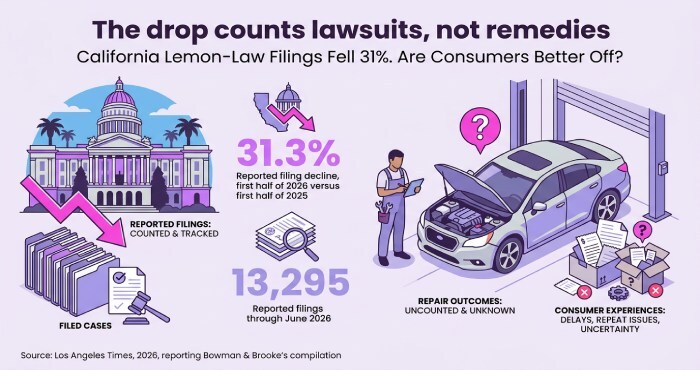
California lemon-law filings reportedly fell 31.3% in the first half of 2026, with 13,295 cases filed through June. The reported decline compares those six months with the same period in 2025. It marks a substantial change in court activity, but does not establish whether consumers received better remedies.
The apparent breadth of coverage needs qualification. Defense firm Bowman & Brooke compiled the figures subsequently discussed in legal reporting and practitioner commentary. The California courts’ news roundup also carries the filing-decline story. Repetition across outlets should not be mistaken for confirmation from independent datasets.
For consumers, the underlying protection matters more than the filing count. California’s Song-Beverly framework provides repurchase or replacement when qualifying warranty-covered vehicle problems persist after reasonable repair attempts. The supplied consumer-rights account describes that protection; an unresolved repair alone does not establish entitlement.
The central question is therefore: did disputes resolve earlier, fail to reach court, or both? An appropriate pre-suit buyback differs fundamentally from abandonment of a viable claim. Yet either outcome could reduce lawsuits.
AB 1755 and SB 26 make that distinction consequential. The supplied procedural analysis describes revised filing windows, notice procedures, early evidence exchanges, and mediation. Manufacturer participation, relevant dates, and requested remedies affect which rules apply.
This article distinguishes procedural design from demonstrated results. It assesses the supplied reporting and research summaries, without access to original filing data or complete statutory text. Earlier settlements and reduced access to court could coexist, but the evidence quantifies neither. Nor does the timing of the decline establish that reforms caused it.
Source: Los Angeles Times, 2026, reporting Bowman & Brooke’s compilation
Read the 31% figure carefully
The 31.3% figure compares first-half filings, not annual totals. Bowman & Brooke’s reported analysis counted 13,295 lawsuits through June 30, 2026. The baseline was the corresponding period in 2025, according to the filing-decline coverage.
The supplied annual projection tells a different story. Approximately 26,500 projected filings for 2026, compared with 32,480 reported for 2025, imply an approximately 18.4% annual decline. That calculation divides the projected reduction of 5,980 by 32,480.
These measures must remain separate:
- 31.3%: the reported decline between comparable first-half periods.
- Approximately 26,500: projected total filings for 2026, not an observed annual count.
- Approximately 18.4%: the annual decline implied by that projection against the reported 2025 total.
A first-half percentage cannot automatically become a full-year forecast. That would assume the remaining months maintain the same year-over-year relationship. Descriptions of an annual decline near 31% do not reconcile with the supplied annual totals.
Historical counts also differ across accounts. An August 2025 report gives Bowman & Brooke’s 2024 count as 30,190; later reporting gives approximately 30,142. Other supplied summaries describe 2024 as exceeding 22,000 or 25,000, without establishing comparable coverage or counting methods.
Any historical filing chart should identify its compiler and distinguish observed counts from projections. It should not blend these accounts into a seamless series. The supplied material does not explain whether differences reflect classification, coverage, revisions, or other methodological choices.
The filing count also excludes important outcomes. As practitioner commentary emphasizes, it cannot reveal how many owners obtained pre-suit buybacks or abandoned disputes. Arbitration and informal settlement remain outside the count unless a dispute also produces a lawsuit.
Settlements reached after filing do not erase the original lawsuit. However, filing totals reveal neither settlement terms nor whether promised relief was completed. The statistic therefore measures entry into court—not compensation, satisfaction, or vehicle reliability.
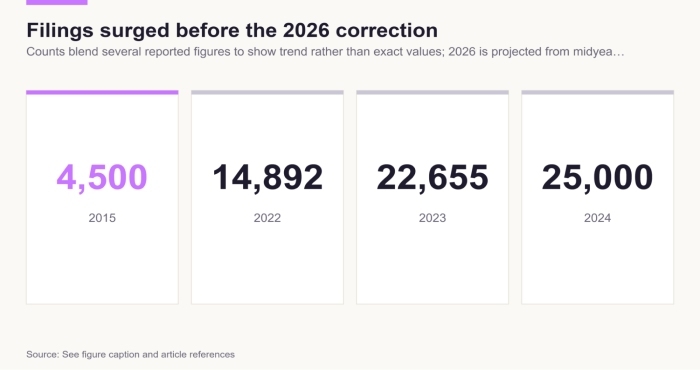
Key statewide lemon-law filing counts show a steep climb from 2015 through a 2025 peak, followed by a projected decline in 2026 that still leaves activity well above mid-2010s levels. Method: Values combine counts reported in AB 1755 legislative analyses, practitioner summaries, and Bowman & Brooke’s projections; because compilers differ, figures are approximate and used to illustrate trends rather than precise totals.[2][7][9][11][20]
Why lawmakers wanted to change the process
Court workload helps explain the push for reform, but not the causes of rising litigation. As a historical comparison, reported statewide lemon-law filings increased from 14,892 in 2022 to 22,655 in 2023. The supplied Advocate reform account discusses those figures and concerns about court capacity.
That increase added 7,763 cases, representing approximately 52% growth, not a near doubling. The calculation divides the additional filings by the 2022 total. Correcting the description preserves the substantial increase without exaggerating it.
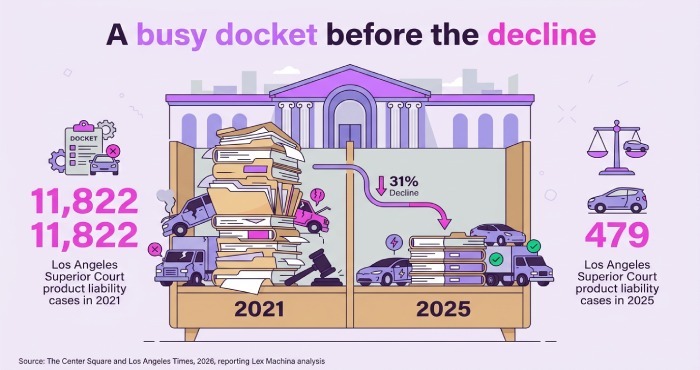
A separate historical comparison shows pronounced local growth. Los Angeles Superior Court’s reported product-liability count rose from 479 in 2021 to 11,822 in 2025.
Vehicle-warranty actions comprised most cases, according to the supplied docket coverage.
These series should not form one trend line. The statewide figures concern lemon-law filings; the Los Angeles figures cover a broader category in one county. Their geography, case definitions, and comparison years differ.
The workload concern extended beyond new complaints. The reform discussion describes discovery disputes, attorney-fee litigation, and the California Judges Association’s capacity concerns. Discovery—the exchange of documents and testimony—can require judicial intervention well before trial.
Fee-shifting serves an important consumer-protection function. Successful consumers can recover qualifying attorney fees from manufacturers under the framework described by Consumer Attorneys of California. That can make representation feasible for people unable to finance a warranty dispute themselves.
Fee recovery also creates a separate subject for negotiation or litigation. Disagreements over payment for legal work can add court work beyond deciding the vehicle claim. Neither that observation nor rising filings proves that fee incentives caused the increase; the supplied evidence does not isolate their contribution.
The reform sought earlier resolution of a growing caseload while preserving consumer remedies. Historical counts explain the pressure to act. They do not establish whether individual lawsuits were unnecessary or whether fewer filings would improve consumer protection.
Source: The Center Square and Los Angeles Times, 2026, reporting Lex Machina analysis
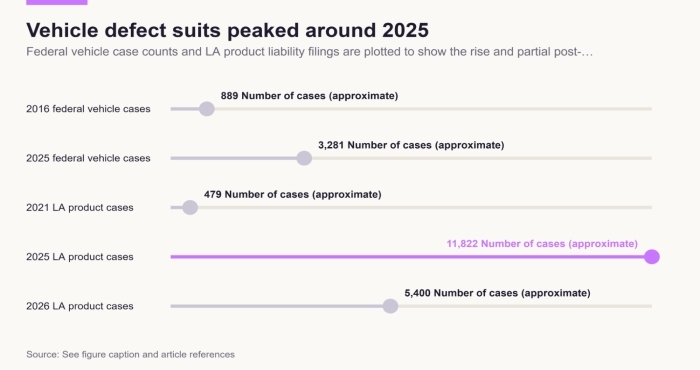
Chronological data on federal vehicle product cases and Los Angeles Superior Court product liability filings illustrate how warranty-related litigation rose to a 2025 peak before partially reverting toward 2024 levels in 2026. Method: Series values draw from Lex Machina’s national product liability report and its breakdown for Los Angeles Superior Court, as summarized in news coverage; the lines highlight directionality rather than exact counts.[1][2]
The new rules start with identifying the right track
The first procedural question is which rules govern the claim. AB 1755 introduced revised filing windows, structured notice, early disclosures, and settlement procedures. SB 26 subsequently added manufacturer election, according to the supplied San Diego docket analysis.
That account describes an accelerated route for electing manufacturers and traditional rules for non-electing manufacturers. The supplied research also reports an annual election list published through the Department of Consumer Affairs’ Arbitration Certification Program. Election status is a starting point, not a complete applicability analysis.
Legislative timing requires particular care. February 2025 reporting concerns efforts to revise the framework; it cannot alone establish SB 26’s eventual terms. Effective dates, election coverage, phased provisions, and treatment of pending claims require verification against controlling law.
For covered restitution or replacement claims, the supplied AB 1755 explanation describes two filing limits: one year after the applicable express warranty expires and six years from original delivery. These should not become universal instructions for every warranty dispute.
Where applicable, those limits could restrict claims despite continuing vehicle problems.
Calculating a deadline requires checking governing provisions, exceptions, and tolling—rules that pause or extend a deadline. Warranty expiration alone is insufficient.
Repurchase remedies and civil penalties require separate analysis. Repurchase addresses the obligation to take back a qualifying vehicle; civil penalties concern willful noncompliance.
The supplied Consumer Attorneys of California account describes structured notice for penalty-seeking claims, rather than a replacement for the underlying remedy.
The research describes written buyback notice by email or certified mail, a 30-day manufacturer response period, and a 60-day completion period when relief is offered. Their precise triggers and conditions are not established by statutory text here. Readers should not assume the 60-day period begins after the 30-day period ends. Nor should a penalty-related procedural failure automatically be treated as eliminating the repurchase claim.
Litigation introduces a separate schedule. The supplied docket analysis describes these milestones for applicable cases:
- 60 days: Exchange specified warranty, maintenance, and repair documents following the defendant’s answer.
- 120 days: Complete limited depositions—sworn questioning—of the consumer and a knowledgeable manufacturer representative.
- 150 days: Hold mediation, in which a neutral participant helps the parties seek agreement.
These milestones are not extensions of the pre-suit notice window. The evidence identifies the answer as the document-exchange trigger. Counsel should verify the trigger and exceptions for each later milestone before calculating dates.
The same account describes most remaining discovery as paused pending mediation, with sanctions supporting compliance. Concentrating early evidence exchange may focus negotiations.Consulting an RV lemon law attorney can help consumers understand their legal options, but it does not establish that settlements occur sooner or provide adequate compensation for their losses. .
Fee disputes follow another distinct process. The supplied reform analysis describes neutral, binding arbitration for specified pre-litigation attorney-fee and cost disputes. This concerns payment for legal work, not whether a vehicle qualifies for repurchase.
The practical lesson is to keep separate procedures and deadlines separate. Identify the applicable route, distinguish requested remedies, and verify each deadline before advising that a claim will move faster.
Three routes to a remedy—and different tradeoffs
The appropriate route depends on the remedy sought, not the shortest advertised timeline. Negotiated repurchases, certified manufacturer-sponsored arbitration, and litigation offer different ways to resolve warranty disputes. Their comparative value depends on evidence, available remedies, applicable procedures, and the proposed resolution’s terms.
Documentation supports all three routes. Repair orders, warranties, and manufacturer correspondence can substantiate negotiations or arbitration and become disclosures in litigation. The supplied Advocate analysis describes the reform’s emphasis on exchanging these records early.
Negotiated repurchases offer resolution without filing suit. A direct buyback request can produce agreement before a contested case begins. Under applicable procedures, structured notice also gives manufacturers an opportunity to resolve claims before consumers pursue civil penalties, as described by Consumer Attorneys of California.
An offer is not the same as adequate, completed relief. A repurchase differs from a cash settlement that leaves the consumer with the vehicle. Reviewing payment, vehicle-return obligations, releases, and performance dates is therefore essential to evaluating an agreement.
Attorneys discussed in the filing-decline coverage report more pre-litigation resolutions. Those observations suggest changing practice, but do not establish negotiated buybacks’ market share or comparative compensation.
Certified arbitration provides an informal warranty-dispute process. The supplied research describes manufacturer-sponsored programs overseen through California’s Arbitration Certification Program. It attributes decisions around 40 days after claim acceptance, and performance generally within 30 days after consumer acceptance, to CalMatters reporting.
Those periods have different starting points and remain subject to program rules and exceptions. They exclude earlier repairs and negotiations, so they cannot establish that arbitration is universally faster. Consumers should verify available remedies, acceptance consequences, and enforcement procedures for the particular program.
Warranty arbitration must also be distinguished from binding arbitration over legal fees. The former addresses the vehicle dispute; the latter concerns specified payment disagreements. Treating them as interchangeable obscures both the decision being made and its consequences.
Litigation offers formal enforcement, supported by fee-shifting and potential penalties. Successful buyers may recover qualifying attorney fees, helping support access to representation. The consumer-attorney account does not make that a guarantee of success or recovery of every requested fee.
The supplied dealer-focused explanation of the underlying law describes civil penalties potentially reaching twice actual damages for willful noncompliance. Penalties are not automatic additions to every repurchase; entitlement requires claim-specific legal and factual analysis.
Comparative outcome evidence remains weak. A commercial settlement explainer reports no official statewide average settlement amount, but its account is not an independent audit of available data. The supplied evidence contains no representative comparison of recovery, costs, or end-to-end timelines across routes. None can therefore be declared universally faster or better.
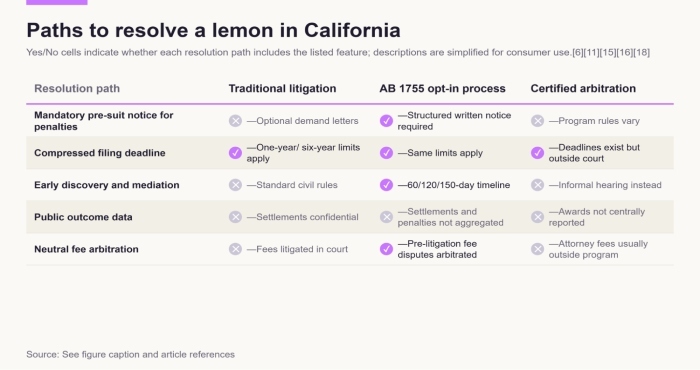
Comparison of three main resolution channels—traditional litigation, AB 1755 opt-in accelerated procedures, and certified arbitration—highlights differences in speed, transparency, and requirements. Method: Features are distilled from statutory texts, legislative analyses, and DCA descriptions of certified arbitration programs; qualitative Yes/No cells indicate whether each path offers or requires a given procedural attribute.[6][11][15][16][18]
Faster relief is plausible, but not yet measured
Faster relief is a plausible mechanism, not an established statewide result. Structured notice creates an opportunity for pre-suit resolution. Early mediation could shorten filed cases. Neither mechanism, by itself, demonstrates better consumer outcomes.
Consumer Attorneys of California presents AB 1755 as intended to deliver remedies within months rather than years. The organization helped craft the legislation, making its account useful evidence of purpose. It is not an independent evaluation of achieved results.
Practitioner observations provide limited support for earlier resolution. The supplied Los Angeles Times coverage describes defense and plaintiffs’ lawyers seeing more disputes settle before litigation. They attribute some change to notice requirements and procedures for resolving fee disputes.
A plaintiff-side account similarly describes greater willingness to accept repurchase requests and quicker buybacks.Agreement among opposing practitioners makes this explanation worth investigating with the guidance of an experienced California lemon law lawyer who can clarify your legal rights and available options. Their experiences still do not constitute a representative sample.
Selection bias limits these observations. Lawyers mainly see people who seek representation and cases their firms accept. Their accounts may omit owners who never contact counsel, receive no offer of representation, or abandon disputes.
Those omissions matter when assessing tighter deadlines. Practitioner commentary raises concerns that compressed filing periods can prevent claims from proceeding. It identifies a plausible risk, not the number of otherwise viable claims lost.
Representation could also change without appearing directly in court totals. Earlier settlements may reduce legal work, while changed fee incentives could affect acceptance of complex cases. The supplied first-year reform commentary discusses such pressures without measuring their prevalence.
Transitional filing behavior offers another explanation. The supplied filing-decline reporting describes accelerated filings in late 2024 and early 2025 ahead of procedural changes. That could inflate the first-half 2025 baseline. A subsequent decline would then partly reflect shifted filing dates, rather than improved relief or lost claims.
Evaluation must also define when the clock starts and stops. Measuring from notice or filing excludes earlier repair attempts and negotiations. Ending at settlement excludes any delay before payment or replacement delivery.
A meaningful assessment would track several outcomes together:
- Speed: Time from initial repair efforts and formal requests to completed relief.
- Compensation: Repurchases, replacements, partial settlements, and denials.
- Completion: Whether promised payments and vehicle exchanges occur.
- Representation: Whether consumers obtain counsel, particularly for difficult claims.
- Attrition: Why owners stop pursuing disputes, including satisfactory resolution, deadlines, or costs.
Faster settlements and reduced access to representation could coexist. Testing both requires resolved, rejected, and abandoned disputes—not merely filed cases or participating firms’ clients. Without that broader sample, neither explanation can be assigned a reliable share of the decline.
Court cases are a narrow window into vehicle problems
Court filings measure litigation, not the prevalence of defective vehicles. Historical California data illustrate the distinction, but cannot establish whether vehicle problems declined in 2026.
As an explicitly historical comparison, the Auto Lemon Index examined California litigation and registration data for 2018–2021. It reported 34,397 lemon-law lawsuits alongside more than 7 million new vehicle registrations. That is fewer than five lawsuits per 1,000 registrations, or less than 0.5%.
The denominator is crucial: registrations are not a count of defective vehicles. Lawsuits are also not a complete inventory of vehicle problems. Dividing one by the other cannot reveal what proportion of defects reached court.
The accompanying Auto Lemon Index figure should therefore compare lawsuits with registrations, not depict lawsuits as a share of all defects. A defensible title is “Lemon-law lawsuits compared with new vehicle registrations, California, 2018–2021.” The remaining registrations must not be represented as defective vehicles whose owners never sued.
Figure caption: Historical California comparison, 2018–2021: 34,397 lemon-law lawsuits alongside more than 7 million new vehicle registrations. Registrations include vehicles without identified defects. This comparison does not estimate the share of defective vehicles reaching court or measure 2026 defect trends.
Manufacturer differences add another qualification. The index reported roughly one lawsuit per 2,029 new Toyota registrations, compared with one per 78 new GM vehicles. GM’s reported lawsuit rate was therefore approximately 26 times Toyota’s during that period.
That contrast does not establish a 26-fold difference in unreliability. Vehicle problems, claim handling, access to representation, and other factors could affect litigation rates. The supplied evidence does not separate their contributions.
Concentration also complicates statewide comparisons. CalMatters reported approximately 9,800 GM suits during 2018–2021. A statewide change could therefore reflect shifts concentrated among particular manufacturers, rather than a uniform change in consumer experiences.
Recall totals cannot supply the missing denominator. The supplied 2026 coverage cites national recall figures from 2024, whereas the index concerns California litigation and registrations during 2018–2021. These populations, periods, and measures are not interchangeable.
The historical evidence supports caution in both directions. Fewer filings do not establish improved reliability, but older lawsuit and recall figures cannot rule it out. Distinguishing better vehicles from better claim resolution—or claims never pursued—requires current, comparable evidence.
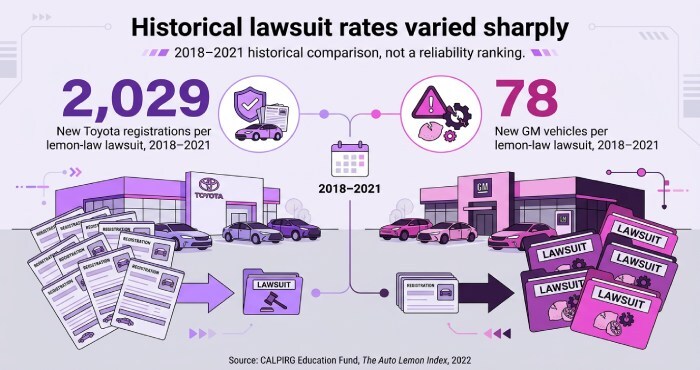
Source: CALPIRG Education Fund, The Auto Lemon Index, 2022
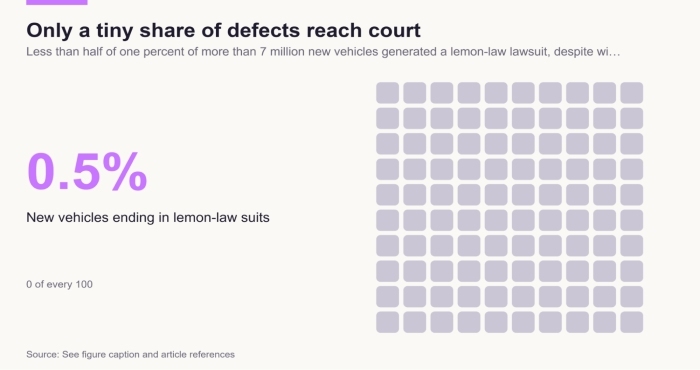
A waffle chart illustrates that less than 0.5% of new vehicles sold in California between 2018 and 2021 resulted in a lemon-law lawsuit, underscoring how filings represent only a small fraction of defect experiences. Method: The percentage comes from the Auto Lemon Index, which compares lawsuit counts to new vehicle registrations; the waffle metaphorically uses a 10×10 grid to show how few cases reach court.[19]
A practical intake checklist for California claims
Begin intake with dates, documents, and governing rules—not the statewide filing trend. The following sequence supports screening and strategy; it does not determine eligibility. The accompanying decision figure should likewise provide orientation, not individualized advice or a substitute for deadline analysis.
- Establish delivery, warranty, and claim dates. Record original delivery, the client’s acquisition date, warranty terms, and potentially applicable expiration dates. Build a chronology of defects, repair visits, manufacturer responses, and earlier proceedings. Preserve documents supporting each date rather than relying solely on recollection.
- Assemble the repair and communication record. Collect purchase or lease documents, warranties, repair orders, maintenance records, recall notices, and dealer or manufacturer correspondence. Record mileage, symptoms, work performed, and periods out of service. Separate documented facts from missing records and disputed events. The supplied docket analysis describes early disclosures under the accelerated procedures, reinforcing the value of organized evidence.
- Verify eligibility separately from any statutory presumption. The draft’s 18-month/18,000-mile and 30-day screening references should not become automatic eligibility rules. The supplied evidence does not establish the presumption’s exact conditions sufficiently for detailed instructions. Check controlling law on repair attempts, notice, and time out of service before accepting or rejecting a claim on those grounds.
- Confirm manufacturer election and procedural applicability. Check the Department of Consumer Affairs’ election information and its relevance to the claim. Review election timing, effective dates, claim timing, pending-case treatment, and requested relief. The supplied procedural overview describes the election framework, but does not replace statutory verification.
- Identify remedies before preparing notice. Distinguish repurchase, replacement, negotiated cash resolution, and civil penalties. For applicable penalty claims, verify notice content, recipient, delivery method, and proof of delivery. The supplied AB 1755 analysis describes email or certified-mail notice. Also verify response periods and any possession requirements before advising a sale or trade-in.
- Calendar deadlines independently of settlement discussions. The supplied analysis describes one-year-after-warranty and six-year-from-original-delivery limits for covered restitution or replacement claims. Determine applicability, exceptions, and tolling before using those limits. Record filing deadlines separately from notice, response, performance, disclosure, and mediation dates. Do not assume negotiation or arbitration pauses the filing clock without a verified legal basis.
- Review the proposed resolution, not merely its headline amount. Assess payment calculations, financing treatment, surrender obligations, releases, fees, and performance dates where relevant. Confirm which statutory settlement protections apply. Advertised settlement ranges do not establish adequacy; the supplied settlement-data explainer itself reports no official statewide average.
This sequence keeps procedural screening distinct from substantive evaluation. A shorter route is useful only if it preserves the claim and delivers an appropriate remedy.
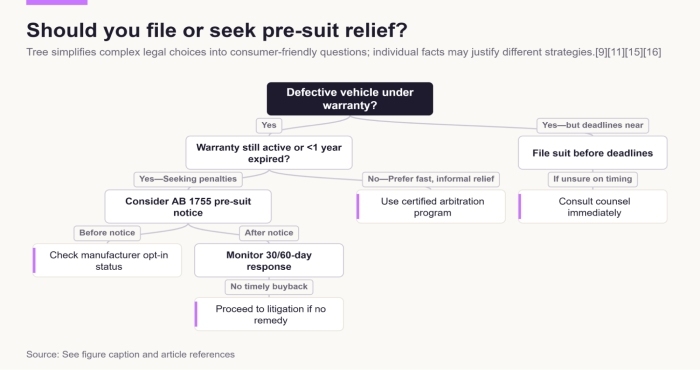
A practical decision guide helps consumers think through whether to pursue structured AB 1755 pre-suit notice, arbitration, or immediate litigation, based on defect severity, deadlines, and manufacturer opt-in status. Method: Nodes translate procedural options from AB 1755 and SB 26 into simple questions; branches use Yes/No or threshold answers to suggest likely next steps, but do not constitute legal advice.[9][11][15][16]
Judge the reform by remedies, not quieter courts
Fewer filings alone cannot establish that consumers are better off. The reported first-half 2026 decline cannot distinguish completed buybacks from inadequate settlements, abandoned claims, or shifted filing dates. The available evidence supports competing explanations, not a measured balance between them.
California should evaluate completed remedies, not merely closed cases. A proposed reporting framework should include disputes resolved before litigation, alongside court and arbitration cases:
- Time to complete relief: Record initial repair efforts, formal claims, agreements, and actual payment or replacement delivery.
- Repurchases and replacements: Track requested, agreed, and completed remedies separately.
- Settlement adequacy: Assess net compensation, deductions, and unresolved obligations against case-specific available relief.
- Denials and abandonment: Distinguish rejected claims from withdrawn claims and record reasons where feasible.
- Deadline-related losses: Separate missed filing deadlines or procedural failures from decisions on substantive eligibility.
- Access to representation: Include unsuccessful efforts to obtain counsel, not only represented cases.
Results should distinguish manufacturer participation in the revised procedures and consumer representation status where feasible. Claim timing, requested remedy, and complexity also matter. Group differences would not, by themselves, prove reform effects; evaluation must account for differing case characteristics and transitional filing behavior.
Consistent definitions, privacy safeguards, and transparent reporting of missing data would be essential. Anonymized reporting and independent review could support comparison without exposing sensitive consumer information.
For consumers and counsel, the immediate priorities are preserving evidence and verifying applicable procedures and deadlines. Consulting a lemon law attorney San Diego can help consumers understand their legal rights, explore available options, and pursue appropriate remedies for defective vehicles. For policymakers, the key question is whether consumers receive timely, adequate relief and whether valid claims are lost without it.
Limitations
- The filing headline rests on one underlying compilation repeated across several reports, not independently verified datasets. No original case-level data were supplied.
- Annual counts differ across accounts. The supplied 2026 projection implies an approximately 18.4% annual decline, not the reported 31.3% first-half decline.
- The evidence consists of research summaries and source metadata, not complete source texts or statutory provisions. Some cited accounts predate developments attributed to them; precise legal requirements require independent verification.
- Practitioner observations are not representative outcome data. The supplied material cannot quantify completed buybacks, settlement adequacy, access to counsel, or abandoned claims.
- Historical lawsuit rates and recall figures cannot establish California’s 2026 defect incidence. Transitional filing behavior also complicates attempts to attribute the decline to reforms.
References
- California ‘Lemon Law’ Filings Fall Sharply After Record Year
- California Lemon-Law Filings Reportedly Fell 31% In 2026. What Changed For Consumers?
- California lemon law filings fall sharply after record year
- California Lemon Law Lawsuits Dropped 31%. That Doesn’ …
- Average Lemon Law Settlement in California (2026)
- AB 1755 One Year Later: Did the Controversial Lemon Law Reform …
- The San Diego Superior Court Lemon Law Docket
- When life gives you lemon…law reform – Advocate Magazine
- California Lemon Law Attorney: Level the Playing Field
- Lemon Law
- California lawmakers scramble to fix ‘lemon’ vehicle law
- Manning Leaver Legal Lane – Lemon Law 101
- The Auto Lemon Index – CALPIRG Education Fund
- California’s “Lemon Law” Changes and Consumer Rights