Strong documentation is essential for a successful California Lemon Law claim. Under the Song-Beverly Consumer Warranty Act, eligible consumers may receive a refund, replacement vehicle, compensation, civil penalties, and attorney’s fees. A California lemon law lawyer can review the warranty, purchase records, and repair history to determine whether the vehicle qualifies.
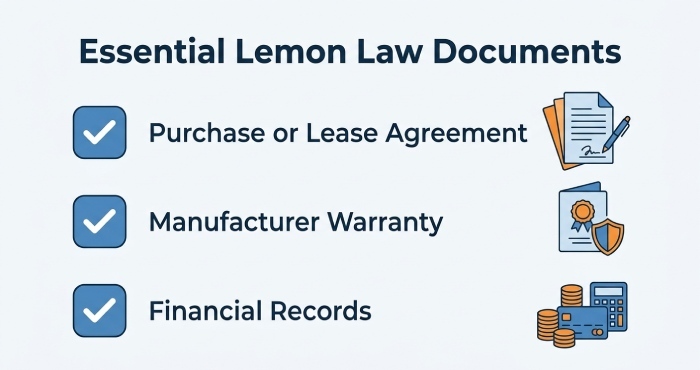
1: Vehicle Purchase or Lease Agreement Showing Warranty Coverage
Your purchase or lease agreement provides key lemon law details, including the buyer, seller, vehicle, purchase date, mileage, financing or lease terms, and whether the vehicle was new, used, certified pre-owned, a demo, or leased.
Why the Agreement Matters
Under California Lemon Law and the Song-Beverly Consumer Warranty Act, timing is critical. The contract helps establish whether the defective vehicle was covered by a warranty when the substantial defect appeared. It may also show the vehicle value, loan/lease pay off amount, registration charges, taxes, and fees that may factor into a full purchase refund or fair replacement.
Key Documents to Preserve
Keep the retail installment sales contract, lease agreement, buyer’s order, odometer disclosure, pink slip paperwork, certified pre-owned inspection checklist, and any defect disclosure documents provided by the dealership or used car dealership.
2: Manufacturer’s Written Warranty and Extended Service Contracts
The manufacturer’s written warranty is essential to proving a breach because the Song-Beverly Consumer Warranty Act examines whether the manufacturer or its authorized repair facility failed to bring the vehicle into conformity with the applicable express warranty.
Warranty Terms That Support the Claim
Keep all warranty booklets, CPO materials, service contracts, powertrain and emissions coverage, and relevant Federal Lemon Law or Magnuson-Moss documents. A lemon law lawyer can review the warranty terms, repair history, defect, and applicable deadlines, including whether the statute of limitations has been preserved.
3: Repair Orders and Service Invoices from the Dealership
What Each Repair Order Should Show
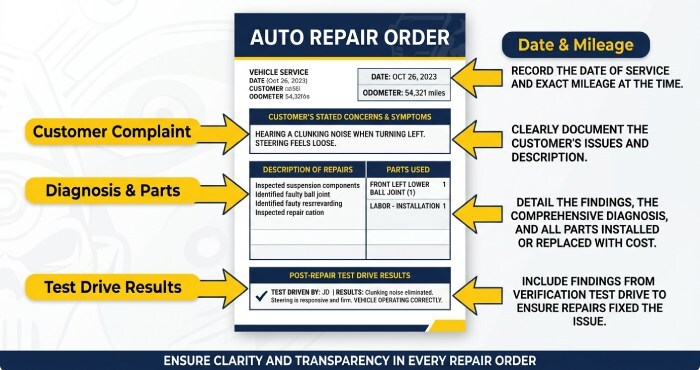
Keep every repair invoice showing the date, mileage, complaint, diagnosis, parts replaced, labor performed, and test-drive results, including “could not duplicate,” “operating as designed,” or “no problem found” entries, as they may still support a lemon law claim when the defect persists.
Avoid Verbal-Only Service Visits
If a service advisor tells you the dealership cannot find the problem, ask for a written repair order. A lemon law attorney can use repeated written complaints to show a reasonable number of repairs, even when the manufacturer later argues that no defect existed.
4: Detailed Timeline of Defects, Breakdowns, and Repair Attempts
Building a Persuasive Chronology
List the date, mileage, symptom, safety concern, dealership visit, and outcome for every event. Include recurring problems such as engine stalling, transmission hesitation, brake failure, electrical shutdowns, infotainment failures, battery drain, or airbag warnings.
Safety and Substantial Defect Details
California Lemon Law generally focuses on defects that impair use, value, or safety. If the issue is a safety defect affecting vehicle safety—such as loss of steering, brake malfunction, or sudden power loss—note how it affected driving conditions, passengers, and the risk of a crash.
5: Written Communications with the Dealership and Manufacturer
Emails, texts, letters, case numbers, and portal messages can prove notice, repair delays, refusals, or warranty-related inconsistencies.
Communications That Strengthen the Case
Save all communications with the service advisor, sales manager, manufacturer, corporate offices, and case managers. Record call dates, representative names, and key details, as these records may support a lemon law attorney’s evaluation of willful violations. Online reviews and California Lemon Law resources may also reveal recurring manufacturer or dealership issues, but they do not replace legal advice.
6: Proof of Days the Vehicle Was Out of Service
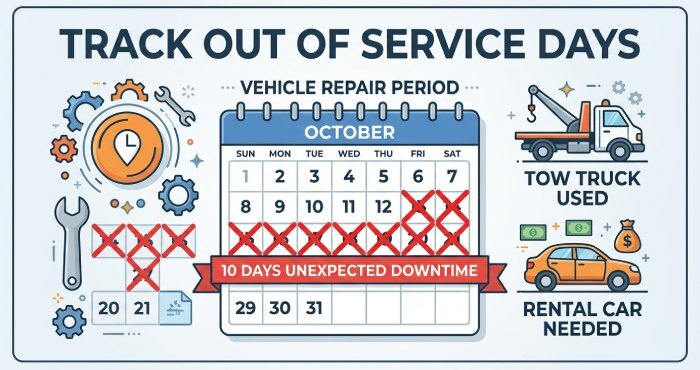
The number of days a vehicle remains out of service can provide strong evidence, as California Lemon Law may offer relief when extended warranty repairs keep the vehicle at a dealership for an excessive period despite repeated repair attempts.
What Counts as Out-of-Service Evidence
Keep repair orders, rental receipts, tow records, dealership appointments, parts backorder notices, and messages showing extended downtime, as they can support settlement, refund, or replacement vehicle claims.
For recreational vehicle claims, downtime evidence may be especially important because repairs can involve specialized components, long parts delays, or multiple service locations. In those cases, consulting an rv lemon law attorney may help determine whether the recreational vehicle qualifies.
7: Photos, Videos, and Diagnostic Records Documenting the Defect
Visual evidence can make a defective vehicle case more persuasive. Photos and videos help demonstrate intermittent or recurring issues that the dealership claims it cannot duplicate.
Effective Visual and Technical Proof
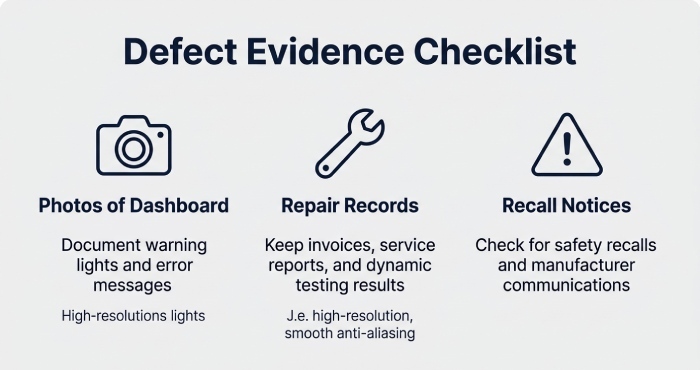
Document warning lights, leaks, smoke, unusual noises, screen failures, water intrusion, brake alerts, and transmission problems when safe. Keep diagnostic codes, scan reports, battery tests, alignment records, and inspection results to help a lemon law lawyer establish that the defect is recurring, warranty-covered, and not caused by the consumer.
8: Maintenance Records Showing Proper Vehicle Care
Manufacturers often defend California Lemon Law claims by blaming the consumer for poor maintenance, misuse, aftermarket modifications, or neglect. Maintenance records help rebut those arguments.
Records That Show Responsible Ownership
Keep maintenance receipts, recall notices, and manufacturer-recommended service records, along with pre-sale inspections and certified pre-owned documents. A lemon law attorney can review these records to assess warranty coverage and vehicle eligibility under California’s Song-Beverly Consumer Warranty Act and related law.
9: Expert Inspection Reports Supporting the Lemon Law Claim
Expert inspections can determine whether a defect is substantial, recurring, and warranty-related by examining the vehicle, diagnostic codes, service records, and quality of previous repairs.
When Expert Evidence Helps
Expert reports can help establish the cause of disputed vehicle defects, especially involving electrical, engine, ADAS, water leak, or safety issues. Alemon law attorney san diego can determine whether an inspection is needed and use the findings to strengthen negotiations with the manufacturer.
10: Records of Costs, Payments, and Damages for Settlement Negotiations
Complete financial records strengthen settlement negotiations by making it easier to calculate compensation, refunds, vehicle replacements, and other remedies available under California Lemon Law and the Song-Beverly Consumer Warranty Act.
Financial Records to Gather
Keep records of your down payment, loan or lease payments, registration fees, insurance, towing, rental cars, rideshare costs, repairs, and other related expenses, as they may affect your refund, payoff, civil penalties, and settlement value. A California Lemon Law lawyer may also pursue recoverable attorney’s fees and evaluate potential claims under the Song-Beverly Consumer Warranty Act or the federal Magnuson-Moss Warranty Act when a manufacturer fails to meet its warranty obligations.
Warning Sign #1: The Manufacturer Keeps Delaying or Ignoring Your Refund Request
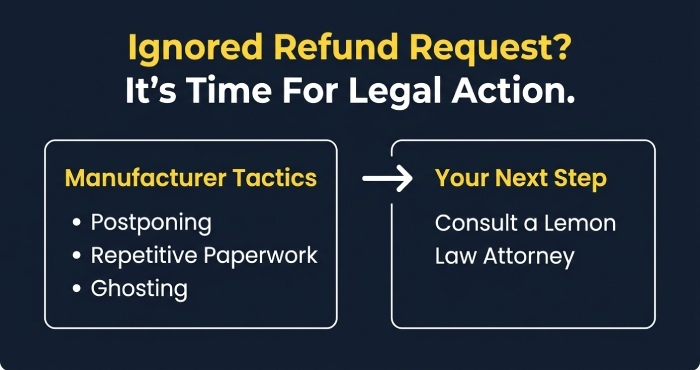
When a manufacturer repeatedly postpones your refund request, asks for the same paperwork again, or stops responding altogether, your California Lemon Law claim may need legal help. Under the Song-Beverly Consumer Warranty Act, a qualifying consumer may be entitled to a refund, a replacement vehicle, or another remedy when a defective vehicle cannot be repaired after a reasonable number of attempts.
Why delay tactics matter
Delays can affect your legal claim because key deadlines still apply, including the statute of limitations and any applicable time limit tied to your lemon law claim. A lemon law attorney can help determine whether the manufacturer’s conduct is unreasonable and whether you should file a claim, pursue mediation, demand arbitration, or prepare for a court case.
If you are dealing with an unresponsive automobile manufacturer, consulting a lemon law attorney san diego can help clarify whether your refund request should escalate into legal action.
What a lawyer will examine
A lemon law lawyer will usually review your purchase contract, warranty documents, vehicle registration, vehicle identification number, repair records, service date history, and communications with the dealer or repair shop. These details help determine whether the defective vehicle meets California Lemon Law requirements and whether the buyback formula has been calculated correctly.
Warning Sign #2: Your Vehicle Has Repeated Repairs for the Same Defect
Repeated repairs and substantial impairment
A defect may qualify if it causes substantial impairment to the vehicle’s use, value, or safety. Examples can include recurring drivetrain failures, braking problems, electrical malfunctions, transmission issues, or engine defects. A service bulletin may also support your claim if it shows the manufacturer knew about the problem.
Important evidence from repair visits
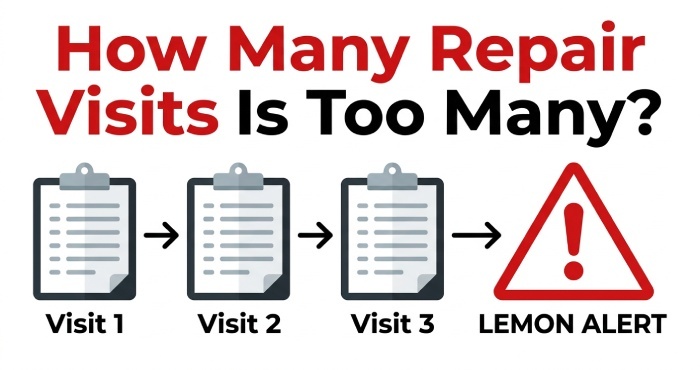
Keep every repair order, invoice, technician note, and communication from the repair shop or car dealer. A lemon law attorney can use this repair history to show the defect was not fixed despite repeated repair attempts. The buyback formula may also depend on dates, mileage, and when the defect first appeared.
Warning Sign #3: The Dealer Claims Your Problem Is “Normal” or Not Covered
When “not covered” may be misleading
A manufacturer or dealer may claim that a serious vehicle defect is simply normal wear, poor maintenance, or driver error, but the key issue under the Song-Beverly Consumer Warranty Act is whether the defect was repaired within a reasonable number of attempts. If not, you may have rights under California Lemon Law and, in some cases, the Magnuson-Moss Warranty Act (Federal Lemon Law), which can apply to new, leased, demonstrator, and certain used vehicles still covered by a warranty.
Special vehicle categories
California Lemon Law issues can also involve a business owner’s vehicle, limited business use, a chassis cab, RV components, or drivetrain defects. For motor homes and recreational vehicles, speaking with an rv lemon law attorney may be especially important because coverage can vary by component and manufacturer responsibility.
Warning Sign #4: You Are Being Offered a Low Settlement Instead of a Full Refund
Refund versus buyback versus replacement vehicle
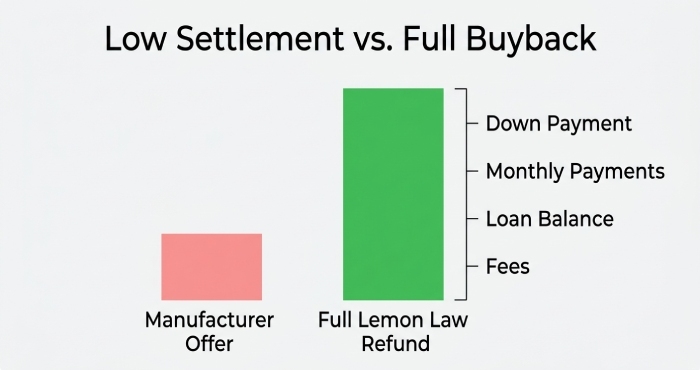
A California Lemon Law refund may include your down payment, monthly payments, registration fees, and other eligible costs, minus a lawful mileage offset, and in many cases the manufacturer must also pay off the remaining loan balance. Depending on the circumstances, a replacement vehicle may be another option, but consulting an experienced lemon law lawyer can help you determine whether a refund, buyback, repurchase, or replacement provides the best outcome.
Why attorney’s fees change the negotiation
Under the Song-Beverly Consumer Warranty Act, the manufacturer may be required to pay attorney’s fees for a successful consumer claim. This means the attorney’s fees issue can significantly affect negotiation leverage. If the manufacturer pressures you to accept a low settlement before you speak with a lemon law attorney, that is a warning sign. A California Lemon Law attorney can help evaluate whether a settlement offer reflects the refund you may be entitled to receive.
Warning Sign #5: Your Repair Orders, Warranty Records, or Mileage Details Are Incomplete
Documents your attorney will likely request
A lemon law attorney will often request:
Purchase contract or lease agreement
Warranty documents and express warranty terms
Repair orders and invoices
Vehicle registration
Vehicle Identification Number documentation
Communications with the dealer, repair shop, seller, or manufacturer
Any settlement offer or arbitration board notices
A california lemon law lawyer can also evaluate whether AB 1755 or recent procedural changes affect how your lawsuit or legal action should be handled.
Why documentation affects the buyback formula
The buyback formula depends heavily on accurate dates, mileage, and repair history. If the service date is wrong or the first repair visit is missing, the manufacturer may argue for a larger mileage offset or deny the refund entirely. California Lemon Law Attorneys often reconstruct the timeline using dealer records, warranty claim logs, and communications with the automobile manufacturer.
Warning Sign #6: The Manufacturer Blames You for the Vehicle’s Defects
Another warning sign is when the manufacturer blames the buyer for the defective vehicle. Common accusations include misuse, lack of maintenance, aftermarket modifications, or accident damage. These arguments are often used to deny a refund, replacement vehicle, buyback, or attorney’s fees.
How blame defenses are challenged
A lemon law lawyer can compare the manufacturer’s claim with inspection reports, service bulletins, repair records, and expert evidence. If the defect existed despite normal use and proper maintenance, the consumer may still have a strong California Lemon Law claim.
Warning Sign #7: You Are Unsure Whether You Qualify for a California Lemon Law Refund
Factors that may determine eligibility
Eligibility for California Lemon Law depends on factors such as the vehicle’s warranty, repair history, number of repair attempts, and whether the defect substantially affects its use, value, or safety. An experienced lemon law attorney can evaluate your case and determine whether you may qualify for a refund, buyback, replacement vehicle, compensation, or another legal remedy through arbitration, mediation, or a lawsuit.
When legal help becomes urgent
Legal help becomes especially important if the manufacturer denies responsibility, the dealer refuses to document repairs, the seller disputes warranty coverage, or the automobile manufacturer offers less than the buyback formula allows. Because attorney’s fees may be recoverable in a successful California Lemon Law case, delaying a case evaluation can put unnecessary pressure on the consumer while giving the manufacturer more time to dispute the claim.
Under lemon law, the key question is not whether a vehicle is unusual, expensive, or performance-oriented—it is whether the defective product qualifies as a covered motor vehicle and whether the defect substantially impairs use, value, or safety. Custom cars can include factory-ordered vehicles with manufacturer performance packages, dealer-installed appearance or tuning options, specialty vehicles, unique vehicles, assembled vehicles, kit-based builds, and modified production models.
Factory Custom Cars, Unique Vehicles, and Assembled Vehicles
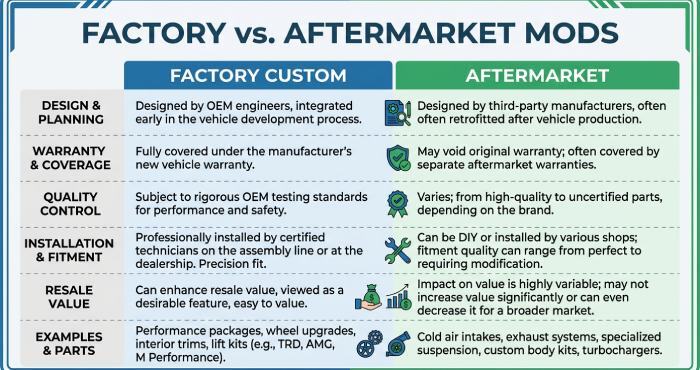
A factory custom car is usually easier to evaluate under lemon law because the manufacturer built and warranted the motor vehicle. Examples include a performance trim, track package, upgraded suspension, carbon-ceramic brakes, factory supercharger, manufacturer-installed ECU calibration, or special-edition model. These custom cars often remain within the standard warranty because the performance components were part of the original build.
By contrast, assembled vehicles, kit cars, and heavily modified vehicles may involve more complex Lemon Law questions. When a vehicle contains components that were not installed by the original manufacturer, the manufacturer may argue that certain defects were caused by aftermarket modifications rather than a factory issue. However, modifications alone do not automatically eliminate a consumer’sLemon Law rights. The key factors are whether the vehicle is covered by a valid warranty, whether the defect substantially affects the vehicle’s use, value, or safety, and whether the manufacturer had a reasonable opportunity to repair the problem.
Vehicle Title and Registration Details Matter
For custom cars, the vehicle title can become central evidence. If the vehicle title lists the car as a regular production model but the sale documents show factory performance content, warranty coverage may be clearer. If the vehicle title identifies one of several assembled vehicles, the manufacturer may argue that some defects came from non-factory work. Before you register your vehicle, confirm that the title application, vehicle transfer paperwork, insurance verification, and temporary permits are consistent with the vehicle’s actual configuration.
How Manufacturer Performance Packages Affect Warranty Coverage
Manufacturer-installed performance packages, such as factory power upgrades, sport suspensions, upgraded transmissions, or enhanced brake systems, are generally covered under lemon law protections. If these factory-authorized components fail during the warranty period and remain unresolved after a reasonable number of repair attempts, the defect may support a valid lemon law claim for the vehicle.
Warranty Coverage Versus Aftermarket Add-Ons
Problems arise when a dealer, aftermarket shop, or owner adds non-factory parts. A manufacturer can deny warranty coverage if it can prove the modification caused the defect. However, it cannot automatically reject every lemon law complaint just because custom cars have modifications. For example, aftermarket specialty license plates from MyPlates, cosmetic wraps, or interior trim changes usually should not affect an engine defect. On the other hand, non-factory tuning, oversized turbochargers, or used auto parts installed in a drivetrain may complicate buyer protection.
Motorists should keep every purchase order, repair invoice, and warranty booklet. In California, a consumer with a defective performance vehicle may consult a california lemon law lawyer to evaluate whether the manufacturer’s warranty still applies. RV owners with customized or performance-equipped motor homes may also need guidance from an rv lemon law attorney.
When Modifications Can Complicate a Lemon Law Claim
Title, Registration, and Ownership Issues
Beyond mechanical defects, custom and assembled vehicles may also face ownership and title issues, such as lien disputes, title delays, or registration problems, that can complicate lemon law claims. While Texas resources and administrative agencies can assist with vehicle titling and registration matters, eligibility for lemon law relief ultimately depends on the vehicle’s warranty coverage, repair history, and applicable state law.
When Commercial or Specialty Use Changes the Analysis
Some performance-modified vehicles may be owned for business purposes, used by companies, or maintained as part of a collection. Commercial use can sometimes affect warranty coverage or the way a manufacturer evaluates a Lemon Law claim. Vehicle owners should keep clear records showing how the vehicle was used, maintained, and repaired. Understanding the vehicle’s warranty terms and usage history can help determine whether a defect may qualify for protection under applicable Lemon Law laws.
HB718 and Temporary Permit Concerns
For custom and performance vehicles, keeping accurate ownership and service records is important when pursuing a Lemon Law claim. Maintain copies of purchase agreements, warranty documents, registration records, repair orders, and communications with the dealership or manufacturer. These documents can help establish when the vehicle was purchased, when defects were discovered, and whether the manufacturer had a reasonable opportunity to repair the problem.
Steps to Protect Your Rights and Build a Strong Lemon Law Case
Practical Action Plan Before You File a Complaint
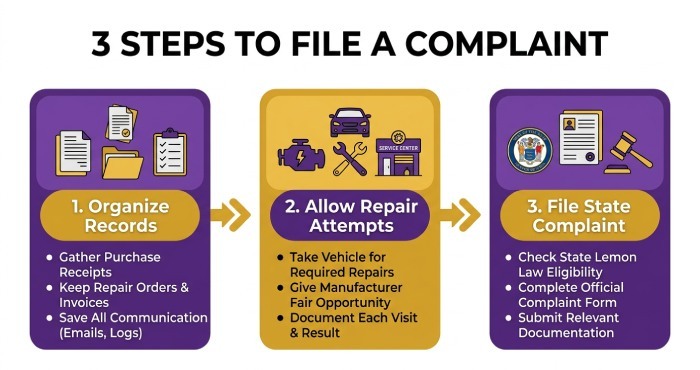
Organize your purchase documents, title, registration, insurance, and repair records, and identify whether each vehicle component was factory-, dealer-, or aftermarket-installed. Then allow the manufacturer a reasonable opportunity to repair the vehicle, and if the problem continues, file a lemon law complaint through the appropriate state process.
If your case is in Southern California, speaking with a lemon law attorney san diego can help clarify deadlines, warranty defenses, and documentation strategy. Consumers elsewhere should review their state’s consumer protection rules before they file a complaint.
1. Evidence to Preserve
Keep photos, videos, diagnostic codes, tow records, repair invoices, warranty documents, correspondence with the manufacturer or dealership, inspection reports, and notes from every service visit. If your vehicle has aftermarket modifications or manufacturer performance upgrades, preserve installation records, purchase receipts, and documentation showing when each modification was added. This evidence can help demonstrate the vehicle’s condition, repair history, and whether the defect was related to a warranty-covered issue rather than owner modifications.
2. How to File a Complaint Effectively
When you file a Lemon Law complaint, be specific and provide as much documentation as possible. A strong complaint should include details about the defect, dates of repair visits, vehicle mileage, number of repair attempts, total days the vehicle was out of service, and how the issue affects the vehicle’s safety, value, or usability. Include supporting documents such as repair orders, warranty records, communication with the manufacturer or dealership, and inspection reports. Accurate documentation can help strengthen your claim and demonstrate whether the manufacturer had a reasonable opportunity to fix the problem.
3. Protecting the Value of Custom Cars
Do not continue driving a dangerous motor vehicle just to “prove” the defect. Also avoid major new modifications while the lemon law complaint is pending. If you need to register your vehicle, renew it, add or remove lien information, or complete a vehicle transfer, keep copies of every submission. Accurate vehicle title records, proper vehicle registration, and consistent warranty documentation help preserve consumer protection rights for custom cars, unique vehicles, and assembled vehicles.
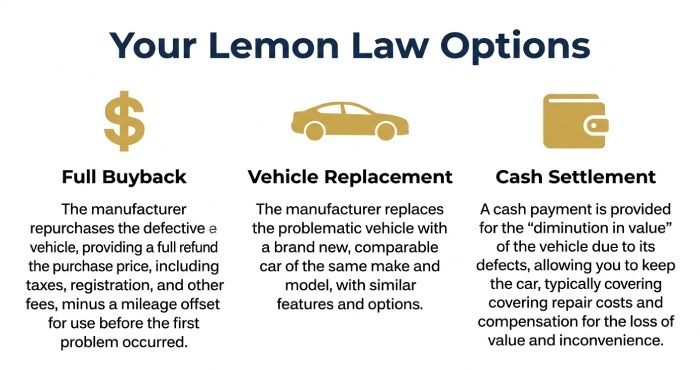
Financial stress can make a defective vehicle even harder to manage. If you are paying for constant repairs, struggling with loan payments, or considering bankruptcy, California Lemon Law may provide relief if your vehicle qualifies. A california lemon law lawyer can review your case and may help you pursue a refund, replacement vehicle, buyback, or cash settlement, often with attorney’s fees paid by the manufacturer if the claim is successful.
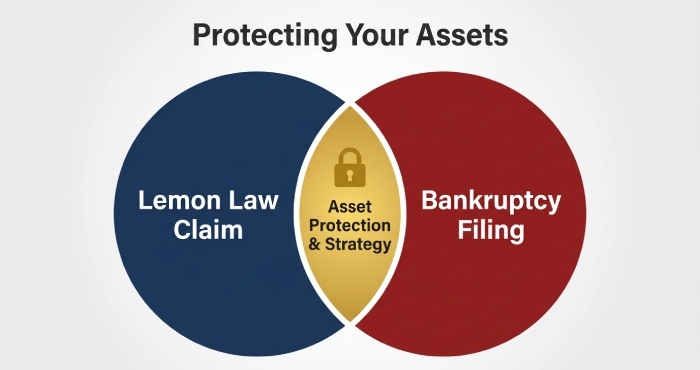
If you are in bankruptcy or considering filing, a California Lemon Law claim may involve additional legal considerations. An experienced California Lemon Law attorney can evaluate your repair history, explain your legal options, and, when appropriate, work alongside your bankruptcy attorney to help ensure the claim is handled properly.
The 9 Benefits of Legal Help When a Defective Vehicle Threatens Your Finances
Benefit 1–2: Protecting Your Legal Rights and Stopping Costly Vehicle Problems From Worsening
Benefit 1: A lemon law attorney protects your legal rights.
During financial stress, many consumers accept whatever the manufacturer or dealer offers because they feel they have no leverage. A california attorney who handles lemon law cases can explain your legal rights, review your warranty, and determine whether the manufacturer has breached its obligations. This is especially important when the defective vehicle has transmission issues, electrical problems, engine failures, brake defects, steering concerns, or safety-related defects.
Benefit 2: A lemon law lawyer helps stop the financial damage from escalating.
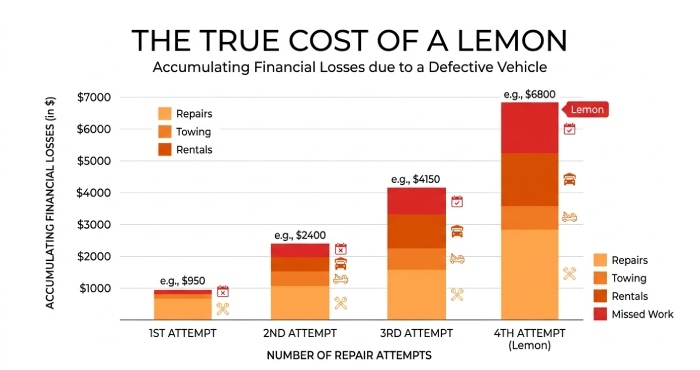
Every failed repair attempt can mean more towing bills, rental costs, missed work, and stress. Lemon law attorneys know how to gather repair orders, service records, payment documents, and communications with the dealer. By building a strong lemon law claim early, lemon law lawyers can help prevent the manufacturer from delaying until your finances get worse.
Documents That Strengthen a Lemon Law Case
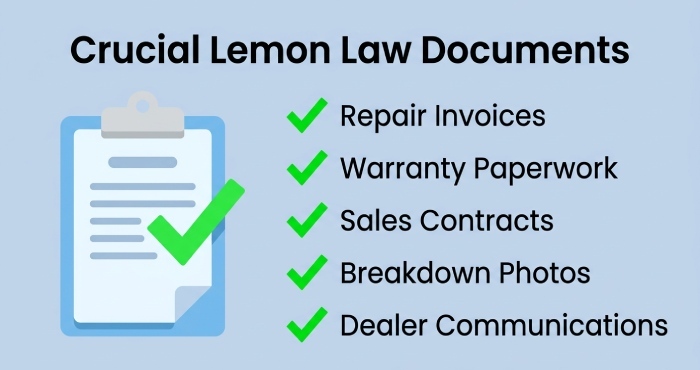
Useful evidence includes repair invoices, warranty paperwork, sales or lease contracts, text messages, emails, photos, videos, and notes about each breakdown. A trial lawyer or team of trial attorneys may use these records in negotiation or litigation if the manufacturer refuses a fair outcome.
Benefit 3–5: Pursuing Refunds, Replacements, or Cash Compensation Without Upfront Financial Pressure
Benefit 3: You may be able to pursue a refund or buyback.
Under california lemon law, a qualifying consumer may be entitled to a refund or manufacturer buyback. This can include amounts paid toward the vehicle, registration, taxes, and certain related charges, subject to mileage offsets and case-specific rules. A lemon law attorney can calculate potential client compensation and explain whether a refund is realistic.
Benefit 4: You may qualify for a vehicle replacement.
Some consumers prefer a vehicle replacement instead of a refund, especially if they need reliable transportation for work, family, medical appointments, or school. A lemon law lawyer can negotiate with the manufacturer and help compare replacement value against other settlement options.
Benefit 5: Many firms offer help without upfront legal fees.
A free consultation allows you to ask questions before committing. Many lemon law attorneys handle valid cases with fees paid by the manufacturer if the claim succeeds, making legal advice more accessible during hardship. If you need guidance for a motorhome or recreational vehicle, an rv lemon law attorney can address the unique repair, warranty, and use issues involved.
What “No Upfront Fees” Can Mean
In many california lemon law matters, the manufacturer may be responsible for reasonable attorney fees and costs if the consumer prevails. A law firm should explain fee terms clearly, including whether litigation expenses, expert reviews, or filing costs apply.
Benefit 6–7: Coordinating Lemon Law Claims With Bankruptcy Concerns, Debt, and Credit Impact
Benefit 6: A california attorney can help coordinate the lemon law claim with bankruptcy duties.
If you have filed for bankruptcy or are considering it, your California Lemon Law claim may involve additional legal considerations. Your Lemon Law attorney can work alongside your bankruptcy attorney, when appropriate, to help ensure the claim is handled properly while protecting your rights under California Lemon Law.
Benefit 7: Legal assistance may reduce credit and debt consequences.
A defective vehicle can lead to late payments, repossession risks, and mounting repair debt. A lemon law lawyer can pursue the manufacturer while you focus on stabilizing your finances. If the matter involves a lease, loan, negative equity, or lender communications, lemon law attorneys can help you understand how a buyback or settlement may affect the balance.
Consumers in San Diego can also seek location-specific guidance from a lemon law attorney san diego when vehicle defects create financial pressure.
Benefit 8–9: Reducing Stress and Maximizing Your Chances of a Successful California Lemon Law Outcome
Benefit 8: A local lemon law lawyer reduces the burden on you.
When you are dealing with debt, job uncertainty, medical bills, or bankruptcy fears, managing a lemon law claim alone can be overwhelming. A lemon law attorney can handle manufacturer communications, evidence review, settlement demands, and litigation strategy. This gives you room to focus on your household and financial recovery.
Benefit 9: Experienced lemon law attorneys improve your chances of a successful outcome.
California lemon law is technical. Manufacturers often have defense teams, adjusters, and attorneys working to limit payouts. Skilled lemon law lawyers know how to counter arguments about misuse, mileage, repair opportunities, and defect severity. The right california attorney can position your lemon law claim for a stronger settlement or trial result.
How California Lemon Law Generally Applies to Vehicles and Consumers
California Lemon Law primarily protects consumers who buy or lease a motor vehicle that has substantial defects the manufacturer or authorized repair shop cannot fix within a reasonable number of repair attempts. In a typical lemon law claim, the vehicle is a new car, leased vehicle, certified pre-owned vehicle, or sometimes a used car sold with an active warranty or remaining manufacturer warranty.
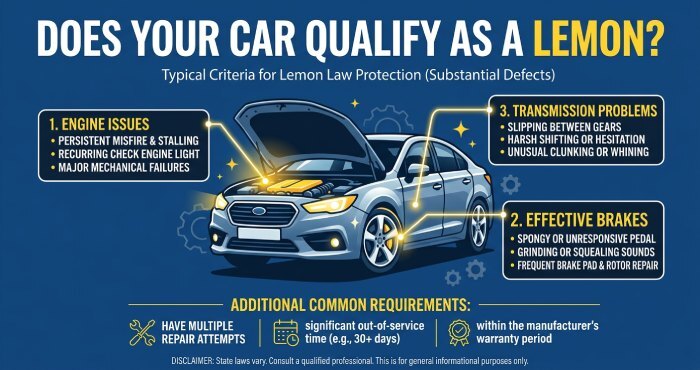
Under California consumer law, a lemon vehicle may qualify for remedies when the defect substantially impairs the vehicle’s use, value, or safety. These substantial defects may involve braking issues, steering failures, electrical malfunctions, transmission problems, engine defects, or other safety defects. If the manufacturer fails to meet its obligations after multiple repair attempts, the consumer may seek a refund, purchase refund, loan/lease payoff, vehicle replacement, or other compensation.
Core protections under California Lemon Law
California Lemon Law protects buyers of defective vehicles that cannot be repaired under the manufacturer’s warranty. If a vehicle qualifies as a lemon, the owner may be entitled to a buyback, replacement, or reimbursement, and a lemon law attorney can help evaluate the repair history, warranty coverage, and evidence needed to pursue a claim.
Consumers often contact lemon law attorneys after repeated visits to a dealership or repair shop involving the same unresolved problem. A lemon law lawyer may also evaluate cases involving Mini Cooper, Mercedes, BMW, truck, sport utility vehicle, family vehicle, recreational vehicle, lemon RVs, and demo vehicles or a demonstration vehicle sold with warranty coverage. For RV-specific issues, a consumer may also consult an rv lemon law attorney.
Rental Cars vs. Purchased or Leased Vehicles: Key Legal Differences
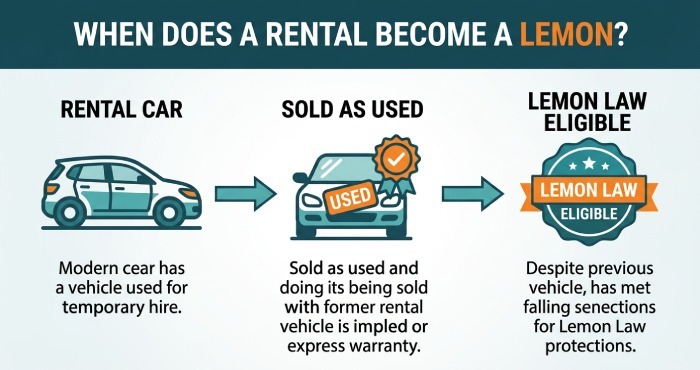
Rental cars are generally not covered by California Lemon Law for the renter because the renter does not own or lease the vehicle or hold the manufacturer’s warranty rights. Instead, the rental company typically has the legal relationship with the manufacturer and may be the party eligible to pursue a Lemon Law claim if the vehicle qualifies as a lemon.
Why the rental agreement matters
A rental agreement gives you temporary use of a vehicle, not ownership, so California Lemon Law usually does not apply directly to renters. Instead, if a defective rental car causes injury, expenses, or other losses, the renter may have legal claims based on negligence, contract law, or consumer protection laws rather than a traditional Lemon Law buyback or replacement claim.
Exceptions and unusual situations
There may be unusual circumstances where rental cars later become sold vehicles. If a former rental car is sold as a used car or certified pre-owned vehicle with an active warranty, and it continues to experience substantial defects after the sale, the buyer may have a viable lemon law claim. In that scenario, a lemon law lawyer can assess whether the manufacturer warranty applies, whether there were multiple repair attempts, and whether the vehicle qualifies as a lemon vehicle.
What Counts as a Known Defect in a California Rental Car
A known defect is a problem that the rental company, manufacturer, or dealership knew—or should have known—about before renting the vehicle. Evidence such as repair records, prior complaints, recall notices, or maintenance documents can help show the defect existed beforehand and may support a claim if the unsafe vehicle was still rented out.
Legal Options for Renters Injured or Inconvenienced by Defective Rental Cars
If a renter is injured or suffers losses because of a defective rental car, they may have legal options beyond California Lemon Law. Depending on the circumstances, they may be able to recover compensation for medical expenses, lost wages, towing, property damage, or other losses through negligence, product liability, rental company liability, or manufacturer claims.
Potential remedies beyond a standard lemon law claim
Depending on the facts, legal options may include:
A refund of rental charges
Reimbursement for hotel, rideshare, or transportation expenses
Insurance claims for injuries or property damage
A settlement with the rental company
A product liability claim against the manufacturer
Claims based on unfair business practices
A lemon law claim by a later purchaser if the rental car is sold with warranty coverage
A renter should document everything immediately. If the rental company offers a replacement vehicle, the renter should still preserve evidence of the defective vehicle and any costs incurred. A replacement vehicle may solve the immediate travel problem, but it does not automatically eliminate a claim for compensation. A california lemon law lawyer can help distinguish between lemon cars, rental fleet disputes, warranty disputes, and injury-related claims.
When to Contact a Lemon Law Lawyer in California About a Rental Car Defect
If a rental car defect causes safety issues, accidents, or repeated problems, consult a lemon law lawyer. In Glendale, California, an attorney can evaluate your legal options. If you later buy that vehicle and it has recurring warranty defects, you may also qualify for a Lemon Law claim.
What to bring to a case evaluation
For a free consultation or case evaluation, gather:
The rental agreement
Photos and videos of the defect
Repair shop or towing documents
Emails, texts, and complaint records
Accident reports, if any
Medical records, if injured
Warranty information, if you purchased the vehicle later
Any manufacturer recall or service bulletin
A lemon law attorney will evaluate whether California Lemon Law applies, whether the manufacturer warranty is active, whether there were multiple repair attempts, and whether the facts support compensation, civil penalties, or another remedy. If the facts involve a purchased defective vehicle, the attorney may pursue a refund, purchase refund, vehicle replacement, or settlement.
For renters in San Diego or elsewhere in California, contacting a lemon law attorney san diego can be especially important when the defect involves safety, significant inconvenience, or disputed responsibility. The right lemon law team can explain the legal process, preserve evidence, and determine whether your case is a rental dispute, personal injury matter, warranty claim, or California Lemon Law case involving a true lemon vehicle.